


In every workplace, communication is the glue that holds everything together. It connects teams, builds trust, and keeps work moving in the right direction. But have you ever thought about who plays what role in this process?
Understanding business communication roles is like knowing who’s who in a well-organized orchestra. Each person has a part to play, and when everyone performs in harmony, the result is smooth, effective communication.
Before exploring these roles, you might want to refresh your basics with what is business communication. Once you understand the foundation, you’ll see why defining roles matters so much.
Understanding Business Communication
Business communication means exchanging information within or outside a company to achieve goals. It could be a manager giving directions, a team reporting progress, or a company talking to customers.
There are several types of business communication, including internal, external, upward, downward, and horizontal. Each type involves different people, messages, and methods.
When everyone knows their role, communication flows effortlessly. Without clear roles, you’ll see misunderstandings, missed deadlines, and workplace tension.
Why Roles Matter in Communication
Think of a company as a machine. Each role is a part that keeps it running. When one part fails, the machine stops working smoothly. The same happens in business communication.
Roles define responsibility and ownership. The sender knows it’s their job to deliver a clear message. The receiver knows they must interpret and respond properly.
Without defined roles, employees end up duplicating efforts or missing tasks. Clear communication roles make teamwork smoother, decisions faster, and the workplace happier.
Key Roles in Business Communication
Let’s break down the essential roles in any communication process.
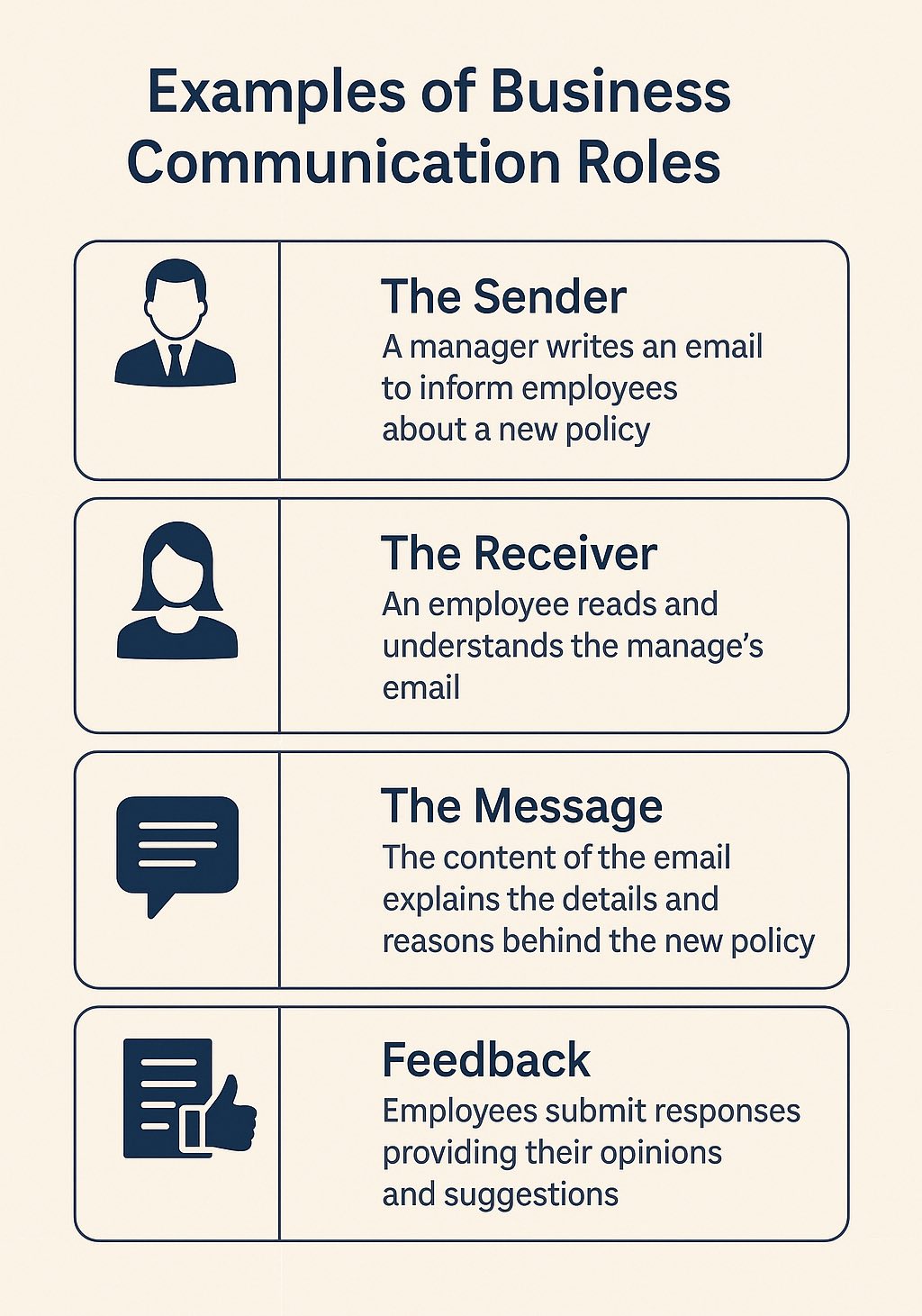
1. The Sender
The sender starts the communication. They form the idea, craft the message, and decide how to share it. A sender can be a manager giving instructions, a salesperson writing an email, or an employee sharing feedback.
A sender’s job is to make the message clear, correct, and complete. They must know their audience and choose the right tone. For instance, a formal letter for a client should sound polite and structured. You can learn the right way to do that in how to write a business letter step-by-step.
If the sender fails to express clearly, even a small idea can turn into big confusion.
2. The Receiver
The receiver is the person who gets the message. Their role is to listen, read, or understand the information accurately.
Good receivers ask questions if something isn’t clear. They also give feedback, so the sender knows the message was received correctly.
Active listening is key here. Many communication failures happen because people don’t really listen. To sharpen your listening skills, explore some techniques for improving listening ability. It’ll help you catch details and respond thoughtfully.
3. The Message
The message is what the communication is all about. It can be an idea, a request, or even feedback. The message must be clear and structured properly.
A good message follows the 7 Cs of communication: clarity, conciseness, completeness, correctness, consideration, concreteness, and courtesy. To understand these better, check the post on 7 Cs of communication.
When the message is confusing or incomplete, even the best sender or receiver can’t fix the misunderstanding.
4. The Channel
The channel or medium is how the message travels. It could be a face-to-face talk, an email, a phone call, or a memo. Choosing the right channel saves time and prevents errors.
For example, complex topics are better discussed in meetings rather than texts. Meanwhile, official information should be sent through written channels.
If you’re unsure which format to choose, read business letter vs email differences to find what suits your message best.
5. Feedback
Feedback completes the communication loop. It tells the sender if the message was received and understood properly. Without feedback, communication is one-sided.
Constructive feedback builds stronger relationships and helps fix mistakes early. In workplaces that value feedback, employees feel heard and motivated.
You can learn about its importance from necessity or importance of feedback.
Feedback also helps leaders understand whether their teams are aligned with goals.
6. Communication Facilitators
Large organizations often have people responsible for managing communication. HR officers, PR professionals, and internal communicators act as bridges between departments.
They make sure announcements reach the right people and that employees understand company policies. These facilitators also handle press releases, newsletters, and crisis communication.
Without them, internal and external communication would quickly fall apart.
Managerial and Organizational Roles
Management’s Role
Managers are like conductors of an orchestra. They set the tone and guide communication flow. A manager’s clarity influences how teams perform.
They also act as both senders and receivers—sending updates and listening to feedback. Open communication from leaders boosts trust and teamwork.
To manage communication efficiently, many use memos, which you can learn about in meaning of memo and its features.
Employee’s Role
Employees play a key role too. They not only receive instructions but also share progress, ideas, and concerns. Employees are often the backbone of upward communication.
When workers share honest feedback, managers can make better decisions. You can explore more about it in benefits of upward communication.
Good employees also maintain a professional tone in their interactions and stay respectful even under pressure.
HR and Corporate Communication Roles
HR ensures that company messages, rules, and ethics reach everyone. Corporate communication teams handle the brand’s voice both inside and outside the company.
These roles require balance—being professional while staying approachable. They also make sure messages are consistent and reflect company values.
Communication Roles Across Levels
Upward Communication
This happens when information moves from employees to managers. Feedback, reports, or suggestions are examples. It helps leaders make informed decisions and shows employees their opinions matter.
Learn about practical strategies in strategies for upward communication.
Downward Communication
Here, messages move from management to staff. Policies, rules, or feedback often flow downward. Effective downward communication makes sure everyone knows their responsibilities.
You can learn tips from how to make downward communication effective.
Horizontal Communication
This type happens between colleagues or teams at the same level. It encourages cooperation and problem-solving. For instance, marketing and sales departments often coordinate through horizontal communication.
You’ll understand its value better by reading about the importance of horizontal communication.
Cross-Cultural Communication
In global businesses, teams often include people from different cultures. Language, tone, and customs vary. Understanding these differences helps avoid confusion.
You can improve these skills by following guidelines to improve cross-cultural communication.
Technological Roles in Modern Business Communication
Technology has revolutionized communication. Emails, instant messages, and video calls make collaboration faster.
However, technology also demands clear etiquette. For example, writing a long paragraph in a chat app may be ignored. Short, structured messages get quicker responses.
If you often join online meetings, follow virtual meetings best practices to keep things productive.
Ethical and Professional Roles
Professional communication isn’t just about grammar or structure; it’s about integrity. Employees must keep sensitive data private and be truthful in their messages.
Rumors and misinformation harm company culture. Learning about ethics in informal communication will show how respect and responsibility build trust at work.
Real-World Scenarios
Let’s look at an example. Imagine a company planning a new product launch.
- The marketing manager drafts the message, becoming the sender.
- The sales team receives the message and acts on it.
- The HR department ensures the news reaches all employees.
- The PR officer handles external announcements.
If anyone ignores their role, confusion follows. But when everyone communicates well, the result is success.
How to Improve Communication Roles
Here are a few ways to strengthen communication roles at work:
- Provide training sessions on communication skills.
- Encourage open discussion and regular feedback.
- Use appropriate tools for different purposes.
- Clarify roles during meetings.
- Reward clear and effective communicators.
When companies focus on better communication, employees feel more connected and motivated.
Conclusion
Business communication roles are the invisible framework of every successful organization. From the sender creating messages to the receiver interpreting them, each role ensures the message reaches its goal.
Strong communication builds trust, teamwork, and productivity. When roles are clear, people know what to do and how to respond. That’s how businesses grow steadily.
So next time you write an email or share feedback, remember your role. Communication isn’t just about words; it’s about connection, understanding, and action.
Frequently asked questions
What should I do if my message isn’t being understood by receivers?
First, check if you’re following the 7 Cs of communication: clarity, conciseness, completeness, correctness, consideration, concreteness, and courtesy. Second, verify you chose the right channel—complex topics need face-to-face discussion, not text. Finally, ask for feedback directly. Ask the receiver to summarize what they understood so you can clarify gaps immediately.
When should I use email versus a face-to-face conversation?
Use email for official records, announcements, and simple information sharing. Choose face-to-face or meetings for complex topics, sensitive feedback, or decisions requiring discussion. If you’re unsure, consider the topic’s complexity and urgency. Sensitive or nuanced messages almost always work better in person where tone and body language matter.
How do I know if I’m giving effective feedback as a sender?
Effective feedback is constructive, specific, and actionable. Instead of saying “your email was unclear,” say “I didn’t understand which deadline applies to which task.” Ask the receiver to confirm they understand and what they’ll do next. Good feedback builds relationships and prevents the same mistakes from repeating.
What happens when communication roles aren’t clearly defined in a team?
Without clear roles, you’ll see duplicated efforts, missed tasks, and misunderstandings. For example, two people might think the other is handling a deadline, or information gets lost between departments. Define who sends what, who receives it, and who gives feedback. This prevents confusion and keeps work moving smoothly.
Can an employee skip the chain of command and communicate directly upward?
It depends on your company culture. In open organizations, direct communication with leadership is encouraged. In formal structures, going through your manager first is expected. Check your company’s communication guidelines or ask your manager. When in doubt, inform your direct manager that you’re reaching out to leadership to maintain transparency.
20 Comments
This article is just clear and very understandable , it has saved my day.
Very helpful and thanks
Any app
Its really educative
Thank you very much for short nots
Harambe is god
THANK OLD BOY
It is so useful thank you so much….
thnks it has helped me much
very nice information and best article post, Thank you
thanks my daughter
Thanks
useful article
interest notes thanks sir,
welcome my son
Thanks a lot.
interest notes thanks sir,
Thank you very much
Its really helping and understanding thanks a lot.
Thnx for easy n short notes