


In any workplace, communication works like the nervous system of a body. It carries ideas, instructions, and feedback that keep everything alive and moving. Without the right flow of information, even the smartest team may struggle. That is why organizations rely on three key communication directions: upward, downward, and horizontal.
Each of these flows plays a unique role. They shape how leaders and employees share thoughts, how policies are spread, and how teams collaborate. In this article, we will compare upward vs downward vs horizontal communication and highlight their key differences. By the end, you will see why mastering all three flows is essential for a healthy workplace.
What is Upward Communication?
Upward communication is the process where information moves from employees to their supervisors or top management. Think of it as the voice of the team reaching the ears of leaders.
Employees usually share feedback, reports, suggestions, or even concerns. For example, when a teacher tells the principal that new classroom equipment is not working well, that is upward communication. Another example could be an employee survey where workers share their opinions about company culture.
This type of communication is powerful because it gives management a clear idea of what is happening on the ground. If you want a deeper dive into examples and benefits, you can check our dedicated post on Upward Communication Examples and Benefits.
What is Downward Communication?
Now, let us flip the direction. Downward communication happens when information flows from managers or supervisors to employees. It often includes instructions, policies, announcements, or even performance reviews.
Imagine the CEO of a company sending out a memo about a new dress code. That is a perfect example of downward communication. Similarly, when a teacher receives a guideline from the school board, it is also a downward flow.
This method works best when organizations need clarity and control. However, if it is overused without listening to feedback, it can sometimes feel one-sided.
What is Horizontal Communication?
Unlike upward or downward flows, horizontal communication works between peers who are at the same level in the hierarchy. It is often used to coordinate, collaborate, or solve problems together.
For instance, two marketing managers discussing an upcoming campaign use horizontal communication. Another example would be doctors in the same hospital department sharing patient updates.
Horizontal communication encourages teamwork and reduces misunderstandings between departments. It keeps projects moving smoothly because everyone is on the same page.
Horizontal communication is also called lateral communication; the two terms mean the same thing.
Key Differences: Upward vs Downward vs Horizontal Communication
Now comes the heart of the discussion. Let us break down the differences in a simple comparison.
| Aspect | Upward Communication | Downward Communication | Horizontal Communication |
|---|---|---|---|
| Direction of Flow | Employee to management | Management to employee | Peer to peer |
| Purpose | Feedback, reporting, suggestions | Instructions, policies, guidelines | Coordination and teamwork |
| Examples | Employee surveys, progress reports, complaints | Memos, performance reviews, official announcements | Team meetings, peer discussions, emails between colleagues |
| Advantages | Builds trust, promotes innovation, improves engagement | Provides clarity, ensures consistency, maintains order | Encourages collaboration, reduces conflict, increases efficiency |
| Formality | Mostly formal, following the chain of command | Mostly formal, following the chain of command | Often informal and flexible |
| Distortion risk | Higher, because messages pass through several levels and may be filtered | Higher, because each layer can reinterpret or filter the message | Lower, because messages pass through fewer hands |
| Challenges | Fear of speaking up, hierarchical barriers | Risk of being too controlling, information overload | Misalignment, lack of authority to implement changes |
This table highlights the central differences. When people search for “upward vs downward communication,” this comparison gives them a clear answer while also adding the role of horizontal communication for a complete picture.
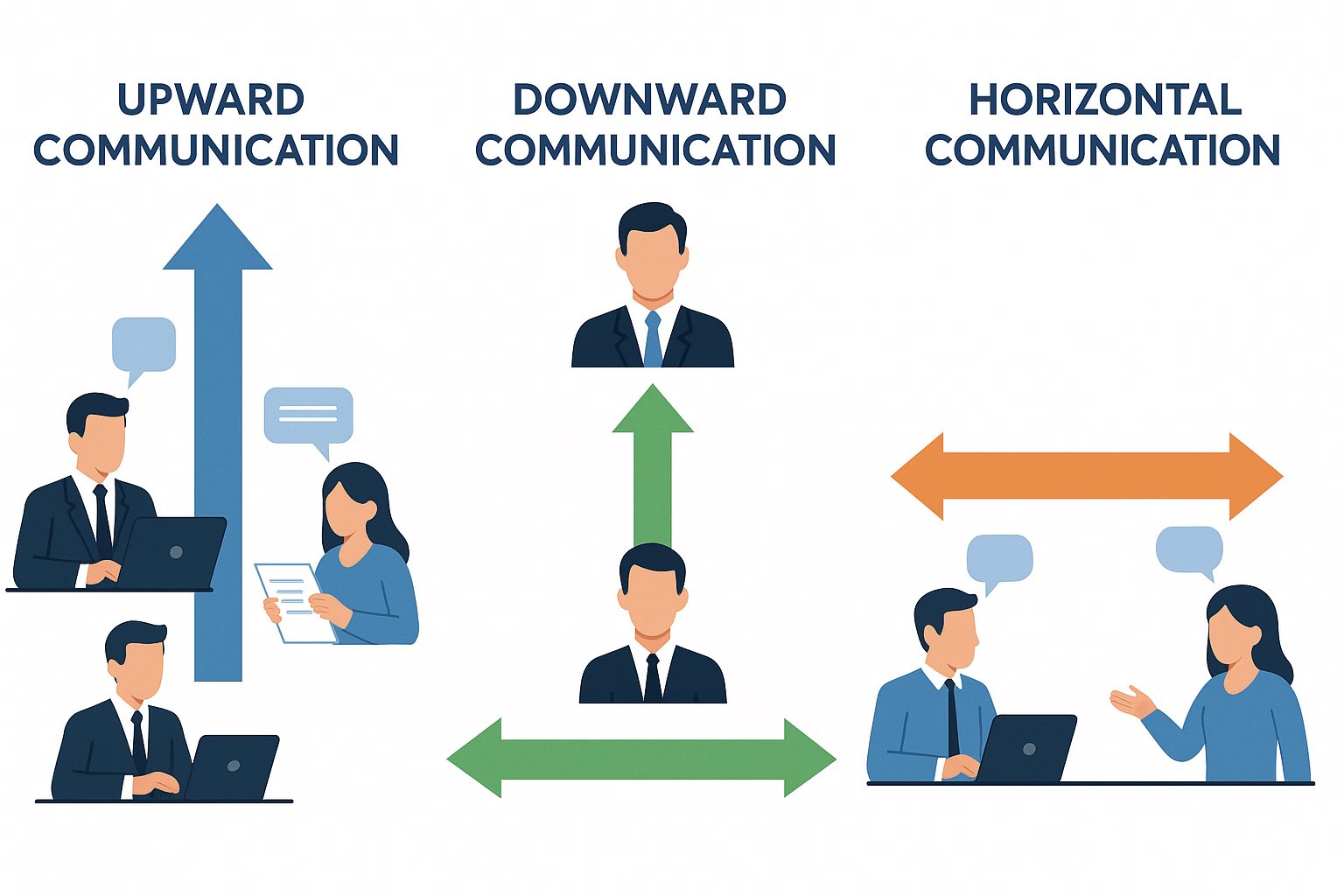
Vertical vs Horizontal Communication at a Glance
Vertical communication is simply upward and downward communication taken together: any message that moves between different levels of the hierarchy. Horizontal communication moves between people at the same level. The table below compares the two on the points people most often ask about.
| Point of difference | Vertical (upward + downward) | Horizontal |
|---|---|---|
| Meaning | Communication between superiors and subordinates | Communication between people of the same rank or status |
| Main purpose | Passing orders and instructions down; receiving reports, suggestions and feedback from below | Coordinating the work of different departments and teams |
| Information flow | Superior to subordinate and back again | Between peers |
| Typical medium | Leans on written channels such as memos, circulars and reports | Leans on oral channels such as face-to-face talks, phone calls and meetings |
| Length of communication line | Longer, since a message may pass through several levels | Shorter, usually direct from sender to receiver |
| Speed and feedback | Slower; feedback is often delayed or filtered | Faster; feedback is quick and open |
Is lateral the same as horizontal communication?
Yes. Lateral communication and horizontal communication are two names for the same flow: information exchanged between colleagues at the same level, such as two department heads sharing resources.
Where diagonal and skip-level communication fit
Not every message moves strictly up, down or sideways. Diagonal communication happens between people at different levels in different departments, for example a sales executive contacting the finance manager directly. Skip-level communication is a vertical flow that bypasses one or more layers, such as a senior leader meeting frontline staff without their immediate manager present. Both can speed things up, but they work best when the managers who were skipped are kept informed.
When to Use Each Communication Flow
Each type of communication has its best time and place.
- Upward communication works best when employees need to report progress, share challenges, or give feedback. For example, sending weekly performance updates to management.
- Downward communication is most useful when leaders want to roll out a new policy or share strategic goals. For example, announcing new working hours.
- Horizontal communication shines when peers need to collaborate, like when two departments coordinate to launch a new product.
Rather than choosing one over the others, organizations should understand when to use each flow.
Benefits of Balancing All Three Types
A workplace cannot survive on only one direction of communication. Balancing upward, downward, and horizontal flows ensures that everyone’s voice is heard, leaders can set clear goals, and teams can coordinate without confusion.
Above all, this balance strengthens decision-making. Leaders get real feedback from upward communication, they share policies through downward communication, and peers solve problems together using horizontal communication. The result is better employee engagement and stronger organizational alignment.
Challenges in Managing Multiple Communication Flows
Of course, no communication style is perfect. Each one comes with challenges.
- Upward communication can suffer if employees feel afraid to speak up. Hierarchical barriers may stop them from being honest.
- Downward communication may feel too controlling if leaders send out too many instructions without listening. Employees might feel overwhelmed.
- Horizontal communication can sometimes lead to misalignment. Colleagues may agree among themselves but still lack the authority to make final decisions.
Despite these challenges, the solution lies in awareness. Encouraging openness, training leaders, and setting up clear communication channels can fix most of these problems.
Final Thoughts
Understanding the differences between upward, downward, and horizontal communication is like learning the grammar of workplace interaction. Each flow has a role to play. Upward communication gives employees a voice, downward communication keeps the system organized, and horizontal communication makes teamwork possible.
On the contrary, relying too much on one style can create gaps. That is why smart organizations focus on balancing all three. The healthier the balance, the stronger the workplace culture.
If you found this comparison interesting, you might want to check out our earlier piece on Upward Communication Examples and Benefits. It dives into how upward communication works in real life and outlines some of its perks!
Frequently Asked Questions
What is the difference between vertical and horizontal communication?
Vertical communication flows between different levels of the hierarchy, either downward from managers to employees or upward from employees to managers. Horizontal communication flows between colleagues at the same level. Vertical messages tend to be more formal and pass through a longer chain, so they face a higher risk of distortion; horizontal messages are usually quicker and more informal. See the comparison table above.
Which is more important, vertical or horizontal communication?
Neither replaces the other. Vertical communication keeps an organization disciplined by setting goals and carrying feedback to leaders, while horizontal communication keeps it flexible by letting teams coordinate directly. Healthy workplaces use both.
What if employees fear speaking up in upward communication?
Fear of speaking up is a common barrier to upward communication. Leaders should create psychological safety by actively listening, responding positively to feedback, and protecting employees from retaliation. Regular one-on-ones and anonymous feedback channels also help. When employees see their input leads to real change, trust builds and they become more willing to share concerns.
Can downward communication be too controlling or overwhelming?
Yes. Excessive downward communication without listening creates a one-sided culture where employees feel unheard. To avoid this, leaders should balance directives with opportunities for feedback. Use downward communication for critical policies and goals, but leave room for questions and discussion. This prevents information overload and maintains employee engagement.
How do I handle horizontal communication when peers disagree?
Peer disagreements are normal in horizontal communication. Focus on the shared goal rather than winning the argument. Document decisions and get alignment from management if the disagreement affects strategy. Regular team meetings and clear role definitions help prevent misalignment. When peers can’t resolve it, escalate respectfully to a supervisor.
Should I always use all three communication types together?
Not always simultaneously, but yes, all three should exist in a healthy workplace. Use upward communication for feedback and reports, downward for policies and goals, and horizontal for daily collaboration. The key is balance. A company relying only on downward communication will miss valuable employee insights and team coordination.
What if horizontal communication leads to decisions without management approval?
Horizontal communication is great for coordination, but peers often lack final decision-making authority. Set clear boundaries about what peers can decide independently versus what needs management sign-off. Document agreements and inform relevant supervisors. This prevents confusion and ensures decisions align with organizational goals.
5 Comments
Wow! I’m highly enlightened.
Powerful.. I like that
great work
It’s good information thanks
Very interesting. Can you please define a communication line in a company for a new employee? How would a new employee find his communication lines?