


Communication shapes every business interaction, from a quick Slack message to a 3,000-word strategy memo. Understanding the fundamental nature of communication, how it works, what makes it effective, and why it sometimes fails, gives you the tools to craft clearer messages, avoid costly misunderstandings, and build stronger professional relationships.
What is communication?
Communication is the exchange of information, ideas, and meaning between two or more parties. It goes beyond simple transmission of data. When you send an email to a colleague, you’re not just moving words from your screen to theirs. You’re encoding your thoughts into symbols (words, punctuation, formatting), transmitting them through a channel (email server), and hoping your colleague decodes them in a way that matches your original intent.
This broader understanding matters because it shifts focus from “Did I send the message?” to “Did we create shared meaning?” A manager who announces a policy change in a company-wide email has transmitted information. But communication only succeeds when employees understand the policy, its rationale, and how it affects their work.
Communication operates across every sphere of human activity. Personal relationships depend on it. Families coordinate daily logistics through it. Organizations execute strategy, resolve conflicts, and innovate because of it. Even a newborn crying for attention is engaging in rudimentary communication, signaling a need and expecting a response.
Core characteristics of communication
Several defining features shape how communication works in practice. Recognizing these characteristics helps you anticipate challenges and design better messages.
Communication requires at least two parties.
You need a sender who initiates the message and a receiver who processes it. In business contexts, one sender often addresses multiple receivers, a CEO delivering a quarterly update to 500 employees, for instance. But even solo activities like journaling involve communication if you consider your future self the receiver.
Messages must be encoded and decoded. Your thoughts exist as abstract concepts until you translate them into words, gestures, or images. The receiver then translates those symbols back into meaning. This two-step process creates opportunities for distortion. A product manager in Dhaka might encode “urgent” to mean “within 24 hours,” while a developer in Manila decodes it as “drop everything immediately.”
Feedback validates understanding. Without confirmation that your message was received and understood correctly, you’re operating blind. Feedback in communication closes the loop, letting you correct misinterpretations before they compound into larger problems. A simple “Got it, I’ll have the draft ready by Thursday at 3 PM” confirms both receipt and comprehension.
Noise and context shape every exchange. Physical noise (a crackling phone line), psychological noise (receiver distracted by personal stress), and semantic noise (jargon the receiver doesn’t know) all interfere with clarity. Context, the relationship between parties, the urgency of the situation, cultural norms, colors how messages are interpreted. The same “Can we talk?” request feels routine from a peer but ominous from your boss.
Communication is continuous. It doesn’t start when you hit “send” and end when the recipient reads your message. Prior conversations, organizational history, and ongoing relationships all influence how your current message lands. A request for overtime carries different weight if you’ve asked three times this month versus once this year. The history between you and the receiver matters as much as the words you choose today.
Communication as a process: linear vs. transactional models
Two dominant models explain how communication unfolds. The linear (or transmission) model presents communication as a one-way journey: sender encodes a message, transmits it through a channel, and the receiver decodes it. Think of a radio broadcast. The station sends; listeners receive. No immediate feedback loop exists.
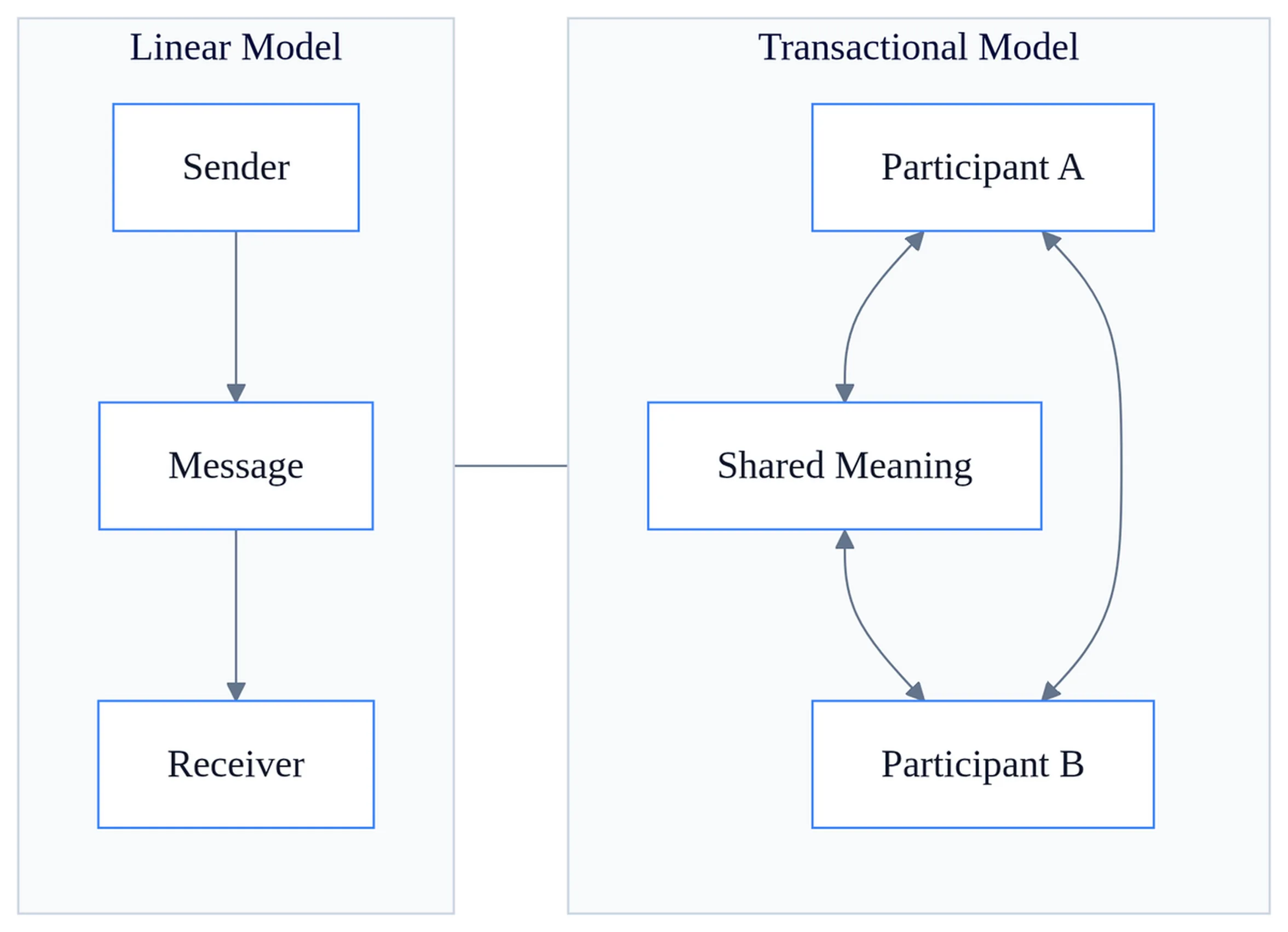
This model works for certain scenarios, company announcements, instructional videos, policy memos, where immediate response isn’t expected or needed. But it oversimplifies most business communication.
The transactional model better reflects reality. Here, both parties simultaneously send and receive. You’re encoding your next thought while decoding your colleague’s response. Meaning emerges through interaction, not transmission. A negotiation exemplifies this: each party adjusts their position based on real-time feedback, body language, and evolving understanding.
| Aspect | Linear Model | Transactional Model |
|---|---|---|
| Direction | One-way (sender → receiver) | Simultaneous, bidirectional |
| Roles | Fixed (you’re sender or receiver) | Fluid (both parties send and receive) |
| Feedback | Absent or delayed | Continuous and immediate |
| Context | Minimal consideration | Central to meaning-creation |
| Best for | Announcements, broadcasts, instructions | Negotiations, meetings, collaborative work |
Most business situations blend both models. A department head sends a linear message (the quarterly budget memo), which triggers transactional exchanges (team meetings to discuss implications). Understanding which model applies helps you set appropriate expectations for response and engagement. For more on the mechanics of encoding, transmission, and decoding, see our guide to the communication process.
One-way and two-way communication in business
One-way communication flows without receiver feedback. A manager emails a policy change and moves on. Information travels, but understanding remains unverified. This approach works when speed matters more than nuance, a fire alarm, a deadline reminder, a regulatory notice. But it carries risk. You won’t know if recipients understood, agreed, or even received the message until consequences appear.
Two-way communication invites response. The receiver provides feedback, asks questions, or confirms understanding. This loop takes longer but dramatically improves accuracy. When rolling out new software, a two-way approach, training sessions with Q&A, not just an instruction manual, reduces errors and resistance.
Symbolic and contextual nature of communication
Communication relies on symbols: words, gestures, images, even silence. These symbols carry no inherent meaning. The word “aggressive” might describe admirable ambition in one culture and unacceptable rudeness in another. A thumbs-up gesture signals approval in most Western contexts but offends in parts of the Middle East.
Meaning emerges from shared context and cultural understanding. When a Bangladeshi startup founder tells her team “we’ll launch when it’s ready,” employees steeped in the company’s quality-first culture understand this means thorough testing. New hires from deadline-driven environments might interpret it as indecisiveness.
This symbolic nature creates both opportunity and peril. You can craft messages that resonate deeply with your specific audience by choosing symbols they value. But you can also alienate or confuse by assuming your symbols translate universally. A sales team celebrating “crushing Q3” sounds energized internally but might read as aggressive to risk-averse clients.
Intentionality adds another layer. Did the sender mean to communicate, or are you reading meaning into unintentional signals? Your manager’s terse email might signal displeasure, or just a packed schedule. Skilled communicators recognize this ambiguity and seek clarification rather than assuming intent. For more on how symbols and signals work together, explore our article on verbal and non-verbal communication.
Communication channels and media types
Every message travels through a channel, and your choice shapes how the message is received. Verbal channels include face-to-face conversations, phone calls, and video conferences. They enable real-time feedback and carry vocal tone, which adds emotional context. A concerned tone transforms “Is this done?” from neutral inquiry to urgent check-in.
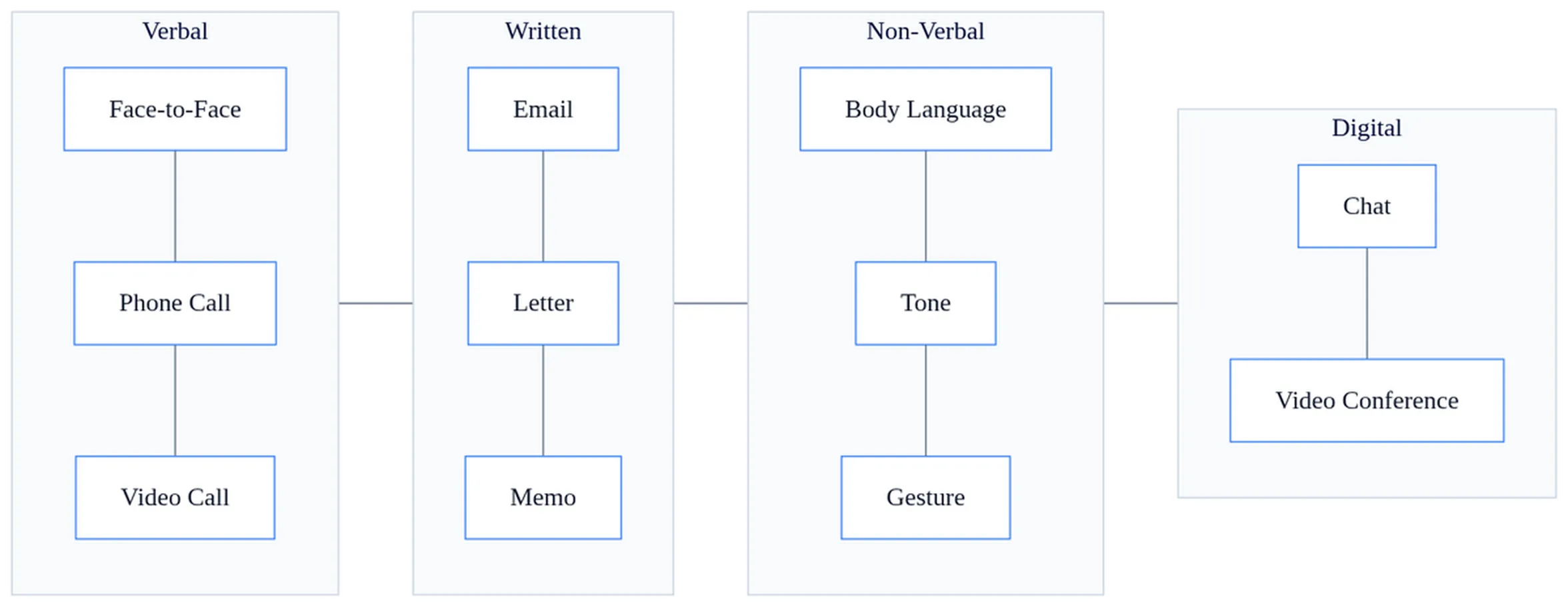
Written channels, emails, memos, reports, chat messages, create permanent records and allow careful composition. You can revise a proposal three times before sending. But they sacrifice immediacy and strip out vocal cues, making sarcasm or urgency harder to convey.
Non-verbal channels operate alongside or independently of words. Body language, facial expressions, posture, and even office layout communicate. An executive who schedules one-on-ones in her office sends a different signal than one who meets employees at their desks. Crossed arms during a pitch might signal skepticism, or just cold office temperature.
Modern business blends these channels. A video call combines verbal (words), vocal (tone), and visual (facial expressions) elements. A Slack message with emoji adds non-verbal context to written text. Choosing the right mix depends on message complexity, urgency, and relationship. Delivering negative performance feedback via email is usually a mistake; the lack of non-verbal reassurance amplifies the critique.
Organizational communication flow
In organizations, communication flows in multiple directions. Vertical communication moves upward (employee to manager), downward (manager to employee), and horizontally (peer to peer). Upward flow carries feedback, concerns, and ground-level intelligence. Downward flow delivers instructions, strategy, and feedback. Horizontal flow enables coordination between departments or team members at similar levels.
Formal channels follow organizational hierarchy, official memos, scheduled meetings, performance reviews. Informal channels operate outside structure, hallway conversations, lunch discussions, instant messages. Both matter. Formal channels ensure accountability and documentation. Informal channels build relationships and surface issues before they escalate.
Why understanding communication nature matters
Recognizing communication as irreversible changes how you craft messages. Once you’ve sent that frustrated email, you can’t unsend it. Apologies and clarifications help, but the original message lingers. This reality encourages pausing before hitting send on emotionally charged messages.

Understanding feedback loops improves clarity. If you frame every message with “How will I know they understood correctly?” you build in verification steps. Instead of announcing “Project deadline moved to Friday,” you ask “Can everyone confirm they can meet the new Friday deadline?”
Awareness of barriers to communication, noise, cultural differences, power dynamics, information overload, enables proactive mitigation. You might schedule important conversations for morning hours when attention is sharpest, or use multiple channels (email plus team meeting) for critical announcements.
The transactional view shows shared responsibility. Effective communication isn’t just about sending clear messages. It’s about creating an environment where receivers feel safe asking questions, where feedback flows freely, and where both parties actively work toward mutual understanding. A manager who blames employees for “not listening” when instructions were unclear misses this point.
Most teams get this backwards. They treat communication as a sender-focused activity. “I told them clearly” becomes the defense when things go wrong. But communication succeeds only when shared meaning emerges. Clarity isn’t what you intended to say, it’s what the other person understood. That shift in perspective, from transmission to transaction, separates adequate communicators from exceptional ones.
The next time you’re drafting an important message, ask yourself: Am I just transmitting information, or am I creating conditions for shared understanding? The answer shapes your word choice, your channel selection, and your follow-up strategy.
Frequently asked questions
Should I use one-way or two-way communication for a time-sensitive announcement?
Send the announcement one-way for speed, but follow up with two-way channels. Email the urgent message immediately, then schedule a brief meeting or Q&A session within 24 hours. This ensures rapid dissemination while giving people a chance to clarify misunderstandings before they cause problems.
What if my receiver decodes my message differently than I intended?
Request specific feedback to catch decoding errors early. Instead of asking “Do you understand?” ask “What’s your plan for implementing this?” or “How does this affect your timeline?” Their answer reveals whether they decoded your message correctly and gives you a chance to clarify before mistakes compound.
How do I account for noise when communicating across time zones or cultures?
Reduce noise by being explicit about expectations and terminology. Define what “urgent” means (24 hours vs. immediate), avoid idioms, and confirm understanding in writing. For cross-cultural teams, acknowledge that context differs—what seems routine in one culture may signal something else in another.
Is it better to communicate in person or via email if both are possible?
Choose based on the model you need. Use email (linear) for announcements and documentation. Use in-person or video calls (transactional) for decisions, conflicts, or complex topics where real-time feedback matters. For sensitive issues, in-person communication reduces misinterpretation and builds trust.
Why did my complaint letter get ignored when I followed all the rules?
You likely sent one-way communication without feedback validation. A formal letter transmits your complaint but doesn’t confirm receipt or understanding. Follow up with a phone call or email asking for acknowledgment. Transactional communication—where the recipient responds—ensures your complaint is actually heard, not just sent.
2 Comments
Point no. three and two seem to be alike,thus they are not different.
point no 2, is about parties
and 3 is about way of communication
i think that’s the difference you’re talking about