


Listening is a learnable skill that determines how much you understand, how well you collaborate, and whether people trust you in professional settings. This guide walks you through eight evidence-based techniques to improve your listening ability, from identifying what blocks your focus to adapting your approach for remote conversations and high-stakes conflict.
What is listening and why it matters in business
Listening is the active mental process of receiving spoken words, decoding their meaning, interpreting context and emotion, and responding appropriately. It differs from hearing, which is the passive physiological act of detecting sound waves. You hear the hum of the air conditioner; you listen to your manager explain a project deadline.
Most professionals overestimate their listening ability. Research from Accenture found that while 96% of professionals consider themselves good listeners, most struggle to listen effectively amid today’s workplace distractions (source). That gap costs businesses time, money, and trust. Misunderstood instructions lead to rework. Missed client concerns lose deals. Team members who feel unheard disengage.
Strong listening skills form the foundation of effective communication. When you listen well, you gather better information, build stronger relationships, and make decisions grounded rather than assumption. The techniques that follow address the full listening cycle: preparation, attention, comprehension, and response.
Identify your listening barriers
Before you can improve listening, you need to know what blocks it. Barriers to effective communication fall into three categories: internal, external, and cognitive. Internal barriers include preconceived judgments about the speaker, emotional reactions to the topic, anxiety about your own response, and wandering thoughts unrelated to the conversation. If you’re mentally rehearsing your rebuttal while someone is still talking, you’ve stopped listening.
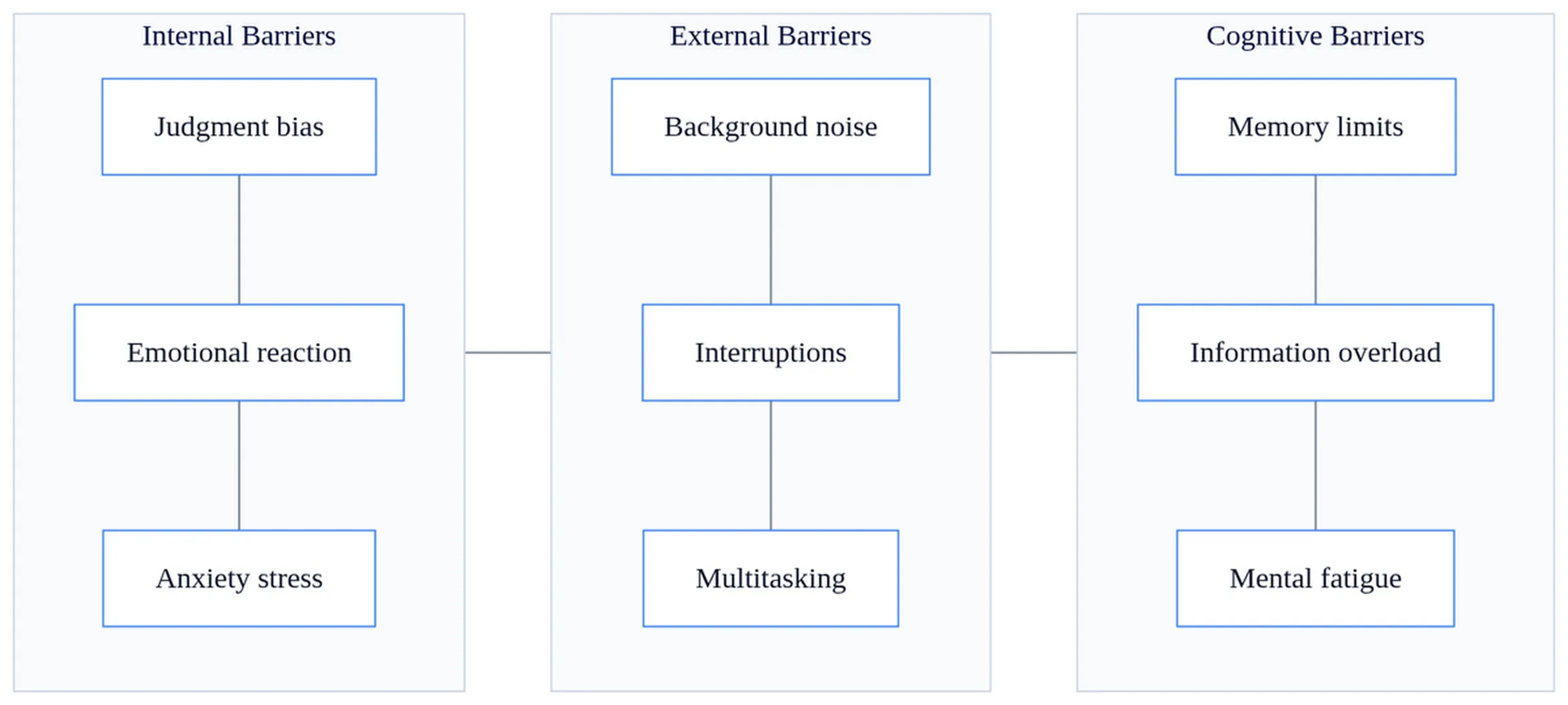
External barriers are environmental. Background noise, visual distractions, phone notifications, and interruptions from colleagues all fracture your attention. Multitasking, answering emails during a video call, for example, creates the illusion of productivity while guaranteeing poor comprehension.
Cognitive barriers stem from how your brain processes information. Working memory is limited; you can hold only about four chunks of information at once before older details start to fade. Information overload happens when a speaker delivers too much complexity too quickly. Fatigue reduces your ability to sustain focus, especially in back-to-back meetings.
Take a moment to assess your own patterns. Do you zone out during long presentations? Do you jump to conclusions when you hear trigger words? Do you find yourself composing responses before the speaker finishes? Naming your specific barriers is the first step toward managing them.
Set your listening intention before conversations
Good listening begins before anyone speaks. Mental preparation, deciding in advance to listen with full attention, dramatically improves comprehension. This is not passive willingness; it’s an active commitment to prioritize the speaker’s message over your own internal dialogue.
Eliminate distractions before the conversation starts. Silence your phone or place it face-down out of reach. Close browser tabs unrelated to the meeting. If you’re in person, choose a quiet environment or position yourself away from high-traffic areas.
Your physical posture influences your mental state. Body language and nonverbal cues work bidirectionally, they communicate your engagement to the speaker and reinforce your own focus. Face the speaker directly. Maintain culturally appropriate eye contact. Relax your shoulders and uncross your arms. An open posture invites both the speaker and your own attention into the conversation.
For high-stakes conversations, performance reviews, client negotiations, conflict resolution, try a brief mindfulness reset. Take two or three slow, deep breaths before the meeting begins. This simple practice reduces anxiety, clears residual thoughts from your previous task, and centers your attention on the present moment. Research in motivational interviewing shows that listeners who set explicit intentions before difficult conversations retain more information and respond more empathetically.
Practice active listening through reflection and paraphrasing
Active listening skills transform passive hearing into engaged understanding. The core technique is reflection, mirroring back what you’ve heard to confirm accuracy and show the speaker you’re tracking their message.
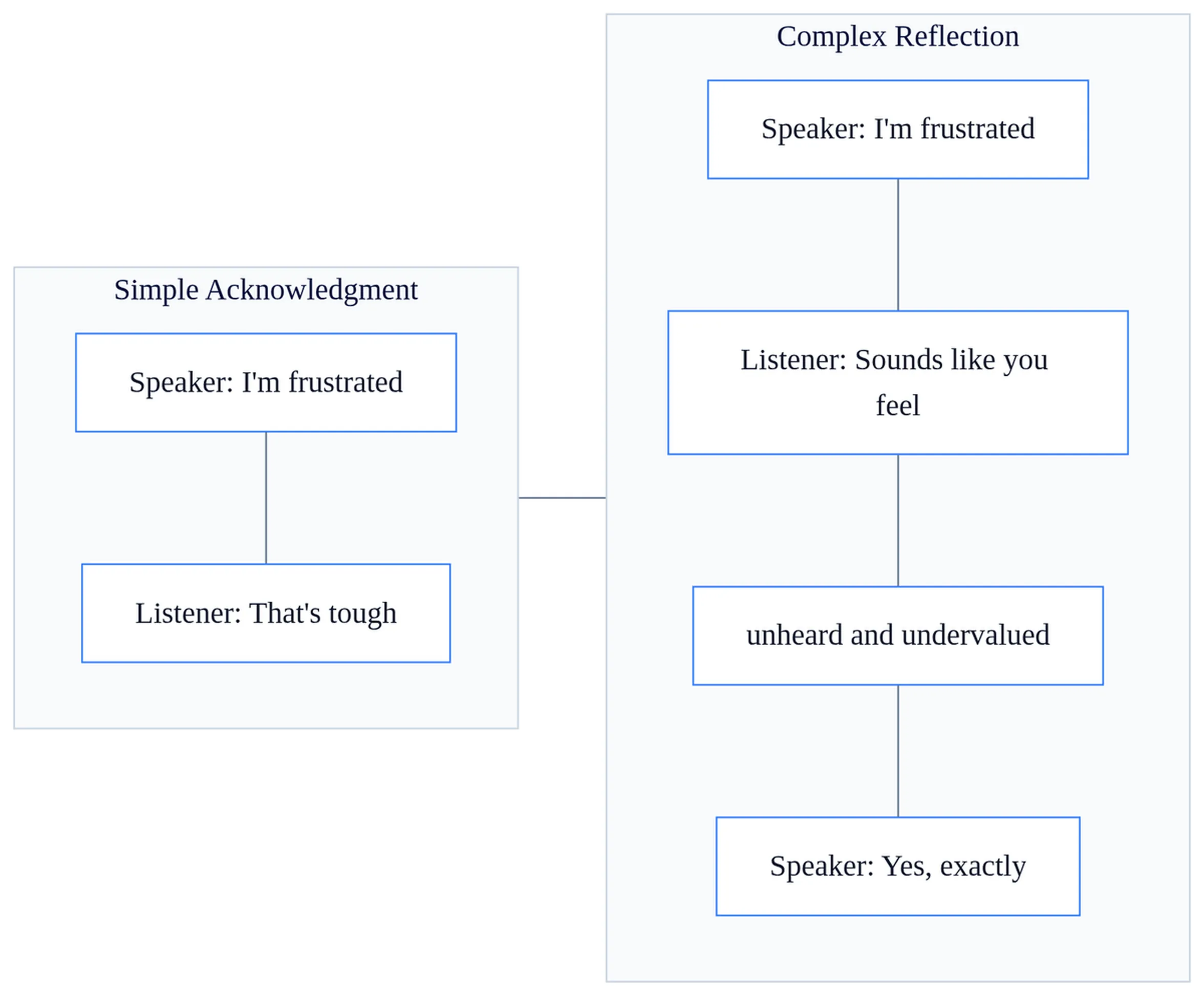
Simple reflection acknowledges the content. After your colleague explains a workflow problem, you might say, “I hear you saying the approval process is taking too long.” This basic confirmation reassures the speaker and gives them a chance to correct misunderstandings early.
Complex reflection goes deeper, capturing not just the words but the emotion and meaning beneath them. If a team member says, “I’ve submitted three reports this week and haven’t heard anything back,” a complex reflection might be, “It sounds like you’re frustrated because you’re putting in effort but not getting feedback on whether you’re on the right track.” This level of listening requires attention to tone, word choice, and context, what one expert calls “the music beneath the words.”
Paraphrasing restates the speaker’s main ideas in your own words. It’s particularly useful in meetings where multiple ideas are discussed. “So what I’m hearing is that we need to prioritize the client deliverable over the internal report, and you’ll need design support by Thursday. Is that right?” This technique clarifies understanding and surfaces any gaps before they become problems.
Timing matters. Reflect and paraphrase after the speaker finishes a complete thought, not mid-sentence. Interrupting to prove you’re listening defeats the purpose. Wait for natural pauses, then offer your reflection as a checkpoint rather than a takeover.
Ask clarifying and open-ended questions
Questions are listening tools when used correctly. They demonstrate curiosity, surface hidden information, and ensure you understand the speaker’s perspective before forming your own response.
Open-ended questions invite fuller answers. Compare “Did you finish the analysis?” with “What did you discover in the analysis?” The first yields a yes or no. The second opens space for explanation, context, and nuance. Leadership research shows that managers who ask open-ended questions build stronger psychological safety and receive more honest feedback from their teams.
Be cautious with “why” questions early in a conversation. “Why did you do it that way?” can sound accusatory, putting the speaker on the defensive. “What led you to that approach?” or “How did you decide on that method?” gathers the same information without the implicit judgment. Save “why” for later, after you’ve established trust and understanding.
Clarifying questions prevent costly assumptions. “When you say ‘soon,’ do you mean by end of day or end of week?” or “Can you give me an example of what you mean by ‘better collaboration’?” These questions acknowledge that language is imprecise and that your interpretation might differ from the speaker’s intent.
Always summarize your understanding before moving to evaluation or problem-solving. “Let me make sure I’ve got this right. You’re saying the vendor missed two deadlines, the quality wasn’t what we discussed, and you’d like to explore alternatives. Did I capture that accurately?” This pause creates a checkpoint and signals respect for the speaker’s perspective.
Take selective, purposeful notes
Note-taking serves two functions: it reinforces memory and creates a reference for later use. The key is selectivity. Trying to transcribe everything the speaker says fractures your attention and guarantees you’ll miss important details.
Record main ideas, keywords, specific numbers or dates, and action items. If a client says, “We need the prototype by March 15th, and it has to include mobile responsiveness and offline functionality,” you’d note: “Prototype: March 15 / mobile responsive / offline mode.” You don’t need full sentences. You need triggers that will reconstruct the conversation later.
Good note-taking shows engagement. When someone sees you jot down their point, they know you’re taking it seriously. But balance is critical. Maintain eye contact and listening flow. Glance down to write, then return your attention to the speaker. If you’re staring at your notebook the entire time, you’re not listening, you’re transcribing.
Review your notes within 24 hours. Memory fades quickly; a brief review solidifies the information and often reveals connections or questions you didn’t catch in the moment.
Adapt listening techniques for remote and virtual settings
Remote and hybrid work environments change the mechanics of listening. Limited nonverbal cues, technical glitches, and screen fatigue all create new barriers that require adapted techniques. Most people underestimate how much they rely on peripheral vision and spatial cues in face-to-face conversation. On a video call, those cues disappear, and you’re left parsing meaning from a small rectangle of someone’s face.
On video calls, eye contact is tricky. Looking at the other person’s face on your screen means you’re not making “eye contact” from their perspective, you’re looking down. To signal engagement, glance at your camera periodically, especially when you’re speaking or when you want to show strong agreement. Position your camera at eye level and place the video window near the camera so your gaze doesn’t drift too far.
Asynchronous communication, email, chat, recorded videos, removes real-time feedback loops. Read messages carefully, twice if they’re complex or emotionally charged. Ask clarifying questions in writing rather than assuming intent. Tone is hard to read in text; what you interpret as curt might simply be brief.
In virtual meetings, you lose many of the subtle cues that aid comprehension in person, shifts in posture, micro-expressions, the energy in the room. Compensate by relying more on tone of voice and word choice. “I want to make sure I’m reading this right, are you saying you’re comfortable with the timeline, or do you have concerns?” This kind of verbal checking replaces the head nods and furrowed brows you’d notice face-to-face.
Summarize understanding in writing after important virtual conversations. A quick follow-up message, “Thanks for the call. Just to confirm, I’ll draft the proposal by Friday and send it to you and Anika for feedback”, prevents miscommunication and creates a shared record.
Listening in difficult conversations and conflict
Your listening skills face their hardest test during conflict, criticism, or emotionally charged conversations. The natural impulse is to defend, explain, or counterattack. Effective listening requires you to suspend that impulse long enough to fully understand the other person’s position.
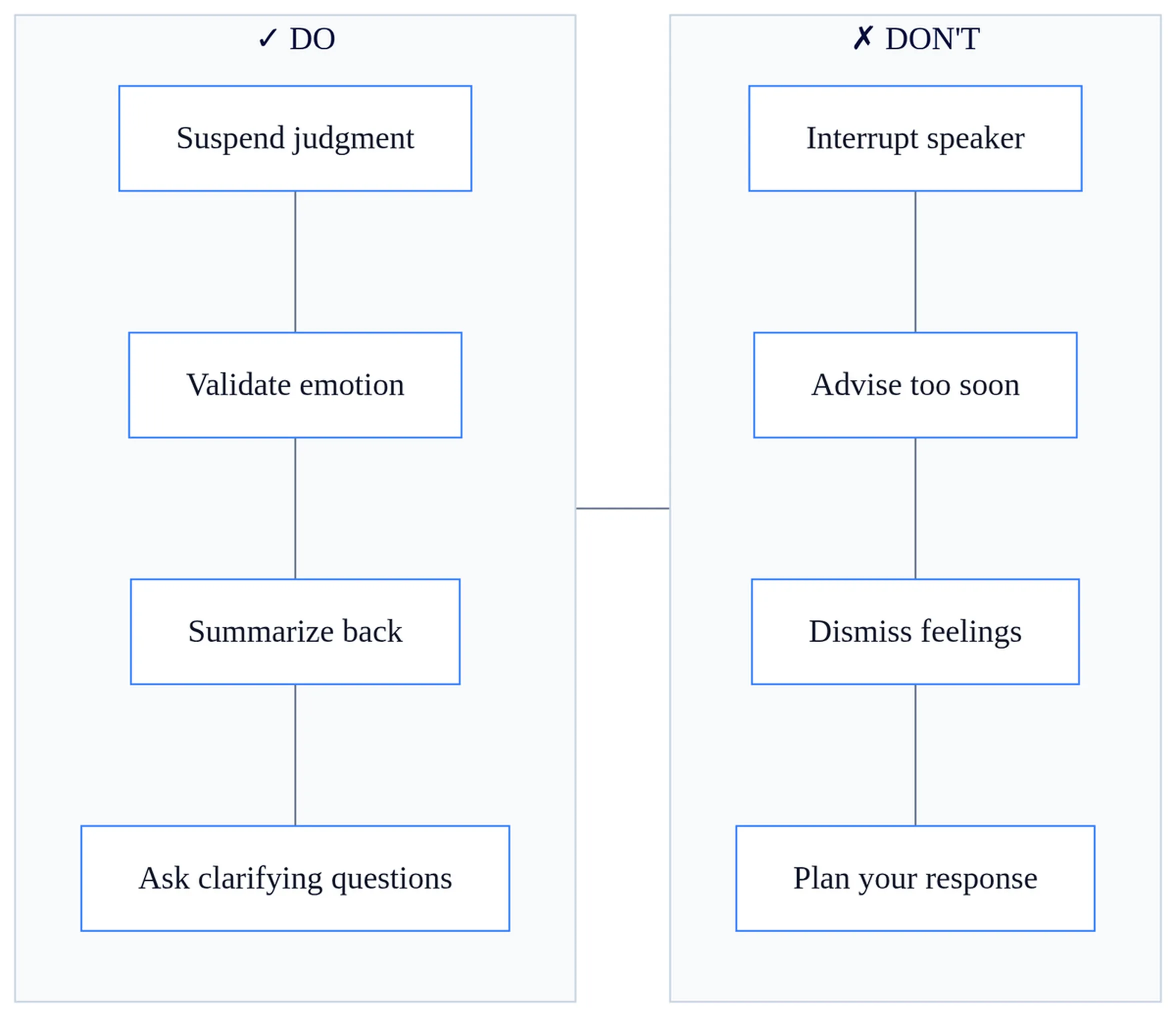
Listen to understand, not to respond. This is harder than it sounds. When someone criticizes your work or challenges your decision, your brain starts composing a rebuttal before they finish their first sentence. Recognize that urge and consciously set it aside. You’ll have time to respond; right now, your job is comprehension.
Validate the speaker’s emotion without necessarily agreeing with their conclusion. “I understand this situation is frustrating for you” or “I can see why you’d be concerned about that” acknowledges their experience. Validation is not capitulation. It’s recognition that their feelings are real, even if you see the facts differently.
Avoid what psychologist Thomas Gordon called “roadblocks”, responses that shut down communication. Don’t advise (“Here’s what you should do”), moralize (“You shouldn’t feel that way”), order (“Just get over it”), or dismiss (“That’s not a big deal”) before you’ve fully listened. These roadblocks communicate that you’re more interested in solving or correcting than in understanding.
Before stating your own perspective, summarize the other person’s position in a way they would agree with. “So if I’m hearing you correctly, you’re upset because the deadline changed without consultation, and you feel that shows a lack of respect for your time. Is that accurate?” This step de-escalates tension and ensures you’re responding to what they actually said, not what you assumed they meant.
| Listening technique | When to use it | Example |
|---|---|---|
| Simple reflection | Routine conversations, basic confirmation | “You’re saying the report is due Friday.” |
| Complex reflection | Emotional topics, conflict, coaching | “It sounds like you’re overwhelmed because you’re managing three projects without clear priorities.” |
| Open-ended questions | Discovery, brainstorming, understanding context | “What challenges are you running into?” or “How do you see this playing out?” |
| Clarifying questions | Ambiguous language, technical details, deadlines | “When you say ‘ASAP,’ do you mean today or this week?” or “Can you define what ‘good enough’ looks like here?” |
| Summarizing | End of meetings, after long explanations, before decisions | “Let me recap: we’ll focus on the client pitch this week, then shift to internal planning next Monday.” |
| Validation | Conflict, criticism, emotional distress | “I can see why that would be frustrating” or “That makes sense given what you were told initially.” |
Start with one technique. Try setting a clear intention before your next important conversation, or practice complex reflection in your next one-on-one. Notice what changes. Most people discover that when they listen better, others share more, trust grows faster, and problems get solved with less friction.
Frequently asked questions
What if I’m naturally impatient and struggle to let people finish talking?
This is an internal barrier you can manage. Before conversations, set a specific intention to pause before responding. During the talk, take a breath when you feel the urge to interrupt. After they finish, count to two before you speak. This creates space for complete thoughts and signals respect. Over time, the habit becomes automatic.
How do I listen well in back-to-back video meetings when I’m mentally exhausted?
Fatigue is a real cognitive barrier. Between calls, take a 5-minute break away from your screen. Step outside, drink water, or do light stretching. During the meeting itself, take notes by hand rather than typing—it forces active engagement. If a meeting is low-priority, ask if you can review notes later instead of attending live.
Should I take notes while listening, or does writing distract from focus?
Light note-taking actually improves listening by keeping your brain engaged. Write key points, not transcripts. Avoid typing on a laptop, which signals distraction to the speaker. Handwriting forces you to synthesize information in real time, strengthening comprehension. Stop writing during complex emotional moments to maintain eye contact and presence.
What if someone’s tone or word choice triggers an emotional reaction in me?
This is a common internal barrier. When you notice the reaction, pause and name it silently: “I’m feeling defensive.” This creates distance between the emotion and your response. Continue listening to gather full context before reacting. Often, understanding the speaker’s intent reduces the emotional charge. Respond after you’ve heard everything, not during the trigger.
Is it better to reflect back everything I hear, or will that annoy the speaker?
Use reflection strategically, not constantly. Simple reflection works well for clarification and shows engagement. Complex reflection is best reserved for emotional or high-stakes conversations where understanding matters most. In casual updates, occasional paraphrasing of key points is enough. Read the room—if the speaker seems impatient, shift to brief confirmations instead.
How do I listen effectively when I disagree with what someone is saying?
Disagreement is not a reason to stop listening. In fact, listening harder when you disagree prevents misunderstandings and strengthens your own position. Focus on understanding their reasoning fully before forming a response. Reflect back what you heard to confirm accuracy. This builds credibility and often reveals common ground you might have missed.
1 Comment
Excellent article, Indeed!
Many times my spouse tells me that I am not a good listener! Are there any ways to test one’s listening skills?