


Secretaries occupy one of the most diverse roles in modern organizations, spanning private offices, multinational corporations, government ministries, and diplomatic missions. Understanding the different types of secretaries, and how their responsibilities, reporting structures, and qualifications differ, helps job seekers choose the right career path and helps organizations hire the right administrative talent.
What is a secretary? Definition and core role
The word “secretary” traces back to the Latin secretarius, meaning “a person entrusted with secrets” or “confidential officer.” This etymology reveals the role’s original purpose: managing sensitive information and acting as a trusted intermediary for people in positions of authority.
Today’s secretary is an administrative professional who manages correspondence, maintains records, coordinates schedules, and enables smooth organizational operations. The role has evolved far beyond its clerical origins. Modern secretaries often serve as strategic enablers, handling complex compliance tasks, managing stakeholder communication, and even functioning as executive heads of departments in public sector contexts.
According to the U.S. Bureau of Labor Statistics, secretaries and administrative assistants held about 3.6 million jobs in 2022, working across every industry from healthcare to legal services to government. The scope of responsibilities varies dramatically by sector and organizational level.
Private secretary
A private secretary is employed by a single individual, typically a high-level executive, doctor, lawyer, politician, or entrepreneur, to manage their personal and professional affairs. This role is intensely personal and demands discretion, adaptability, and the ability to anticipate needs before they’re articulated.
Private secretaries handle correspondence, schedule appointments, screen visitors and phone calls, manage travel arrangements, and maintain confidential files. They often serve as gatekeepers, protecting their employer’s time and attention.
The functions of a private secretary extend beyond administrative tasks to include representing the employer in their absence and acting as a liaison between the employer and external parties. The qualifications of a private secretary typically include strong organizational skills, proficiency in office software, and sometimes specialized knowledge in the employer’s field.
Private secretaries usually work in small office environments or even from the employer’s home. The relationship is often long-term and built on mutual trust, with compensation varying widely based on the employer’s income level and the secretary’s experience.
What does a private secretary do? (functions)
No fixed list covers every private secretary, because the work depends on the nature of the employer’s business and on what the employer asks for. The following functions are common to most posts:
- Routine office work. Sending and receiving letters and email, filing, indexing and preserving important papers, managing shared files, and taking dictation and typing it up.
- Liaison and public relations. Acting as the employer’s point of contact: receiving guests and visitors, handling correspondence and phone calls, screening information, and arranging meetings and interviews.
- Meeting work. Preparing and sending the notice and agenda, arranging the venue, helping the employer conduct the meeting, and writing the minutes.
- Personal accounts. In some posts, keeping records of the employer’s income and expenditure, looking after personal bank accounts, and paying insurance premiums and utility bills.
- Drafting. Preparing drafts of reports and speeches, and sometimes writing up material from the employer’s spoken notes.
- Schedules and travel. Managing the employer’s calendar, arranging the daily work plan and tour schedules, and booking travel.
- Accompanying the employer. Travelling with the employer on official tours when needed.
- Confidentiality. Keeping the employer’s papers, conversations and plans private and exercising discretion in every dealing.
- Other duties. Reminding the employer about programmes they are to attend and, depending on the employer, handling some personal errands.
Qualifications of a private secretary
A private secretary is hired to take routine work off a busy executive, professional or public figure, so the post calls for a minimum set of qualifications. The required level of education varies with the job.
| Qualification | Why it matters |
|---|---|
| Education and general knowledge | Helps the secretary handle new or unexpected situations |
| Command of language | Needed to draft letters, reports and speeches with correct vocabulary and grammar |
| Typing speed, dictation and transcription | The secretary takes dictation and turns it into typed documents; shorthand is still examined in some syllabi |
| Knowledge of office procedure | Filing, indexing, record keeping and correspondence are daily tasks |
| Modern office tools | Email, calendars, cloud files and other office technology save time |
| Knowledge of secretarial practice | Notices, agendas, minutes and staff supervision are core secretarial work |
For senior roles, a working awareness of company, labour, commercial and tax law is helpful, though it is not a requirement for most private secretary posts.
Personal qualities matter as much as formal qualifications:
- Discretion and loyalty
- Tact with visitors and callers
- Punctuality
- Initiative
Company secretary
A company secretary occupies a fundamentally different tier. This is a senior statutory officer in corporations, particularly in Commonwealth countries, responsible for legal compliance, corporate governance, and regulatory filings. The role carries legal liability and requires specialized qualifications.
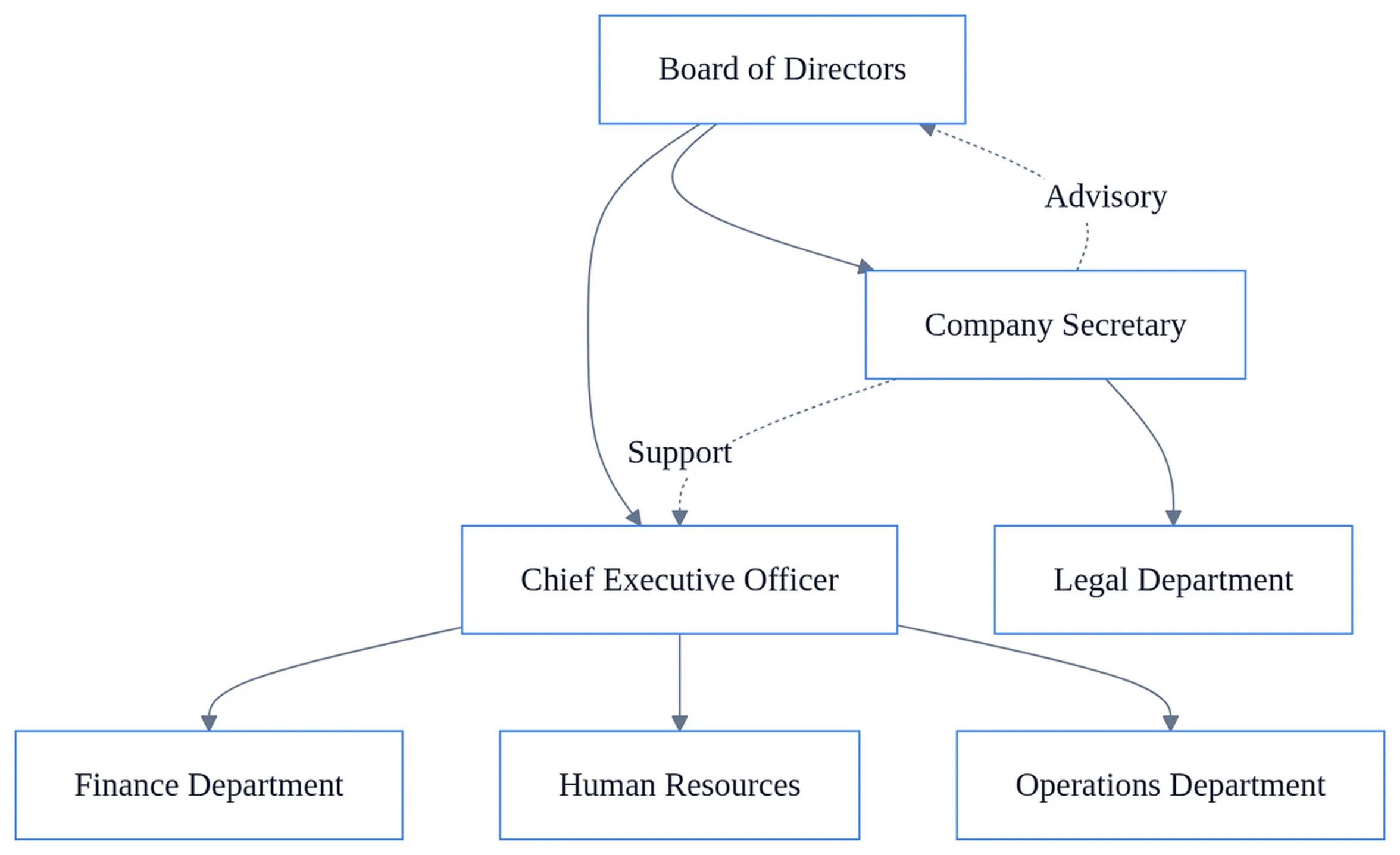
Company secretaries maintain statutory registers, file annual returns, ensure board meetings comply with corporate law, advise directors on governance matters, and serve as the primary liaison between the board of directors and shareholders. They’re not personal assistants but corporate officers with fiduciary duties. The company secretary appointment and responsibilities are governed by companies legislation, which in many jurisdictions mandates specific educational credentials and professional certification.
Company secretaries operate at the executive level, often reporting directly to the board rather than to a single manager. A company secretary at a publicly traded firm might manage investor relations communications, coordinate audit committee meetings, and ensure compliance with securities regulations, tasks that demand legal expertise and strategic judgment.
Legal meaning of a company secretary
A company’s work falls into two parts: management of the business and secretarial work. Secretarial work includes keeping the books and registers required by companies law, issuing share certificates, recording share transfers, preparing agendas, issuing notices of meetings, arranging and attending meetings, drafting minutes, and sending returns to the registrar.
Companies law generally describes the company secretary in a way that gives the post three features:
- Only an individual can be appointed; a firm or body corporate cannot.
- The person must hold the qualifications prescribed by law.
- The duties are ministerial and administrative in nature; the secretary is not a manager.
In Bangladesh, the Companies Act 1994 recognises the company secretary as an important officer of the company.
How is a company secretary appointed?
Whether an appointment is compulsory depends on the country and on the type and size of the company, so check the companies law that applies. The usual methods of appointment are:
- By the promoters. The first secretary is often appointed before incorporation to help with formation work, meetings, minutes and documents. The name may be included in the articles of association.
- By the first board of directors. After incorporation, the board appoints a secretary by resolution at its first meeting, either a new person or the one appointed by the promoters.
- From among the directors. The board may appoint one of the directors who is qualified for the post.
- As an outside professional. The directors may appoint a professional company secretary on a part-time or full-time contract.
The appointment should be made through a written agreement that sets out the term of office, conditions of employment, salary or allowances, and the rules for termination.
Private secretary vs company secretary
| Point | Private secretary | Company secretary |
|---|---|---|
| Employed by | A single individual | A company |
| Reports to | The individual employer | The board of directors |
| Main work | Personal and professional support, correspondence, schedules | Legal compliance, governance, statutory registers and filings |
| Legal status | Ordinary employee | Statutory officer with legal liability |
| Qualifications | Flexible; office skills and experience | Prescribed professional qualifications |
Government and public sector secretaries
Government secretaries occupy three distinct categories, each with its own legal framework and scope of authority.
Secretary of a government department is the executive head of a ministry or department, positioned directly under the minister. In countries following the Westminster system, the secretary is a career civil servant who provides continuity and operational management while the minister sets policy direction. A secretary in the Ministry of Commerce, for example, oversees thousands of employees, manages multi-billion-dollar budgets, and implements legislative mandates. This is an administrative leadership role, not a clerical one.
Secretary of a local body, such as a municipal corporation, district board, or village council, is the chief administrative officer for local government. Appointed according to statutory rules, these secretaries execute council decisions, maintain records of proceedings, manage staff, and ensure compliance with local government legislation. Their work is public-facing and often involves direct interaction with citizens filing permits, lodging complaints, or seeking services.
Secretary of an embassy or high commission supports diplomatic missions abroad. Positioned next to the ambassador or high commissioner, the embassy secretary manages operational matters, coordinates with host-country officials, handles classified communications, and often assumes charge of the mission in the ambassador’s absence. This role requires cultural sensitivity, protocol knowledge, and sometimes security clearance.
All three government secretary types share a common thread: they operate within rigid legal and procedural frameworks, enjoy job security typical of civil service positions, and wield authority derived from statute rather than personal employment contracts.
Association and cooperative secretaries
Many voluntary organizations, trade associations, sports clubs, and cooperative societies appoint secretaries to handle day-to-day administration.
Secretary of an association, whether a cultural club, professional body, or advocacy group, acts as the chief executive officer or administrative coordinator. This secretary conducts correspondence with members and external parties, maintains membership records, arranges meetings, and supervises any paid staff. In a trade association representing textile manufacturers, the secretary might organize annual conferences, lobby government officials on policy matters, and publish industry newsletters. The role combines executive leadership with hands-on administration, and the secretary typically reports to an elected managing committee or board of trustees.
Secretary of a cooperative society performs similar functions but within the specific governance structure of cooperatives. Appointed by the managing committee and paid a fixed salary, the cooperative secretary maintains account books, ensures compliance with cooperative legislation, coordinates member meetings, and implements committee decisions. A credit cooperative’s secretary, for instance, processes loan applications, maintains deposit records, and prepares financial statements for audits.
Both association and cooperative secretaries work under the oversight of elected bodies rather than individual employers. Their authority is delegated, and their tenure often depends on periodic reappointment.
Comparison: secretary types by sector and responsibility
The secretary landscape is easier to navigate with a clear comparison framework. Here’s how the major types differ across key dimensions:

| Secretary Type | Sector | Reports To | Primary Scope | Authority Level |
|---|---|---|---|---|
| Private Secretary | Private | Individual employer | Personal and professional support | Delegated, limited |
| Company Secretary | Corporate | Board of Directors | Legal compliance, governance | Statutory, high |
| Government Department Secretary | Public | Minister | Department administration, policy execution | Executive, very high |
| Local Body Secretary | Public | Elected council | Municipal/district operations | Executive, moderate |
| Embassy Secretary | Diplomatic | Ambassador/High Commissioner | Mission operations, protocol | Operational, moderate |
| Association Secretary | Voluntary | Managing committee | Member services, event coordination | Delegated, moderate |
| Cooperative Secretary | Cooperative | Managing committee | Member transactions, compliance | Delegated, limited |
Salary expectations vary just as widely. Private secretaries’ compensation depends entirely on their employer’s means. A Fortune 500 executive’s secretary earns far more than a small-town lawyer’s assistant. Company secretaries in large corporations command six-figure salaries plus benefits, reflecting their legal expertise and liability exposure. Government secretaries enjoy stable, scale-based pay with pension benefits. Association and cooperative secretaries typically earn modest fixed salaries, though some large trade bodies pay competitively.
Qualification requirements also differ. Company secretaries must hold professional certifications (such as ICSI in India or ICSA internationally). Government secretaries enter through competitive civil service examinations. Private, association, and cooperative secretaries face more flexible requirements, though practical experience and software proficiency increasingly matter across all types.
Key skills and qualifications across secretary types
Certain competencies unite all effective secretaries, regardless of type. Strong written and verbal communication is non-negotiable, you’re the voice of your employer or organization in countless interactions. Organizational ability separates adequate secretaries from exceptional ones; managing competing priorities, tracking deadlines, and maintaining systematic records are daily requirements. Confidentiality is paramount, especially for private and company secretaries handling sensitive information.
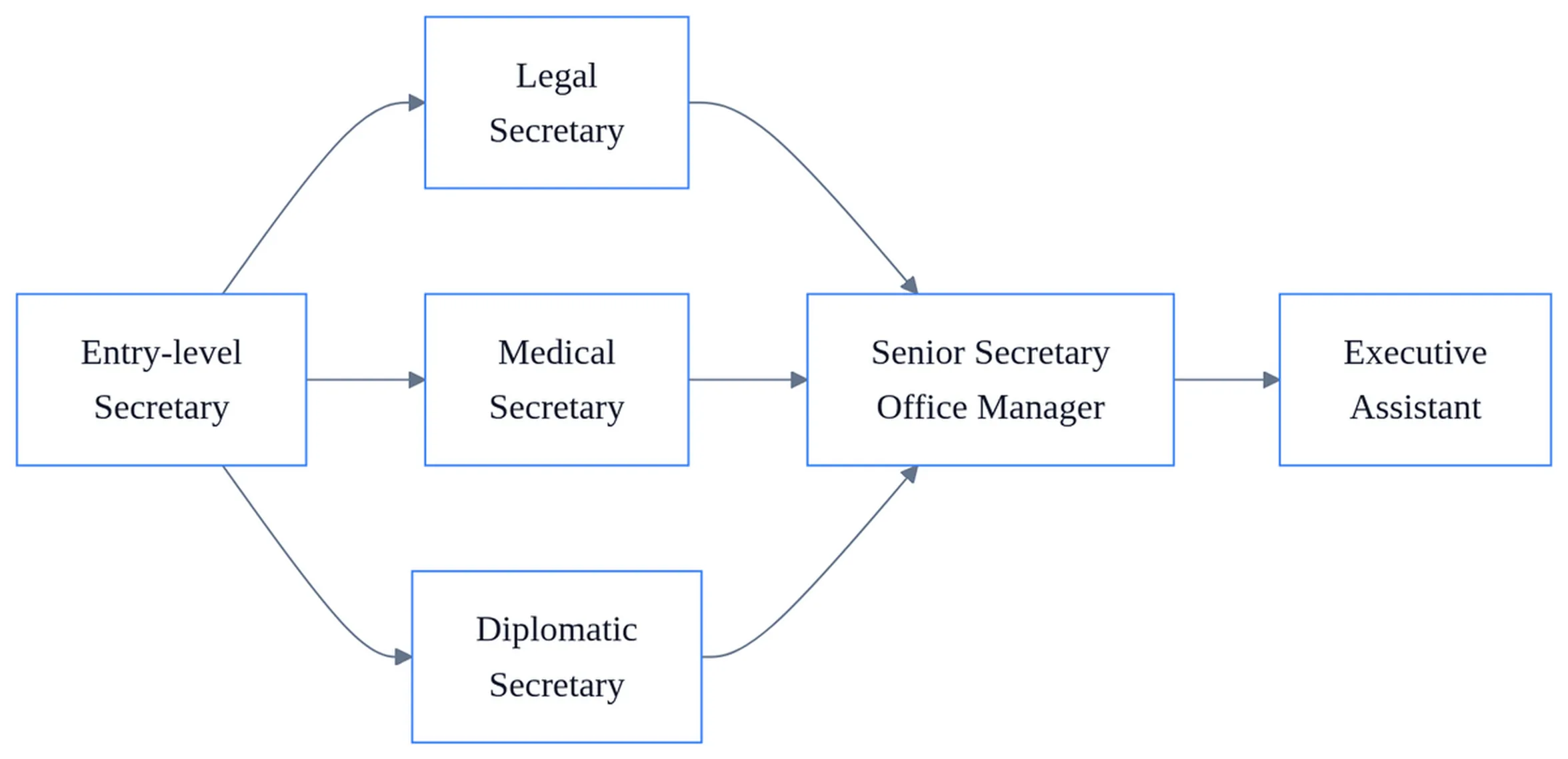
Technology proficiency has shifted from optional to essential. Word processing, spreadsheet management, email platforms, calendar systems, and video conferencing tools form the baseline. Company secretaries need familiarity with board portal software and compliance databases. Government secretaries work with e-governance platforms and document management systems. If you’re still resisting learning new software because “the old way works fine,” you’re limiting your career ceiling more than you realize.
Specialized qualifications create career differentiation. Company secretaries pursue chartered secretary credentials through professional institutes. Legal secretaries benefit from paralegal training. Medical secretaries need healthcare terminology knowledge and sometimes medical coding certification. Embassy secretaries often hold degrees in international relations or foreign languages.
Education pathways range from high school diplomas with on-the-job training (common for entry-level private and cooperative secretaries) to bachelor’s degrees in business administration (increasingly expected for association and local body roles) to professional certifications and even postgraduate degrees (required for company and senior government secretaries). Employers increasingly value candidates who combine formal education with practical software skills and industry-specific knowledge.
One skill often overlooked: cultural intelligence. Secretaries interact with diverse stakeholders, board members, government officials, international clients, community members. The ability to adapt communication style, understand unspoken expectations, and navigate organizational politics often determines long-term success more than technical proficiency alone. You can be the fastest typist in the office, but if you can’t read a room or adjust your tone for different audiences, you’ll plateau quickly.
Choosing the right secretary role for your career
Your ideal secretary role depends on what you value most: autonomy, stability, specialization, or advancement potential.
If you prefer working closely with one person and enjoy variety in your daily tasks, a private secretary role offers that intimacy and unpredictability. You’ll develop deep expertise in your employer’s field and potentially travel or work flexible hours. Career progression might mean moving to more prominent employers or transitioning into executive assistant roles with broader strategic involvement.
If you’re drawn to legal frameworks, corporate governance, and high-stakes decision-making, the company secretary track offers intellectual challenge and professional prestige. This path requires significant upfront investment in education and certification, but it opens doors to board-level influence and lucrative compensation. Many company secretaries eventually move into general counsel or chief compliance officer positions.
If job security and structured career ladders appeal to you, government secretary roles provide exactly that. Competitive examinations are demanding, but once you’re in, promotions follow seniority and performance. You’ll work on matters affecting thousands or millions of people, which some find deeply meaningful. The trade-off is bureaucracy and slower decision-making compared to private sector roles.
If mission-driven work matters more than maximum compensation, association and cooperative secretaries find purpose in serving communities and member organizations. These roles suit people who value collaborative governance and don’t mind wearing multiple hats, you might draft a newsletter one hour and negotiate a vendor contract the next.
Embassy secretaries occupy a unique niche for those fascinated by international relations and willing to relocate frequently. The work combines administrative rigor with cultural immersion, and it can lead to broader diplomatic service careers.
Many secretaries don’t stay in one category forever. A private secretary might pursue company secretary certification to move into corporate governance. A cooperative secretary might transition to a local body role through civil service examination. An association secretary could join a multinational as an office manager. The core skills transfer across contexts, even as specialized knowledge accumulates.
What most people get wrong is assuming all secretary roles are entry-level positions with limited growth. Company secretaries sit on executive teams. Government department secretaries manage billion-dollar budgets. Experienced private secretaries wield considerable informal influence. The ceiling depends entirely on which type you choose and how deeply you develop specialized expertise. Understanding these distinctions early in your career lets you make intentional choices rather than drifting into whichever secretary job happens to be advertised first.
The secretary role remains one of the most important business communication roles in any organization, serving as a critical node in organizational communication networks. Whether you’re coordinating a CEO’s calendar, ensuring a corporation’s regulatory compliance, or managing a municipal council’s operations, you’re enabling others to focus on their core work.
Frequently asked questions
Should I pursue a company secretary role if I want to avoid legal responsibility?
No. Company secretaries carry fiduciary duties and legal liability—they’re corporate officers, not administrative assistants. If you prefer hands-on administrative work without legal exposure, a private secretary or departmental secretary role may suit you better. Company secretary positions require specialized qualifications and involve governance compliance.
Can a private secretary transition into a company secretary position?
Unlikely without additional education. Private secretaries manage personal affairs; company secretaries are statutory officers requiring professional certification and legal expertise. The roles demand different skill sets. A private secretary could pursue formal qualifications (like ICSA certification) to bridge this gap, but it requires significant additional training.
What’s the main difference between a government department secretary and a private secretary?
A government department secretary is an executive head managing thousands of employees and large budgets—an administrative leadership role. A private secretary serves one individual, handling correspondence and scheduling. Government secretaries operate within legal frameworks and civil service structures; private secretaries work in personal, trust-based relationships.
Do embassy secretaries need security clearance or special training?
Yes, embassy secretaries typically require security clearance due to classified communications and diplomatic sensitivity. They also need protocol knowledge and cultural awareness. This role demands more specialized preparation than private or corporate secretary positions, often including government vetting processes.
Which secretary role offers the most job security and benefits?
Government and public sector secretaries enjoy civil service job security, pensions, and structured benefits. Private secretaries depend on employer stability and compensation varies widely. Company secretaries have corporate-level security but face performance pressures. Government roles generally offer the strongest long-term security.
What are the functions of a private secretary?
Routine office work, liaison with visitors and callers, meeting work (notice, agenda, minutes), keeping the employer’s personal accounts, drafting reports and speeches, managing schedules and tours, accompanying the employer and keeping matters confidential. See the full list above.
What are the qualifications needed to work as a personal secretary?
A sound general education, good command of language, fast typing and dictation skills, knowledge of office procedure and modern office tools, and knowledge of secretarial practice, along with discretion, tact and punctuality.
How is a company secretary appointed?
By the promoters before incorporation, by the first board of directors by resolution, from among the directors, or as an outside professional on a part-time or full-time contract. The terms should be set out in a written agreement.
8 Comments
It was really helpful for me to score a very good marks and increase my knowledge about the secretaries
So thanks a lot
at least, it serves my requirements. thanks
Great post! I didn’t realize how crucial the role of a Company Secretary is in maintaining corporate governance and compliance. Thanks for breaking it down so clearly!
I do not mean to criticise but if I were to quote anything here for my assignment, I believe I would score very low marks. Though, this is not a test book, it should be more detailed and explicit to a greater extent as a reference material.
Boorrriiinnnggg!!! But got myself some help for the project…… soo….. thnx!
This is not really giving me what I want
Wow. I do qualify
could be a better source of information