


Business communication is the structured exchange of information within an organization and between the organization and its external stakeholders, customers, suppliers, investors, and regulators. Unlike casual conversation, business communication is goal-oriented, formal in tone and structure, and directly tied to organizational outcomes. When done well, it drives profitability, reduces employee turnover, and creates competitive advantage. When it breaks down, the costs appear in delayed decisions, duplicated work, and disengaged teams.
This article explains why communication matters to your bottom line, how it shapes productivity and trust, and what happens when organizations fail to measure its impact.
What is business communication and why it matters
Business communication encompasses every formal and informal exchange that moves information through your organization. It includes emails, meetings, performance reviews, project updates, policy announcements, and customer service interactions. The key distinction from general communication is context: business communication happens within an organizational framework, serves specific objectives, and carries consequences for performance and reputation.
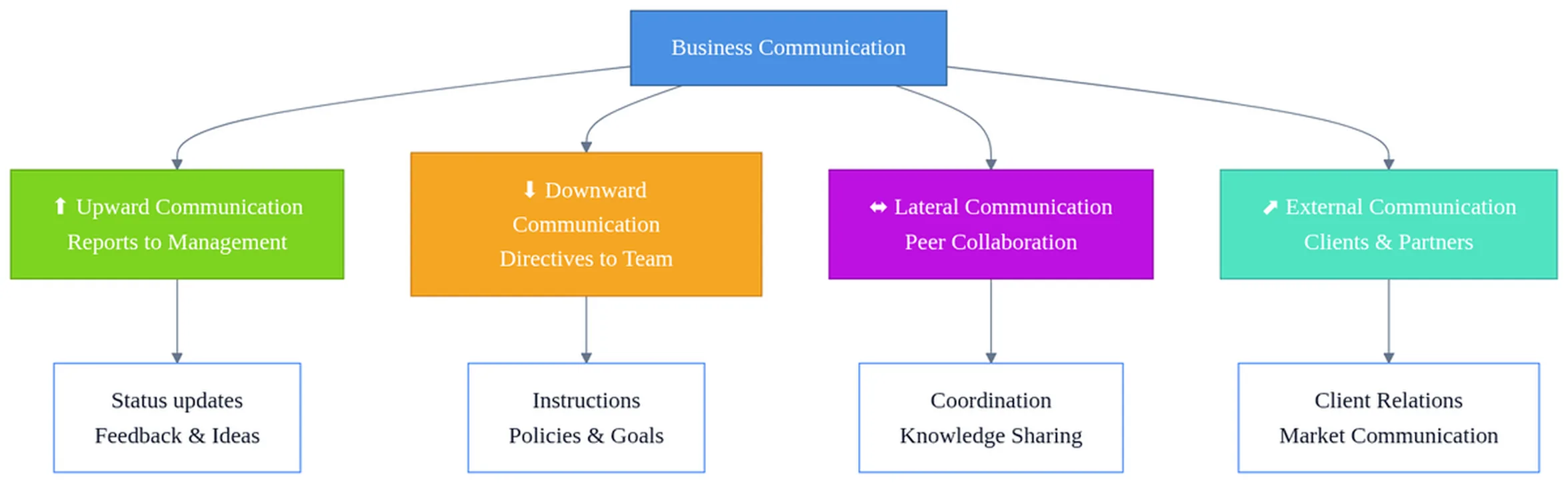
The types of business communication flow in four directions: upward from employees to management, downward from leadership to staff, laterally across departments, and externally to customers and partners. Each direction serves a distinct purpose, but all share a common requirement: clarity that prevents misinterpretation and drives action.
Why does this matter? Because communication quality correlates directly with financial performance. Organizations with highly engaged workforces, a product of effective communication, tend to see stronger financial performance than those with low engagement. The difference isn’t just morale. It’s revenue.
How business communication drives organizational efficiency
Information flow determines how quickly your team can make decisions and act on them. When a warehouse receives an order cancellation, immediate communication to the processing team stops production before materials are wasted. That single message saves labor hours, preserves inventory, and frees the team to work on active orders. Without it, you pay for work that produces nothing.
Cross-functional alignment prevents the kind of rework that drains budgets. A marketing team launching a campaign without input from sales might create materials that don’t address the objections sales hears daily. A product team building features without customer support feedback might solve problems customers don’t have. Communication bridges these gaps.
Consider a mid-sized software company with engineering, sales, and customer success teams spread across three time zones. Weekly asynchronous updates, written summaries of priorities and blockers, let each team adjust their work without waiting for a meeting. The result: faster feature releases and fewer support tickets caused by miscommunication. This is horizontal communication working as intended.
Most organizations already understand this in theory. The challenge is execution. Silos form when departments optimize for their own metrics without visibility into how their work affects others. Breaking those silos requires intentional communication structures, not just good intentions.
The productivity and revenue impact of effective communication
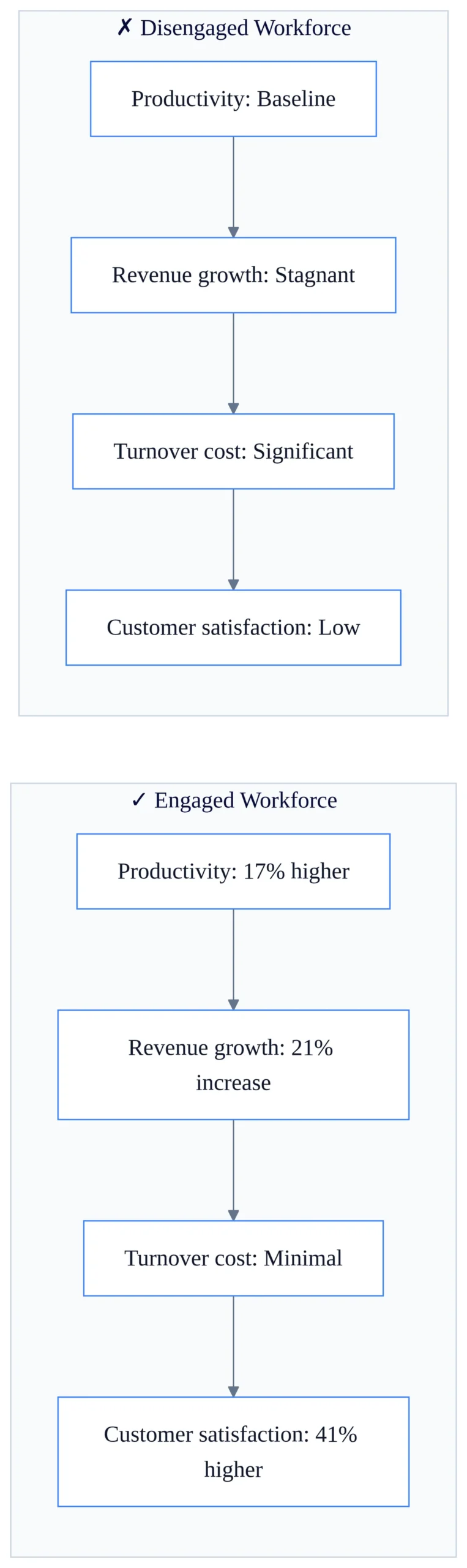
Engaged employees are 25% more productive than disengaged ones, and that productivity gap translates to measurable revenue differences. But engagement doesn’t happen by accident. It’s built through consistent, transparent communication that gives employees context for their work and a voice in how it’s done. The cost of poor communication shows up most clearly in turnover. Replacing a C-suite executive costs up to 213% of their annual salary when you account for lost productivity, recruiting fees, and onboarding time. Mid-level roles run 50-200% of salary. For a company with 100 employees and 15% annual turnover, that’s easily $500,000 to $1 million in preventable costs, much of it driven by employees who leave because they feel uninformed or misaligned with leadership.
Email overload compounds the problem.
Knowledge workers receive 120-150 emails daily, and many spend more time managing their inbox than doing deep work. When every update, question, and approval request lands in email, productivity suffers. Organizations that adopt clearer communication protocols, specifying which channels to use for what purpose, reduce noise and let teams focus.
Remote work has intensified these dynamics. A 2023 Buffer survey found that 98% of workers want some form of remote flexibility, but distributed teams require more intentional communication than co-located ones (source). Without the hallway conversations and quick desk visits that happen naturally in an office, remote teams must create explicit channels for both work updates and social connection. Companies that treat remote communication as an afterthought lose talent to competitors who’ve built it into their culture.
| Metric | High Engagement | Low Engagement |
|---|---|---|
| Productivity increase | +25% | Baseline |
| Operating income growth | +19.2% | -32.7% |
| Turnover cost (C-suite) | Lower replacement frequency | Up to 213% of salary |
| Turnover cost (mid-level) | Lower replacement frequency | 50-200% of salary |
Building trust and psychological safety through communication
Psychological safety, the belief that you can speak up without punishment, is a communication outcome, not a personality trait. It’s built when leaders ask questions and actually listen to the answers, when feedback flows in both directions, and when mistakes are treated as learning opportunities rather than career-ending failures.
Active listening is the foundation. A manager who listens to understand, not just to respond, signals that employee input matters. Over time, that signal creates a culture where people raise concerns early, share ideas freely, and collaborate without fear of blame.
Transparent, timely messaging reduces the anxiety that fills information vacuums. When leadership delays communicating about layoffs, restructuring, or strategic shifts, employees fill the gap with speculation. Rumors spread faster than facts, and morale drops. Honest communication, even when the news is difficult, builds trust that carries through future challenges.
Recognition and appreciation motivate performance in ways that bonuses alone cannot. A specific acknowledgment of good work (“Your analysis in the Q3 report helped us avoid a $50,000 budget error”) reinforces the behaviors you want to see. Warnings and corrective feedback, delivered clearly and privately, prevent small issues from escalating into formal disciplinary action. Both require communication skills that many managers never receive training in.
Trust-based cultures reduce conflict because people assume positive intent and address disagreements directly rather than letting resentment build. This doesn’t mean conflict disappears. It means conflict becomes productive rather than destructive.
Communication as risk mitigation and change enablement
During a crisis (a data breach, a product recall, a sudden leadership departure), communication determines whether your organization responds cohesively or fractures. Leadership clarity in the first 24 hours prevents panic and misinformation. Employees need to know what happened, what’s being done, and what’s expected of them. Customers and partners need reassurance that you’re managing the situation competently.
Change management follows a similar pattern. When organizations roll out new processes, tools, or strategies without explaining the rationale and timeline, resistance is almost guaranteed. People don’t resist change. They resist being changed without input or context. Clear, repeated communication about why the change matters, how it will work, and what support is available reduces resistance and accelerates adoption.
Conflict resolution depends on honest dialogue. When two team members disagree about priorities or approach, a manager who facilitates a structured conversation (clarifying each person’s perspective, identifying common ground, and agreeing on next steps) prevents the issue from escalating to HR or formal grievances. Most workplace conflicts stem from miscommunication or misaligned expectations, not fundamental personality clashes.
Organizations that treat communication as a risk management tool, not just a “soft skill,” build resilience. They recover faster from disruptions, adapt more quickly to market shifts, and retain institutional knowledge when key employees leave. For a deeper look at what blocks these outcomes, explore common communication barriers and how to address them.
External communication and competitive advantage
Customer-centric messaging builds loyalty that outlasts price competition. When your communication (whether marketing copy, support emails, or product documentation) demonstrates that you understand customer problems and respect their time, you create relationships that generate repeat business and referrals.
Supplier and stakeholder alignment ensures supply chain resilience. A manufacturer that communicates proactively with suppliers about demand forecasts, quality standards, and payment timelines builds partnerships that weather disruptions. When a shortage or delay occurs, those relationships determine whether you’re first in line for available inventory or last.
Consistent brand voice across channels reinforces market positioning. A company that sounds professional on LinkedIn, casual on Twitter, and formal in press releases confuses potential customers about who you are and what you stand for. External communication strategy aligns these touchpoints so every interaction strengthens your brand.
What most companies get wrong: they treat external communication as a marketing function rather than an organizational capability. Sales, customer support, product, and leadership all communicate externally, and inconsistency across those touchpoints erodes trust faster than any single message can build it.
The measurement gap: why most organizations fail to track communication ROI
Only 12% of internal communicators track how their work ties into the wider business, according to Gallagher’s 2026 Employee Communications Report. Without metrics, you can’t distinguish between communication that drives outcomes and communication that’s just noise. You can’t justify budget requests, optimize channel selection, or identify what’s working.
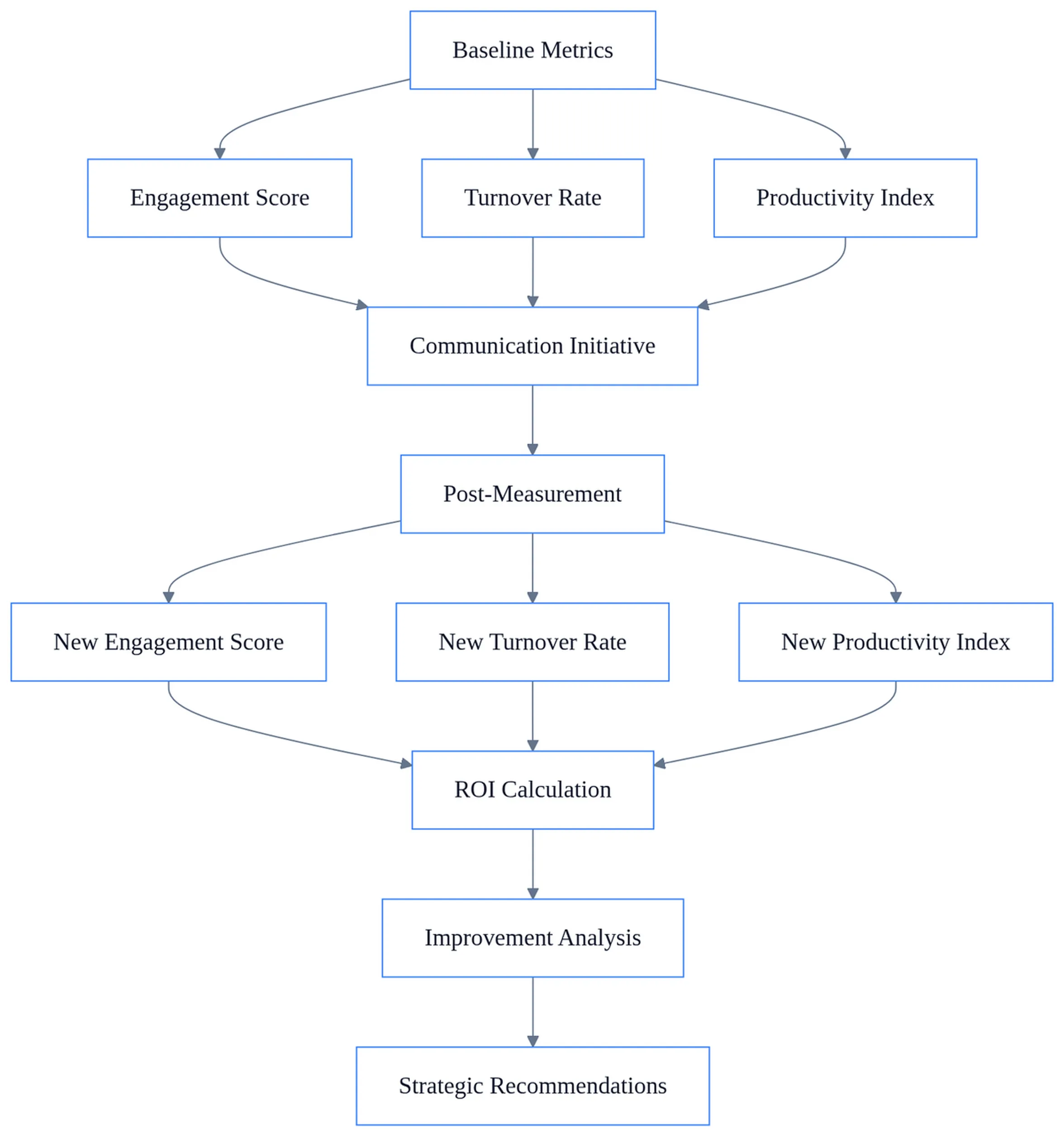
The absence of key performance indicators (engagement scores, sentiment analysis, retention correlation, productivity indices) hides ROI and makes communication seem like overhead rather than investment. A company that spends $100,000 on a new collaboration platform but never tracks whether it reduces email volume, speeds decision-making, or improves cross-functional alignment has no idea whether the tool was worth the cost.
Tool adoption without measurement wastes both money and attention. Teams install Slack, Microsoft Teams, Asana, and a dozen other platforms, then wonder why employees complain about tool fatigue. The problem isn’t the tools. It’s the lack of clarity about what each tool is for and whether it’s delivering value.
Here’s a simple measurement framework: establish baseline metrics before launching any communication initiative. Track engagement (email open rates, meeting attendance, intranet visits), sentiment (pulse surveys, exit interview themes), and business outcomes (turnover rate, time-to-decision, project completion rate). Run the initiative for a defined period, say, six months. Measure again. Calculate the difference. That’s your ROI.
A Dhaka-based tech startup used this approach when rolling out weekly all-hands meetings. They tracked employee engagement scores and cross-departmental project velocity before and after. Six months in, engagement was up 18% and projects were shipping 12% faster. The cost of the meetings (roughly 10 hours of collective time per week) was easily justified by the productivity gain. Without measurement, they would have had only anecdotal evidence.
Overcoming communication barriers in modern workplaces
Language, cultural, and technology barriers require intentional channel selection. A multinational with offices in the US, India, and Bangladesh can’t rely on idioms, humor, or cultural references that don’t translate. Clear, direct language and visual aids (diagrams, screenshots, recorded demos) reduce misunderstanding across linguistic and cultural divides.
Remote work demands both asynchronous and synchronous communication. Asynchronous channels (email, project management tools, recorded video updates) let distributed teams work across time zones without waiting for everyone to be online simultaneously. Synchronous channels (video calls, instant messaging) build rapport and enable real-time problem-solving. Organizations that default to one mode or the other miss the benefits of both.
Technology barriers are often overlooked. Not everyone has high-speed internet, the latest devices, or fluency with collaboration software. Accessibility matters: can your team access critical information from a phone? Can they participate in a video call without video if bandwidth is limited? Companies that assume everyone has the same technology access exclude people unnecessarily. For a detailed breakdown of these and other obstacles, review the full taxonomy of communication barriers.
The real-world messiness: even with the right tools and processes, communication breaks down when people are tired, distracted, or overwhelmed. Perfect communication is a myth. The goal is resilient communication, systems and habits that catch misunderstandings early and correct course before small problems become expensive ones.
Start with one metric, one process improvement, or one channel optimization. Track engagement scores for a single communication initiative. Clarify which tool your team should use for urgent requests versus updates. Ask your direct reports what information they need but aren’t getting. The ROI will show up faster than you expect, and you’ll have the data to prove it.
Frequently asked questions
If my team is remote, how often should I communicate updates?
Remote teams need more intentional communication than co-located ones because informal hallway conversations don’t happen. Establish a rhythm: daily standup summaries (written or brief video), weekly priority updates, and monthly all-hands meetings. The frequency matters less than consistency and clarity about which channel to use for what. This prevents both information gaps and email overload.
What should I do if my organization has severe email overload?
Start by mapping which types of messages belong in email versus other channels. Urgent decisions might use Slack or Teams. Project updates could use a shared dashboard. Policy announcements belong in a central hub. Set team norms: email for formal records, chat for quick questions, meetings only when discussion is needed. This reduces noise without losing critical information.
How do I know if communication problems are causing my turnover?
Exit interviews are your clearest signal. Ask departing employees whether they felt informed about company direction, understood how their work mattered, and had a voice in decisions. If multiple people cite feeling disconnected or misaligned, communication gaps are likely a factor. Cross-reference this with engagement survey data on transparency and leadership visibility.
Can I measure the ROI of improving internal communication?
Track metrics before and after changes: employee engagement scores, voluntary turnover rate, time-to-decision on key projects, and customer satisfaction. A 5% reduction in turnover alone can save $100,000+ for a mid-sized company. Compare productivity metrics like project completion time and support ticket resolution rates. These changes take 3-6 months to show, so measure quarterly.
Should I communicate differently with remote versus in-office employees?
Use the same channels and cadence for both groups to prevent a two-tier system where remote workers feel left out. If you hold in-person meetings, record and share them. If you use async updates, make them available to everyone equally. The goal is inclusion, not separate communication tracks. This also makes hybrid work sustainable.