


Preparing an effective speech requires more than collecting ideas and standing at a podium. You need a deliberate process that shapes your message, anticipates your audience’s needs, and builds the confidence to deliver with clarity. This guide walks you through eight practical steps to prepare speeches that inform, persuade, or inspire, without relying on perfection or pretending nervousness doesn’t exist.
What is a speech in business communication?
A speech is a planned talk in which a speaker passes information, ideas or feelings orally to an audience, in a formal or informal setting. Unlike casual conversation, it has a clear goal: to inform, persuade, motivate or entertain. A sales manager briefing her team before a product launch, a CEO explaining quarterly results to shareholders and a project lead updating stakeholders on a changed timeline are all giving speeches.
This guide covers preparing and delivering a speech. For spoken communication in general, including conversations, meetings and phone calls, see our guide to oral communication.
Elements of a speech
Every speech involves five elements:
- Speaker: the person delivering the message.
- Message: the information, idea or feeling being expressed.
- Audience: the people listening.
- Medium or channel: how the speech is delivered, such as in person, online or on video.
- Feedback: the audience’s reactions, which show whether the message is understood.
Types of speech
Speeches are usually grouped by purpose. The purpose you choose in Step 1 below decides which type you are preparing.
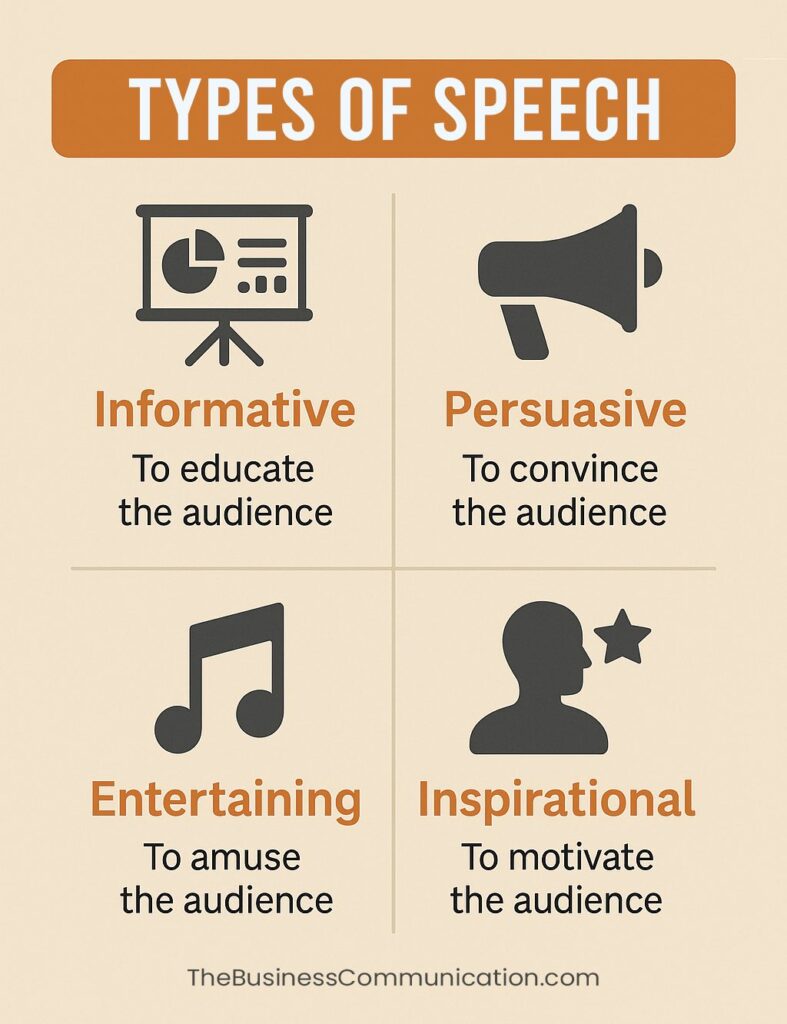
| Type of speech | Purpose | Example |
|---|---|---|
| Informative | Share knowledge and explain facts | A trainer explaining report-writing techniques |
| Persuasive | Change opinions and prompt action | A sales pitch, or a manager urging the team to adopt new software |
| Motivational | Inspire and encourage, often through personal stories | A leader encouraging staff to keep learning new skills |
| Entertaining | Amuse and build rapport | A toast at a company dinner or an awards ceremony |
| Special occasion | Mark a ceremony or event | A farewell, inauguration or anniversary speech |
| Business or professional | Inform or persuade in a workplace setting | A presentation at a meeting or conference |
Why speech preparation matters in business communication
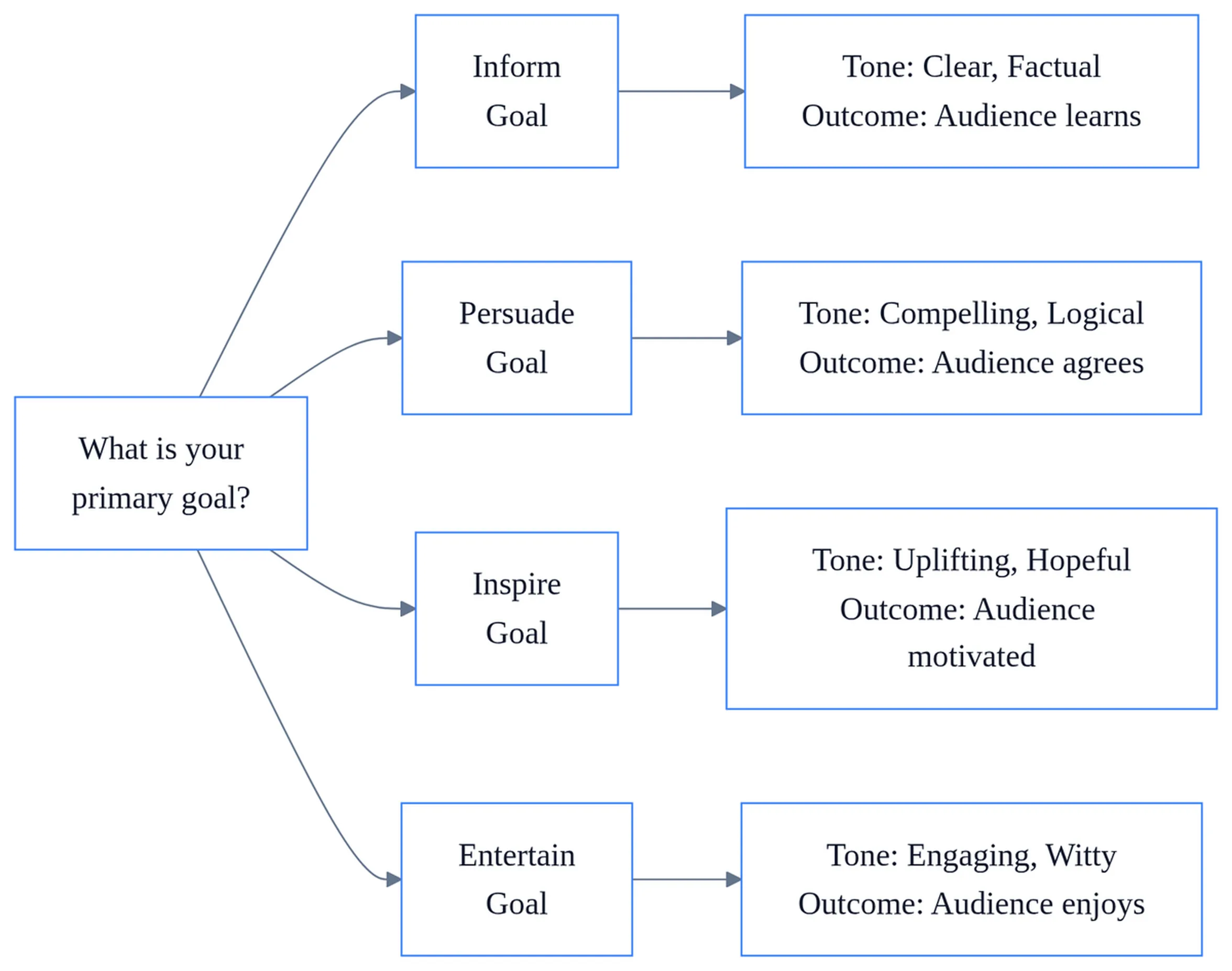
Speeches serve three primary functions in business communication: they inform teams about strategy shifts, persuade stakeholders to back a proposal, or inspire colleagues during organizational change. Each function demands clear messaging and intentional structure. Without preparation, even the smartest ideas get lost in rambling delivery or buried under competing points.
Poor preparation costs you more than audience attention. It erodes your credibility. A sales director who delivers a disorganized quarterly review signals to leadership that they lack strategic thinking. A product manager who can’t articulate a feature roadmap loses buy-in from engineering teams. Career progression often hinges on your ability to communicate ideas with confidence and precision.
Preparation also reduces the physical and mental toll of public speaking. When you’ve rehearsed your structure, tested your pacing, and anticipated questions, anxiety shifts from “What if I forget everything?” to manageable pre-performance energy. You won’t eliminate nervousness entirely, and you shouldn’t try. But a solid preparation process transforms fear into focus.
Advantages and disadvantages of speech
Before you prepare a speech, check that speaking is the right channel for the message. Speech has clear strengths and some real weaknesses.
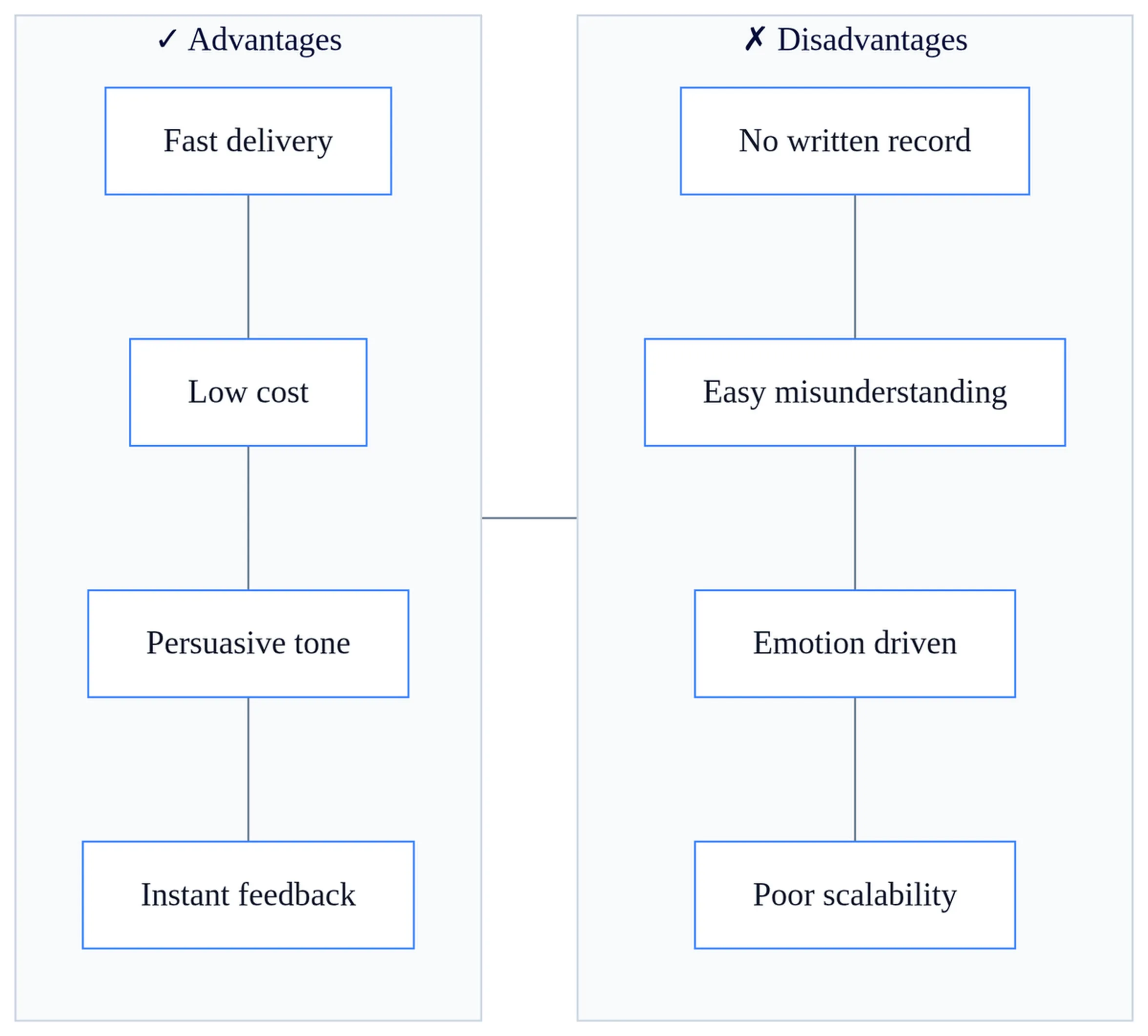
Advantages of speech
- Persuasive power: tone, facial expression and physical presence carry sincerity and emotion that a written memo cannot.
- Immediate feedback: you can see confused faces, hear questions and adjust your explanation on the spot.
- Speed: the whole group hears the same message at the same time, so action can start at once.
- Relationship building: speaking face to face signals respect and builds trust, especially when your body language matches your words.
Disadvantages of speech
- No permanent record: unless it is recorded, spoken content is open to denial, misquotation or dispute later.
- Misunderstanding risk: listeners cannot reread a confusing point, and a distracted listener simply misses it.
- Delivery dependency: a strong idea delivered poorly still fails, and many professionals struggle with fear of public speaking.
- Emotional distortion: visible anger, or cheerfulness at the wrong moment, can overshadow the message itself.
When to choose speech over written communication
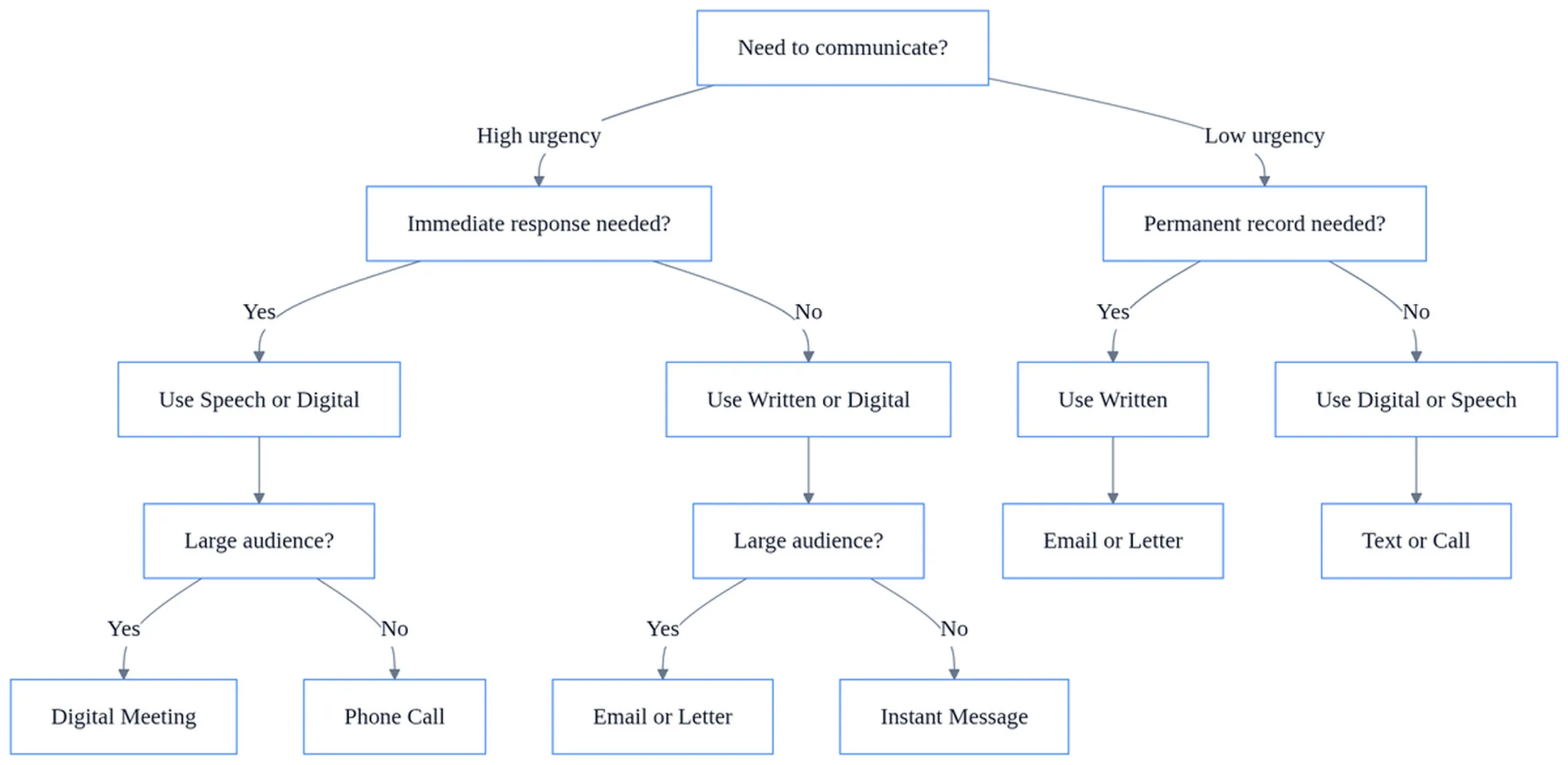
Use speech for urgent announcements that need immediate action, leadership messages that must build commitment, complex explanations that need dialogue, and conversations where tone and trust matter.
Avoid speech for legal agreements, detailed technical specifications, compliance records and policies that people will need to look up again. These belong in writing.
Combine both when the message matters. Announce it live so people can ask questions, then send a short written summary of the key decisions, action items and deadlines. Before moving on during the speech, ask someone to sum up a key point in their own words to check that it landed. If your audience is spread across time zones, record the speech and share it with the summary.
| Dimension | Speech | Written communication | Digital tools (email/chat) |
|---|---|---|---|
| Speed of delivery | Fastest for a group in one place | Slowest (composition time) | Moderate (quick but asynchronous) |
| Permanence | Weakest (unless recorded) | Strongest (archived document) | Moderate (searchable but editable) |
| Persuasive impact | Highest (emotion and presence) | Moderate (relies on writing skill) | Lowest (impersonal, fragmented) |
| Reach | Limited by place and time zone | Good (one-to-many distribution) | Widest |
| Feedback speed | Immediate | Slowest | Moderate |
A quick test: does the message need dialogue, emotional connection or immediate feedback? If yes, speak. If not, write it. For a fuller comparison, see oral vs. written communication.
Barriers to effective speech
Good preparation also means planning around the things that stop a speech from getting through:
- Physical barriers: background noise, a poor sound system or a room where people cannot see you.
- Language barriers: jargon or complex words the audience does not share.
- Psychological barriers: fear, nervousness or low confidence (see Step 8).
- Cultural barriers: examples, humour or gestures that mean something different to part of the audience.
- Poor organization: ideas with no clear order, which leave listeners unsure of the main point.
Step 1: define your speech purpose and core message
Before you open a blank document or sketch an outline, answer two questions: What do I want this speech to accomplish? And what is the one idea I need my audience to remember three days from now?
Your purpose falls into one of four categories: to inform (share data, explain a process), to persuade (change minds, secure approval), to entertain (build rapport, lighten mood), or to inspire (motivate action, shift perspective). A budget presentation to the finance committee is informational. A pitch to expand into a new market is persuasive. A keynote at a company retreat might be inspirational. Mixing purposes within a single speech confuses listeners and dilutes impact.
Once you’ve named your purpose, distill your message to a single core idea. Not three ideas. Not five takeaways. One sentence that captures what matters. For example: “Our customer retention rate will improve by 15% if we invest in post-sale support training.” Everything else in your speech exists to reinforce that core message.
Most speakers over-deliver. They pack speeches with every relevant fact, every supporting argument, every impressive credential. The result is cognitive overload. Your audience can’t process twelve competing ideas in twenty minutes. They’ll remember the story you told or the statistic that surprised them, but only if you give those elements room to breathe. Message discipline separates memorable speeches from forgettable ones.
Step 2: analyze your audience and occasion
Your speech isn’t about you. It’s about what your audience needs to hear, framed in language they understand, delivered at a pace that matches their familiarity with your topic. Audience analysis is not optional background research, it’s the foundation of every decision you’ll make during preparation.
Start with demographic and professional context. What is the age range? What industries or functions do they represent? How much prior knowledge do they have about your topic? A speech on digital transformation will sound completely different when delivered to a room of IT managers versus a board of directors with limited technical background. The IT managers need specifics: which platforms, what migration timeline, how you’ll handle legacy systems. The board needs business outcomes: cost savings, competitive advantage, risk mitigation.
Next, consider psychological factors. What are their expectations for this event? Are they required to attend, or did they choose to be there? What problems keep them awake at night, and how does your message address those concerns? A small business owner attending a Chamber of Commerce lunch wants actionable takeaways they can implement Monday morning. They don’t want theory or jargon.
Finally, assess the occasion itself. Is this a formal keynote or an informal team huddle? How much time do you have? What comes before and after your speech? If you’re the fourth speaker in a three-hour conference session, your audience is tired. You’ll need stronger hooks, shorter sentences, and more interactive elements to hold attention. Adapt your tone, pacing, and structure to fit the room’s energy and constraints.
Step 3: research and organize your content
With purpose and audience clear, gather the raw material for your speech. Collect data, case studies, anecdotes, and examples from credible sources. Look for stories that humanize abstract concepts. A statistic about employee turnover becomes memorable when paired with a brief story about one person’s experience navigating a poorly managed onboarding process.

Resist the urge to include everything you find.
Limit your body to three to five main points. Each point should directly support your core message. If a piece of information, no matter how interesting, doesn’t reinforce that central idea, cut it. Your job is not to demonstrate how much you know. Your job is to make one idea stick.
Structure your speech in three parts. The opening establishes credibility and hooks attention. You might open with a surprising statistic, a relevant question, or a brief story that illustrates the problem your speech will address. The body presents your main points with clear transitions between each. Use signposting language: “The first factor is…” or “This brings us to the second challenge…” The conclusion reminds the audience why your message matters and what they should do next. Avoid introducing new information in your conclusion. Instead, reinforce your core message and issue a specific call to action.
Aim for twenty to twenty-five minutes of speaking time for a standard business presentation. Longer than that, and attention drops sharply unless you’re an exceptionally skilled speaker or your content is extraordinarily compelling. Use a timer during your drafting process to estimate length. As a rough guide, a double-spaced page of text takes about two minutes to deliver at a conversational pace.
Step 4: write, then speak, then rewrite
Here’s where most speakers get the process backwards. They think, then write, then speak. But speeches are not essays. They’re conversations. And conversations sound different on the page than they do in your head.
Try this instead: think through your main points, then speak them aloud before you write anything down. Record yourself on your phone or just talk to an empty room. Listen to how the ideas sound. You’ll immediately catch awkward phrasing, unclear explanations, and sentences that are too long or too formal. Speaking ideas aloud reveals tone problems that silent reading never catches.
Once you’ve tested your ideas vocally, write your draft. Then read it aloud again. Multiple times. Does it sound like something a real person would say to another real person? Or does it sound like a corporate memo being read at a podium? If you stumble over a sentence while reading aloud, your audience will stumble over it too. Simplify. Shorten. Remove jargon unless your audience uses that jargon daily.
Treat your speech as a conversation with the audience, not a document to be performed. This doesn’t mean you should wing it or avoid preparation. It means your preparation should produce something that sounds natural and human when spoken. Professional speakers often describe this as “writing for the ear, not the eye.” The US Chamber Foundation shows this principle in their speech-writing framework, noting that even data-heavy presentations benefit from conversational phrasing.
Step 5: choose your delivery method
You have four options for how you’ll deliver your speech. Each comes with trade-offs between flexibility, safety, and authenticity. Choose the method that matches your comfort level, the stakes of the occasion, and your audience’s expectations.
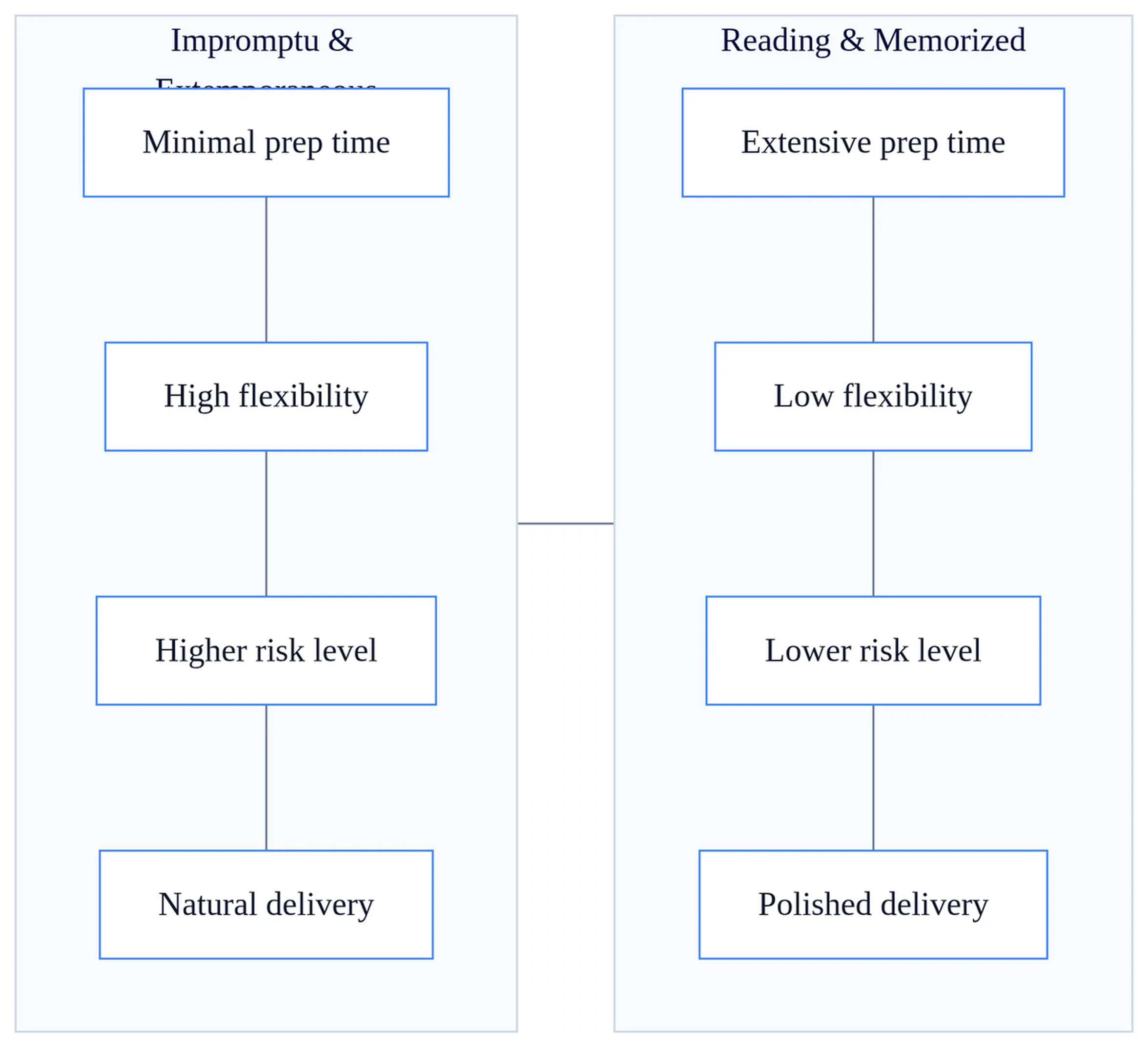
| Delivery Method | Preparation Required | Flexibility | Best Used When | Risk Level |
|---|---|---|---|---|
| Impromptu | None | High | Informal remarks, unexpected requests, low-stakes situations | High (easy to ramble or lose focus) |
| Extemporaneous | Outline + note cards | High | Most business presentations, team meetings, pitches | Low (recommended for most scenarios) |
| Reading from script | Full manuscript | Low | Legal statements, policy announcements, word-perfect accuracy required | Medium (sounds robotic if not practiced) |
| Memorized | Full memorization | Very low | Trained speakers, theatrical performance, very short speeches | High (risk of blanking, sounds rehearsed) |
Extemporaneous delivery offers the best balance for most business contexts. You prepare thoroughly, create a detailed outline with key points and transitions, and use note cards or slides as prompts. This method lets you adapt to audience reactions, adjust pacing if you’re running short on time, and maintain eye contact instead of reading. You sound prepared but not scripted.
Avoid memorization unless you’re a trained performer. Memorized speeches often sound mechanical, and if you lose your place mid-speech, recovery is difficult. Reading from a script is safer but distances you from the audience. Use it only when exact wording matters, for example, when announcing a policy change that could have legal implications.
Step 6: rehearse using mirror, timer, and peer feedback
Rehearsal is not optional. It’s the single most effective way to build confidence, refine pacing, and identify problems before you’re standing in front of a live audience. But not all rehearsal is equally useful. Use a three-part system: mirror practice, timed runs, and peer feedback.
Mirror practice lets you observe your own non-verbal communication and body language. Stand in front of a full-length mirror and deliver your speech. Watch your facial expressions. Are you making eye contact with your reflection, or staring at the floor? Do you have nervous habits, touching your face, shifting weight, fidgeting with note cards? Awareness is the first step toward control. You don’t need to eliminate all movement, but you do need to know what your body is doing while you speak.
Timed rehearsal reveals pacing issues. Set a timer and deliver your speech at full speed. If you’re consistently running over your allotted time, you need to cut content, not speed up your delivery. Speaking too quickly makes you harder to understand and signals nervousness. If you finish early, you can either expand key points or build in pauses for emphasis. Silence feels much longer to you than it does to your audience. A three-second pause after a major point gives listeners time to absorb what you’ve said.
Peer feedback provides an external perspective. Rehearse in front of a trusted colleague or friend. Ask specific questions: Which points were unclear? Where did you lose interest? Did I make eye contact? Was my pacing too fast or too slow? General feedback (“It was good!”) doesn’t help. You need honest, specific input. If possible, rehearse in the actual venue where you’ll deliver the speech. Walk the room. Test the microphone. Identify any physical obstacles, a podium that’s too tall, a projector screen that blocks sightlines, acoustics that swallow your voice.
Repeat this process three to five times. The first rehearsal will feel awkward. The second will reveal structural problems. By the third, you’ll start to feel comfortable with the flow. By the fifth, you’ll have internalized your key points and transitions, freeing you to focus on delivery rather than content recall. Toastmasters recommends this layered rehearsal approach as a core component of speech preparation, particularly for speakers new to public speaking.
Step 7: prepare visual aids that reinforce, not distract
Visual aids, slides, charts, props, handouts, can strengthen your message when used strategically. They can also undermine your speech if they become the focus instead of supporting your words. The rule is simple: visuals should reinforce key points, not replace your speaking or decorate the room.
Keep slides minimal. One idea per slide. Large text. High contrast. Few words. If your slide contains three paragraphs of text, you’re creating a document, not a visual aid. Your audience will read the slide instead of listening to you. Use images, charts, or single data points that illustrate what you’re saying. For example, if you’re discussing quarterly revenue growth, show a simple bar chart with one highlighted data point. Speak to the audience about what that growth means, don’t read the numbers on the screen.
Avoid reading slides aloud. Your audience can read faster than you can speak. If you’re simply narrating what’s on the screen, you’re wasting their time and yours. Instead, use slides as a visual anchor while you provide context, interpretation, or a story that brings the data to life.
Test all technical setup before the event. Arrive early. Connect your laptop to the projector. Advance through your slides to confirm they display correctly. Test audio if you’re showing a video. Have a backup plan. Bring printed handouts in case the projector fails. Know how to describe your key visuals verbally if the technology doesn’t cooperate. A small tech failure won’t derail your speech if you’ve prepared for contingencies.
Finally, know when not to use visual aids. A ten-person strategy discussion around a conference table doesn’t need slides. A heartfelt motivational speech to your team after a tough quarter might be more powerful without any visual distractions. Slides are tools, not requirements. Use them when they add clarity or emphasis. Skip them when your words and presence are enough.
Step 8: manage nervousness and deliver with authenticity
Even experienced speakers feel nervous before a presentation. The goal is not to eliminate anxiety, it’s to channel it into focused energy and prevent it from derailing your delivery. Preparation is your best defense. When you’ve rehearsed thoroughly, tested your pacing, and anticipated likely questions, nervousness becomes manageable background noise rather than a paralyzing force.
Arrive early to settle into the space. Walk the room. Stand at the podium or speaking position. Familiarize yourself with sightlines, lighting, and acoustics. This physical grounding reduces the shock of stepping into an unfamiliar environment. If you’re speaking virtually, test your camera angle, lighting, and microphone well before the session starts. Close unnecessary browser tabs and silence notifications.
When you begin speaking, slow down. Nervousness accelerates your internal clock, making you feel like you’re speaking at a normal pace when you’re actually rushing. Speak more slowly than feels natural. Pause between major points. Silence gives your audience time to process information and gives you time to breathe. What feels like an awkward, endless pause to you registers as a brief, thoughtful moment to your listeners.
Make eye contact with different audience members throughout your speech. Don’t stare at one person or scan the room mechanically. Pick a friendly face, hold eye contact for a full sentence, then move to another person. This builds rapport and keeps you present. If you’re speaking to a large audience, divide the room into sections and address each section periodically.
Use natural gestures and movement. Avoid pacing, which signals anxiety. Avoid standing rigidly, which makes you look uncomfortable. Find a neutral stance, feet shoulder-width apart, weight balanced, hands relaxed at your sides or holding note cards, and move purposefully when you want to highlight a point or transition between ideas. Your body language should support your message, not distract from it. For more strategies on managing severe presentation anxiety, see our guide on fear of public speaking.
Authenticity matters more than polish. Your audience doesn’t expect perfection. They expect honesty, clarity, and respect for their time. If you stumble over a word, correct yourself and move on. If you lose your place, pause, check your notes, and resume. A small mistake humanizes you. What damages credibility is pretending the mistake didn’t happen or apologizing excessively. Acknowledge, adjust, continue.
Most speakers worry too much about how they look and not enough about whether their message is landing. If you’re sitting on the fence about whether to rehearse one more time or whether your opening story is too personal, the answer is usually yes, rehearse again, and no, the story isn’t too personal if it connects to your core message. Focus on whether your listeners understand your message, find it relevant, and know what to do next. This shift in perspective, from “How do I look?” to “Are they getting what they need?”, reduces self-consciousness and improves delivery. Developing strong oral communication skills takes practice, but each speech you prepare and deliver builds competence and confidence for the next.
After your speech, stay available for questions. Active listening and audience engagement don’t end when you finish your conclusion. Questions reveal what resonated, what confused people, and what they care about most. Treat Q&A as an extension of your speech, not an interrogation. If you don’t know an answer, say so and offer to follow up. Honesty builds trust. Bluffing destroys it.
Preparing an effective speech is about doing the work: clarifying your message, understanding your audience, structuring your content, rehearsing your delivery, and managing the inevitable nervousness that comes with public speaking. Each of these eight steps builds on the previous one. Skip a step, and you’ll feel it during delivery. Follow the process, and you’ll walk into the room ready to communicate with clarity and purpose.
Frequently asked questions
What if my audience has mixed knowledge levels about the topic?
Pitch your content to the middle ground. Assume some listeners know basics but others don’t. Use concrete examples and define jargon the first time you use it. Avoid oversimplifying for experts or overwhelming novices. You can briefly acknowledge different experience levels in your opening: ‘Some of you work with this daily; others are new to it. I’ll cover fundamentals and advanced applications.’
Should I memorize my speech word-for-word or use notes?
Memorizing word-for-word often backfires—you sound robotic and panic if you forget a line. Instead, memorize your core message, main points, and key stories. Use note cards with bullet points and transitions. This approach lets you maintain eye contact, adapt to audience reactions, and recover naturally if you lose your place.
How do I handle nervousness right before delivering?
Nervousness is normal and signals you care about performing well. Channel that energy into focus rather than fighting it. Practice deep breathing, arrive early to test equipment, and review your opening lines. Remind yourself you’ve prepared thoroughly. Physical movement—walking, stretching—helps burn off excess adrenaline before you step to the podium.
What if I finish my speech early or run over time?
Build flexibility into your preparation. Identify stories or examples you can cut if running long, and prepare one or two additional points you can add if you finish early. During delivery, adjust your pacing and pause length based on how much time remains. Always respect the audience’s schedule—running over damages credibility more than finishing slightly early.
Is it better to use slides, or will they distract from my message?
Slides are tools, not crutches. Use them only if they clarify your message—showing data trends, displaying images, or breaking up long sections. Avoid slides packed with text that duplicate what you’re saying. If slides aren’t essential, skip them. A strong speaker with a focused message needs minimal visual support.
How many times should I rehearse before delivering?
Rehearse at least three to five times. First run-through: speak aloud to catch awkward phrasing and timing issues. Middle rehearsals: refine pacing and transitions. Final rehearsals: practice in front of someone or record yourself to identify filler words and body language habits. Stop rehearsing once you feel confident in your structure, not when you’ve memorized every word.
Should I record a speech if I can’t gather everyone in person?
A recording works for passing on information, but it loses the immediate feedback that makes live speech powerful. If your goal is persuasion, relationship-building or handling complex questions, a live video call is better than a recording. For simple announcements or training content, a recording is fine and lets people rewatch parts they missed.
Is it better to speak or email when delivering negative feedback to an employee?
Speak first. A direct conversation shows respect, lets you gauge the person’s reaction and gives them a chance to respond. Then follow up with a written summary of what was discussed and the next steps, so there is a clear record.
1 Comment
I agree, preparation is key to delivering effective speech. Particularly love your advice to analyze the audience so you can speak directly to them. Thanks for this post!