


Business communication is the structured exchange of information, ideas, and messages related to organizational activities among internal and external stakeholders. In this guide, you’ll learn what distinguishes business communication from general conversation, why it drives measurable organizational outcomes, and how it functions in today’s hybrid workplaces.
What is business communication? A foundational definition
Business communication is the purposeful exchange of business-related information among parties involved in organizational activities: employees, managers, customers, suppliers, investors, regulators, and the general public. Unlike casual conversation, business communication is goal-oriented. It aims to align stakeholders, coordinate action, solve problems, and advance organizational objectives.
What separates business communication from general communication? The exchange occurs within or on behalf of a business entity, not between individuals acting in purely personal capacities. Messages typically flow through formal or semi-formal channels (email, meetings, reports, presentations, policy documents) rather than spontaneous social interaction. And business communication seeks specific outcomes: a decision made, a task completed, a relationship strengthened, a transaction concluded.
Think of business communication as the hidden operating system of your organization. Just as an operating system coordinates hardware and software to execute tasks, business communication coordinates people, processes, and resources to achieve strategic goals. When it runs smoothly, work flows. When it breaks down, projects stall, teams fragment, and customers disengage.
Why business communication matters: Strategic importance and ROI
Business communication is not a soft skill. It’s a hard driver of organizational performance, backed by quantifiable return on investment.
According to a ZipRecruiter/Wonderlic survey, 93% of employers say soft skills like communication play a critical role in hiring decisions (source). That preference reflects real-world economics: poor communication costs money, and effective communication generates measurable gains.
Organizations with connected employees (those who receive timely, relevant information and can share feedback) report a 25% productivity increase. Leadership satisfaction with communication systems correlates with a 64% boost in engagement scores. On the flip side, miscommunication costs the average company $12,506 per employee annually. For a 100-person organization, that’s $420,000 in lost productivity, duplicated effort, and errors.
Employee retention offers another lens. Communication gaps contribute directly to turnover. Replacing a single C-suite executive can cost up to 213% of their annual salary. Mid-level managers and specialists aren’t cheap to replace either, with typical costs ranging from 50% to 150% of salary when you factor in recruiting, onboarding, and productivity ramp-up time.
Beyond individual metrics, effective business communication reduces organizational silos. When departments share information transparently and leadership communicates strategy consistently, teams align their work toward common goals rather than optimizing for local priorities that may conflict.
Internal vs. external business communication
Business communication splits into two broad domains: internal and external.
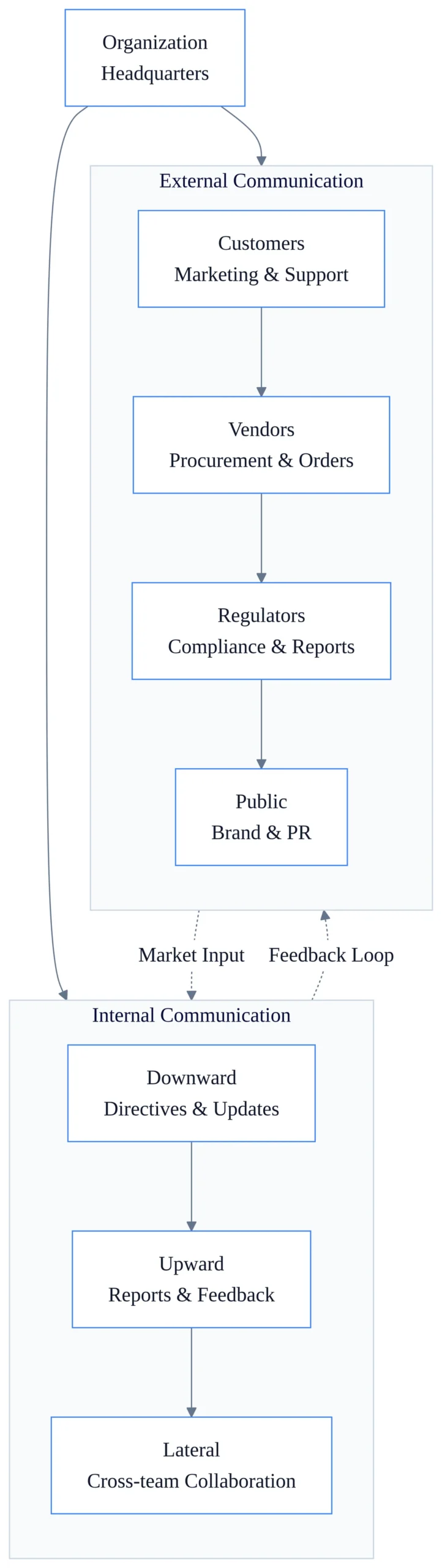
Internal communication refers to information exchange among employees, managers, and leadership within the organization. It includes status updates, policy announcements, feedback sessions, strategic planning discussions, and cross-departmental collaboration. Internal communication drives alignment, builds culture, and ensures that everyone understands priorities and expectations. Internal communication methods range from team meetings and email to intranet portals and instant messaging platforms.
External communication encompasses all messaging directed outside the organization: to customers, vendors, suppliers, investors, regulators, media, and the general public. It includes marketing campaigns, sales conversations, customer support interactions, investor relations updates, regulatory filings, and public relations statements. External communication builds reputation, strengthens relationships, and positions the organization in its competitive and regulatory environment.
The strategic difference? Internal communication optimizes for alignment; external communication optimizes for perception and relationship capital. Both require distinct skills, channels, and governance structures.
Transactional vs. transformational communication
Not all business communication serves the same purpose. A useful distinction separates transactional from transformational communication.
Transactional communication is task-focused. Its goal is to convey instructions, confirm details, or report status. Examples include project timelines, policy updates, meeting agendas, expense approvals, and technical specifications. Transactional communication values clarity, brevity, and speed. It’s the workhorse of daily operations.
Transformational communication is relationship-focused. It aims to shift attitudes, inspire action, or strengthen culture. Examples include vision statements, performance feedback, mentoring conversations, change management messaging, and recognition programs. Transformational communication values empathy, storytelling, and emotional resonance.
Both types matter. An organization that relies solely on transactional communication becomes mechanical, efficient but disengaged. One that over-indexes on transformational communication without clear operational directives becomes inspirational but ineffective. The best communicators toggle between modes based on context: a crisis demands transactional precision, while long-term employee development requires transformational depth.
Key communication directions and channels
Business communication flows in multiple directions, each serving distinct functions within organizational communication structures.
Upward communication carries employee feedback, suggestions, concerns, and reports from staff to leadership. Suggestion boxes, skip-level meetings, and anonymous surveys are classic upward channels. Vertical communication includes both upward and downward flows, creating a feedback loop between hierarchical levels.
Downward communication delivers directives, policies, strategic information, and performance expectations from leadership to staff. Town halls, policy memos, and performance reviews exemplify downward channels. Effective downward communication reduces ambiguity and aligns teams with organizational priorities.
Lateral or horizontal communication enables peer-to-peer collaboration and cross-departmental coordination. Horizontal communication breaks down silos, allowing marketing to coordinate with sales, engineering to align with product management, and finance to collaborate with operations without routing every decision through executive layers.
These flows rely on diverse channels spanning verbal and non-verbal communication. Verbal channels include face-to-face meetings, phone calls, video conferences, and presentations. Written channels include email, memos, reports, and instant messages. Visual channels include dashboards, infographics, and slide decks. Non-verbal channels (body language, tone, facial expressions) add context, especially in synchronous interactions.
The communication process: Elements and feedback loops
Effective business communication follows a structured process, even when it feels spontaneous.
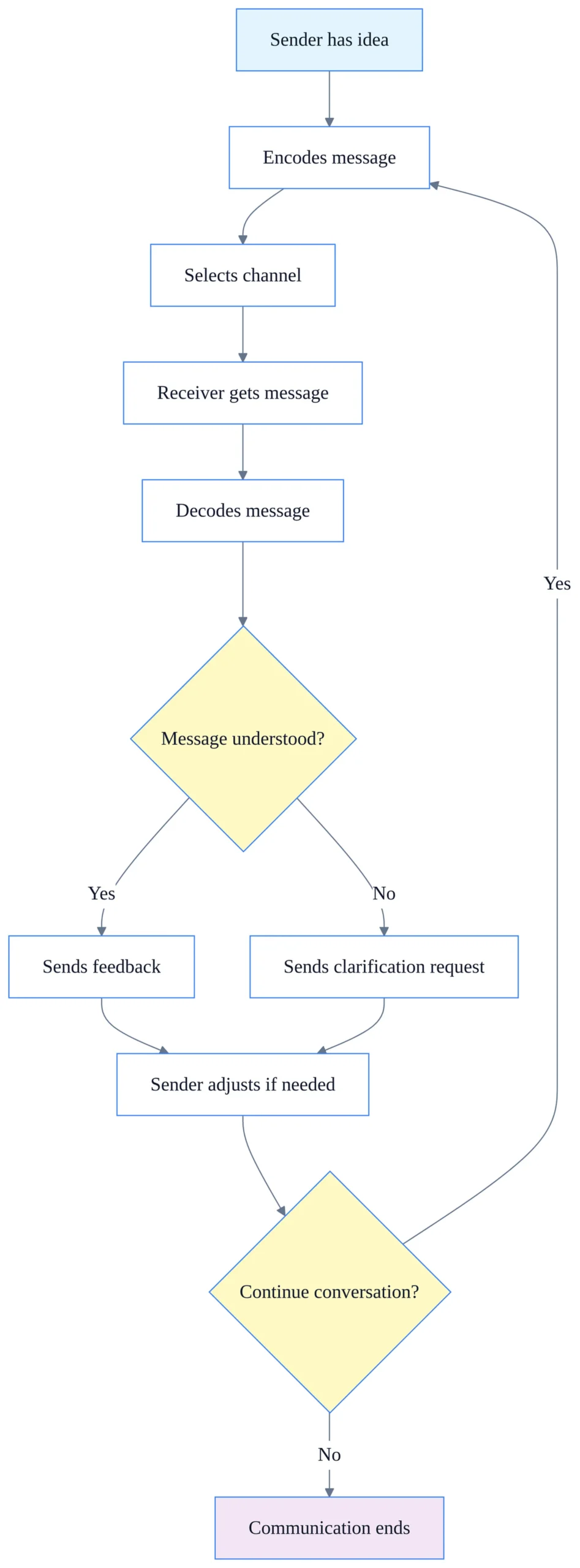
The sender encodes a message with clear business intent, selecting words, tone, and format to match the audience and objective. A project manager announcing a deadline shift chooses different language for the executive sponsor (strategic rationale) than for the development team (technical implications).
The receiver decodes the message, interpreting meaning based on their context, prior knowledge, and relationship with the sender. Decoding is inherently subjective. The same email can be read as urgent by one recipient and routine by another, depending on their workload and priorities.
Feedback closes the loop.
The receiver’s response (a confirmation email, a follow-up question, a completed task) signals whether the message was understood and acted upon. Two-way communication is essential. One-way broadcasts risk misunderstanding and disengagement because the sender never learns if the message landed.
Real-world communication is messy. Communication barriers (noise, assumptions, jargon, channel limitations, cultural differences) distort meaning at every stage. The sender may encode poorly, the channel may introduce static (a dropped video call), or the receiver may decode through the lens of outdated information. Feedback helps detect and correct these distortions before they compound. Most teams underestimate how much context gets lost in translation, especially when moving from synchronous to asynchronous channels. If you’re sitting on the fence about whether to follow up on a message, the answer is usually yes.
Business communication in remote and hybrid workplaces
The shift from co-located to distributed teams has fundamentally reshaped business communication. Remote and hybrid workplaces demand new channel strategies and communication norms.
Synchronous communication (video calls, instant messaging, live collaboration sessions) enables real-time problem-solving but requires schedule coordination across time zones. Asynchronous communication (email, recorded updates, shared documents) offers flexibility but risks delays and misalignment when decisions need rapid iteration.
Remote communication introduces specific challenges. Non-verbal cues diminish on video calls, making it harder to read reactions or detect confusion. Time zone differences complicate scheduling, forcing teams to choose between inconvenient meeting times and excluding key stakeholders. Tool overload (juggling email, Slack, Microsoft Teams, Zoom, project management platforms) fragments attention and buries important messages in notification noise.
Best practices for remote communication include intentional channel selection: use video for complex or sensitive topics where tone and reaction matter, async updates for routine status reports, and documentation for decisions that need a permanent record. Establish clear norms around response time expectations, meeting-free blocks, and channel purposes (email for formal records, chat for quick questions). Build regular feedback loops through standups, retrospectives, and pulse surveys so misunderstandings surface before they escalate.
Emerging technologies (AI-assisted writing tools, voice assistants, automated status updates) streamline routine communication tasks. But the personal touch remains irreplaceable for relationship-building. A handwritten thank-you note or a spontaneous video message carries weight that no algorithm can replicate.
Common business communication problems and solutions
Most organizations struggle with predictable communication breakdowns. Recognizing these patterns helps you design targeted solutions.
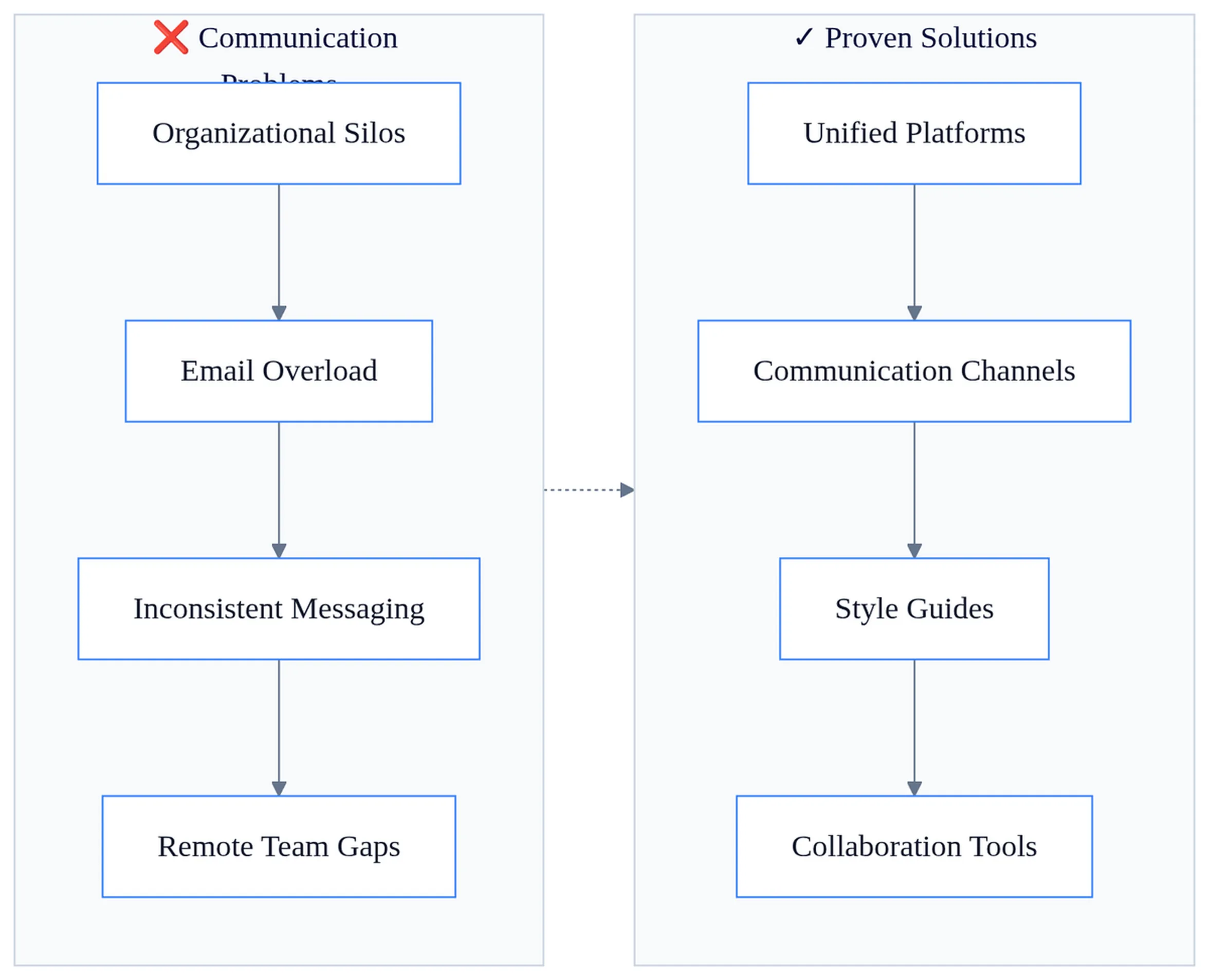
| Problem | Symptom | Solution |
|---|---|---|
| Communication silos | Departments operate in isolation; duplicate work; conflicting priorities | Create lateral communication forums (cross-functional standups, shared knowledge bases); rotate team members across projects |
| Email overload | 120-150 emails per day; important messages buried; decision paralysis | Establish channel norms (email for formal records, chat for quick questions); implement meeting discipline (agenda required, decisions documented) |
| Inconsistent messaging | Conflicting information across channels; employees confused about priorities | Centralize communication calendars; develop style guides; ensure leadership alignment before announcements |
| Remote collaboration gaps | Asynchronous teams struggle with real-time problem-solving; decisions lack context | Use structured standups; record decision rationale in shared docs; adopt async-first documentation practices |
Consider a small Dhaka-based digital agency that grew from 15 to 50 employees in eighteen months. Initially, the founders communicated strategy through informal hallway conversations. As the team expanded and added remote contractors, critical information stopped flowing. Project managers made conflicting commitments to clients because they didn’t know what other teams had promised. The solution? A weekly all-hands meeting (synchronous alignment), a shared project dashboard (asynchronous visibility), and a communication charter defining which channels to use for which purposes. Revenue per employee increased 18% within six months as duplicated effort and client confusion declined.
Measuring and improving business communication effectiveness
What gets measured gets managed. To improve business communication, track leading and lagging indicators.
Metrics include employee engagement scores (quarterly pulse surveys), internal survey feedback on information accessibility, message comprehension testing (ask recipients to paraphrase key announcements), retention rates (communication gaps correlate with turnover), and productivity benchmarks (cycle time, rework rates).
Improvement strategies span multiple levers. Communication training equips employees with specific skills: writing clear emails, facilitating meetings, delivering presentations, giving feedback. Channel optimization ensures the right medium for each message type. Leadership modeling demonstrates desired behaviors; when executives respond promptly, share transparently, and invite dissent, those norms cascade. Feedback mechanisms (suggestion boxes, skip-level meetings, anonymous surveys) surface problems before they metastasize. A transparent culture, where information defaults to open rather than restricted, reduces rumors and builds trust.
For a deeper dive into the qualities that make communication truly effective communication, explore principles like clarity, conciseness, and audience awareness that apply across all channels and contexts.
Treat communication as an organizational capability to develop continuously, not a one-time initiative. The types of business communication you need will evolve as your organization grows, your workforce disperses, and your technology stack changes. Regular iteration (testing new channels, gathering feedback, adjusting norms) keeps your communication system aligned with your operational reality. When you invest in those pathways through clear processes, appropriate tools, and a culture that values transparency, you build an organization that adapts faster, executes better, and retains talent longer than competitors who treat communication as an afterthought.
Frequently asked questions
If I need to communicate the same message internally and externally, should I use different versions?
Yes. Internal communication optimizes for alignment and transparency; external communication optimizes for perception and relationship capital. A product delay, for example, requires honest operational detail for employees but a carefully framed message about timeline adjustments for customers. The core facts stay consistent, but tone, emphasis, and level of detail shift based on audience and strategic intent.
How do I know when to use transactional versus transformational communication?
Use transactional communication for task execution: project timelines, policy updates, expense approvals. Use transformational communication for culture-building and attitude shifts: vision statements, performance feedback, change announcements. In practice, high-stakes messages often need both—clear operational directives wrapped in context that connects to organizational values and employee growth.
What’s the biggest mistake teams make when communication breaks down?
Treating communication as a one-time event rather than a system. A single announcement doesn’t create alignment. Effective business communication requires consistent channels, feedback loops, and reinforcement. Teams that check the box with one email but lack follow-up meetings or two-way dialogue often see the same misalignment resurface within weeks.
Can poor communication really cost my organization $420,000 annually?
For a 100-person organization, yes. The average company loses $12,506 per employee annually to miscommunication through duplicated effort, errors, and rework. That compounds across payroll. The cost isn’t speculative—it shows up as missed deadlines, repeated meetings, and turnover. Investing in communication systems typically pays for itself within months.
Should internal communication be as formal as external communication?
No. Internal communication can be less formal while remaining professional and clear. Employees often respond better to conversational tone and accessible language in emails, meetings, and announcements. External communication typically requires more polish and formality to protect brand reputation. The key is matching formality to audience and purpose, not defaulting to the same standard for both.
1 Comment
wow…. beautiful your post.