


Intrapersonal communication happens inside your own mind, thinking, evaluating, and processing information before you respond. Interpersonal communication occurs between two or more people, exchanging ideas and building relationships. Understanding how these two types work together will improve your workplace effectiveness, decision-making, and self-awareness.
What is intrapersonal communication?
Intrapersonal communication is the internal dialogue you conduct with yourself. It’s the process of sensing, thinking, evaluating, and interpreting events within your own mind. Every time you receive information through your senses, what you see, hear, or feel, you engage in intrapersonal communication before deciding how to respond.
Your self-concept sits at the foundation of this process. How you see yourself, shaped by past experiences and beliefs, determines how you interpret external stimuli. When your manager sends a terse email, your internal processing might range from “They’re upset with me” to “They’re probably just busy.” That interpretation happens entirely within your mind, yet it dictates your next move.
Consider a sales representative preparing for a client pitch. Before entering the room, she runs through potential objections, rehearses her opening statement, and manages her anxiety about the stakes. All of this is intrapersonal communication. She’s processing information, evaluating options, and regulating her emotional state, none of it visible to anyone else.
This type of communication matters because it precedes every external response you make. According to the American Psychological Association, self-awareness, a product of strong intrapersonal communication, correlates with better decision-making and emotional regulation. When you improve how you talk to yourself, you improve how you talk to others.
The challenge is that intrapersonal communication often operates on autopilot. You might not notice the negative self-talk loop running in the background or recognize how cognitive biases shape your perception. Two people can witness the same event and respond completely differently because their internal processing differs.
What is interpersonal communication?
Interpersonal communication is the exchange of information between two or more people. Unlike the internal nature of intrapersonal communication, this type is external and observable. It happens face-to-face, over the phone, through video calls, or via written channels like email and messaging apps.
The defining characteristic of interpersonal communication is mutual influence. Meaning isn’t delivered from one person to another like a package; it’s co-created through interaction. When you explain a project deadline to your team, their questions, body language, and responses shape how you clarify and adjust your message in real time.
This communication type serves multiple purposes in business contexts. You use it to establish relationships with colleagues, coordinate decisions across departments, resolve conflicts, and build trust with clients. A procurement manager negotiating with a vendor, a HR professional conducting an exit interview, and a project lead running a stand-up meeting are all engaging in interpersonal communication.
The communication process and components, sender, receiver, message, channel, feedback, and noise, all come into play here. Both parties continuously switch between sending and receiving roles, creating a dynamic feedback loop that doesn’t exist in intrapersonal communication.
Interpersonal communication relies on both verbal and nonverbal communication. The words you choose matter, but so do your tone, facial expressions, posture, and timing. In remote work settings, where nonverbal cues are limited or absent, the burden shifts heavily to verbal clarity and intentional word choice.
Key differences at a glance
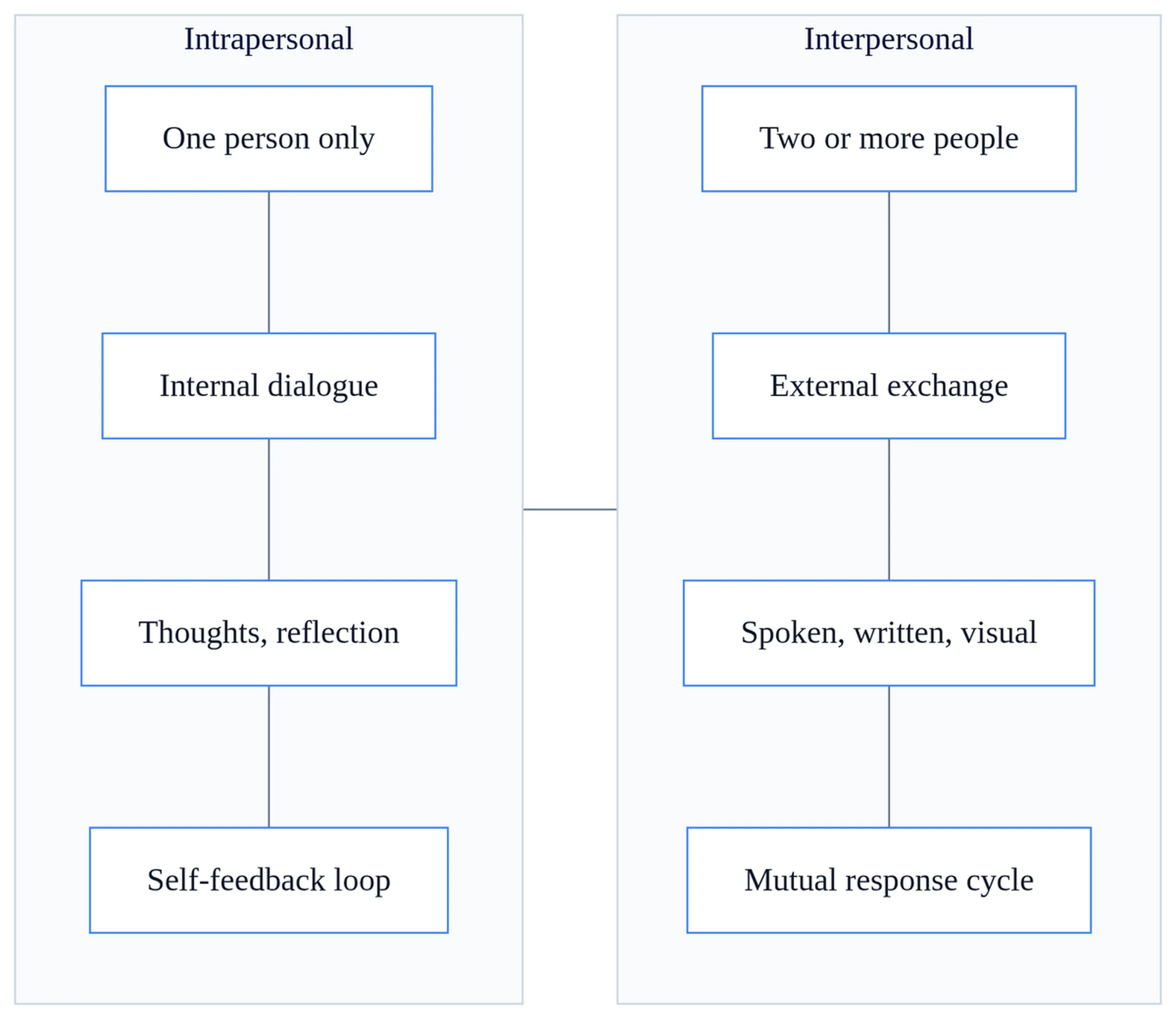
While both communication types are essential, they operate differently across several dimensions. The table below breaks down the core distinctions:
| Dimension | Intrapersonal Communication | Interpersonal Communication |
|---|---|---|
| Participants | One person (communicator only) | Two or more people |
| Nature | Internal, invisible, private | External, observable, social |
| Media required | None, happens entirely in the mind | Verbal, nonverbal, or digital channels |
| Information flow | Stays within one mind | Moves from one mind to another |
| Feedback source | Self-generated reflection | Response from other participants |
| Visibility | Hidden unless externalized | Visible and contextual |
These differences matter in practice. Intrapersonal communication requires no medium, so it can happen continuously and instantly. You process thousands of internal messages daily without conscious effort. Interpersonal communication, by contrast, requires a shared channel and active participation from others, making it more resource-intensive and contextually dependent.
The visibility distinction is particularly important in professional settings. Your internal doubts about a proposal remain invisible until you voice them in a meeting. Once externalized, they become interpersonal communication subject to interpretation, feedback, and organizational consequences.
How self-concept bridges intrapersonal and interpersonal communication
Self-concept, your perception of who you are, acts as the bridge connecting these two communication types. It’s shaped by intrapersonal reflection but constantly updated by interpersonal feedback. This creates a continuous loop that most people never consciously examine.

Here’s how it works in practice. Imagine a junior analyst presenting quarterly results to senior leadership. During the presentation (interpersonal), she notices an executive checking his phone and another frowning at a slide. Immediately, her intrapersonal processing kicks in: “They’re not interested. I’m losing them. Maybe I’m not ready for this level.”
That internal interpretation, accurate or not, updates her self-concept. If she concludes “I’m bad at presentations,” that belief will influence her next interpersonal interaction. She might speak more hesitantly, avoid eye contact, or decline future presentation opportunities. The interpersonal moment triggered intrapersonal processing, which then shaped her self-concept, which will affect future interpersonal communication.
The feedback loop runs both directions. Positive interpersonal experiences strengthen your self-concept, which improves your confidence in future interactions. A manager who receives genuine thanks from a team member processes that feedback internally, reinforcing the belief “I’m effective at supporting my team.” This strengthened self-concept makes her more likely to offer support again.
The risk emerges when negative self-talk or distorted self-perception dominates your intrapersonal communication. If you consistently interpret neutral feedback as criticism, your self-concept erodes, undermining your interpersonal effectiveness. You might become defensive, withdraw from collaboration, or over-explain simple points, all interpersonal behaviors rooted in intrapersonal distortion.
Improving self-awareness through deliberate intrapersonal reflection directly strengthens interpersonal confidence. When you can accurately identify your emotions, recognize your biases, and separate interpretation from fact, you respond more effectively to others.
Barriers and challenges in each type
Each communication type faces distinct obstacles. Intrapersonal barriers include cognitive distortions, negative self-talk, confirmation bias, anxiety, and limited self-awareness. You might catastrophize a minor mistake, replay conversations obsessively, or convince yourself you’re inadequate based on selective evidence. These internal barriers operate below conscious awareness, making them difficult to identify and address.
Overthinking is a common intrapersonal trap in business contexts. A project manager might spend hours internally debating whether to escalate a risk, cycling through worst-case scenarios and second-guessing her judgment. This excessive intrapersonal processing can delay action and erode confidence.
Interpersonal barriers operate differently. Cultural differences, communication style mismatches, assumptions about intent, poor listening habits, and emotional triggers all interfere with exchange between people. When a German engineer communicates with a Bangladeshi marketing manager, different norms around directness, hierarchy, and time orientation can create friction neither party recognizes.
Many barriers to effective communication stem from the interaction between intrapersonal and interpersonal challenges. Your internal anxiety about conflict (intrapersonal) might cause you to avoid necessary confrontation (interpersonal), which then reinforces your anxiety when problems fester. If you’re wondering why a communication breakdown happened, look at both levels, not just the words exchanged.
Mitigation strategies must target the appropriate level. For intrapersonal barriers, practices like mindfulness meditation, journaling, cognitive reframing, and self-reflection exercises help you observe and adjust your internal dialogue. For interpersonal barriers, developing empathy, clarifying intent explicitly, and practicing active listening skills improve your ability to connect with others despite differences.
Practical applications in the workplace
Understanding both communication types transforms how you approach everyday workplace situations. Consider a manager preparing to deliver critical feedback to an underperforming employee. The process involves multiple communication layers:

First, the manager engages in intrapersonal planning: reviewing the employee’s performance data, managing her own frustration, choosing specific examples, and anticipating the employee’s reaction. She might rehearse phrasing mentally, reminding herself to focus on behaviors rather than character. Next comes the interpersonal delivery: sitting down with the employee, explaining concerns clearly, reading body language, adjusting tone based on the employee’s response, and answering questions. The employee’s facial expressions and verbal reactions provide real-time feedback that shapes how the manager continues the conversation. Then the employee processes the feedback intrapersonally: interpreting the manager’s intent, evaluating the criticism against his self-concept, managing emotional reactions, and deciding how to respond. His internal processing might range from “She’s right, I need to improve” to “This is unfair, she has unrealistic expectations.” Finally, the employee responds interpersonally: asking clarifying questions, expressing his perspective, or committing to specific changes. This response triggers new intrapersonal processing in the manager, continuing the cycle.
Remote work contexts amplify the importance of both communication types. When nonverbal cues are limited in video calls or absent in written messages, intrapersonal communication becomes more critical. You must be clearer about your intent internally before externalizing it, because recipients have fewer contextual clues to interpret your meaning.
A Dhaka-based software team coordinating with US clients via Slack faces this challenge daily. Written interpersonal communication requires stronger intrapersonal clarity, knowing exactly what you mean before typing, because there’s no tone of voice or facial expression to soften ambiguity or signal humor.
Team dynamics improve when members develop strong intrapersonal self-awareness. A team member who recognizes her tendency to interrupt can internally pause before speaking, improving interpersonal collaboration. According to SHRM research on emotional intelligence, self-awareness is the foundation of workplace relationships.
Improving both communication types
Strengthening intrapersonal communication starts with self-reflection practices. Spend five minutes daily reviewing your internal responses to events. When you felt anxious before a client call, what specific thoughts ran through your mind? When a colleague’s comment irritated you, what interpretation triggered that emotion?
Journaling makes intrapersonal patterns visible.
Write down your internal dialogue during challenging situations, then review it later with distance. You’ll often spot distortions you couldn’t see in the moment, catastrophizing, mind-reading, or all-or-nothing thinking. Mindfulness meditation trains you to observe your thoughts without immediately reacting to them. This creates space between stimulus and response, giving you more control over both intrapersonal processing and interpersonal reactions.
Managing self-talk requires active intervention. When you notice harsh internal criticism (“I always mess up presentations”), pause and reframe with evidence (“I’ve delivered successful presentations before; this one had some rough spots I can improve”). This isn’t blind optimism, it’s accurate self-assessment replacing cognitive distortion.
Interpersonal skills develop through different practices. Active listening, fully focusing on the speaker rather than planning your response, strengthens connection. Empathy exercises, where you deliberately consider situations from others’ perspectives, reduce interpersonal friction. Most people over-rely on empathy as a passive understanding tool when it works better as an active inquiry method. Ask “What constraints might they be facing?” rather than assuming you already know.
The synergy between both types creates a multiplier effect. Practicing active listening in interpersonal contexts sharpens your ability to listen to your own internal dialogue intrapersonally. When you notice yourself interrupting others, you’ll also catch yourself interrupting your own reflection with premature conclusions.
Self-awareness improves how you listen to others. If you recognize your tendency to become defensive when questioned, you can internally pause during interpersonal exchanges, choose curiosity over protection, and ask clarifying questions instead of justifying immediately.
Start with one concrete practice: before your next important conversation, spend two minutes in intrapersonal preparation. Identify your goal, anticipate your emotional triggers, and commit to one specific listening behavior. This brief intrapersonal investment dramatically improves interpersonal outcomes.
Why both matter in modern communication
Intrapersonal communication is the foundation of all external interaction. How you process information internally determines the quality of your interpersonal communication. If your internal dialogue is cluttered with anxiety, bias, or distortion, your external communication will reflect that noise.
Interpersonal communication is where outcomes happen. Your ability to connect, influence, collaborate, and resolve conflict depends on translating internal clarity into external exchange. Neither type works well in isolation, they form an integrated system.
The digital shift in modern work makes both types more demanding. Remote and hybrid arrangements reduce spontaneous interpersonal contact, placing greater weight on scheduled interactions. Each video call or email must accomplish more, requiring stronger intrapersonal clarity about purpose and intent before you communicate.
Asynchronous communication, Slack messages, project management comments, recorded video updates, removes real-time feedback loops that help you adjust interpersonal communication on the fly. You must get it right the first time, which demands better intrapersonal processing upfront.
According to interpersonal communication research, emotional intelligence integrates both communication types. Self-awareness (intrapersonal) and social awareness (interpersonal) work together to create effective communication qualities that drive professional success.
Most professionals underinvest in intrapersonal development, focusing exclusively on external skills like presentation techniques or negotiation tactics. This creates a shaky foundation. Without clear internal processing, even sophisticated interpersonal techniques fall flat because they lack authentic grounding. Before important interpersonal interactions, clarify your intent internally. After challenging exchanges, process what happened and what you learned.
Frequently asked questions
Can intrapersonal communication actually improve my interpersonal skills?
Yes. Strong intrapersonal communication builds self-awareness, which directly improves how you interact with others. When you manage your internal dialogue and recognize your biases, you respond more thoughtfully in conversations. You’re less likely to react defensively or misinterpret others’ intentions, making your external communication clearer and more collaborative.
What if my internal dialogue contradicts what I say to others?
This inconsistency often shows through nonverbal cues—tone, hesitation, or body language—even if your words sound confident. Others sense the mismatch, which damages trust. Address it by examining your self-talk first. If you doubt a decision internally but defend it externally, resolve that conflict privately before communicating to others.
How do I stop negative self-talk from affecting my work interactions?
Recognize the pattern first. When you catch yourself thinking “I’ll mess this up,” pause and examine the evidence. Is it fact or assumption? Replace it with a specific, realistic thought: “I’ve handled similar situations before.” This intrapersonal shift prevents anxiety from leaking into your emails, meetings, or tone with colleagues.
Should I share my internal doubts in team meetings or keep them private?
Share the doubt if it’s relevant to the decision and you’ve thought it through. Vague hesitation wastes time. Instead, say: “I see a potential risk with timeline X because of Y.” This is constructive interpersonal communication. Keep private the self-doubt (“I’m not smart enough to weigh in”), not the substantive concern.
Why do two people interpret the same feedback completely differently?
Their intrapersonal processing differs. Self-concept, past experiences, and current emotional state shape how each person filters the message internally before responding. One person hears “improve this” as growth opportunity; another hears criticism. Both receive identical words but process them through different internal lenses.