

Close Menu
The Business CommunicationThe Business Communication
    What's Hot

    Memo vs. Business Letter: Key Differences & When to Use Which

    December 3, 2025

    Mastering Negotiation Skills: The Role of Oral Communication

    December 2, 2025

    Non-Verbal Cues: How Body Language Impacts Oral Communication

    December 2, 2025
    Facebook X (Twitter)
    The Business CommunicationThe Business Communication
    Button
    • Basics
      1. Introduction
      2. Communication Skills
      3. Modern Communication
      4. View All

      Medical Appointment Inquiry Email (Clinics/Hospitals)

      September 22, 2025

      Business Communication – Importance of Business Communication

      September 26, 2019

      Guidelines to Improve effectiveness of Cross Cultural Communication

      August 8, 2018

      Types of Communication Skills: Essential Abilities for Workplace Success

      June 7, 2015

      What Is Communication Style | Classification Of Communication Style

      January 1, 2022

      Meaning Of Cross-Cultural Communication

      July 9, 2018

      Various Styles Reading or Techniques of Reading

      March 26, 2017

      8 Ways To Improve Your Listening Skills

      August 8, 2015

      Role Of Technology In Business Communication

      June 24, 2023

      What Is Communication Satellite?

      January 3, 2023

      What Is Multimedia In Communication | Importance Of Multimedia

      November 24, 2022

      What Is The Video Conference? Advantages & Disadvantages of Video Conferencing

      September 19, 2022

      Memo vs. Business Letter: Key Differences & When to Use Which

      December 3, 2025

      Mastering Negotiation Skills: The Role of Oral Communication

      December 2, 2025

      Non-Verbal Cues: How Body Language Impacts Oral Communication

      December 2, 2025

      Glossophobia: How to Overcome the Fear of Public Speaking

      December 2, 2025
    • Forms of Communication
      • Oral Communication
      • Non-Verbal Communication
      • Report Writing
    • Written Communication
      1. Letter Writing
      2. Circular Letter
      3. inquiry letter
      4. Ultimatum Letter
      Featured
      Letter Writing

      Memo vs. Business Letter: Key Differences & When to Use Which

      By Masudur RashidDecember 3, 2025
      Recent

      Memo vs. Business Letter: Key Differences & When to Use Which

      December 3, 2025

      Email vs Printed Collection Letters: Pros, Cons & Best Practices

      October 16, 2025

      50+ Sample Business Letters for Different Situations (Google Docs)

      October 14, 2025
    • In Business
      1. Company Meeting
      2. Secretarial Functions
      3. View All

      Future of Company Meetings: Hybrid, AI & Trends for 2026

      October 19, 2025

      After the Meeting: Follow-Up, Action Items & Accountability

      October 19, 2025

      How to Facilitate Productive Project Meetings

      October 19, 2025

      Daily Standup vs Weekly Staff Meeting: Which One is Better?

      October 19, 2025

      What Is Organizational Communication – Types of Organizational Communication

      September 17, 2015

      What is Secretary? Types of secretary

      July 11, 2014

      Memo vs. Business Letter: Key Differences & When to Use Which

      December 3, 2025

      Mastering Negotiation Skills: The Role of Oral Communication

      December 2, 2025

      Non-Verbal Cues: How Body Language Impacts Oral Communication

      December 2, 2025

      Glossophobia: How to Overcome the Fear of Public Speaking

      December 2, 2025
    • Internal Communication
      1. Downward Communication
      2. Horizontal Communication
      3. Upward Communication
      4. View All

      Advantage And Disadvantages of downward communication

      November 21, 2013

      Key Objectives of Downward Communication in an Organization

      November 20, 2013

      Essential Elements of Downward Communication: A Complete Guide for Managers

      November 20, 2013

      What is downward communication? [Objectives and Methods]

      October 31, 2013

      Importance of Horizontal Communication (With Real-Life Examples)

      November 30, 2013

      Advantages and Disadvantages of Horizontal Communication (With Real Examples)

      October 23, 2013

      Upward vs Downward vs Horizontal Communication: Key Differences

      March 13, 2013

      What is Horizontal Communication: Definition, Examples & Importance

      March 13, 2013

      Future of Upward Communication in Remote/Hybrid Workplaces

      September 13, 2025

      Leadership Styles That Encourage Employees to Speak Up

      September 13, 2025

      Strategies to Enhance Upward Communication in Organizations

      September 8, 2025

      How Informal Communication Spreads Rumor

      December 3, 2013

      Memo vs. Business Letter: Key Differences & When to Use Which

      December 3, 2025

      Mastering Negotiation Skills: The Role of Oral Communication

      December 2, 2025

      Non-Verbal Cues: How Body Language Impacts Oral Communication

      December 2, 2025

      Glossophobia: How to Overcome the Fear of Public Speaking

      December 2, 2025
    The Business CommunicationThe Business Communication
    Home » Introduction » 7 Cs of Communication: Meaning, Importance, and Examples for Effective Communication

    7 Cs of Communication: Meaning, Importance, and Examples for Effective Communication

    By Masudur RashidNovember 4, 2013Updated:May 25, 202610 Comments11 Mins Read Introduction
    Facebook Twitter Reddit WhatsApp Telegram Pinterest LinkedIn Email
    Share
    Facebook Twitter Pinterest WhatsApp Email

    Good communication can make or break a relationship, career, or business. Whether you are talking to your teacher, writing an email, or presenting an idea to a client, the way you express yourself matters. But how can you make sure your message is clear, respectful, and effective every single time?

    The answer lies in the 7 Cs of Communication. These seven principles act like a checklist that helps you communicate with confidence and clarity in every situation. Let’s explore what they are and how you can apply them in your daily life.

    Introduction

    Communication is not just about speaking or writing. It is about making sure that your message reaches the audience exactly as you intend it to. The 7 Cs of communication are a set of simple yet powerful principles that help you make your messages effective, professional, and easy to understand.

    These principles apply to all forms of communication, whether it is business writing, classroom discussions, or casual talks with friends. If you master them, you will be able to express your thoughts more confidently and avoid misunderstandings.

    If you want to refresh your basics first, check out this post on what is effective communication. It will help you understand why these seven principles are so important in our daily lives.

    Origin and Concept of the 7 Cs of Communication

    The idea of the 7 Cs of communication was introduced by Scott M. Cutlip and Allen H. Center, two communication experts who wanted to make business and professional communication more effective. Over time, these principles became popular in both education and corporate environments.

    The main goal behind the 7 Cs is to make communication clear, concise, and impactful. They serve as a practical guide to help individuals share their ideas in a structured and polite manner.

    These principles are not limited to business settings. Teachers, students, leaders, and even families can apply them in everyday life. They are simple to learn but take practice to master.

    If you want to know how these principles fit within the bigger framework of communication, read this helpful article on principles of communication.

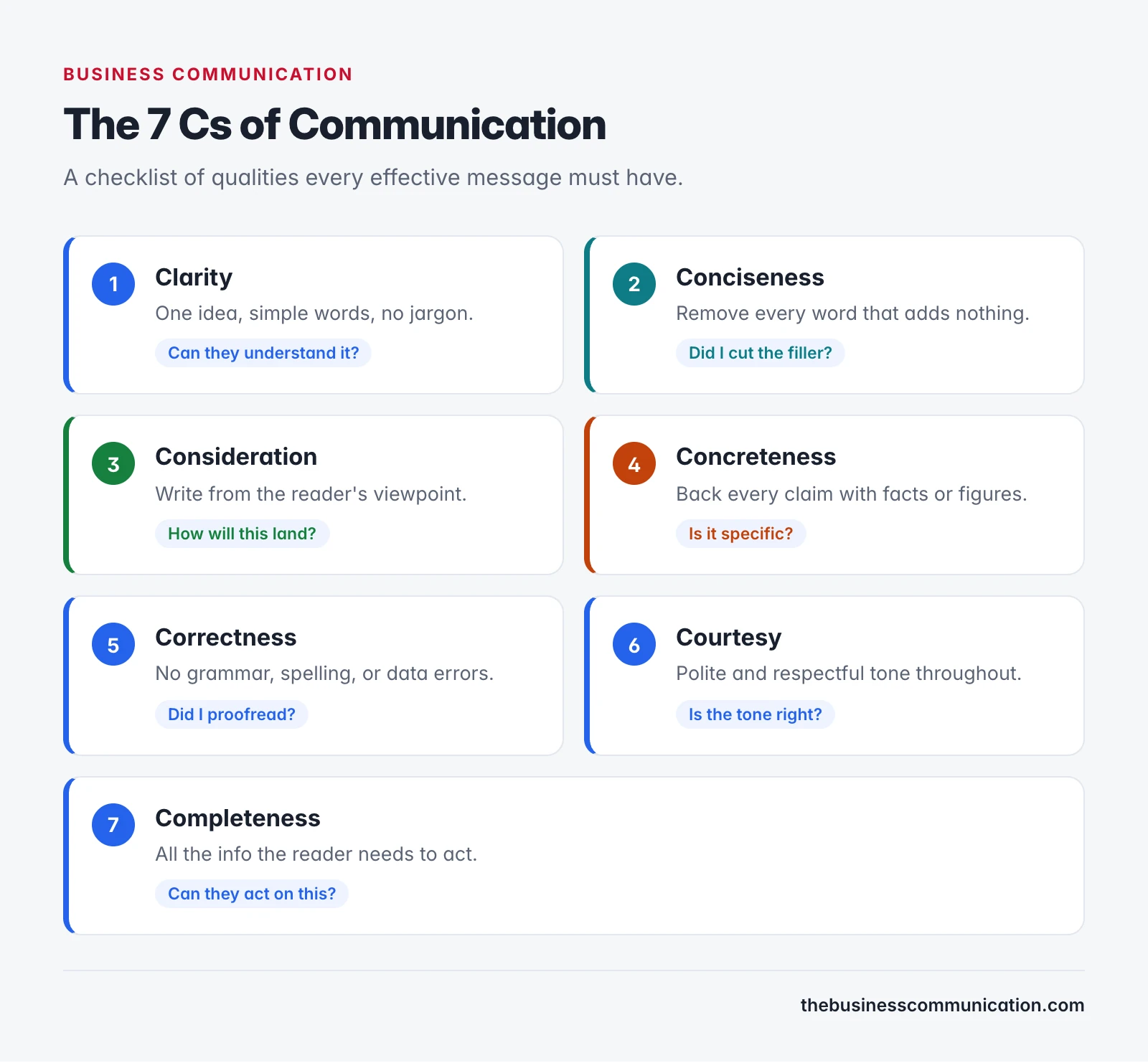
    7 Cs of Communication

    The Seven Cs Explained

    Now that you know where the concept came from, let’s understand each of the seven Cs in detail. Each one adds a special quality to your message that makes it more professional and easier to understand.

    1. Clarity

    Clarity means making your message easy to understand. When your message is clear, there is no room for confusion.

    Think of it like cleaning a dirty window. Once the dust is gone, you can see everything clearly. Similarly, when your words are simple and direct, your audience quickly understands what you want to say.

    Use short sentences and familiar words. Avoid jargon or complicated phrases unless absolutely necessary. For instance, instead of saying, “Kindly expedite the documentation process,” you can say, “Please finish the paperwork quickly.”

    If you want to see how clarity improves overall communication, you may find this post on qualities of good communication useful.

    2. Conciseness

    Conciseness is all about keeping your message brief and to the point. People today are busy, so they appreciate messages that are short but meaningful.

    For example, instead of writing a long paragraph explaining why a meeting is postponed, you can simply say, “The meeting is postponed to Monday due to scheduling conflicts.”

    Avoid unnecessary words, repetition, or long explanations. The trick is to express more meaning with fewer words. Concise communication saves time and increases understanding.

    One way to practice this is to review your emails or reports before sending them and remove extra words. Less is often more.

    3. Consideration

    Consideration means thinking about the receiver’s feelings, needs, and perspective before you communicate. In simple terms, it is about putting yourself in the listener’s shoes.

    Ask yourself, “How will my message make the other person feel?” or “Is this respectful and polite?”

    For instance, instead of saying, “You didn’t follow my instructions,” you can say, “Maybe there was some confusion with the instructions. Let’s review them together.”

    This simple change turns a potentially negative comment into a constructive one.

    A similar idea in business writing is known as the “You-attitude,” which focuses on the reader rather than the writer. You can read more about it in this article on importance of You-attitude in a business letter.

    4. Concreteness

    Concreteness adds strength and reliability to your message. A concrete message is supported by facts, figures, and examples rather than vague words.

    For example, saying “Our sales increased by 20% last quarter” is more powerful than “Our sales went up recently.”

    Concrete communication builds credibility. It shows that you know what you are talking about. In report writing, this is especially important because vague statements can lead to confusion or mistrust.

    Whenever possible, use specific details, statistics, and real-life examples. It makes your message more believable and easier to remember.

    5. Correctness

    Correctness refers to using proper grammar, spelling, punctuation, and accurate information. Errors can make your message confusing and reduce your credibility.

    For instance, writing “your welcome” instead of “you’re welcome” might seem small, but it creates a bad impression. Similarly, using wrong data in a report can damage your professional image.

    Always double-check your work before sending it. Tools like Grammarly or Hemingway can help, but personal proofreading is equally important.

    Correctness also includes factual accuracy. If you are quoting data or statistics, make sure they are up to date and from reliable sources.

    6. Courtesy

    Courtesy means being polite, respectful, and thoughtful while communicating. It involves using kind words and a positive tone, even when you disagree.

    A courteous message shows professionalism and builds strong relationships. For example, instead of saying, “You are late again,” you can say, “I understand delays happen, but let’s try to be on time for the next meeting.”

    Courtesy does not mean being overly formal. It simply means showing respect and using a friendly tone. A courteous communicator earns trust and cooperation from others.

    7. Completeness

    Completeness means giving all the necessary information your audience needs to understand your message. An incomplete message can lead to confusion and wasted time.

    For instance, saying “Let’s meet tomorrow” without mentioning the time or place leaves the receiver guessing. Instead, say, “Let’s meet tomorrow at 10 AM in the conference room.”

    A complete message answers all possible questions like who, what, when, where, why, and how. It leaves no room for misunderstanding.

    When writing reports, emails, or letters, always check if the reader can act on your message without needing further clarification.

    Importance of the 7 Cs in Communication

    The 7 Cs are like seven building blocks of effective communication. Together, they help you express your ideas clearly, confidently, and respectfully.

    In business, they are essential for writing professional reports, proposals, and emails. In education, they help students present ideas logically. Even in daily life, these principles make conversations smoother.

    For instance, clarity and correctness prevent confusion, while courtesy and consideration strengthen relationships. These small but powerful habits can change how people perceive you.

    If you want to strengthen your communication foundation further, visit the post on principles of communication for a broader perspective.

    Practical Application of the 7 Cs

    Knowing the theory is good, but applying the 7 Cs in real life is what makes you an effective communicator. Let’s look at how you can practice them in different situations.

    In Business Writing

    • Use clarity and conciseness in reports and emails.
    • Always include all relevant details to maintain completeness.
    • Keep your tone courteous and professional.

    In Classrooms or Presentations

    • Speak clearly and use simple examples.
    • Avoid unnecessary words or complicated sentences.
    • Respect your audience’s time and attention.

    In Everyday Communication

    • Be polite even when disagreeing.
    • Think before you speak.
    • Double-check your facts before sharing information.

    A useful example of clear and structured writing can be found in your earlier post on steps in writing business report. It demonstrates how communication principles can make professional writing more effective.

    The 7 Cs in Modern Digital Communication

    In the digital world, communication happens faster, but clarity often gets lost. Emails, instant messages, and social media posts are short, so following the 7 Cs is even more important.

    For example, when writing emails, be concise, but also courteous. Avoid using slang or abbreviations that others may not understand. When posting online, consider your tone, as written words can be easily misinterpreted.

    In virtual meetings, make sure you speak clearly and maintain eye contact. Try to apply all seven principles in digital spaces, just as you would face to face.

    You can also learn some helpful tips from the post on virtual meetings best practices, which discusses how to stay professional in online communication.

    7 Cs vs. Other Communication Models

    Many communication models, like the Shannon-Weaver model, focus on how messages move from sender to receiver. The 7 Cs, however, focus on how to make that process effective.

    While models explain the structure of communication, the 7 Cs improve its quality. They are practical guidelines that can be applied to any type of communication, from business letters to classroom discussions.

    In short, the 7 Cs tell you how to say it right, while models tell you how it works.

    Common Barriers to the 7 Cs

    Even with the best intentions, barriers can stop communication from being effective. These barriers may be physical, emotional, or linguistic.

    For example:

    • Language barriers cause misunderstanding when people speak different languages.
    • Emotional barriers arise when someone is angry or stressed.
    • Information overload happens when too much data is shared at once.

    To overcome these problems, practice patience and active listening. Simplify your language, and use examples when explaining complex topics.

    You can explore more about this in the article on types of communication barriers. It provides practical ways to remove obstacles to understanding.

    Summary Table: The 7 Cs at a Glance

    PrincipleMeaningBenefitExample
    ClarityBe clear and simpleAvoid confusionUse short, direct sentences
    ConcisenessBe briefSave timeRemove extra words
    ConsiderationBe empatheticBuild trustUse a friendly tone
    ConcretenessBe specificIncrease credibilityUse data or examples
    CorrectnessBe accurateAvoid mistakesCheck grammar and facts
    CourtesyBe politeBuild goodwillUse kind words
    CompletenessBe wholeAvoid gapsInclude all necessary details

    Future Relevance of the 7 Cs

    In the future, communication will continue to evolve, especially with AI and automation. However, the 7 Cs will remain just as important. Machines can send messages quickly, but only humans can communicate with empathy and understanding.

    As technology grows, applying the 7 Cs will help maintain clarity and trust in digital conversations. Whether it is a tweet, an email, or a speech, following these principles ensures your message always reaches the right people in the right way.

    Conclusion

    The 7 Cs of Communication are simple yet powerful principles that can transform how you connect with others. They help you write clearly, speak politely, and express ideas effectively.

    Remember, communication is not about speaking more, but speaking better. If your message is clear, concise, and considerate, it will always have a stronger impact.

    So, the next time you write an email, give a presentation, or even chat with a friend, think of these seven Cs. They will help you become not just a better communicator, but also a more thoughtful person.

    Frequently asked questions

    How do I balance clarity with conciseness without oversimplifying?

    Use short, direct sentences with familiar words, but include necessary context. Remove redundant phrases and filler words, not important details. For example, “Sales rose 20% due to Q3 marketing” is both clear and concise. Test by reading aloud—if it sounds natural and complete, you’ve struck the balance.

    What if my audience has different communication preferences or backgrounds?

    Apply consideration by adapting your approach. For technical audiences, use industry terms with brief definitions. For general audiences, simplify language. Always define jargon on first use. Research your audience beforehand when possible. This flexibility ensures your message remains clear and respectful across different groups.

    Can I use the 7 Cs in informal settings like texts or casual emails?

    Yes. Even casual communication benefits from clarity and consideration. Keep texts brief and clear to avoid misunderstandings. Use correct spelling in professional contexts. Informal settings allow more flexibility, but the core principles—being clear, respectful, and accurate—still apply and strengthen your relationships.

    How do I know if my message lacks concreteness?

    Look for vague words like “soon,” “many,” or “improved.” Replace them with specific numbers, dates, or examples. If someone could misinterpret your message, it needs more concrete details. Before sending, ask: “Could someone act on this clearly?” If not, add facts or examples.

    What’s the quickest way to check for correctness before sending?

    Read your message aloud to catch grammar and flow issues. Use spell-check tools, then manually verify numbers and facts. For important messages, have someone else review it. This two-step approach catches both obvious errors and factual mistakes that automated tools might miss.

    7 C’s of communication Seven C's of communication
    Share. Facebook Twitter Pinterest LinkedIn WhatsApp Reddit Email
    Previous ArticlePrinciples of Communication: 14 Key Rules for Effective Communicators
    Next Article Factors influencing the meaning of business communication
    Masudur Rashid
    • Facebook
    • X (Twitter)
    • Instagram
    • LinkedIn

    👋 Hi, I am Masudur Rashid. I studied Management (Honors and Masters) but my real passion has always been Business Communication. Through this blog, I share simple tips, lessons, and resources to help students and professionals communicate with confidence.

    Related Posts

    Introduction 08 Mins Read

    Medical Appointment Inquiry Email (Clinics/Hospitals)

    Introduction 08 Mins Read
    Introduction 012 Mins Read

    Business Communication – Importance of Business Communication

    Introduction 012 Mins Read
    Introduction 011 Mins Read

    Guidelines to Improve effectiveness of Cross Cultural Communication

    Introduction 011 Mins Read
    Introduction 112 Mins Read

    Types of Communication Skills: Essential Abilities for Workplace Success

    Introduction 112 Mins Read
    View 10 Comments

    10 Comments

    1. yaseen

      you have written very well i was looking for same thing for my college assignment

      Reply
    2. Jaxter japhet

      Easy language you have used hence it’s clear to everyone thanks for your help 🤝🤝🤝🤝

      Reply
    3. Ava Olivia

      Communicating effectively is a skill worth developing. If you want to stand out and network effectively, you must learn how to communicate effectively. The seven Cs of communication are: Clarity, Comprehensiveness, Consistency, Coordination, Confidence, Cooperation and Contact. Whether you’re talking to a group or one person, knowing how to use these seven Cs will help you connect with others and enhance your professional and personal life.

      Reply
    4. Asep Hardiansyah

      Business must be clear in
      determine the message, both formal
      or informal. Because
      an organization consists of
      different people, and
      have many ideas

      Reply
    5. Ume kulsoom

      Well-explained so, anyone can easily understand.

      Reply
    6. John CROSBY

      you spelled correctness wrong in the circle of the 7 C’s you might want to correct that. In the circle, you spelled correctness with an extra E ex correcteness, but in the correctness paragraph you spelled it correct.

      Reply
    7. Pragati Sambrani

      Please proof-read your content. The sentence formation and grammar in this article is incorrect.

      Reply
      • The Business Communication

        We have en-reached our content. Hope it will help you to learn 7c of business communication.

        Reply
      • Alyssa

        It’s still pretty awful and it’s been a year since your comment!

        Reply
      • Pratik

        Many mistakes…i had to understand and form the correct sentences…the irony is…the guy is talking about communication

        Reply
    Leave A Reply Cancel Reply

    This site uses Akismet to reduce spam. Learn how your comment data is processed.

    Subscribe to Updates

    Get the latest business communication news from TBC.

    By signing up, you agree to the our terms and our Privacy Policy agreement.

    Check your inbox or spam folder to confirm your subscription.

    Top Picks

    Medical Appointment Inquiry Email (Clinics/Hospitals)

    Trying to call a clinic and being stuck on hold for ten minutes can be…

    Business Communication – Importance of Business Communication

    Business communication is the structured exchange of information within an organization and between the organization…

    Guidelines to Improve effectiveness of Cross Cultural Communication

    Effective cross-cultural communication is not automatic, even in organizations with diverse teams. You need deliberate…

    Types of Communication Skills: Essential Abilities for Workplace Success

    Have you ever met someone who is brilliant but cannot explain their ideas? They have…

    Welcome to TheBusinessCommunication.com, your guide to clear and effective business communication. Here you will find simple lessons on report writing, letters, meetings, oral and written communication, and modern tools like email or virtual meetings. Our mission is to make learning communication easy, practical, and fun, so you can apply it in your studies, career, and everyday life.
    We're social. Connect with us:

    Facebook X (Twitter) YouTube LinkedIn RSS
    Top Insights

    Memo vs. Business Letter: Key Differences & When to Use Which

    Mastering Negotiation Skills: The Role of Oral Communication

    Non-Verbal Cues: How Body Language Impacts Oral Communication

    Subscribe to Updates

    Get the latest business communication news from TBC.

    By signing up, you agree to the our terms and our Privacy Policy agreement.

    Check your inbox or spam folder to confirm your subscription.

    Copyright © 2026 TheBusinessCommunication. All Rights Reserved.
    • Home
    • About Us
    • Contact US
    • Our Authors
    • Privacy Policy
    • Terms and Conditions

    Type above and press Enter to search. Press Esc to cancel.