


A communication satellite is an artificial satellite designed to relay radio signals between distant points on Earth, enabling global telecommunications by overcoming the curvature of the planet. Unlike natural satellites such as the moon, these human-made spacecraft serve specific functions: amplifying and redirecting signals for television broadcasts, telephone networks, internet connectivity, and emergency communications. Understanding how they work, and why they’re positioned where they are, reveals the engineering foundation of modern global connectivity.
What is a communication satellite?
Communication satellites are spacecraft placed in orbit around Earth to receive, amplify, and retransmit radio frequency signals between ground stations. They function as relay towers in space, positioned high enough to “see” multiple continents simultaneously. This makes them fundamentally different from weather satellites, which observe atmospheric conditions, or navigation satellites like GPS, which broadcast precise timing signals.
The Soviet Union launched the first artificial satellite, Sputnik, in 1957. Within a few years, engineers realized satellites could solve a critical problem: how to send telephone calls and television signals across oceans without laying thousands of miles of undersea cable. The first active communication satellite, Telstar, relayed the first transatlantic television signal in 1962, proving the concept worked at commercial scale.
Today, more than 2,000 active communication satellites orbit Earth, each designed for a specific role within the broader landscape of types of communication infrastructure. Some broadcast television to entire continents. Others form constellations that route internet traffic or connect remote oil rigs to corporate networks.
Why satellites are essential for global communication
Radio waves travel in straight lines. When you transmit a signal from a tower in Dhaka, it reaches receivers within about 50 kilometers before Earth’s curvature blocks the path. To communicate with someone in London or São Paulo using ground-based radio alone, you’d need relay towers every 50 km across continents and oceans, a physical and economic impossibility.
Satellites solve this by sitting above the curve. A single satellite positioned 35,786 km above the equator can “see” roughly 42% of Earth’s surface. Three such satellites, spaced evenly, provide coverage to nearly every inhabited region except the polar extremes. This geometry is why the geostationary orbit became the workhorse of satellite television and international telephony.
In regions where fiber optic cables are impractical (remote islands, deserts, mountainous terrain, or disaster zones where infrastructure has failed), satellites often represent the only viable communication link. A fishing fleet 800 km offshore, a mining operation in the Australian outback, or a hospital in rural Nepal all rely on satellite connectivity because no other technology can economically bridge the distance.
How communication satellites work: uplink and downlink
The signal journey has three stages. First, a ground station transmits an encoded signal, perhaps a video stream or a block of internet data, toward the satellite. This is the uplink, typically using frequencies in the C-band (4-8 GHz) or Ku-band (12-18 GHz) range. The signal weakens as it travels through the atmosphere, arriving at the satellite thousands of times fainter than when it left Earth.

Once received, the satellite’s transponder amplifies the signal by a factor of 10 billion or more and shifts it to a different frequency to prevent interference with the uplink. This amplified signal is then broadcast back to Earth, the downlink, covering a specific geographic footprint. A satellite designed for European television might have a beam that covers from Lisbon to Warsaw but fades to nothing over North Africa or Scandinavia.
Ground stations equipped with parabolic dish antennas receive the downlink signal. These dishes focus the weak signal onto a low-noise amplifier, which boosts it enough for decoding. The entire uplink-transponder-downlink cycle takes about 240 milliseconds for a geostationary satellite, noticeable in a phone call but acceptable for broadcasting or non-interactive data transfer.
What most people get wrong: the satellite doesn’t “understand” the content it’s relaying. It’s a frequency-shifting amplifier in space, not a router or server. The intelligence (encoding, encryption, routing decisions) happens on the ground.
Key components: transponders, antennas, and frequency bands
The transponder is the heart of any communication satellite. Each transponder is a channel that receives a specific frequency band, amplifies the signal, and retransmits it on a different frequency. A typical broadcast satellite carries 24 to 72 transponders, each handling a separate television channel or data stream. When a transponder fails, that channel goes dark until ground controllers switch traffic to a backup unit.
Antennas come in two main types. Parabolic reflectors focus incoming signals onto a feed horn, concentrating weak radio waves the way a magnifying glass focuses sunlight. Phased-array antennas use hundreds of small elements to electronically steer the beam without moving the satellite, enabling rapid switching between coverage zones. Modern satellites often carry both: a large reflector for the main service area and phased arrays for spot beams targeting cities or regions.
Frequency bands determine how much data a satellite can carry and how weather affects the signal. C-band (4-8 GHz) penetrates rain and clouds well but requires large ground antennas. Ku-band (12-18 GHz) allows smaller dishes but suffers “rain fade” during heavy storms. Ka-band (26.5-40 GHz) offers enormous bandwidth for high-speed internet but degrades even in moderate rain. Engineers choose bands based on the application: C-band for critical government links, Ku-band for television, Ka-band for consumer internet where occasional dropouts are acceptable.
Ground stations do more than receive signals. They track satellites as they drift slightly within their orbital slots, adjusting dish angles in real time. They also monitor signal strength, coordinate with other stations to avoid interference, and manage uplink power to compensate for atmospheric conditions. A small business in Chittagong using satellite internet connects through a regional teleport, a ground station that aggregates traffic from thousands of customers before uplinking to the satellite.
Orbital types and their communication applications
Where you place a satellite determines what it can do. The trade-offs between altitude, coverage area, signal delay, and cost shape the entire communication architecture.
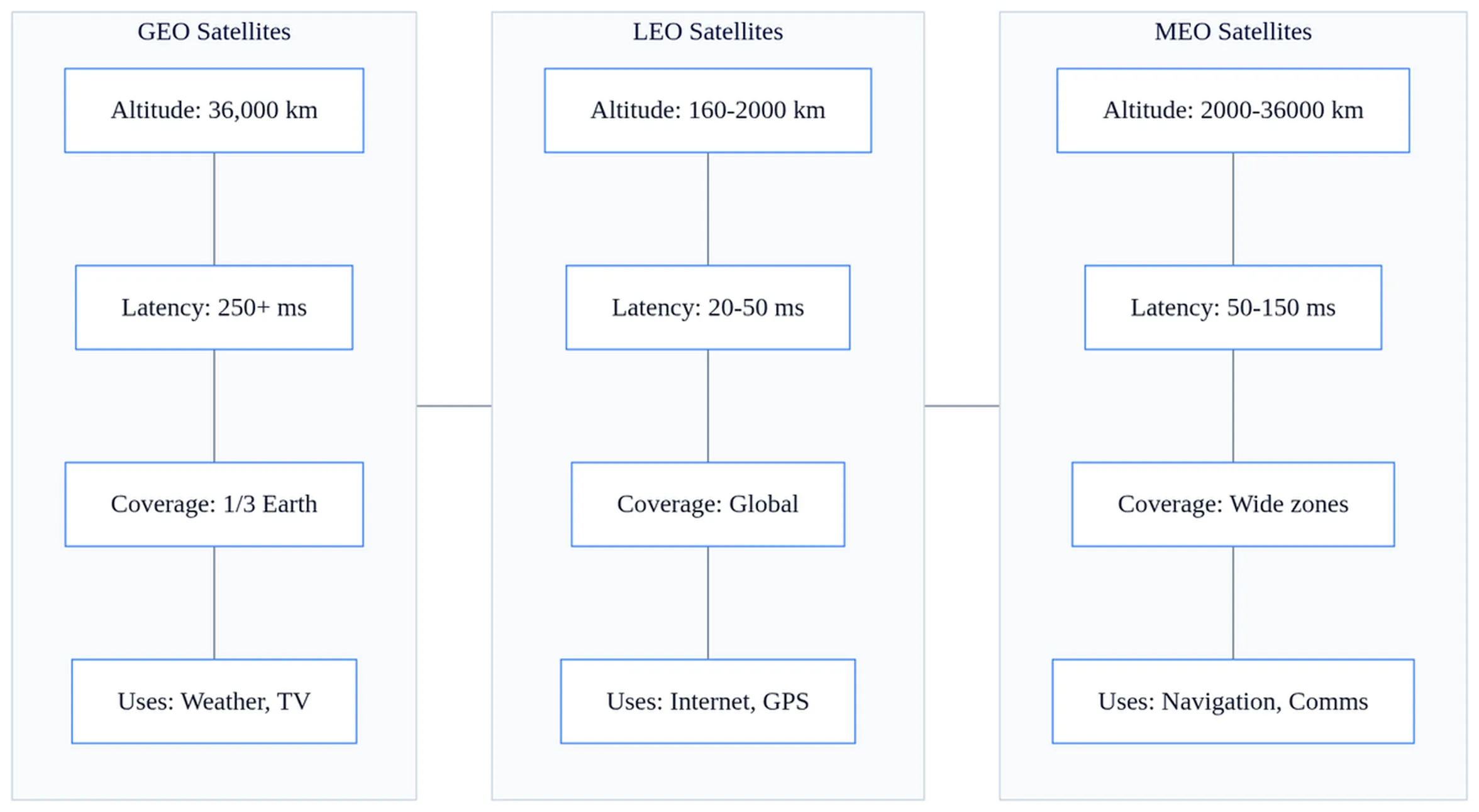
| Orbit Type | Altitude | Coverage per Satellite | Latency (Round-Trip) | Primary Uses |
|---|---|---|---|---|
| Geostationary (GEO) | 35,786 km | ~42% of Earth’s surface | 240-280 ms | Television broadcasting, weather monitoring, fixed telephony |
| Low-Earth Orbit (LEO) | 160-2,000 km | ~3-5% of Earth’s surface | 20-50 ms | Satellite internet constellations, Earth observation, mobile communications |
| Medium-Earth Orbit (MEO) | 5,000-20,000 km | ~15-20% of Earth’s surface | 80-120 ms | Navigation systems (GPS, Galileo), emerging communication services |
Geostationary satellites orbit at exactly the speed Earth rotates, so they appear stationary above a fixed point on the equator. This makes them ideal for television: your dish points at the same spot in the sky 24/7. The downside is latency. A signal traveling 71,572 km round-trip takes time, making real-time video calls awkward and online gaming impossible.
Low-Earth orbit satellites zip around the planet every 90 to 120 minutes. Because they’re much closer, latency drops to levels comparable with fiber optic cables. But each satellite only covers a small area for a few minutes before disappearing over the horizon. To provide continuous service, you need a constellation (dozens or hundreds of satellites working together), handing off your connection as they pass overhead.
Medium-Earth orbit splits the difference.
MEO satellites are high enough that a dozen can cover the globe, but close enough that latency stays under 120 ms. GPS satellites use this orbit, and some next-generation communication networks are exploring MEO as a middle ground between GEO’s simplicity and LEO’s performance.
Applications: from television to internet and emergency response
Television broadcasting remains the largest commercial use of communication satellites. A single satellite can deliver 200 channels to millions of homes across a continent, far cheaper than building terrestrial transmitters for every city and town. Regional broadcasters in South Asia, Africa, and Latin America rely on leased transponder capacity to reach audiences scattered across multiple countries.
International telephone networks shifted from satellites to undersea fiber optic cables in the 1990s because fiber offered higher capacity and lower latency. But satellites still carry voice traffic in regions where cables don’t reach: rural Africa, the Pacific islands, and temporary installations like mining camps or military bases. When a cyclone severed Bangladesh’s submarine cable links in 2008, satellite circuits kept international calling alive until repairs were completed.
Satellite internet has evolved from a niche service for ships and remote offices into a mass-market product. Low-Earth orbit constellations now deliver 100+ Mbps to rural homes and businesses that previously had no broadband option. This expansion illustrates the broader role of technology in business communication, where connectivity increasingly determines which markets companies can serve.
Emergency and disaster response teams depend on satellite links when floods, earthquakes, or hurricanes destroy cell towers and fiber lines. A portable satellite terminal the size of a briefcase can restore voice and data service within minutes, coordinating rescue operations and reconnecting affected communities. During the 2015 Nepal earthquake, satellite phones provided the only reliable communication for relief organizations working in mountain valleys.
These applications form part of the larger ecosystem of electronic communication systems that businesses and governments rely on daily, though satellites handle the scenarios where terrestrial infrastructure falls short.
Modern developments: miniaturization and mega-constellations
Traditional communication satellites weigh 3,000 to 6,000 kg and cost $200-400 million to build and launch. CubeSats, satellites no larger than a shoebox, have slashed those figures. A CubeSat might weigh 5 kg and cost under $500,000, enabling universities and startups to experiment with space-based communication technologies that were once the exclusive domain of national telecom monopolies.
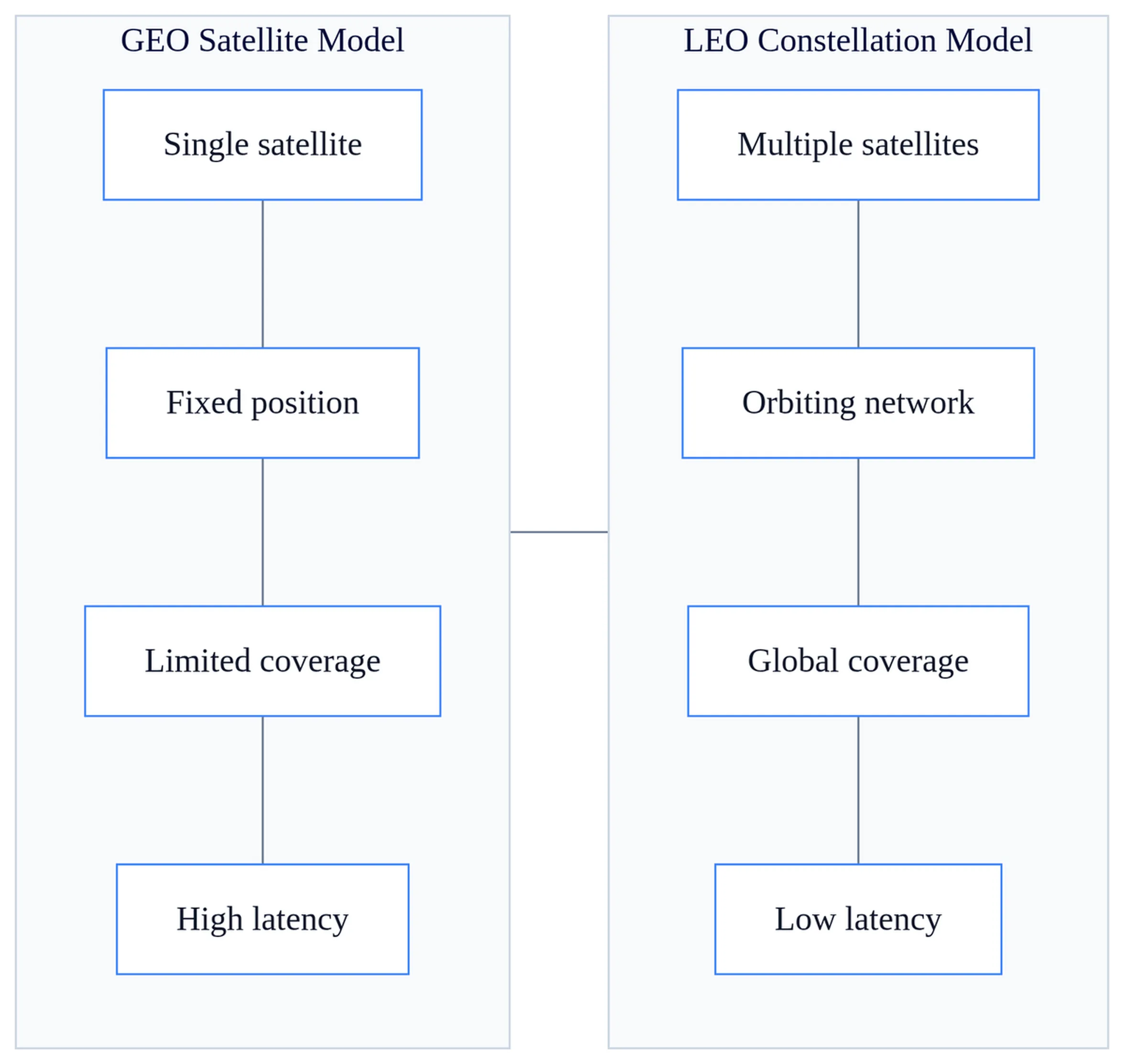
The real transformation is happening in low-Earth orbit. Companies are deploying mega-constellations, networks of thousands of small satellites working as a coordinated system. As of 2024, NASA reports that more than 5,000 active satellites orbit Earth, with LEO constellations accounting for the majority of recent launches. These constellations route data packets between satellites using laser links, reducing reliance on ground stations and cutting latency further.
This shift from the single-satellite GEO model to distributed LEO constellations changes the economics of global connectivity. Instead of one $300 million satellite covering a continent, you launch 300 satellites at $1 million each. If one fails, the constellation automatically reroutes traffic. The system becomes more resilient but operationally complex, requiring sophisticated software to manage thousands of moving relays.
For rural businesses and remote workers, this means broadband speeds that were impossible five years ago. A small export-oriented garment manufacturer in rural Rajshahi can now videoconference with European buyers and upload design files in real time, capabilities that previously required relocating to Dhaka or Chittagong.
Challenges and limitations
Latency remains the fundamental constraint for geostationary satellites. That 240 ms delay makes interactive applications like voice calls feel sluggish and renders real-time collaboration tools frustrating. LEO constellations reduce latency to 20-50 ms, but they introduce a different problem: frequent handoffs as satellites move overhead can cause brief connection drops.
Weather interference affects higher frequency bands. During a heavy monsoon downpour, a Ku-band satellite internet connection might slow to a crawl or drop entirely, a phenomenon called rain fade. C-band systems resist this better but require larger, more expensive antennas. Engineers compensate by increasing uplink power during storms or temporarily switching to lower data rates, but the physics can’t be eliminated.
Spectrum crowding is becoming critical. The International Telecommunication Union coordinates frequency allocations to prevent satellites from interfering with each other, but available bandwidth is finite. As more countries and companies launch satellites, competition for prime frequency slots intensifies. Regulatory disputes over orbital positions and spectrum rights now involve billions of dollars in potential revenue.
Space debris poses an existential risk. Defunct satellites, spent rocket stages, and collision fragments create a cloud of high-velocity shrapnel in popular orbits. A single collision can generate thousands of new debris pieces, each capable of destroying an operational satellite. LEO mega-constellations increase collision risk simply by adding more objects to crowded orbital zones. Operators now design satellites to de-orbit within five years of mission end, but legacy debris from decades past will remain a hazard for generations.
Communication satellites have evolved from experimental relays to critical infrastructure supporting $277 billion in annual global services. The technology isn’t glamorous (it’s frequency-shifting amplifiers in metal boxes), but it enables the global connectivity that businesses, governments, and individuals now take for granted. As LEO constellations mature and launch costs continue falling, satellite communication will shift from a backup option for remote areas to a primary network layer competing directly with fiber and cellular systems. If you’re evaluating connectivity options for distributed operations, the real question isn’t whether satellites will remain relevant, but which orbital architecture will deliver the latency and cost profile your specific application demands.
Frequently asked questions
Why does my satellite internet lag more than fiber during video calls?
Geostationary satellites orbit 35,786 km up, so signals travel 240 milliseconds each way—acceptable for streaming but noticeable in real-time conversation. Fiber optic cables transmit at light speed through shorter paths, creating near-instant response. Low-earth orbit satellites reduce this delay but cover smaller areas and require more ground stations.
If a satellite transponder fails, does the entire satellite become useless?
No. A satellite typically carries 24 to 72 transponders. When one fails, ground controllers reroute traffic to backup transponders on the same or neighboring satellites. Only that specific channel goes dark. A complete satellite failure is rare and affects only the services it uniquely provided.
Why can’t satellites use the same frequency for uplink and downlink?
Using the same frequency would create interference—the satellite’s powerful downlink signal would drown out the weak incoming uplink. Transponders shift the signal to a different frequency band before retransmitting, keeping the two paths separate and clear.
Does rain really knock out satellite internet, and why doesn’t it affect TV?
Rain fade affects higher frequencies more. Ka-band internet (26.5-40 GHz) degrades in moderate rain. C-band television (4-8 GHz) penetrates clouds better but requires larger dishes. Broadcasters use C-band for reliability; internet providers accept some rain fade to offer faster speeds with smaller equipment.
How does a satellite know which ground station to send a signal to?
The satellite doesn’t decide. Ground stations encode routing information into the uplink signal itself. The satellite simply amplifies and retransmits the entire signal to its coverage footprint. Multiple ground stations receive it, but only the intended recipient’s equipment decodes the message.