


Every organization depends on formal communication, yet few teams understand exactly when it helps and when it gets in the way. This guide walks through the core advantages and disadvantages of formal communication, explains the types and examples, and shows how to strike the right balance in modern workplaces.
What is formal communication?
Formal communication is the structured, official exchange of information through organizational channels. It follows hierarchy, documented protocols, and predetermined pathways. Its chief advantages are clarity, accountability, and legal documentation. Its key disadvantages are slow approval chains, rigidity, and impersonal tone.
Unlike casual hallway conversations or instant messages, formal communication moves through official pathways with clear authority recognition and leaves a documented trail. It includes policy memos, official emails, quarterly reports, board meeting minutes, performance reviews, and disciplinary records.
The defining feature is not the medium but the intent. Formal communication establishes accountability, creates records, and follows rules. A 2,000-word policy memo is formal. A three-line message asking a colleague about lunch plans is not.
Both types are part of types of business communication. Understanding the advantages and disadvantages of formal communication helps you decide which channel fits each situation.
Types of formal communication
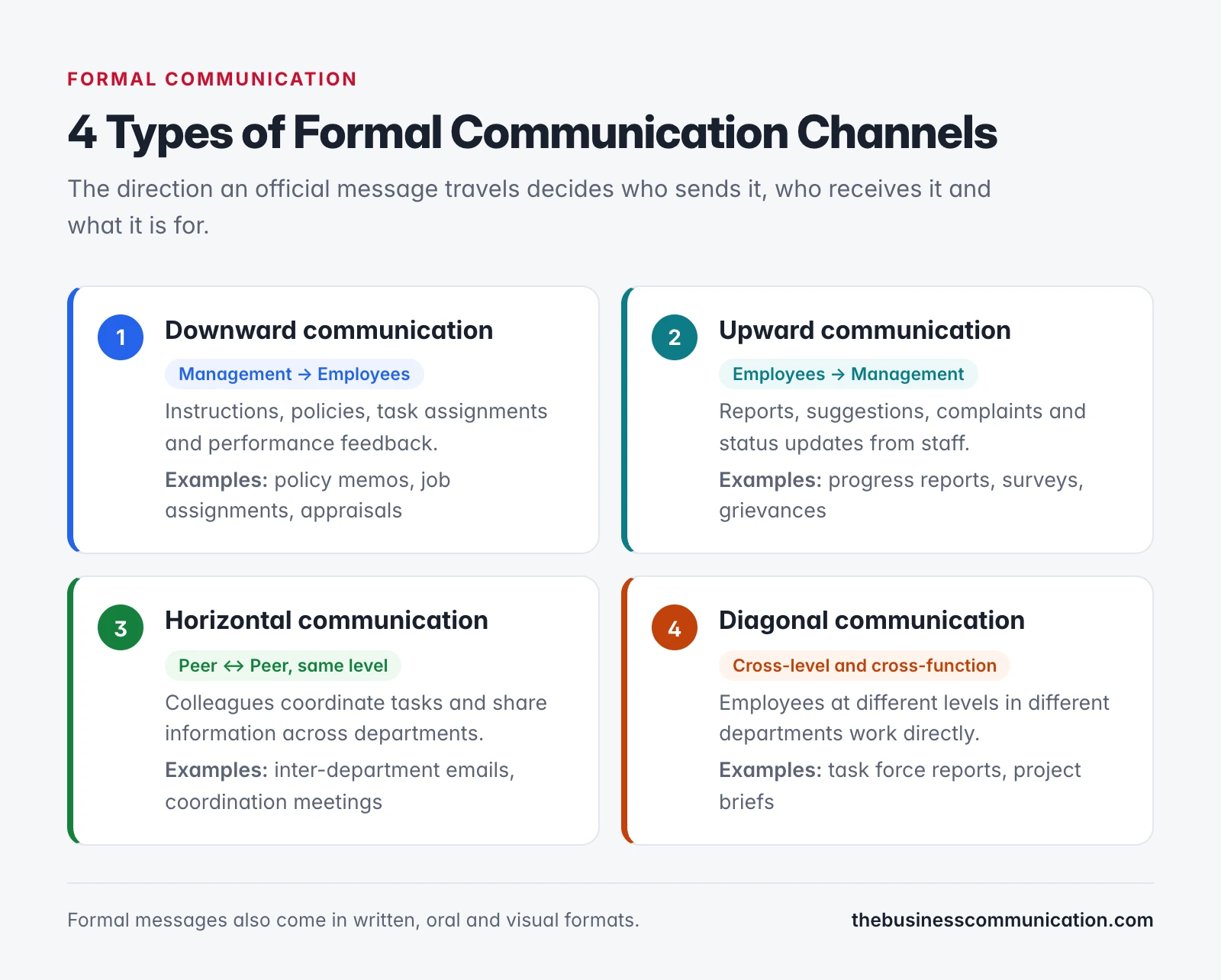
Messages in an organization travel through four directional channels, and each one has a different sender, receiver, and purpose.
- Downward communication flows from management to employees. Executives send policy memos, job assignments, instructions, and performance feedback down the hierarchy. This is the most common form in most organizations. See downward communication for a full breakdown.
- Upward communication travels from employees to supervisors or executives. Progress reports, complaints, suggestions, and survey responses are examples. Organizations that ignore upward channels miss critical ground-level insights. See upward communication for strategies.
- Horizontal communication occurs between colleagues at the same organizational level, often across different departments. A finance analyst coordinating with an HR specialist on budget planning is one example. It reduces silos and speeds up cross-functional work.
- Diagonal communication crosses both functional and hierarchical boundaries. A junior marketing coordinator communicating directly with a senior operations manager to coordinate a product launch is diagonal. It speeds decisions but requires clear protocols to avoid confusion.
Formal communication also divides by format: written (memos, reports, letters), oral (formal presentations, board meetings), and visual (official charts, compliance dashboards). Our guide to organizational communication shows how these channels connect to the broader system.
Advantages of formal communication
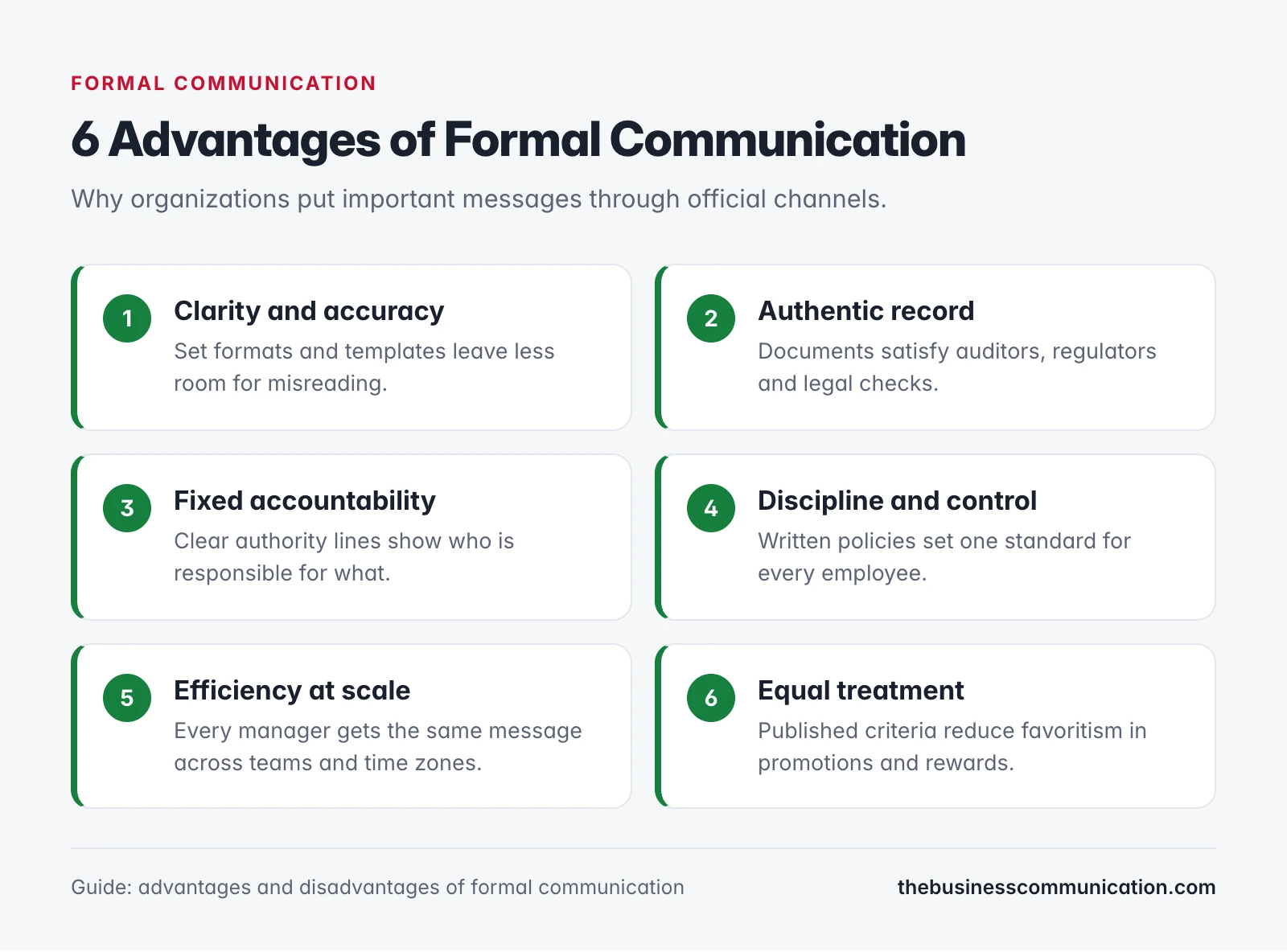
These six advantages use the standard exam labels from business communication textbooks, since that is the language most readers are searching for.
- Clarity and accuracy: Predefined rules and templates reduce misinterpretation. When HR sends a benefits enrollment memo in a standard format, employees know exactly where to find deadlines, eligibility criteria, and next steps. The structure itself guides comprehension.
- Authentic record and legal compliance: Regulated industries depend on formal documentation to satisfy auditors and regulators. A healthcare provider documenting patient consent cannot rely on informal channels. Proper formal records protect organizations during disputes and regulatory reviews.
- Fixed responsibility and accountability: Clear authority lines establish who is responsible for what. When a project manager sends a formal task assignment, both parties understand expectations and deadlines. That documentation creates accountability that informal requests lack.
- Discipline and control: Formal channels reinforce organizational hierarchy and help managers monitor performance. Documented policies set consistent standards that apply equally to all employees, reducing the scope for arbitrary decisions or favoritism.
- Systematic flow and efficiency at scale: In a 500-person company, word-of-mouth cannot reliably communicate a policy change. Formal channels deliver consistent messaging across departments, time zones, and reporting lines. Every manager receives the same information simultaneously.
- Equal treatment and fairness: Documented processes prevent favoritism. When promotion criteria are formally communicated and consistently applied, employees trust the system. Well-connected employees are less likely to hear about opportunities before others do.
Disadvantages of formal communication
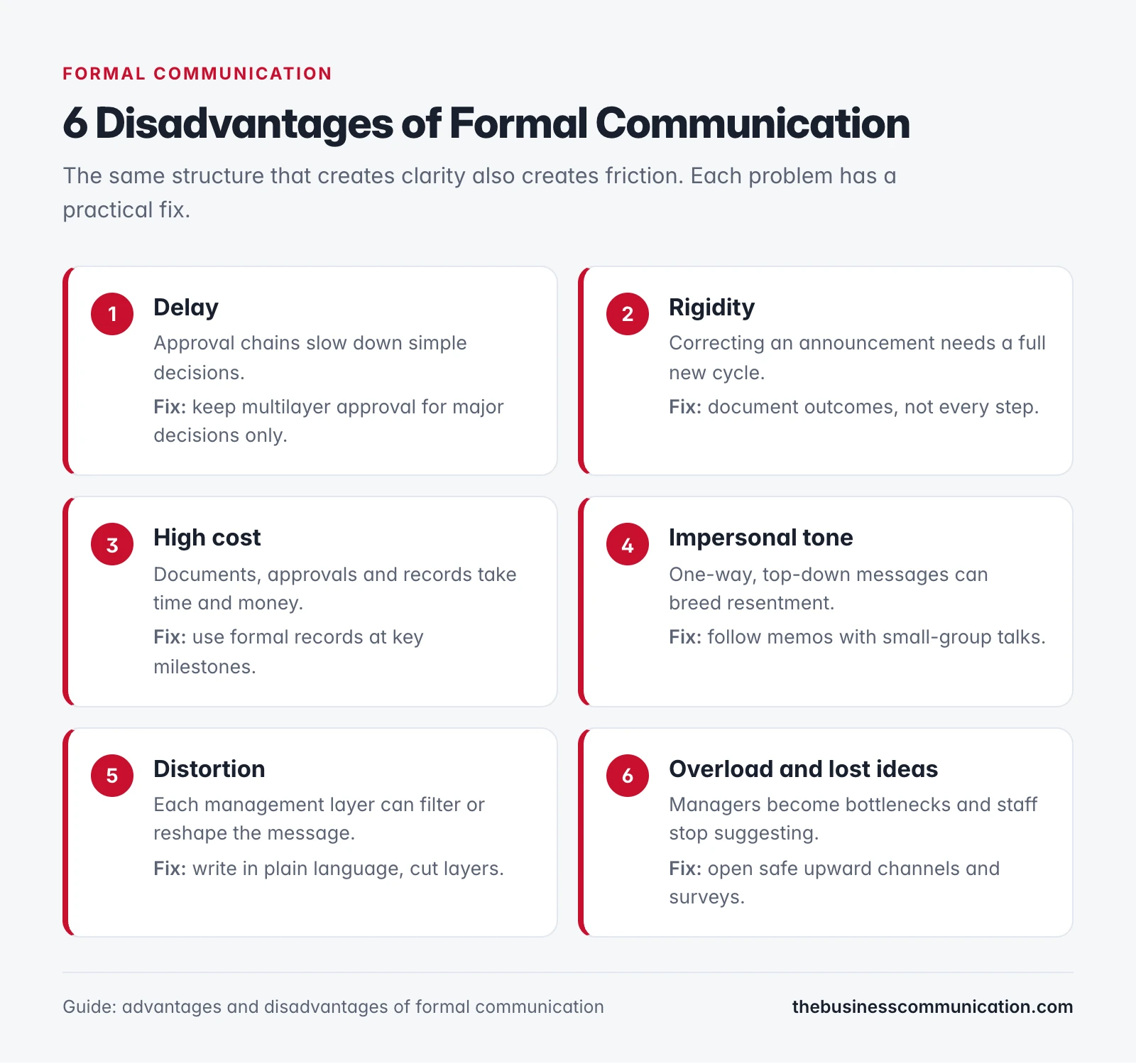
The same structure that creates clarity also introduces friction. These six demerits use the exam-standard labels.
- Delay and time-consuming process: Hierarchical approval chains slow decision-making. A simple vendor contract requiring signatures from a department head, finance director, and VP can take two weeks to route. In fast-moving situations, that delay costs opportunities.
- Rigidity and inflexibility: Correcting an error in a formal policy announcement requires another full communication cycle. You cannot simply update the message or clarify in real time. This frustrates employees who see obvious improvements but lack authority to fix them.
- Costly to maintain: Producing formal documentation, routing approvals, holding formal meetings, and storing records all consume time and money. For small organizations, these overheads can outweigh the benefits of the structure entirely.
- Impersonal and authoritarian culture: Formal tone creates emotional distance. Power imbalances embedded in top-down communication can breed resentment when formal channels only flow one direction, making employees feel like order-takers rather than contributors.
- Distortion through the chain of command: Messages passing through multiple management layers often arrive changed. Each relay point can filter, summarize, or reinterpret the original. The farther a message travels, the greater the risk of distortion.
- Overload on managers and stifled creativity: Managers become bottlenecks when every decision must pass through them. Employees who must navigate formal proposal channels for every idea often abandon suggestions before submitting them. Both effects reduce organizational adaptability over time.
Examples of formal communication
Here are ten common examples, followed by a short memo that puts the format in concrete terms.
- Company-wide policy memos and circulars
- Official business letters and emails
- Quarterly and annual financial reports
- Board meeting minutes and resolutions
- Employee performance reviews and appraisals
- Disciplinary notices and termination letters
- Purchase orders and vendor contracts
- Formal project proposals and status reports
- Compliance training completion records
- Official meeting agendas and employee handbooks
MEMORANDUM: ABC Ltd.
To: All Staff. From: Sarah Chen, Head of Operations. Re: Updated Remote Work Policy.
Effective 1 November, employees in eligible roles may work remotely up to three days per week. Line managers must approve schedules by 25 October using the standard form on the intranet. Please direct any questions to hr@abcltd.example.
Notice the memo names a specific sender, a firm deadline, and a clear action step. That precision is what separates formal from informal communication.
When formal communication works best
Formal communication is not universally good or bad. These five scenarios are where its structure delivers the clearest value.
Crisis management requires formal communication. When a data breach occurs or a safety incident threatens employees, consistent official messaging prevents rumors. The CEO’s formal statement becomes the single source of truth.
Compliance-heavy industries make it non-negotiable. Healthcare providers documenting patient care, financial advisors recording investment recommendations, and manufacturers tracking safety protocols cannot function on informal channels. Regulators demand documented evidence of proper procedures.
Large organizations where informal networks cannot scale reliably need formal structures. A ten-person startup can coordinate through casual conversations. A 10,000-person multinational cannot. Formal communication provides the infrastructure for consistent information flow across geographic and organizational boundaries.
Sensitive decisions requiring documented authority depend on formal channels. Disciplinary actions, terminations, and policy changes affecting employee rights must follow formal protocols. Written communication creates the permanent record these situations demand.
Cross-departmental coordination requiring clear accountability benefits from formal channels. When marketing, product, and sales must align on a launch timeline, formal project documentation ensures everyone understands dependencies. Informal coordination works until something goes wrong and you need to trace decisions.
When formal communication creates problems
Innovation-focused teams suffer under rigid protocols. A design team brainstorming product concepts needs rapid idea exchange, not formal proposal templates. When every suggestion requires documentation and approval, creativity dies. Teams optimizing for innovation should minimize formal structures during generative phases.
Remote and hybrid work environments expose the weaknesses clearly. Asynchronous formal channels create delays that in-office teams could resolve with a quick conversation. A question that takes 30 seconds to answer in person can become a 24-hour email thread when routed through formal channels across time zones.
Small teams find formal structures unnecessarily bureaucratic. A six-person agency requiring formal meeting minutes and documented task assignments signals distrust. The overhead damages morale without delivering meaningful benefits. Small teams thrive on informal communication that heavy formal structures undermine.
Situations requiring real-time clarification or emotional nuance expose the limits. A confused employee reading a policy change needs immediate clarification, not a formal inquiry process. A manager delivering critical feedback needs to read body language and adjust tone, which written formal communication cannot accomplish.
Employee feedback suffers when formal channels are the only option. Staff hesitate to share honest concerns through channels that create permanent records and route through multiple management layers. The formality itself becomes a barrier to candor.
Balancing formal and informal communication
The question is not whether to use formal communication but when and how much.
Use formal communication for policy announcements, compliance requirements, accountability documentation, and cross-functional coordination. These situations demand the clarity and permanence that formal channels provide.
Use informal communication for relationship-building, quick clarifications, idea generation, and trust-building. These activities require speed and emotional connection that formal structures inhibit.
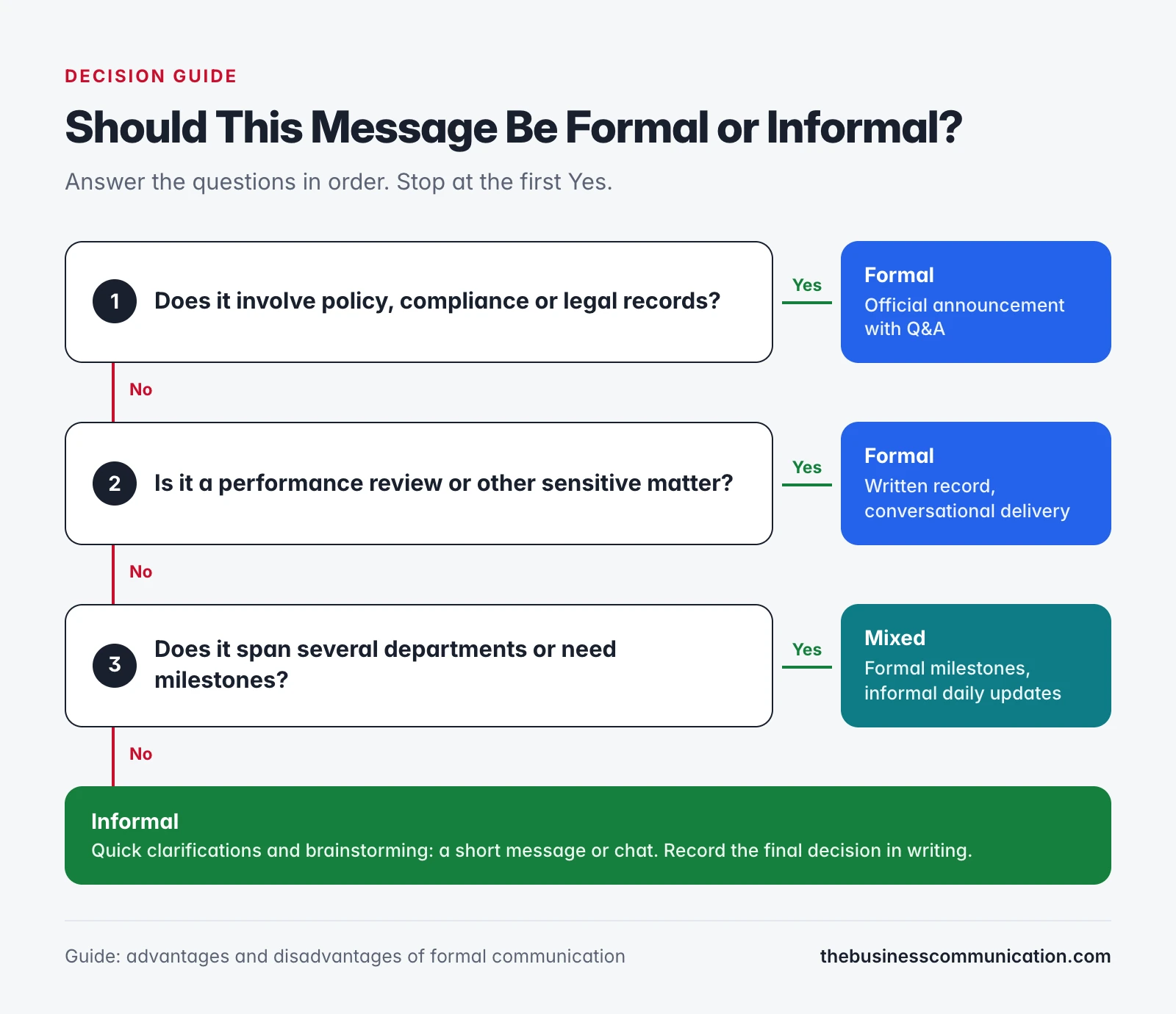
A hybrid approach often works best. Use formal channels to document decisions while encouraging informal implementation discussions. A product launch might have formal milestone documentation but rely on informal daily standups for problem-solving. For a side-by-side comparison, see formal vs. informal communication.
Formal communication in modern work contexts
Remote and hybrid work has shifted the dynamics noticeably. When teams lack physical proximity, formal channels become primary information pathways. Email, documented video meetings, and project management platforms replace hallway conversations.
Digital tools have blurred the lines between formal and informal. Platforms like Slack can carry formal announcements despite their casual medium. Email remains the default formal channel, but its volume creates information overload that undermines effectiveness.
Asynchronous work makes formal documentation more critical. When a team spans multiple time zones, real-time clarification is not always possible. Messages must therefore be clearer and more complete than they would need to be in a co-located office.
Generational expectations create tension around formality. Younger employees accustomed to rapid digital communication sometimes resist traditional formal structures. Organizations must balance legitimate documentation needs with communication styles that feel natural to their workforce. When in doubt, formalize less, not more.
Mitigating formal communication disadvantages
Reducing hierarchy layers for routine decisions is the most direct fix. Reserve multilayer approval for genuinely significant decisions, and document only the outcome rather than every step along the way.
Creating safe channels for upward communication helps too. Anonymous surveys, skip-level meetings, and designated feedback sessions allow employees to share concerns without fear of formal repercussions. Input gathered informally can still feed into formal policy changes.
Plain language cuts through the bureaucratic weight. A policy written at an accessible reading level is more effective than one dense with legal terminology. Legal review does not require legal language in employee-facing communication.
Pairing formal announcements with informal team discussions also helps. When leadership announces a major change by memo, small-group follow-up conversations give employees space to ask questions and voice concerns in a lower-stakes setting.
Finally, document decisions rather than every step of the process. A project team might communicate informally throughout development but create formal documentation at key milestones. That keeps necessary accountability without drowning teams in paperwork.
| Scenario | Formal Communication Fit | Recommended Approach |
|---|---|---|
| Policy change affecting all employees | High | Formal announcement with Q&A sessions |
| Team brainstorming new features | Low | Informal discussion, formal documentation of final decisions |
| Performance review and feedback | High | Formal documentation with conversational delivery |
| Quick clarification on task details | Low | Informal message or brief conversation |
| Compliance training completion | High | Formal tracking with engaging informal content |
| Cross-department project coordination | Medium-High | Formal milestones and approvals, informal daily updates |
The disadvantages of formal communication are real but manageable. Organizations that treat it as a tool rather than a default make better decisions about when structure helps and when it hinders.
In the author’s view, most communication failures stem not from choosing the wrong channel type but from failing to match mode to purpose. Recognizing where formal communication excels lets you design systems that capture its benefits while limiting its costs.
Frequently asked questions
What are the advantages and disadvantages of formal communication?
The main advantages of formal communication are clarity, authentic records, fixed responsibility, discipline, systematic information flow, and equal treatment. The main disadvantages are delays in approval chains, rigidity, high administrative costs, impersonal tone, message distortion, and management overload. The right balance depends on organization size, industry, and message urgency.
What are the advantages and disadvantages of formal and informal communication methods?
Formal methods offer accountability, documentation, and consistency, but they are slow and rigid. Informal methods are fast and build relationships, but they lack documentation and can spread inaccurate information. Most organizations need both: formal channels for compliance and policy, informal channels for culture and quick problem-solving.
Should I use formal communication for urgent decisions that need quick approval?
Not always. Formal channels create accountability but introduce delays through approval chains. For time-sensitive decisions, use informal channels to reach the decision quickly, then document it formally afterward. This balances speed with the record-keeping you need for compliance.
What if my organization uses formal communication for everything, even casual updates?
Overreliance on formal channels signals rigidity and stifles initiative. Push back by proposing a tiered approach: reserve formal channels for decisions affecting multiple departments, legal matters, and policy changes. Use informal channels for routine updates and brainstorming. This reduces bureaucracy while preserving accountability where it matters most.
Can I mix formal and informal communication in a single message?
Yes, but clearly separate them. A formal policy announcement followed by an informal note inviting feedback works well. Blending tones within the same section confuses readers about what requires compliance versus what invites discussion. Keep the formal content structured and distinct from any informal remarks.
Why did my formal complaint or suggestion get ignored by leadership?
Formal communication requires clear routing and ownership. If your message went to a general inbox or lacked a specific recipient, it likely got lost. Always address formal communications to a named person with decision-making authority. Include a clear call-to-action and a response timeline.
Is formal documentation necessary for small team decisions?
It depends on the decision’s impact. Document anything affecting pay, performance, compliance, or future disputes. Small team decisions about workflow or scheduling can stay informal. The test: if someone could later claim they were not informed or agreed differently, formalize it. When in doubt, document.
Exam tip: A common exam question asks you to list five advantages and three disadvantages of formal communication. Use the labeled lists in the sections above as your study reference.
20 Comments
there is on impossible
Thank you for good explanation
NICE explanation thank you so much
I found this post on formal communication really insightful! The advantages you mentioned, like clarity and professionalism, definitely stand out. However, I can also see how the disadvantages, such as rigidity and slower decision-making, can be challenging in fast-paced environments. It’s a great reminder that the key is finding the right balance for effective communication in different contexts!
Ooooooh my god this is amaizing I love this🙏🙏💪💪
they are interesting and understandable
It is nice since it gives very good explanations which is understandable
Wooowww…..good explanation👌
This was really helpful
This is a great overview of formal communication! I appreciate how you highlighted both the advantages and disadvantages. It’s interesting to see how while formal communication can enhance clarity and professionalism, it can also create barriers or slow down decision-making. I’d love to hear more examples of how these dynamics play out in different organizations!
Well!
The info is helpful. The organizations today are using the internet to create organizational forums where members of the organization can discuss about various issues and get a solution.
I like. it is good explanation thank you a lot
good explanation thank you so much
I find this form of communication insightful! Statistic of population wise In and if used any in State of Washington and in what areas? Pretty interesting! Website!
😍😘 Good explanation ….Thanks so much ……😘😘
thanks for the stuff its useful
The explanation had enabled me to understand more ,,, thanks 😊😊
Well, very understood keep it up
I like your answers