


Downward communication is the flow of information from management to employees through an organization’s hierarchy. Leaders use it to assign tasks, share policies, deliver feedback, and keep staff working toward the same goals. When it works well, the entire organization moves from the same set of facts.
What is downward communication?
Downward communication moves information from higher organizational levels to lower ones. A CEO’s strategic announcement, a manager assigning tasks to their team, and an HR policy update to all staff are all examples of this flow.
The flow follows the organizational hierarchy. A message typically begins with the executive team, passes through department heads, reaches team leaders, and finally arrives at frontline employees. Each level receives information from above and often passes it further down.
It is one of two directions in vertical communication. The other direction is upward communication, where employees send ideas, feedback, and concerns to management. What distinguishes this flow is authority: information originates at a higher level and travels down.
The core purpose is alignment. Organizations use it to ensure employees understand goals, follow policies, complete assigned tasks, and receive performance feedback consistently.
Objectives of downward communication
Leaders rely on top-down messaging for six distinct purposes.
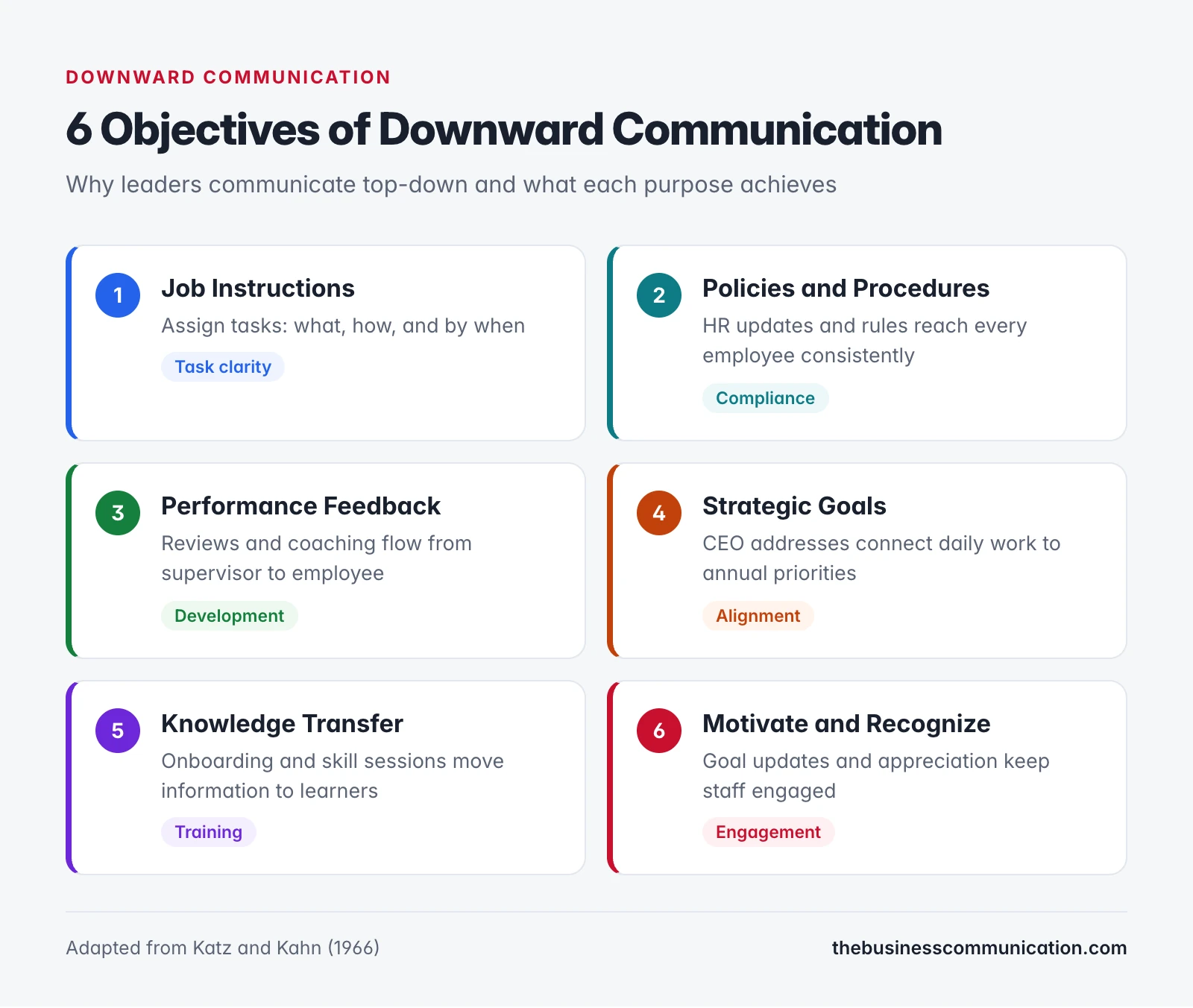
- Give clear job instructions. Managers assign tasks with precise expectations about what to do, how to do it, and by when.
- Communicate policies and procedures. HR updates, compliance rules, and safety protocols reach every employee with the same message.
- Deliver performance feedback. Annual reviews, quarterly check-ins, and real-time coaching all flow from supervisor to employee.
- Share organizational goals and strategy. A CEO’s all-hands address connects daily work to the company’s annual priorities and long-term direction.
- Transfer knowledge through training. Onboarding programs, skill sessions, and system demonstrations move information from trainers to learners.
- Motivate and recognize employees. Goal updates and messages of recognition keep staff informed and engaged.
Essential elements of effective top-down messaging
A message that reaches every employee intact depends on five things. First, clarity: plain language, no jargon. A policy written for the legal team will confuse a warehouse worker.
Second, timeliness. Late messages compete with distorted rumors already spreading through informal channels. Deliver the message when employees still need it, not after they’ve already heard garbled versions.
Third, the right channel. A sensitive performance review warrants a meeting or phone call. A routine policy update suits email or memo. The mismatch is the mistake most managers make.
Fourth, a feedback loop. Even one-way messages need a mechanism for questions. Without one, misunderstandings stay hidden until they cause real problems.
Fifth, consistency. The same core message must travel intact from the executive team to every frontline employee, regardless of how many layers it passes through.
Types and examples of top-down organizational messages
Katz and Kahn (1966) identified five categories of top-down organizational messages. These still map onto everyday workplace communication today.
- Job instructions: A supervisor telling a team member exactly what to do, in what order, and by which deadline.
- Job rationale: A manager explaining why a task matters, not just what needs to be done.
- Procedures and practices: HR issuing an updated leave policy that applies uniformly to every department.
- Performance feedback: A quarterly review where a manager evaluates an employee’s work and sets improvement goals.
- Indoctrination: A CEO all-hands address explaining the company’s vision, values, and annual priorities.
Common examples of downward communication in organizations:
- CEO announces a company-wide strategic shift at an all-hands meeting
- Manager assigns a project with a deadline via email
- HR distributes an updated leave policy to all staff
- Supervisor provides real-time coaching after observing a customer interaction
- Training team delivers a system demonstration to new hires
- Safety officer issues a new protocol after a workplace incident
- Department head shares the quarterly plan with team leads
- Employee handbook distributed to every new joiner
Which of the following is an example of downward communication? Any message that originates at a higher authority level and travels toward employees qualifies. All eight examples above meet that definition.
Advantages and disadvantages of downward communication
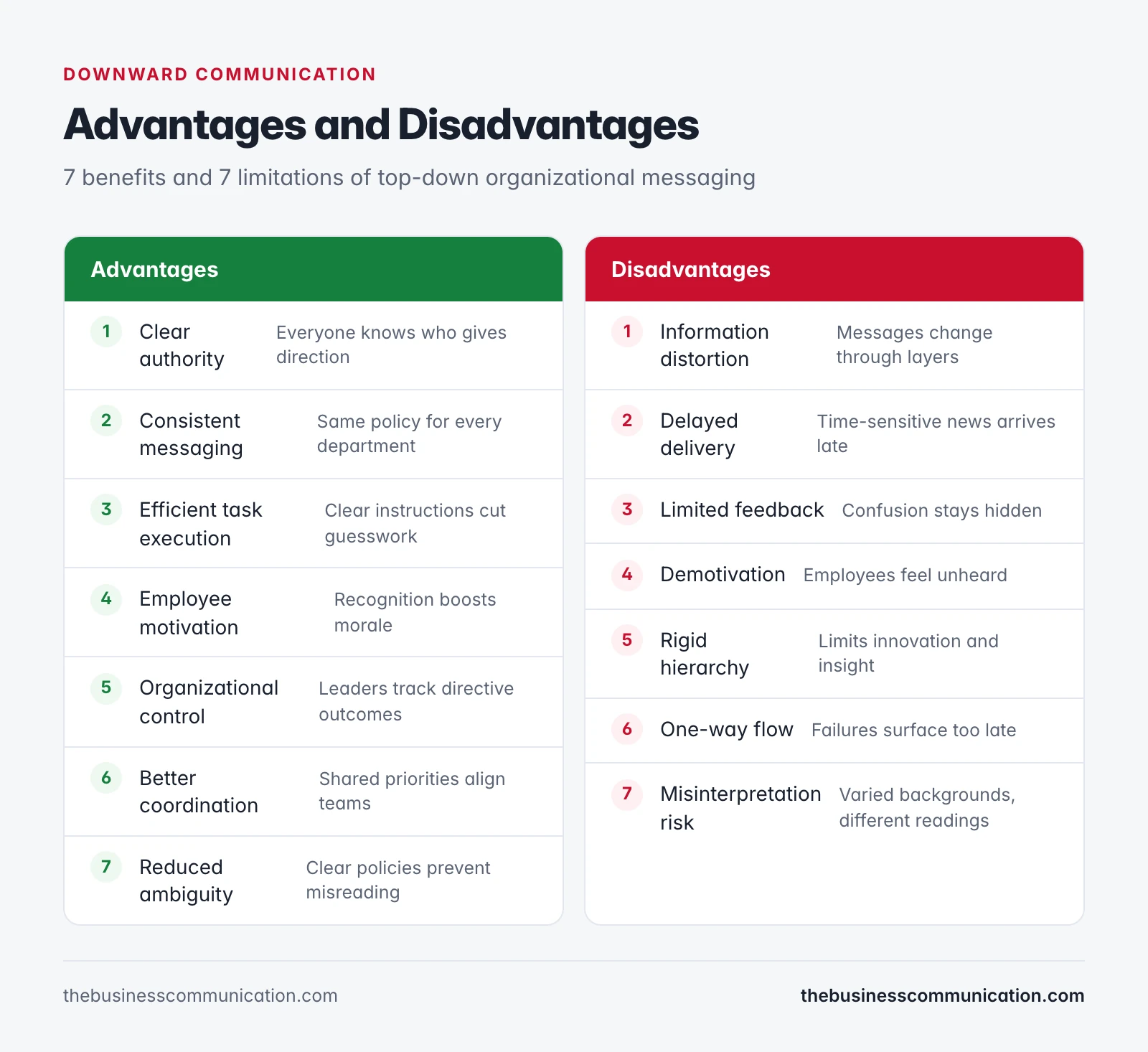
Top-down messaging has real structural benefits, but it also carries predictable risks. Both matter for leaders who want to use it well.
Advantages
- Clarity of authority. Employees know who gives direction and what they must deliver.
- Consistent messaging. A policy sent from the top is identical for every department, reducing variation and confusion.
- Efficient task execution. Clear instructions reduce guesswork and improve output quality.
- Employee motivation. Recognition messages and goal updates boost morale.
- Organizational control. Leaders can monitor whether their directives produce the right behaviors and outcomes.
- Better coordination. When all teams receive the same priorities, cross-department work falls into line.
- Reduced ambiguity. Clear policies lower the risk of different teams reading the same rule differently.
Disadvantages
- Information distortion. Messages change as they pass through multiple management layers.
- Delayed delivery. Time-sensitive messages can take days to reach frontline employees through the chain of command.
- Limited feedback. Employees rarely have an easy way to signal confusion or disagreement upward.
- Demotivation. Staff who only receive orders often feel their expertise does not matter to the organization.
- Rigid hierarchy. Over-reliance on rank limits innovation and blocks frontline knowledge from reaching decision-makers.
- One-way flow. Misunderstandings stay hidden until they cause visible operational failures.
- Misinterpretation risk. Varied backgrounds and education levels cause the same message to land differently.
Choosing the right communication channel
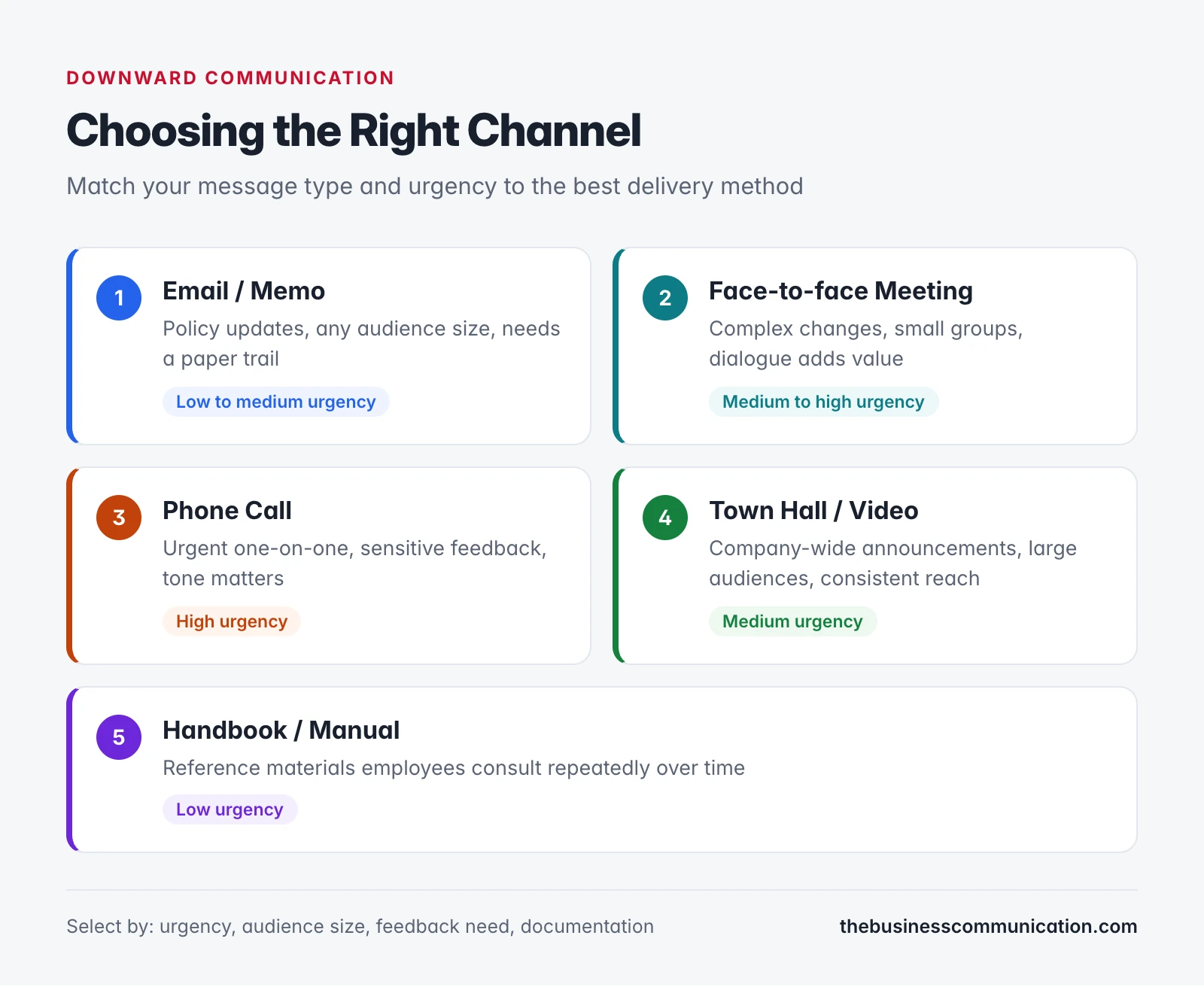
Email and memos work best for documented, non-urgent messages. Policy updates, meeting recaps, and procedural changes fit this channel well. The written record creates accountability and gives employees something to reference later.
Face-to-face meetings handle complex information better than any written channel. Strategic announcements and feedback that requires real discussion both benefit from in-person delivery. You can answer questions in real time and adjust based on what you see in the room.
Phone calls suit urgent, one-on-one situations. When a manager needs to clarify a misunderstood instruction quickly, a phone call beats email. The back-and-forth is immediate, without the formality of scheduling a meeting.
Town halls and video addresses reach large audiences consistently. A CEO announcing a major restructuring can speak to thousands of employees at once. This is especially useful for distributed teams who cannot gather in one place.
Handbooks and manuals are ongoing reference materials. Standard operating procedures and compliance guides are tools employees consult repeatedly. They carry information that does not fit in a single email or meeting.
Four factors guide the choice: urgency, audience size, need for real-time feedback, and whether a written record is required.
| Channel | Best for | Urgency | Audience size | Feedback loop |
|---|---|---|---|---|
| Email / Memo | Policy updates, documented instructions | Low to medium | Any size | Limited |
| Face-to-face meeting | Complex decisions, strategic changes | Medium to high | Small to medium | High |
| Phone call | Urgent clarification, sensitive feedback | High | Individual | High |
| Town hall / Video | Company-wide announcements, CEO messages | Medium | Large | Medium |
| Handbook / Manual | Reference materials, ongoing procedures | Low | Any size | None |
See our guide to methods of internal communication for a fuller breakdown of channel options.
Problems with downward communication
The most damaging problem is message distortion. A CEO announces a budget review to vice presidents. Each management layer adds its own interpretation. By the time the message reaches frontline staff, a routine review sounds like an imminent layoff.
Gallup’s 2024 research found that only 46% of U.S. employees say their manager provides clear expectations, down from 56% in 2020. That ten-point drop reflects how often top-down messages fail to reach employees with any precision.
- Delay. Passing a message through five management levels can take days or weeks.
- Information overload. Employees who receive too many directives start ignoring all of them, including the important ones.
- No feedback path. Leaders assume the message was understood. Employees assume leadership knows what is needed. Neither confirms.
- Psychological distance. When executives never interact with frontline staff, their messages feel abstract and disconnected from daily reality.
Prevention strategies: use written documentation for critical messages so every layer shares the exact same text; send high-stakes announcements directly via video or all-staff email; build a feedback mechanism into every major announcement; use skip-level conversations periodically to check how messages are landing without middle-management filters.
Balancing authority with two-way dialogue
Directive-only communication creates disengagement. When employees only receive instructions and never contribute ideas, engagement drops. The best staff leave for organizations that value their input.
Consider a hypothetical creative agency. The founder issues detailed instructions for every project, leaving no room for designer input on execution. Senior creatives resign, citing the same reason: their expertise does not matter here.
The problem is not the use of top-down channels. It is the absence of any return path.
Gallup’s 2025 State of the Global Workplace found that manager engagement fell from 31% in 2022 to just 22% in 2025. That decline in manager communication and coaching is the primary driver of the broader employee engagement downturn.
Top-down messaging works better when paired with genuine invitation for employee input on implementation.
The most effective leaders use top-down channels for the direction and the rationale. They invite two-way dialogue on execution details.
Practical tools: open Q&A sessions after major announcements, anonymous suggestion channels, pulse surveys following policy changes, and manager-led discussion sessions that let employees shape how a directive gets carried out.
Top-down messaging in hybrid and remote workplaces
Asynchronous work patterns complicate synchronous messaging. A 10am all-hands reaches some employees during work hours and others outside them. Someone always misses the live session.
The answer is layered delivery: a live session for those available, plus a recording, a written summary, and a FAQ document for everyone else.
Remote employees also miss informal reinforcement. In a physical office, an important policy spreads through hallway conversations. A remote employee may see it only once, in a single email, while multitasking on something else.
For distributed teams, the practical steps are:
- Announce in a live session and record it for those who cannot attend.
- Send a written summary the same day with the key points highlighted.
- Post a FAQ document for ongoing reference.
- Keep an async channel open for follow-up questions across all time zones.
Measuring communication success
Getting a message in front of people is not the same as having them understand it. Most organizations track delivery, when what actually matters is what employees do differently afterward.
Comprehension checks are the most direct test. After a major announcement, ask employees to describe the key change in their own words. Weak answers reveal that the message did not land, even if every meeting had full attendance.
Behavioral compliance tells you whether the message changed anything. If you announce a new approval process and employees keep using the old one, the communication failed. Track actual behavior change, not just open rates.
Engagement signals matter too. Low pulse-survey participation and empty Q&A sessions usually mean employees find the communication irrelevant or untrustworthy.
Message retention is often overlooked. Can employees recall key company priorities two weeks after a town hall? If not, the message did not stick.
Business outcomes are the ultimate measure. Track whether communication clarity correlates with productivity and staff turnover. Teams with consistently high communication clarity show lower attrition and stronger output over time.
Red flags to watch for: high distortion between management levels, widespread policy confusion, and delayed task execution. These are communication failures, not performance problems.
Upward vs downward communication
While top-down messaging carries direction from leadership to staff, upward communication moves the reverse: employee feedback, ideas, and concerns back to management. Both are necessary in a healthy organization.
| Downward | Upward | |
|---|---|---|
| Direction | Management to employees | Employees to management |
| Initiated by | Leaders, managers, HR | Employees, frontline staff |
| Purpose | Direct, inform, evaluate, motivate | Feedback, ideas, concerns, reports |
| Common channels | Town halls, memos, email, meetings | Surveys, suggestion boxes, one-on-ones |
| Speed | Fast from the source | Slower, often filtered by middle layers |
For a detailed breakdown with practical examples, see our guide to upward communication.
Quick exam-style summary
Downward communication is the top-to-bottom flow of information in an organizational hierarchy. Its six main objectives are giving job instructions, communicating policies, delivering feedback, sharing strategy, transferring knowledge, and motivating employees.
Key advantages: clarity, consistent messaging, and organizational control. Key disadvantages: message distortion, communication delay, and limited employee feedback. Effective use requires plain language, the right channel for each message type, and a built-in feedback loop.
Frequently asked questions
What does downward communication mean?
Downward communication is the transfer of information from higher authority levels to lower levels through an organization’s chain of command. It includes task assignments, policy updates, performance feedback, strategic goals, and training. The direction is always from leadership toward employees.
What is an example of downward communication?
A manager emailing a project brief and deadline to a team member is a typical example. Others include a CEO’s all-hands strategy announcement and an HR team distributing a new leave policy.
All share the same direction: from a higher authority level to a lower one. Any message that meets that criterion qualifies.
What is an example of a problem with downward communication?
The most common problem is message distortion. A budget review announced by a CEO may reach frontline staff as a rumor of layoffs. Each management layer adds interpretation, removes nuance, and sometimes exaggerates or softens the original message. The further the message travels, the more it can change.
What’s the difference between upward and downward communication?
Downward communication flows from management to employees. It carries directions, policies, and feedback. Upward communication flows from employees to management. It carries feedback, ideas, and concerns. Both are necessary. Organizations that rely only on top-down messaging eventually lose touch with frontline operational realities.
What are the advantages of downward communication?
The main advantages are clear authority, consistent messaging, efficient task execution, employee motivation, organizational control, better coordination, and reduced ambiguity about roles and policies. When well-executed, top-down messaging gets an entire organization working from the same set of priorities.
Should I announce a major policy change via email or in a meeting?
Use a meeting for the initial announcement. Explain the reasoning, answer questions, and gauge employee reaction in real time. Follow up with a detailed email the same day that employees can reference later. This combination gives you both the dialogue and the documentation.
What if my message gets distorted as it passes through multiple management layers?
Provide written talking points that managers share verbatim with their teams. Schedule cascade briefings where each level confirms understanding before passing the message further down. Periodic skip-level check-ins let you verify that frontline employees received the original message accurately. For high-stakes announcements, direct all-staff communications bypass the distortion problem entirely.
6 Comments
Such a great article. Reading the article from beginning to end was so enlightening. I’m so glad this came up. Knowledge is power.
thanx for the disadvantages bt you wrote the effectiveness of top down communication, although not a single was mentioned
Could you please add some examples of downward communication.
please we need info authors and dates of publication, for referencing sake
This content was published on Feb 29, 2016. And the author name “Masud Bappi”.
Thank you so much it was so helpful and well explained