


Communication media are the channels and tools you use to transmit messages from sender to receiver. Choosing the right medium, whether face-to-face conversation, email, instant message, or video call, determines how quickly your message arrives, how well it’s understood, and whether it prompts the action you need. This guide explains the primary types of communication media and when to use each one in business settings.
What is communication media?
Communication media refers to the channels or means through which messages travel from sender to receiver. In organizational contexts, media selection directly affects whether your message lands clearly, gets documented properly, or sparks confusion. A sensitive performance review delivered by email risks misinterpretation; a routine policy update announced in a 30-minute meeting wastes time.
Different media carry different amounts of information. A face-to-face conversation transmits words, tone, facial expressions, and immediate feedback. An email carries only text and whatever emotion your punctuation conveys. The medium shapes the message, as scholars have noted for decades.
Business communication fails more often from poor channel choice than from poor wording. You might craft a perfectly clear memo, but if your audience never checks their inbox, the message never arrives. You might schedule a video call for a simple yes-or-no question, burning 20 minutes when a text would have worked.
Primary categories of communication media
Business communication media fall into four broad categories, each with distinct characteristics:
Oral and verbal media include face-to-face conversations, phone calls, video calls, meetings, and conferences. These channels rely on spoken words and often include tone, pace, and vocal emphasis. Verbal and non-verbal communication work together in most oral exchanges, especially when participants share physical space or video.
Written media encompass emails, letters, memos, reports, proposals, and any text-based document. Written channels create a permanent record and allow the receiver to read at their own pace. The advantages and disadvantages of written communication depend heavily on message complexity and the need for documentation.
Visual media include charts, diagrams, infographics, slide presentations, and videos. These channels excel at conveying data patterns, spatial relationships, and processes that words describe poorly. A 500-word explanation of quarterly sales trends becomes instantly clear in a bar chart.
Digital and electronic media span instant messaging platforms, collaboration tools, social media, and cloud-based document systems. Electronic communication often blends written, visual, and oral elements. A Slack thread might contain text, screenshots, and a quick voice memo.
Synchronous vs. asynchronous media
One of the most practical ways to categorize communication media is by timing: does the exchange happen in real time, or can participants respond on their own schedule?
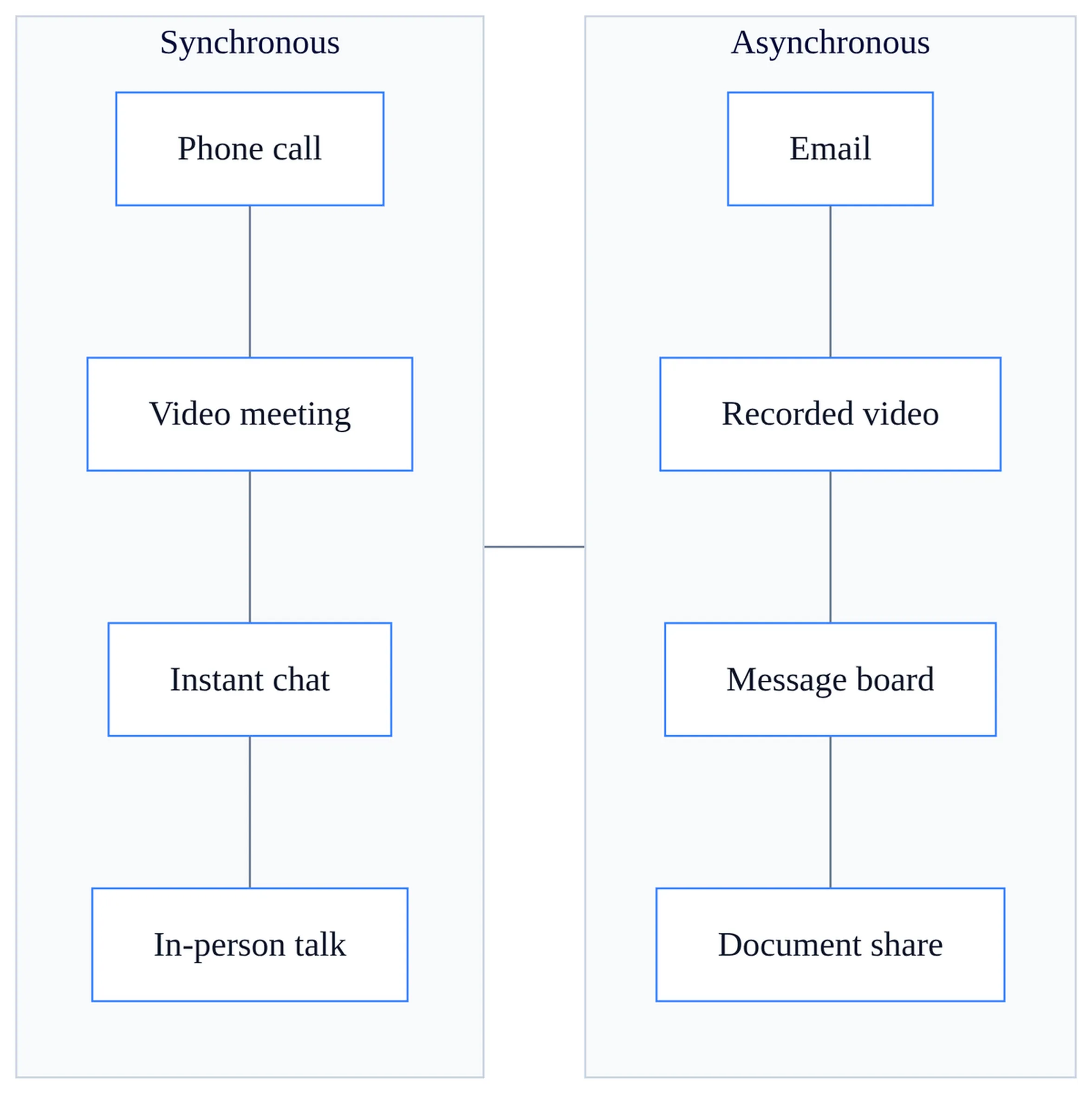
Synchronous media require both sender and receiver to be present simultaneously. Face-to-face conversations, phone calls, video conferences, and live chat all demand real-time participation. These channels work best when you need immediate feedback, want to build rapport quickly, or must resolve a complex issue through back-and-forth discussion. The main drawback? Scheduling. Getting five people on a video call often takes more effort than the meeting itself.
Asynchronous media allow delayed responses. Email, recorded video messages, documents, and message boards let receivers consume the content when convenient. A product manager in Dhaka can send a detailed project update via email that a colleague in New York reads six hours later. Asynchronous channels respect time zones, reduce interruptions, and create automatic documentation.
Voicemail is a useful example of an asynchronous oral medium: the message is spoken, so it keeps the sender’s tone of voice, but the receiver listens to it later.
Hybrid work has made this distinction critical. A small software team might use synchronous video standups for daily check-ins but rely on asynchronous Slack threads for detailed technical discussions. Urgent budget approvals might demand a synchronous phone call, while routine expense reports flow through asynchronous email workflows.
What most people get wrong: treating all messages as urgent and defaulting to synchronous channels. A question that could wait three hours becomes a video call that derails someone’s focus work. Reserve synchronous media for genuinely time-sensitive or relationship-critical communication.
Channel richness and media selection
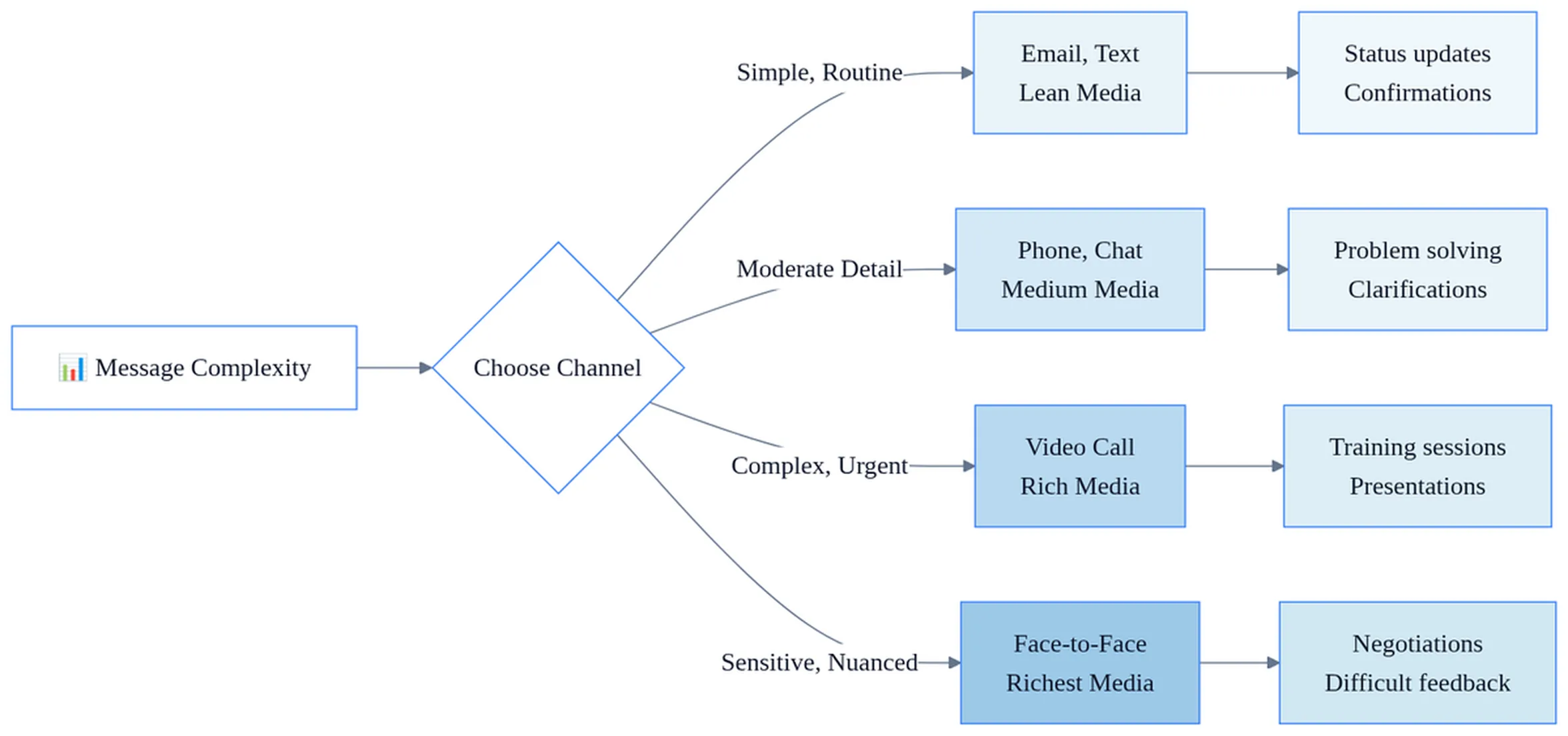
Channel richness theory, developed by organizational researchers, explains why some media handle complex messages better than others. Rich media carry multiple information cues, allow immediate feedback, and convey personal focus. Lean media offer fewer cues, delayed feedback, and less personal connection.
| Media Type | Richness Level | Information Cues | Best Use Cases |
|---|---|---|---|
| Face-to-face conversation | Richest | Words, tone, facial expressions, gestures, immediate feedback | Performance reviews, conflict resolution, relationship building |
| Video conferencing | High | Words, tone, facial expressions, some gestures, real-time feedback | Remote team meetings, client presentations, interviews |
| Phone call | Medium-high | Words, tone, real-time feedback | Quick decisions, clarifications, informal check-ins |
| Voicemail | Medium | Words, tone, delayed feedback | Short, time-sensitive messages when the person cannot pick up |
| Medium-low | Words only, delayed feedback | Routine updates, documented instructions, non-urgent requests | |
| Text message / IM | Lean | Brief text, delayed or quick feedback | Simple yes/no questions, status updates, quick coordination |
| Formal report | Leanest | Structured text, no immediate feedback | Detailed analysis, compliance documentation, archived records |
Match message complexity to channel richness. When you need to deliver bad news, discuss ambiguous strategy, or negotiate terms, choose a rich medium. The immediate feedback loop helps you gauge reactions and adjust your approach. When you’re sharing straightforward information, lean media work fine and save everyone time.
A practical example: imagine you’re a regional manager who needs to explain a 15% budget cut to your team. An email (lean medium) will spark confusion and anxiety because people can’t ask clarifying questions or see your reassuring tone. A video call (rich medium) lets you explain the context, answer concerns in real time, and demonstrate that leadership hasn’t abandoned the team.
Oral communication media
Face-to-face conversation remains the richest communication medium available. You pick up micro-expressions, adjust your message mid-sentence based on listener reactions, and build trust through physical presence. Sales negotiations, mentorship conversations, and difficult feedback sessions all benefit from in-person interaction. The advantages and disadvantages of oral communication become most apparent in face-to-face settings, where clarity is high but documentation is absent unless you take notes.
Phone and mobile calls strip away visual cues but preserve tone and real-time feedback. A five-minute phone call often resolves issues that would take 20 emails. Customer service teams, remote sales reps, and executives coordinating across time zones rely heavily on voice calls. The limitation? No visual aids. Trying to explain a complex spreadsheet over the phone frustrates everyone involved.
Video conferencing has become essential for distributed teams. Tools like Zoom, Microsoft Teams, and Google Meet combine visual and auditory channels, letting participants see reactions and share screens. Video conferencing works especially well for presentations, collaborative problem-solving, and maintaining team cohesion when people work remotely.
Meetings and conferences gather multiple people for synchronous oral communication.
A well-run meeting aligns teams, surfaces concerns, and reaches decisions faster than email threads. A poorly run meeting wastes collective time and could have been an email. The difference lies in agenda clarity and participant preparation.
Voicemail
Voicemail is a system that records a spoken message when the receiver cannot answer a phone call, so they can listen to it later. It is the oral counterpart of email: email carries written words, while voicemail carries the sender’s voice. Because the receiver responds on their own schedule, voicemail is oral content in an asynchronous channel.
Advantages of voicemail
- Reaches people who are unavailable: the message waits for the receiver instead of being lost when a call goes unanswered.
- Kept for later listening: the receiver can play the message at a convenient time and replay it if needed.
- Carries tone of voice: urgency, warmth or concern come through in a way that text often loses. It also suits receivers who read poorly.
Disadvantages of voicemail
- Poor for long or complex messages: details, figures and instructions are hard to follow and remember by ear.
- Language and accent barriers: if sender and receiver do not share a language or accent, the message may be misunderstood.
- Slow to retrieve and scan: the receiver has to listen from start to finish rather than skim, as they would with text.
Modern forms such as visual voicemail and automatic transcription show messages as a list or as text, which reduces the slow-to-scan problem.
How to leave a professional voicemail
- State your name and organization at the start.
- Give the reason for your call in one sentence.
- Mention the one key detail, request or deadline.
- Say your call-back number slowly, and repeat it.
- Keep it short, and close politely. Follow up in writing if details matter.
Written communication media
Written channels create permanent records and allow careful message crafting. A business letter conveys formality and legal weight; an email balances speed with documentation; a business memo distributes internal information efficiently.
Business letters and formal documents serve official purposes: contracts, formal proposals, legal notices, and executive correspondence. Despite digital alternatives, letters still signal importance and create legally binding records. A 500-employee manufacturing firm might send offer letters and termination notices as physical documents to ensure receipt and formality.
Email dominates daily business communication. It’s fast, searchable, and creates automatic documentation. Email works well for non-urgent information sharing, project updates, and coordinating schedules. The weakness? Overuse.
Memos communicate internal information concisely. A two-paragraph memo announcing a policy change reaches everyone simultaneously and provides a reference document. Memos work best for routine announcements, procedural updates, and brief directives that don’t require discussion.
Reports and proposals deliver detailed analysis, research findings, and formal recommendations. A 30-page market analysis report documents methodology, presents data, and supports strategic decisions. These documents live in archives and inform future planning, making accuracy and clarity essential.
Digital and emerging media
Digital platforms have transformed business communication in the past decade, creating hybrid channels that blend written, oral, and visual elements.
Instant messaging platforms like Slack, Microsoft Teams, and WhatsApp enable quick, informal exchanges. A developer can ask a quick question in Slack and get an answer in 90 seconds, avoiding the formality of email and the interruption of a phone call. These platforms support threaded conversations, file sharing, and searchable history. The risk? Constant notifications fragment attention, and important decisions made in chat threads can get lost.
Collaboration platforms such as Google Workspace, Microsoft 365, and Notion let teams create, edit, and comment on documents simultaneously. Five people can build a presentation together, seeing each other’s changes in real time. This asynchronous-yet-interactive model works especially well for distributed teams across time zones. A marketing team in Manila can draft content that a design team in London refines eight hours later.
Social media serves external communication needs: brand messaging, customer engagement, and stakeholder updates. LinkedIn posts reach professional networks, Twitter handles customer service inquiries, and Facebook groups build community around products. These channels offer broad reach and direct audience interaction but demand careful tone management and quick response times.
Most organizations now use a media mix. A tech startup might coordinate daily work through Slack, hold weekly video standups, document decisions in Notion, and send formal updates via email. The key is establishing clear norms: which channel for which purpose, expected response times, and escalation paths for urgent issues.
Choosing the right communication medium
Media selection shouldn’t be random or habitual. Apply these criteria systematically:
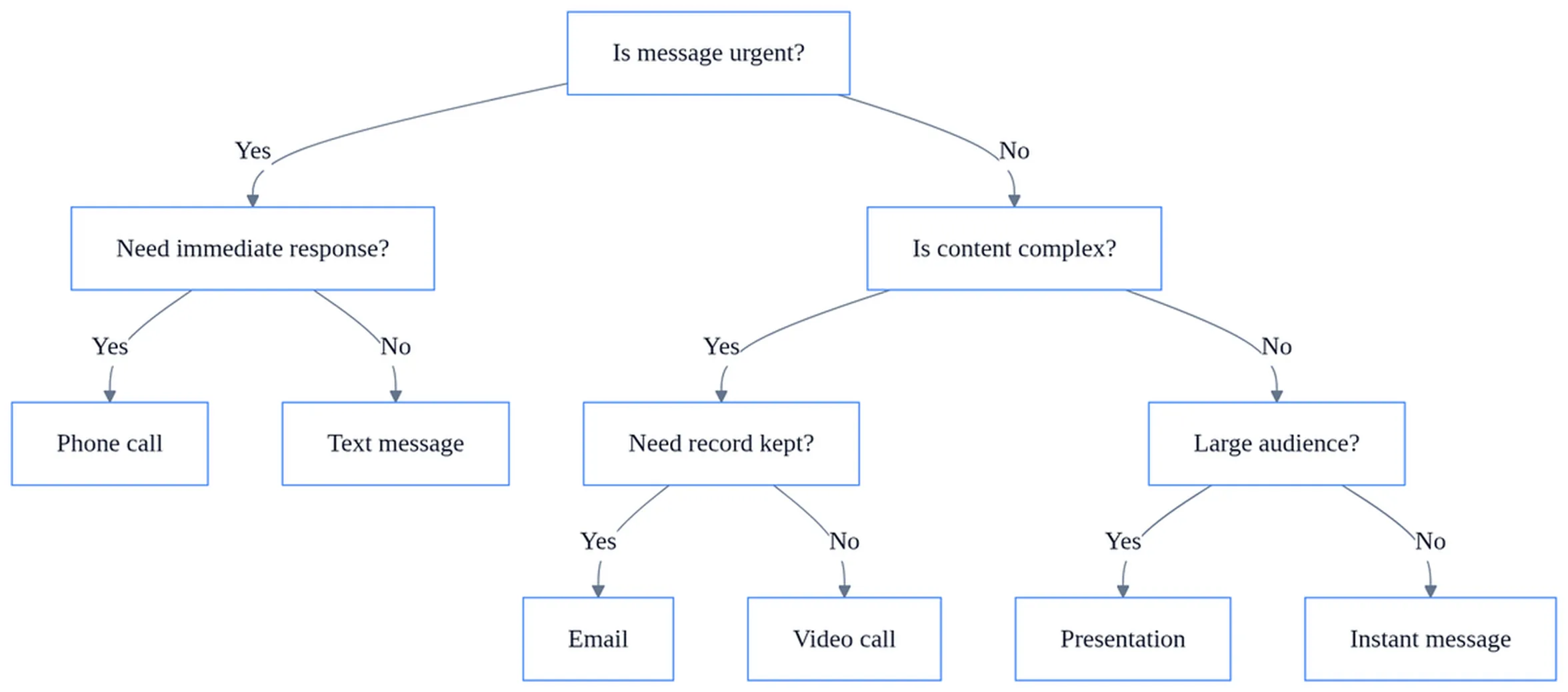
Message urgency determines timing requirements. A server outage demands synchronous communication, phone calls or instant messages. A quarterly review summary can travel via asynchronous email. Urgent doesn’t always mean important, and important doesn’t always mean urgent. A strategic plan is important but rarely urgent enough to interrupt someone’s focus work.
Message complexity guides richness selection. Explaining a new commission structure with multiple tiers and exceptions? Use a rich medium like video or face-to-face conversation, supplemented by written documentation. Confirming a meeting time? Text message works fine.
Audience size affects channel choice. One-to-one conversations suit phone calls or direct messages. Team updates work well in email or Slack channels. Company-wide announcements might require a combination: an all-hands video meeting followed by a detailed email for reference.
Documentation needs favor written channels. If you need proof of what was said, when it was said, and who agreed, use email, memos, or collaboration platform comments. Oral channels require separate documentation through meeting minutes or follow-up summaries.
Organizational culture shapes acceptable media use. A formal law firm might default to email and scheduled calls, while a startup culture might run entirely on Slack and impromptu video chats. New employees should observe existing patterns before breaking norms.
Cost and accessibility matter in resource-constrained settings. Video conferencing requires reliable internet bandwidth, not always available in rural areas or developing regions. A small business in a Bangladeshi district town might rely more heavily on phone calls and WhatsApp than on Zoom, simply because connectivity is inconsistent.
Voicemail, text or email? Leave a voicemail for a short, time-sensitive message when the person cannot pick up. Send a text for a brief fact they can read at a glance. Use email when the details must be recorded, and follow up a voicemail in writing if the details matter.
Here’s a practical framework: ask yourself whether this message requires immediate feedback. If yes, go synchronous. Next, is this message complex, sensitive, or ambiguous? If yes, choose a rich medium. Finally, do you need a permanent record? If yes, use a written or recorded channel. These filters will steer you toward the right choice most of the time.
The real skill isn’t mastering every communication tool. It’s knowing when to use which one. A manager who sends a 2,000-word email when a five-minute conversation would work wastes time. A team lead who schedules video calls for every minor question creates meeting fatigue. If you’re sitting on the fence about which medium to use, the answer is usually the one that respects your audience’s time while still delivering the message clearly. Match your medium to your message, and document what matters.
Frequently asked questions
What are the types of communication media?
Business communication media fall into four broad categories: oral and verbal media (face-to-face talks, phone calls, video calls, meetings), written media (emails, letters, memos, reports), visual media (charts, diagrams, slides, videos) and digital or electronic media (instant messaging, collaboration tools, social media).
Is voicemail oral or written communication?
Voicemail is oral communication. The message is spoken rather than written, but because it is heard later, it travels through an asynchronous channel, much like email does for written messages.
Should I use email or a phone call to deliver critical feedback?
Use a phone call or face-to-face meeting. Critical feedback requires tone, immediate clarification, and relationship repair—all impossible in email. Email risks misinterpretation and creates a harsh written record. A synchronous channel lets you gauge the recipient’s reaction and adjust your approach in real time.
What if my team is spread across time zones—how do I choose between synchronous and asynchronous?
Default to asynchronous for routine updates, decisions, and documentation. Use synchronous only when genuinely urgent or relationship-critical. Record video messages or host rotating meeting times for important discussions. Asynchronous channels respect time zones and reduce burnout while still keeping teams aligned.
Is it wasteful to send a detailed explanation via email when a quick call would be faster?
Not if the recipient needs to reference the information later or work across time zones. Email creates a searchable record and lets the receiver digest complex details at their own pace. A call works better for immediate decisions or when you need real-time feedback. Choose based on whether documentation matters.
Why do my instant messages get ignored while emails get responses?
IM is lean media—it signals low urgency and easy dismissal. Email lands in an inbox people check regularly and creates a task. If your IM needs action, follow up with email or a call. Reserve IM for quick coordination; use richer media when you need accountability or a documented response.
Can I mix media—like start a discussion in Slack then move to email for the final decision?
Yes. Use Slack for brainstorming and quick feedback, then send a formal email summarizing the decision and next steps. This approach captures the benefits of both: real-time collaboration plus a documented record. Just make sure the final decision email is clear and stands alone for anyone who didn’t see the Slack thread.
13 Comments
coherent. many thanks to you
Very nc
Great to learn about communication,
very nice and helpful
Nice article ! Why don’t you write down on digital medium of comminication like Whastapp API and mails.
It is clear, and understandable..thankyou
what are the types of communications used in media on social justice issues
All types are used. No matter what kind of media, information on social justice issues can be posted everywhere
What does loud media expression means? Concept pls?
Very understandable article
Nice article. Fair explanation of all communication channels.
For a beginner, could you explain the sequence in which he/she should start learning the mentioned skill of communications.
good
Clear article , understandable. Thank you