


Have you ever sent an email to your team and assumed the job was done? You hit “send,” sat back, and waited for the results. But a week later, you realized that half the team didn’t read it, and the other half completely misunderstood it.
This is the classic difference between sending information and communicating.
In the corporate world, information flows from the top down. We call this downward communication. It is the backbone of organizational structure. It is how CEOs share their vision and how managers assign tasks.
However, the mere existence of this flow does not guarantee its success. Just because water flows downhill doesn’t mean it reaches the fields that need irrigation. It might get blocked, diverted, or evaporated along the way.
So, how do we determine if this process is actually working?
In this guide, we will explore the effectiveness of downward communication. We will look at the signs of success, the hidden barriers that block the flow, and most importantly, how you can measure if your message is truly landing.
If you need a quick refresher on the basics before we dive deep, you can check our definition of what is downward communication.
Signs of Effective Downward Communication
How do you know if your communication is effective? Is it when everyone nods their heads in a meeting? Not necessarily. Effectiveness is not about compliance; it is about comprehension and action.
When downward communication is working effectively, you will see specific signs in your workplace.
Clear Understanding
Above all, effectiveness means understanding. Employees should know exactly what is expected of them. There is no ambiguity. When a manager gives an instruction, the employee shouldn’t have to guess the details.
Timely Action
Effectiveness is also measured by speed. When a directive comes down from the top, does it trigger immediate action? Or does it sit in an inbox for days? In an effective system, instructions are executed without unnecessary delay.
Organizational Alignment
Imagine a rowing team. If everyone rows at their own pace, the boat spins in circles. If everyone rows in sync, the boat flies.
Effective downward communication creates this synchronization. It ensures that every department is moving toward the same goals. If you want to dive deeper into what these goals should be, read our post on the objectives of downward communication.
Factors Influencing Effectiveness
Why does communication work well in one company and fail in another? Several variables determine the success of the downward flow.
Organizational Climate (Trust)
Trust is the currency of communication. If employees trust their management, they will listen. They will assume the message is for their benefit.
Conversely, if the organizational climate is toxic, employees will view every memo with suspicion. They will read between the lines, looking for hidden agendas. Therefore, building a culture of trust is a prerequisite for effectiveness.
Choice of Medium
You wouldn’t use a megaphone to tell someone a secret. Similarly, choosing the wrong medium can kill effectiveness.
For complex, detailed policies, written communication is best. It allows the employee to read and re-read the information. On the other hand, for sensitive news or motivation, oral communication is far superior.
Managers must be skilled at selecting the right channel for the right message. To understand the nuances between these two channels, you can explore the difference between oral and written communication.
Information Volume
We live in the age of information overload. A common mistake managers make is thinking that more communication is better communication.
This is false. If you bombard your employees with ten emails a day, they will stop reading them. Effectiveness relies on brevity. It relies on prioritizing quality over quantity.
Feedback Mechanism
How do you know if the receiver understood the message? You need feedback.
Effectiveness is a two-way street. Even though the information flows downward, there must be a mechanism for questions to flow upward. Without this, you are flying blind. For a deeper look at why this loop matters, read about the necessity or importance of feedback.
Barriers that Reduce Effectiveness
Despite our best efforts, messages often get garbled. There are specific barriers that attack downward communication as it travels through the hierarchy.
Filtering
This is a human problem. As information passes through middle management, it often gets “filtered.”
A manager might withhold bad news to protect their team’s morale. Or, they might block good news to prevent jealousy. While the intention might be good, the result is that the top management’s message never reaches the bottom in its original form.
Distortion
Have you played the “Telephone Game”? You whisper a phrase to the person next to you, and it changes completely by the time it reaches the end of the line.
In business, this is called distortion. Each layer of management adds their own interpretation to the directive. By the time it reaches the frontline, a request to “cut costs” might be interpreted as “layoffs are coming.”
Semantic Barriers
Managers often speak a different language than employees. They use corporate jargon, acronyms, and complex buzzwords.
If a factory worker doesn’t understand what “paradigm shift” or “synergy” means, the communication has failed. Simplicity is key.
Psychological Distance
Sometimes, the barrier is not physical but psychological. If the executives sit in an ivory tower and never interact with the staff, a gap forms. Employees feel disconnected. This distance makes them less likely to internalize messages from the top.
To learn more about the different obstacles that block understanding, check out our guide on the types of communication barriers.
How to Measure the Effectiveness
This is the most critical part. You cannot improve what you cannot measure. But how do you measure something as intangible as communication?
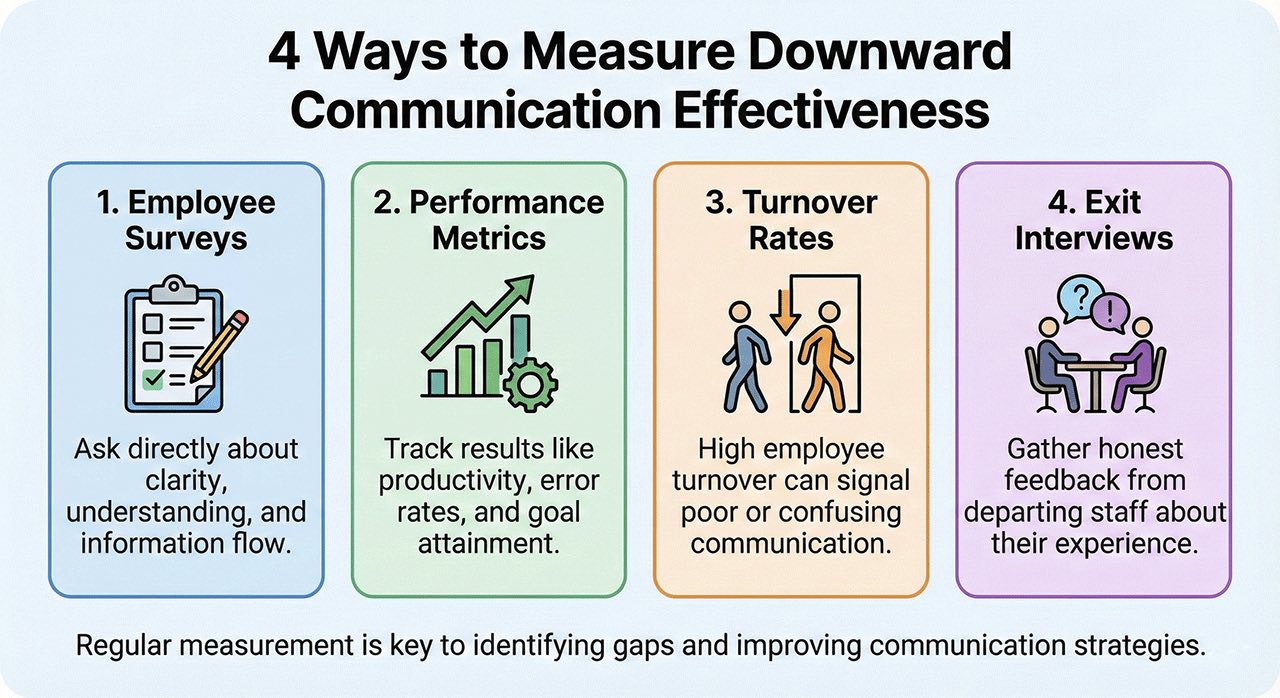
Here are four practical methods to assess the effectiveness of your downward flow.
1. Employee Surveys
The simplest way is to ask. Conduct regular “pulse surveys” asking specific questions about communication.
- “Do you understand the company’s goals for this year?”
- “Do you feel informed about major changes?”
- “Is the feedback you receive helpful?”
If the majority answers “no,” your downward communication is ineffective, regardless of how many newsletters you send.
2. Performance Metrics
Actions speak louder than words. If you communicated a new safety procedure, are accidents going down? If you explained a new sales strategy, are conversion rates going up?
Check the data. If the metrics haven’t moved, it implies the message wasn’t received or understood.
3. Turnover Rates
People rarely leave jobs; they leave managers. High turnover is a red flag. It often indicates that employees feel disconnected, undervalued, or confused—all symptoms of poor downward communication.
4. Exit Interviews
When people leave, they are often brutally honest. Use exit interviews to gather data. Ask departing employees if they felt well-informed during their tenure. Their answers can reveal blind spots in your communication strategy.
The Impact of Effectiveness on Business Success
Why does all this matter? Is it worth the effort?
Absolutely. When downward communication is effective, the entire organization benefits. Productivity rises because people aren’t wasting time guessing what to do. Errors decrease because instructions are clear.
Moreover, morale improves. Employees feel respected when they are kept in the loop. They feel like partners in the business.
Conversely, ineffective communication leads to chaos, rumors, and low engagement. To weigh the full scope of benefits and risks, you can review the advantages and disadvantages of downward communication.
Strategies to Enhance Effectiveness
If you have realized that your current communication isn’t effective, don’t panic. It is fixable.
The key is to move from a mindset of “telling” to a mindset of “connecting.” You need to be clear, concise, and empathetic. You need to verify that your message was understood.
We have covered the assessment here, but if you are ready to take action and implement specific solutions, we have a step-by-step guide waiting for you. Read our detailed post on how can you make downward communication effective to start transforming your strategy today.
Conclusion
Effectiveness in downward communication is not a destination; it is a journey. It requires constant attention.
You cannot just set up a system and forget it. You must constantly check for barriers like filtering and distortion. You must constantly measure your success through surveys and feedback.
Remember, the goal is not just to transfer information. The goal is to create a shared understanding that drives the organization forward.
So, the next time you draft a memo or stand up to give a speech, ask yourself: “Will this actually be effective?” The answer lies not in what you say, but in what your team hears, understands, and does.
Frequently asked questions
What if employees nod in meetings but don’t actually understand the message?
Nodding doesn’t equal comprehension. True effectiveness requires employees to demonstrate understanding through action and questions. Use feedback mechanisms like follow-up surveys, one-on-ones, or asking employees to summarize the directive back to you. If understanding is unclear, the message failed—regardless of apparent agreement in the room.
How do I prevent middle managers from filtering or distorting my message?
Establish clear communication protocols that bypass unnecessary layers when possible. Provide managers with the exact language and context for directives so they can’t reinterpret them. Use written documentation for critical messages. Hold managers accountable for accurate transmission. Consider occasional direct communication from leadership to frontline staff to verify the message arrived intact.
Should I send one detailed email or multiple shorter messages to avoid overload?
One well-structured message beats multiple emails. Employees stop reading after too many messages. Consolidate related information into a single, clear communication with a logical structure. Use formatting (bullets, headers) to aid scanning. If the topic is truly complex, send one message with a clear call-to-action and offer follow-up sessions for questions.
What’s the best way to measure if downward communication actually worked?
Measure three things: comprehension (do employees understand expectations?), action (are directives executed on time?), and alignment (are departments moving toward shared goals?). Use surveys, task completion rates, and one-on-one check-ins. Ask employees to explain the message back to you. Track whether problems arise from misunderstanding versus other causes.
Can I use email for sensitive or motivational messages, or must I speak in person?
Avoid email for sensitive news or motivation. These require tone, empathy, and the ability to respond to reactions—things email cannot convey. Use oral communication (in-person or video) for layoffs, major changes, or messages meant to inspire. Reserve email for detailed policies, procedures, and information employees need to reference later.
How do I close the psychological distance between executives and frontline staff?
Reduce the ivory tower effect through regular, visible interaction. Have leaders attend team meetings, visit work areas, and engage in informal conversations. Share context behind decisions so employees understand the ‘why.’ When staff feel connected to leadership, they’re more likely to internalize messages and trust the organization’s direction.
3 Comments
thanx for the disadvantages bt you wrote the effectiveness of top down communication, although not a single was mentioned
please we need info authors and dates of publication, for referencing sake
This content was published on Feb 29, 2016. And the author name “Masud Bappi”.