


Business communication isn’t just about sending messages, it’s about ensuring those messages are understood the way you intended. When a CFO emails “We need to tighten controls,” the finance team hears process refinement while the product team hears budget cuts. This gap between what you say and what others hear determines whether projects succeed, teams align, or conflicts escalate. Eight specific factors shape how your messages are interpreted in professional settings, and recognizing them helps you diagnose miscommunication before it derails work.
What is business communication and why meaning matters
Business communication is the exchange of information between people in a professional context where shared understanding drives decisions and action. The critical word here is “shared.” A message successfully transmitted is not the same as a message correctly understood.
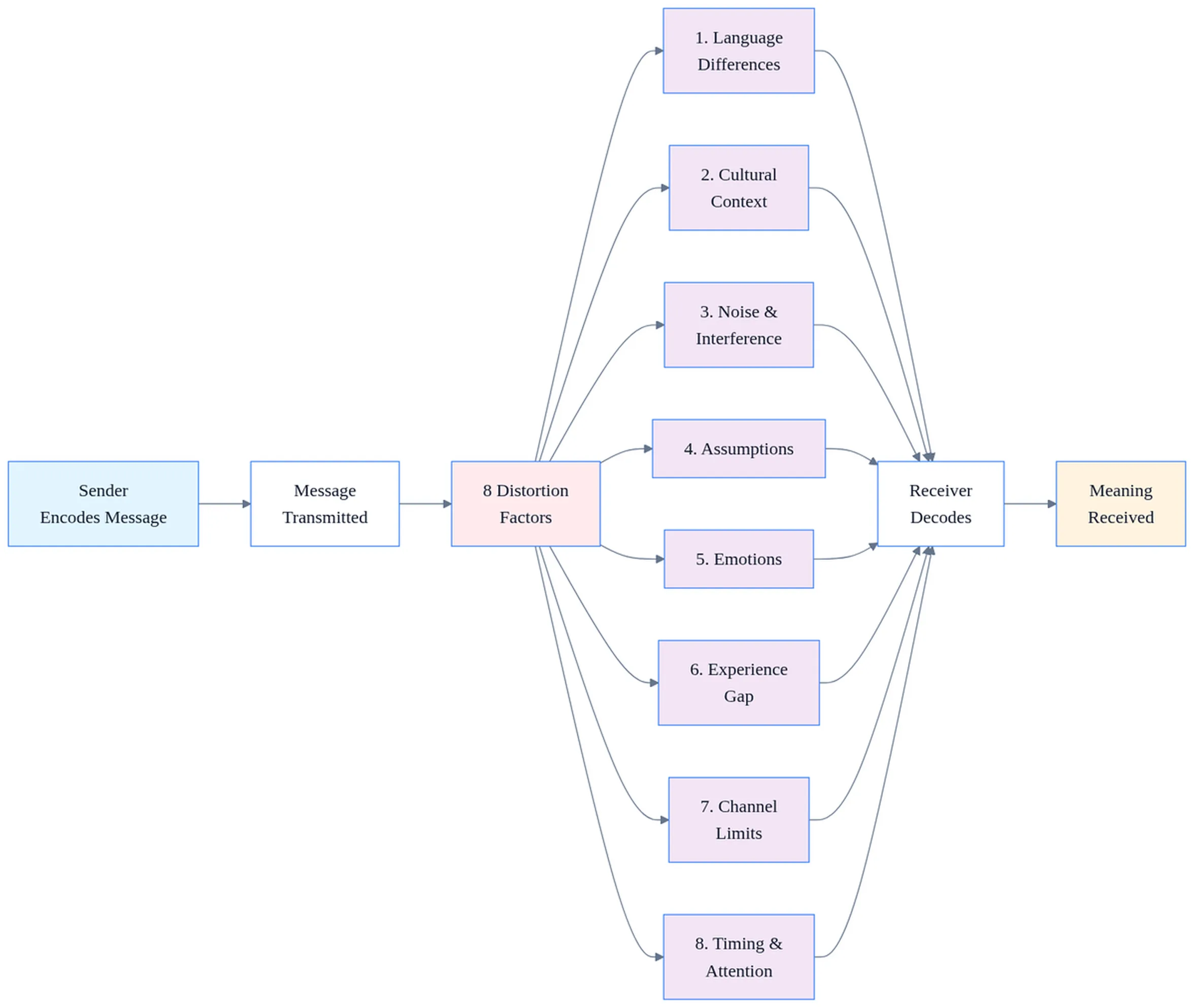
The sender encodes an idea using words, tone, and context they think are clear. The receiver decodes that message through their own filters, their department’s priorities, their past experience with the sender, their stress level that day. When those filters distort the original meaning, you get delayed projects, duplicated work, or interpersonal conflict.
Miscommunication costs organizations with 100 employees an average of $420,000 per year in lost productivity and rework, according to workplace communication consultant Debra Hamilton (source). For larger companies, the figure climbs into the millions.
Functional and departmental silos
People who work in different departments often speak different professional dialects. A financial controller discussing “accruals” and “variance analysis” assumes everyone shares their accounting framework. A product manager talking about “user stories” and “sprint velocity” expects familiarity with agile methodology. When these two exchange messages, each interprets the other’s words through their own functional lens.
Consider a real scenario: A finance director sends an email asking the product team to “justify the ROI on the new feature set before Q3 close.” The product director reads this as a request for user engagement metrics and sends back click-through rates and session duration data. Finance wanted a cost-benefit analysis with revenue projections. Both parties thought they were clear. Neither got what they needed.
Cross-functional teams struggle most when members don’t recognize they’re using the same words to mean different things. “Risk” means regulatory exposure to compliance, technical debt to engineering, and market volatility to sales. Without shared context, even simple requests become multi-round clarification loops.
The fix isn’t eliminating jargon, it’s recognizing when you’re crossing functional boundaries and adding one extra sentence of context. “By ROI, I mean projected revenue minus development costs” takes three seconds and prevents a week of back-and-forth.
Positional hierarchy and power dynamics
Your position in the organizational hierarchy changes how others interpret your words and how carefully you listen to theirs. When a senior executive says “I’d like to explore this idea,” subordinates often hear a directive and scramble to implement it. When a junior employee says “We might want to reconsider the timeline,” managers may dismiss it as inexperience rather than a valid concern.
This isn’t just about formality. Power dynamics create psychological filters. Subordinates often soften bad news or bury critical feedback in euphemisms because they fear career consequences. A project manager might say “We’re facing some minor resourcing challenges” when they mean “We’re three people short and will miss the deadline by a month.”
Senior leaders, meanwhile, tend to communicate in abstractions. A CEO announcing “We need to be more agile and customer-focused” thinks they’ve given clear direction. Front-line staff hear buzzwords with no actionable guidance. The hierarchy gap means neither side realizes the message didn’t land.
The relationship between rank and communication runs both ways. For a deeper look at how information flows, or fails to flow, up and down organizational structures, see our guide to vertical communication.
Educational and intellectual differences
When sender and receiver share similar educational backgrounds, they share mental models, vocabulary, and reference points. A team of engineers with computer science degrees can use technical shorthand because they’ve all studied the same concepts. Drop a self-taught developer or a business analyst into that conversation, and half the meaning evaporates.
Educational differences don’t just mean formal degrees. Industry experience, specialized training, and professional certifications all create knowledge gaps. A marketing manager with an MBA might reference Porter’s Five Forces or the Ansoff Matrix and expect recognition. A graphic designer without business school training hears jargon, not strategy.
The trap is assuming your level of knowledge is universal. You’ve spent years building expertise, so terms like “net present value” or “continuous integration” feel basic. To someone outside your domain, they’re opaque.
Bridging educational gaps requires simplifying without condescending. Instead of saying “Let’s calculate the NPV to determine project viability,” try “Let’s figure out if this project will make more money than it costs when we account for timing.” Then, if the other person wants the technical term, they’ll ask. Most people would rather admit they don’t know a term than sit through a meeting pretending to understand.
Group affiliations and identity
People naturally cluster into formal and informal groups, and those affiliations shape how they interpret messages. Formal groups include departments, project teams, labor unions, and management tiers. Informal groups form around age, gender, tenure, regional background, or shared interests.
In-group members assume shared understanding. When two senior managers who’ve worked together for a decade exchange a three-word Slack message, they’re drawing on years of context. A new hire reading the same thread has no idea what’s actually being communicated. This isn’t intentional exclusion, it’s cognitive shorthand that forgets not everyone shares the history.
Cross-group communication requires explicit context that feels redundant to insiders. Union representatives and management may use identical words, “fair compensation,” “productivity standards”, but interpret them through opposing frameworks shaped by their group’s interests and past conflicts. A manager proposing “flexible scheduling” sees employee empowerment; a union rep sees erosion of overtime protections.
Regional and cultural group affiliations add another layer. In a Dhaka-based software company with both local and returning expatriate employees, a phrase like “let’s table this discussion” means opposite things depending on whether you learned English in South Asia (put it on the agenda) or North America (postpone it indefinitely).
Emotional state and interpersonal history
Your emotional state when you receive a message colors how you interpret it. Read an email when you’re calm and rested, and a manager’s “Can we talk about the report?” feels neutral. Read the same email after a stressful client call, and it feels like criticism.
Emotions act as interpretive filters. Stress amplifies perceived threats. Fatigue reduces your ability to catch nuance. Anger makes you read hostility into ambiguous phrasing. A doctor delivering a diagnosis to a patient’s family demonstrates professional detachment because emotional distance is necessary for clear communication. The family, experiencing acute stress, may interpret that same detachment as coldness or indifference.
Past communication history between the same sender and receiver compounds emotional effects. If your last three interactions with a colleague involved them missing deadlines, you’ll interpret their next “I’ll get this done soon” with skepticism. If a manager once publicly criticized your work, you’ll read every subsequent email from them as potential criticism, even when they’re genuinely praising you.
Trust deficit is the killer. When you doubt someone’s intentions, you interpret ambiguous messages negatively. A simple “Let’s discuss this” becomes “They’re going to blame me” if trust is low. Rebuilding that trust requires consistent, explicit communication over time, and sometimes, direct acknowledgment of past friction.
Language, jargon, and cultural context
Words carry different meanings across technical domains, industries, and cultures. Technical jargon creates barriers when the receiver doesn’t share the sender’s specialized vocabulary. Sometimes this is intentional, professionals use precise terms to communicate efficiently with peers. More often, it’s unconscious; you forget that “churn rate” or “technical debt” aren’t universally understood.
Idioms and cultural references fail when sender and receiver come from different linguistic or regional backgrounds. The classic example: a British manager tells their American colleague they’ll deliver a report “in a fortnight.” The American, unfamiliar with the term, might hear “fourth night” and expect it in four days rather than two weeks. Neither realizes the confusion until the deadline passes.
Colloquialisms rarely translate. “Let’s touch base,” “circle back,” “move the needle”, these phrases are workplace staples in some regions and meaningless corporate-speak in others. When a multinational team spans Indian, Bangladeshi, European, and North American offices, even simple phrases require extra thought.
For deeper strategies on navigating linguistic and cultural interpretation gaps, see our guide to cross-cultural communication.
How digital channels amplify these factors
Remote and hybrid work have made asynchronous digital communication the default for many teams, and every factor we’ve discussed gets amplified when you remove real-time feedback. Email, Slack, and project management tools strip away tone of voice, facial expressions, and the ability to immediately clarify misunderstandings.
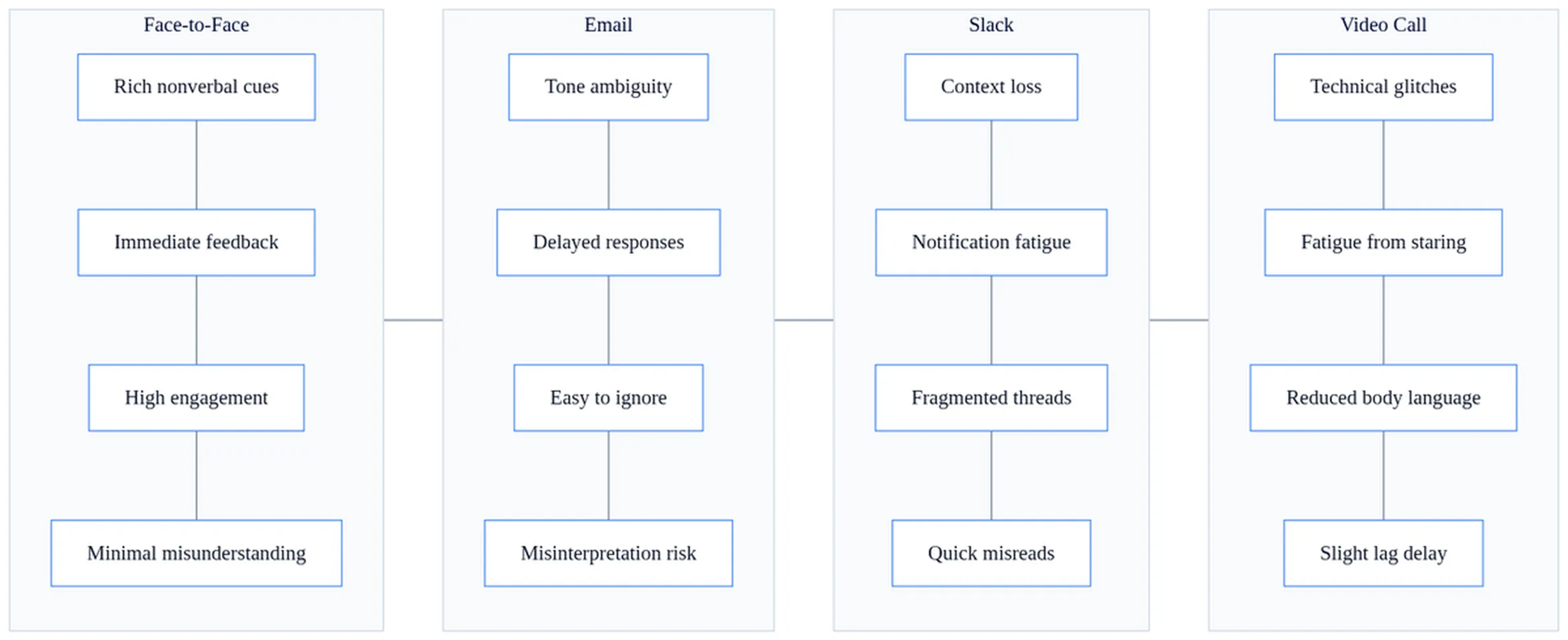
Email brevity is a particular trap. A senior executive sends a three-line message: “Need the Q3 numbers. ASAP. Thanks.” To them, it’s efficient. To the recipient, especially if they’re junior or from a culture that values formal communication, it reads as curt or even angry. Hierarchy plus urgency plus text-only communication equals misinterpretation.
Slack and chat tools introduce informal tone that can mask serious intent. A manager drops a casual “hey, got a sec to chat about that project?” into a channel. Is this a friendly check-in or a precursor to criticism? Without vocal tone or nonverbal communication and body language, the receiver guesses based on past experience and current stress level.
Emoji add another variable. A thumbs-up might signal agreement, acknowledgment, or passive-aggressive dismissal depending on context and cultural norms. What feels friendly in one workplace feels unprofessional in another.
Video calls seem like they’d solve these problems, but they introduce new ones. Lag disrupts conversational rhythm and makes interruptions feel ruder than they are. Camera anxiety changes how people present themselves. Muting during large calls means you lose the small verbal cues, “mm-hmm,” “right,” “okay”, that signal understanding in face-to-face conversation.
Remote teams often report higher rates of miscommunication around task priorities and project status because they lack the informal hallway conversations that naturally align understanding.
Diagnosing and mitigating meaning barriers
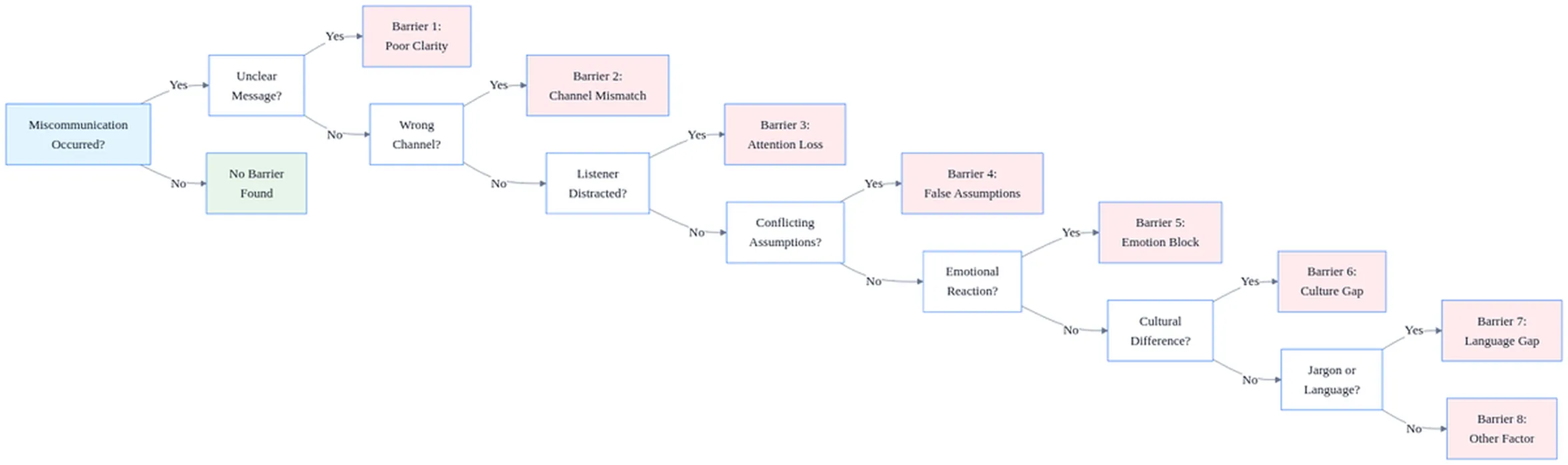
When miscommunication happens, most people assume the other party wasn’t paying attention or doesn’t care. More often, one of these eight factors distorted the message. Diagnosing which factor is active helps you fix the right problem rather than just repeating yourself louder.
| Factor | Diagnostic Question | Quick Mitigation |
|---|---|---|
| Functional silos | Do we work in different departments with different priorities? | Add one sentence defining technical terms in plain language |
| Hierarchy | Is there a significant rank difference between us? | Explicitly invite questions; junior staff, state concerns directly |
| Education | Do we have different professional training or industry backgrounds? | Avoid acronyms; check understanding with “Does that make sense?” |
| Group affiliation | Are we part of different formal teams or informal social groups? | State shared context explicitly rather than assuming it |
| Emotional state | Are either of us stressed, angry, or dealing with conflict? | Acknowledge emotions; delay sensitive discussions if possible |
| Past history | Have we had miscommunication or conflict before? | Address past issues directly; rebuild trust through consistency |
| Language/culture | Do we come from different linguistic or cultural backgrounds? | Avoid idioms; confirm understanding in their own words |
| Digital channel | Are we communicating asynchronously or through text-only tools? | Switch to video or voice for complex topics; over-communicate tone |
Mitigation doesn’t mean eliminating these factors, you can’t erase hierarchy or cultural differences. It means recognizing when they’re active and adjusting your communication accordingly. Ask clarifying questions even when you think the message is obvious. Repeat important information in different words across multiple channels. Invite the other person to paraphrase what they heard to confirm alignment.
The practice of active listening becomes critical here. Instead of waiting for your turn to talk, focus on understanding the other person’s interpretation. Many communication breakdowns happen not because the message was unclear, but because neither party checked whether understanding was actually shared.
For a broader framework of communication obstacles and solutions, explore our guide to barriers to effective communication.
One thing most communication training gets wrong: it assumes you can prevent all miscommunication with the right technique. You can’t. People are messy, contexts shift, and sometimes you’ll say exactly the right thing and still be misunderstood. The goal isn’t perfection, it’s catching misunderstanding early, before it compounds into conflict or project failure. When you recognize which factor is distorting meaning, you can address the actual problem rather than just repeating yourself and hoping for different results.
Frequently asked questions
How do I know if my message was misunderstood due to departmental silos?
Watch for delayed responses, requests for clarification, or deliverables that don’t match what you asked for. If a finance team sends user metrics when you requested a cost-benefit analysis, you’ve hit a functional dialect gap. The fix: ask the other person to summarize what they understood before they start work. A 30-second verbal recap prevents weeks of rework.
Should I communicate differently with my boss than with my team?
Yes. Power dynamics change how messages land. Subordinates soften bad news due to career concerns, while leaders communicate in abstractions that sound clear to them but vague to staff. With your boss, be direct about problems early. With your team, translate strategy into specific actions. Adjust formality to the hierarchy gap, not just the person.
What if I use technical jargon and the other person doesn’t stop me to ask?
They’re likely nodding along without understanding. Most people won’t admit confusion in real-time due to embarrassment or power dynamics. Assume knowledge gaps exist and define terms upfront. Say “net present value—that’s the profit after accounting for timing” rather than waiting for questions. It takes seconds and prevents misalignment.
Can I bridge communication gaps if I don’t know someone’s background?
Yes. Use the “explain it simply, then offer the term” approach. Describe the concept in plain language first, then add the technical term if relevant. This works across educational, generational, and cultural differences. It also signals respect—you’re not assuming they know something just because others in the room do.
Why did my complaint or feedback get ignored by leadership?
Hierarchy often mutes upward messages. Junior employees soften bad news or bury critical feedback in euphemisms due to career fears. Leaders may dismiss concerns as inexperience. To be heard: lead with the business impact, not the emotion. Say “This will delay the deadline by a month” instead of “We’re struggling.” Specificity cuts through the hierarchy filter.