


Have you ever played the childhood game “Chinese whispers”? One person whispers a short message to another, and by the time it reaches the last person, the message has completely changed. What started as “I like chocolate” might end up as “The teacher is on a diet.” Fun in games, but not so fun in real life.
That is exactly how informal communication spreads rumor inside organizations. A single statement can travel across the grapevine, change shape, and become a story that nobody planned. This is why understanding rumor in informal communication is essential for any workplace.
If you are not yet clear about the basics of informal talk, you might want to start with our guide on informal communication definition and examples. In this post, however, we will focus on how rumors spread, why they are so powerful, and what organizations can do about them.
Understanding Rumors in Informal Communication
A rumor is not just ordinary talk. It is unverified information, often shared casually, that may or may not be true. Unlike official announcements, rumors lack confirmation. Yet they spread fast because people are naturally curious.
So, why do rumors thrive in informal networks? The answer lies in human psychology. People crave information, especially when official channels are silent. In the absence of clarity, they fill gaps with assumptions. Grapevine communication provides the perfect stage for such exchanges.
As we discussed in grapevine communication factors, things like curiosity, secrecy, and emotional involvement make rumors flourish.
Why Informal Communication Spreads Rumor
There are several reasons rumors grow like wildfire in informal communication. Let us explore them one by one.
1. Lack of Clarity in Formal Channels
When organizations do not communicate clearly, people start guessing. For example, if management delays in announcing promotion details, employees begin to speculate. These speculations turn into rumors.
2. Human Curiosity and Storytelling
Humans love stories. Even at work, people enjoy discussing what might happen next. A simple “I heard something” often gets more attention than a detailed email. Curiosity makes rumors attractive.
3. Emotional Nature of Grapevine Talk
Rumors are not just about facts, they are about feelings. If employees fear layoffs, any small comment about budget cuts can quickly become a big rumor. Emotions act like fuel in the spreading process.
4. Speed of Casual Conversations
Informal talk spreads faster than memos. In minutes, one person’s comment can reach an entire department. Formal channels usually take more time because they need approvals and structure.
5. Digital Platforms Accelerating Spread
In today’s workplaces, rumors do not need the lunchroom. WhatsApp groups, Slack channels, or quick Zoom chats spread them instantly. This makes controlling rumors even harder in remote or hybrid settings.
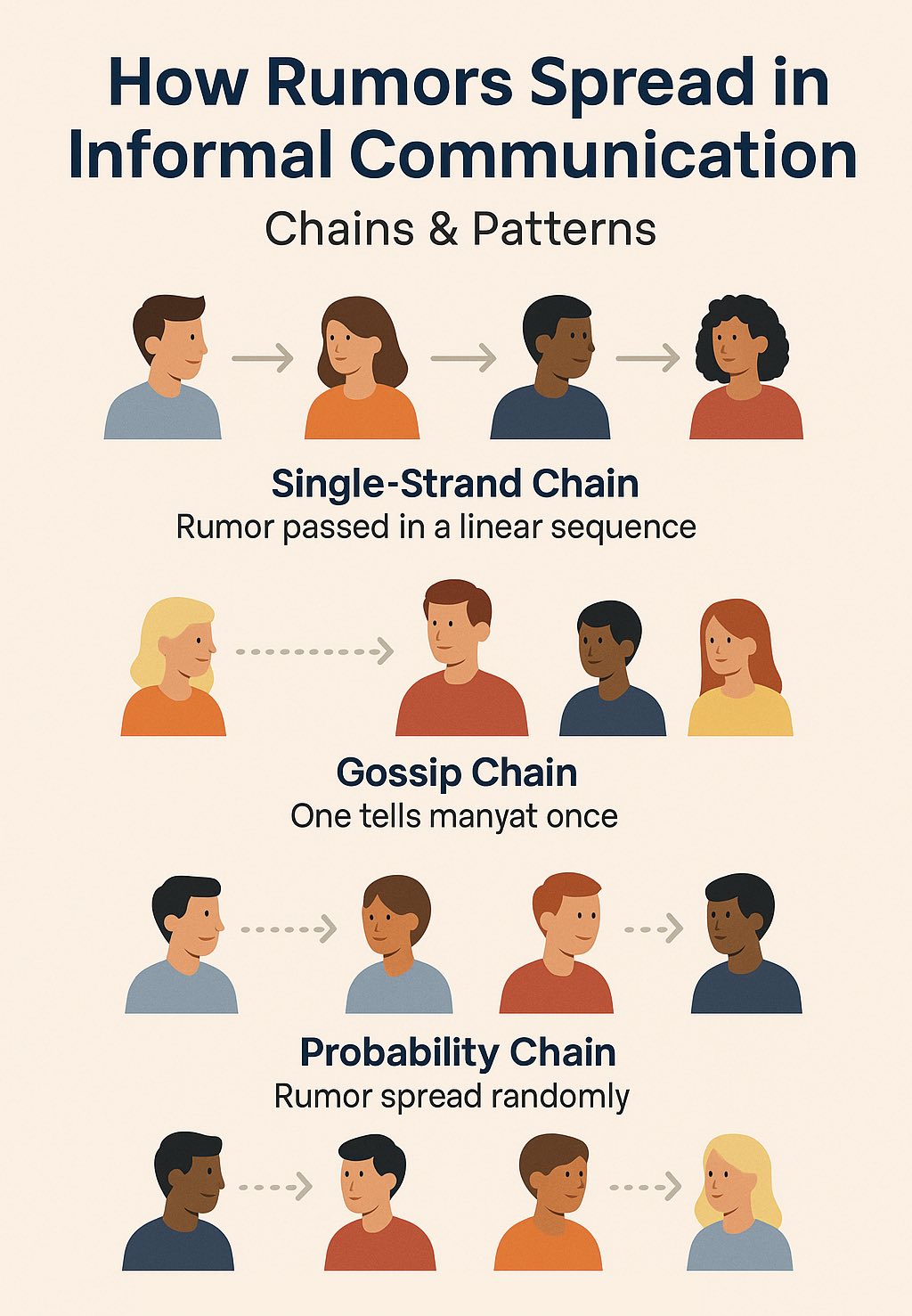
Patterns of Rumor Spread in Grapevine Communication
Rumors do not spread randomly. They often follow certain patterns in informal communication, also known as grapevine networks.
Single-Strand Chain
In this type, one person tells another, who tells another, and so on. Each time the message passes, it changes a little. By the time it reaches the tenth person, the story may be unrecognizable.
Gossip Chain
Here, one person tells many at once. Think of it as broadcasting. An employee might return from a meeting and announce, “We are getting a new manager soon.” Within minutes, the whole office is buzzing.
Probability Chain
This is when someone shares information randomly. A person may mention, “I think bonuses will be delayed,” and only some choose to pass it on. The rumor spreads unpredictably, reaching some groups but not others.
Cluster Chain
The most common type. A person shares information with a close group of trusted colleagues. Those colleagues then share it with their own circles. This chain feels reliable because it moves within small, trusted clusters.
If you want to read more about these patterns, check out our guide on types of informal communication.
Real-Life Examples of Rumor Spread
Example 1: Promotion Confusion
A manager casually mentions that the company is “reviewing performance.” Someone interprets it as “promotions are coming soon.” By the time the story spreads, employees believe promotions are confirmed. When nothing happens, disappointment and mistrust follow.
Example 2: Layoff Scare
An accountant notes that the company is cutting costs. Informally, this turns into “layoffs are happening.” Fear spreads quickly. Productivity drops even though management never planned layoffs.
Example 3: Digital Rumors
In remote teams, one employee shares a half-true update in a WhatsApp group. Screenshots spread to other groups. Soon, even employees in different countries believe something that was never officially announced.
These examples show how easily informal communication spreads rumor in different forms.
Consequences of Rumors in Organizations
Rumors are not just harmless chatter. They can have serious effects on organizations.
- Loss of Trust: Employees begin doubting management if rumors spread unchecked.
- Lower Morale: Fear and confusion reduce motivation.
- Conflicts: Misunderstandings create tension between teams.
- Reduced Productivity: People spend more time talking about rumors than working.
- Damaged Workplace Culture: A culture of gossip weakens transparency and respect.
For more on this cultural angle, you can see our post on informal communication and workplace culture.
Ethical Issues Around Rumors
Spreading rumors is not just a communication problem, it is also an ethical issue. Employees have a responsibility to respect privacy, share information carefully, and avoid gossip that can harm others.
Our article on ethics of informal communication explains how dignity and respect must guide informal conversations. A simple rule to remember: if you are unsure whether something is true, do not spread it.
How Organizations Can Manage Rumor Spread
Rumors may be unavoidable, but they can be managed. Here are some strategies:
- Promote Transparency: Keep employees updated with clear, formal communication.
- Clarify Quickly: When a rumor spreads, respond with facts as soon as possible.
- Encourage Open Dialogue: Let employees ask questions directly instead of guessing.
- Monitor Informally: Managers should listen to grapevine but not suppress it completely.
- Use Informal Positively: Encourage employees to share positive stories, achievements, and success.
For practical methods, check our detailed guide on how to use grapevine communication effectively.
Practical Tips for Employees
Employees also play a role in managing rumors. Here are some tips:
- Verify before sharing. If you cannot confirm it, keep quiet.
- Avoid gossiping about sensitive issues. Respect colleagues’ privacy.
- Ask instead of assuming. Go to the source if you are unsure.
- Be positive. Use informal talk to support colleagues, not scare them.
FAQs on Informal Communication and Rumor Spread
Q1: Why does informal communication spread rumors so easily?
Because it is fast, emotional, and often lacks verification.
Q2: What is the difference between gossip and rumor?
Gossip may involve personal details, while rumor is unverified information, often about events or decisions.
Q3: Can managers completely stop rumors?
Not entirely, but they can reduce them through transparency and quick clarification.
Q4: How can employees avoid being part of rumor chains?
By verifying facts, avoiding gossip, and promoting positive conversations.
Conclusion
Rumors spread in organizations much like wildfire. They start small but quickly grow, fueled by informal communication. While grapevine talk is natural and sometimes helpful, it becomes risky when used carelessly.
The key is balance. Organizations must encourage open, ethical informal communication while addressing rumors with transparency. Employees too must take responsibility, verifying before sharing and respecting privacy.
In the end, informal communication is here to stay. The challenge is making sure it builds trust rather than breaking it. For more on the bigger picture, you can read our article on advantages and disadvantages of informal communication.
Frequently asked questions
What should I do if I hear a rumor at work?
Don’t pass it on without verification. Ask yourself: Is this confirmed by official channels? If not, avoid repeating it. If the rumor affects your work, ask your manager directly instead of spreading speculation. Breaking the chain stops rumors from growing.
Why do cluster chains feel more trustworthy than other rumor patterns?
Cluster chains move through small groups of trusted colleagues, making the information feel vetted and reliable. However, this trust is misleading—the rumor is still unverified. Trust in the source doesn’t make false information true. Each cluster reinforces the rumor, making it harder to correct.
Can management stop rumors by staying completely silent?
No. Silence creates a vacuum that rumors fill. When organizations don’t communicate clearly, employees assume the worst and fill gaps with speculation. The best approach is proactive, honest communication about decisions—even if the answer is ‘we don’t know yet.’
How do I know if a rumor I heard is worth reporting to HR?
Report it if the rumor involves discrimination, safety concerns, or unethical behavior—even if unverified. HR needs to know what’s circulating. For other rumors (promotions, budget cuts), focus on stopping the spread rather than reporting. Ask your manager for clarity instead.
Why do emotional rumors spread faster than factual ones?
Emotions trigger urgency and fear. A rumor about layoffs spreads faster than one about a new office policy because people feel threatened. Fear makes people want to warn others, accelerating the chain. Factual rumors lack this emotional fuel, so they spread more slowly.