


Close Menu
The Business CommunicationThe Business Communication
    What's Hot

    How to Respond to a Passive-Aggressive Email (Scripts That Stay Professional)

    October 31, 2026

    Passive-Aggressive Email Phrases and What to Say Instead

    October 25, 2026

    Polite Alternatives to “Just Following Up” and “Per My Last Email”

    October 14, 2026
    Facebook X (Twitter)
    The Business CommunicationThe Business Communication
    Button
    • Basics
      1. Introduction
      2. Communication Skills
      3. Modern Communication
      4. View All

      Medical Appointment Inquiry Email (Clinics/Hospitals)

      September 22, 2025

      Business Communication – Importance of Business Communication

      September 26, 2019

      Guidelines to Improve effectiveness of Cross Cultural Communication

      August 8, 2018

      Types of Communication Skills: Essential Abilities for Workplace Success

      June 7, 2015

      What Is Communication Style | Classification Of Communication Style

      January 1, 2022

      Meaning Of Cross-Cultural Communication

      July 9, 2018

      Various Styles Reading or Techniques of Reading

      March 26, 2017

      8 Ways To Improve Your Listening Skills

      August 8, 2015

      Role Of Technology In Business Communication

      June 24, 2023

      What Is Communication Satellite?

      January 3, 2023

      What Is Multimedia In Communication | Importance Of Multimedia

      November 24, 2022

      What Is The Video Conference? Advantages & Disadvantages of Video Conferencing

      September 19, 2022

      How to Respond to a Passive-Aggressive Email (Scripts That Stay Professional)

      October 31, 2026

      Passive-Aggressive Email Phrases and What to Say Instead

      October 25, 2026

      Polite Alternatives to “Just Following Up” and “Per My Last Email”

      October 14, 2026

      How to Follow Up on an Email With No Response: 20 Templates

      October 7, 2026
    • Forms of Communication
      • Oral Communication
      • Non-Verbal Communication
      • Report Writing
    • Written Communication
      1. Letter Writing
      2. Circular Letter
      3. inquiry letter
      4. Ultimatum Letter
      Featured
      Written Communication

      How to Respond to a Passive-Aggressive Email (Scripts That Stay Professional)

      By Masudur RashidOctober 31, 2026
      Recent

      How to Respond to a Passive-Aggressive Email (Scripts That Stay Professional)

      October 31, 2026

      Passive-Aggressive Email Phrases and What to Say Instead

      October 25, 2026

      Polite Alternatives to “Just Following Up” and “Per My Last Email”

      October 14, 2026
    • In Business
      1. Company Meeting
      2. Secretarial Functions
      3. View All

      Future of Company Meetings: Hybrid, AI & Trends for 2026

      October 19, 2025

      After the Meeting: Follow-Up, Action Items & Accountability

      October 19, 2025

      How to Facilitate Productive Project Meetings

      October 19, 2025

      Daily Standup vs Weekly Staff Meeting: Which One is Better?

      October 19, 2025

      What Is Organizational Communication – Types of Organizational Communication

      September 17, 2015

      What is Secretary? Types of secretary

      July 11, 2014

      How to Respond to a Passive-Aggressive Email (Scripts That Stay Professional)

      October 31, 2026

      Passive-Aggressive Email Phrases and What to Say Instead

      October 25, 2026

      Polite Alternatives to “Just Following Up” and “Per My Last Email”

      October 14, 2026

      How to Follow Up on an Email With No Response: 20 Templates

      October 7, 2026
    • Internal Communication
      1. Downward Communication
      2. Horizontal Communication
      3. Upward Communication
      4. View All

      Advantages and Disadvantages of Downward Communication

      November 21, 2013

      Key Objectives of Downward Communication in an Organization

      November 20, 2013

      Essential Elements of Downward Communication: A Complete Guide for Managers

      November 20, 2013

      What Is Downward Communication? Definition, Objectives, Advantages, and How to Make It Effective

      October 31, 2013

      Importance of Horizontal Communication (With Real-Life Examples)

      November 30, 2013

      Advantages and Disadvantages of Horizontal Communication (With Real Examples)

      October 23, 2013

      Upward vs Downward vs Horizontal Communication: Key Differences

      March 13, 2013

      What is Horizontal Communication: Definition, Examples & Importance

      March 13, 2013

      Future of Upward Communication in Remote/Hybrid Workplaces

      September 13, 2025

      Leadership Styles That Encourage Employees to Speak Up

      September 13, 2025

      Strategies to Enhance Upward Communication in Organizations

      September 8, 2025

      How Informal Communication Spreads Rumor

      December 3, 2013

      How to Respond to a Passive-Aggressive Email (Scripts That Stay Professional)

      October 31, 2026

      Passive-Aggressive Email Phrases and What to Say Instead

      October 25, 2026

      Polite Alternatives to “Just Following Up” and “Per My Last Email”

      October 14, 2026

      How to Follow Up on an Email With No Response: 20 Templates

      October 7, 2026
    The Business CommunicationThe Business Communication
    Home » Written Communication » How to Respond to a Passive-Aggressive Email (Scripts That Stay Professional)

    How to Respond to a Passive-Aggressive Email (Scripts That Stay Professional)

    By Masudur RashidOctober 31, 2026No Comments10 Mins Read Written Communication
    Facebook Twitter Reddit WhatsApp Telegram Pinterest LinkedIn Email
    Share
    Facebook Twitter Pinterest WhatsApp Email

    How to Respond to a Passive-Aggressive Email (Scripts That Stay Professional)

    The short answer: reply to the request, not the tone. Keep your message factual and forward-facing. Do not mirror the sarcasm or match the edge. If the behavior recurs, move the conversation off email. That is how you stay professional and protect your standing.
    How to respond to a passive-aggressive email: 6 scripts that stay professional

    A 2024 Preply survey of 1,000 US workers found that 83% have received a covertly hostile work email. If you are reading this, you are almost certainly in that group.

    Most professionals need to know how to respond to a passive aggressive email at some point. This guide covers when to reply, when to let it go, and what to write. Every script here is ready to copy and adapt.

    What Makes an Email Passive-Aggressive?

    Passive-aggressive emails are polite on the surface but carry a hidden edge. They express frustration or criticism without stating it directly.

    Common signals include unnecessary reminders, sarcastic praise, and overly formal language after a warm relationship. Specific phrases like “per my last email” and “just a gentle reminder” are the most common markers. Our companion guide covers the full list of passive-aggressive email phrases with direct alternatives.

    According to the Preply data, 76% of these hostile workplace interactions happen over email, not in person. The writer often sounds polite while meaning something quite different.

    Should You Reply, Ignore, or Escalate?

    Not every passive-aggressive email needs a response. Replying can sometimes extend a conflict that would have faded on its own. Ask yourself three questions before you type a single word.
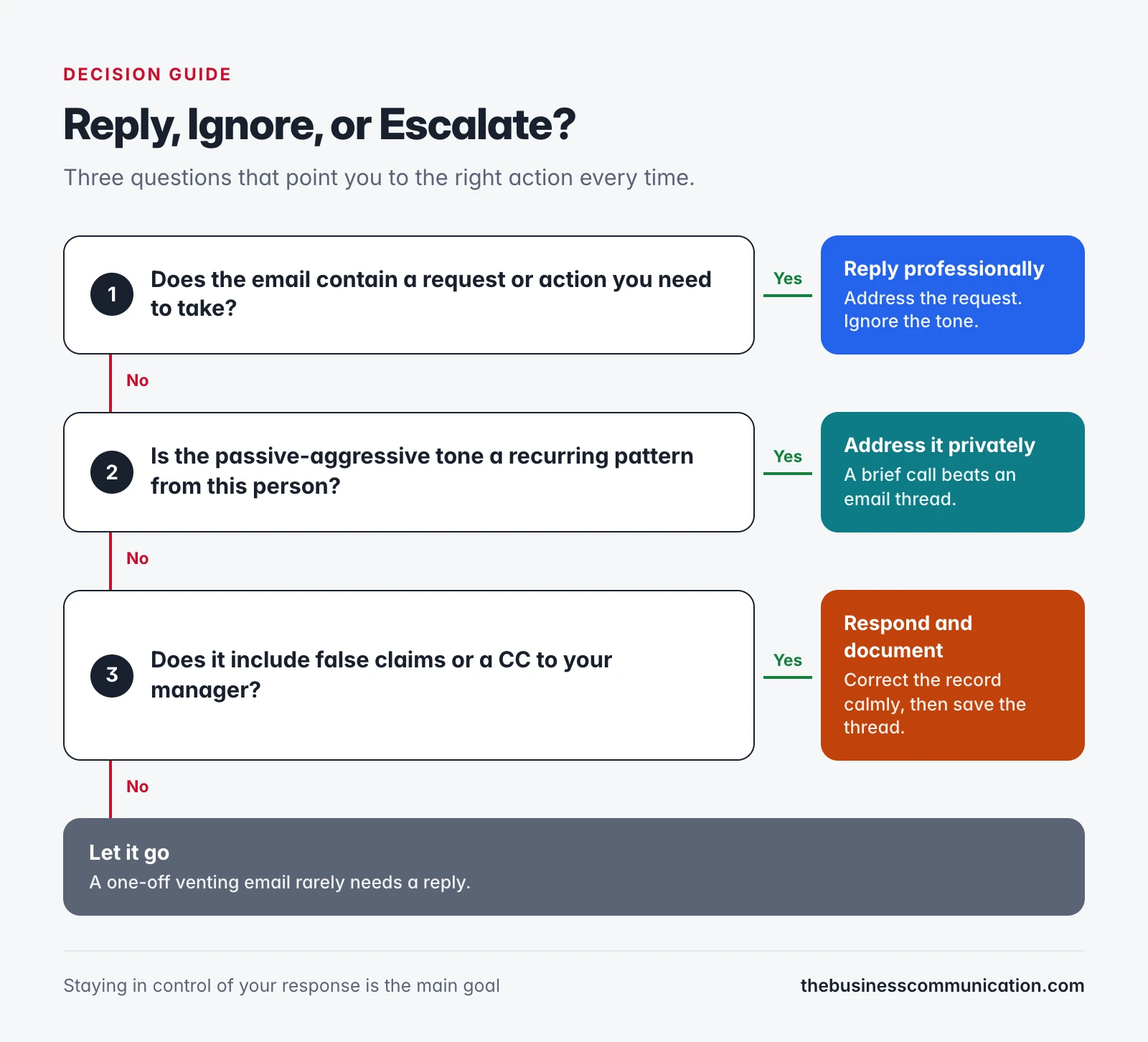
    Decision guide: should you reply, ignore, or escalate a passive-aggressive email?
    • Does the email contain a concrete request? If yes, reply to that request. Ignore the tone completely.
    • Is this a recurring pattern? If the person routinely sends this kind of message, address the behavior privately, in a call or meeting, not in an email thread.
    • Does it include false claims or a surprise CC to your manager? Reply briefly to correct the record, then save the thread for your own documentation.

    If none of those apply, consider letting it go. A single venting message rarely warrants a reply. Engaging can signal that the tactic works.

    How to Respond to a Passive Aggressive Email: 6 Strategies

    When you do reply, choose the strategy that fits the situation. Each one below maps to a real scenario and includes a ready script in the next section.
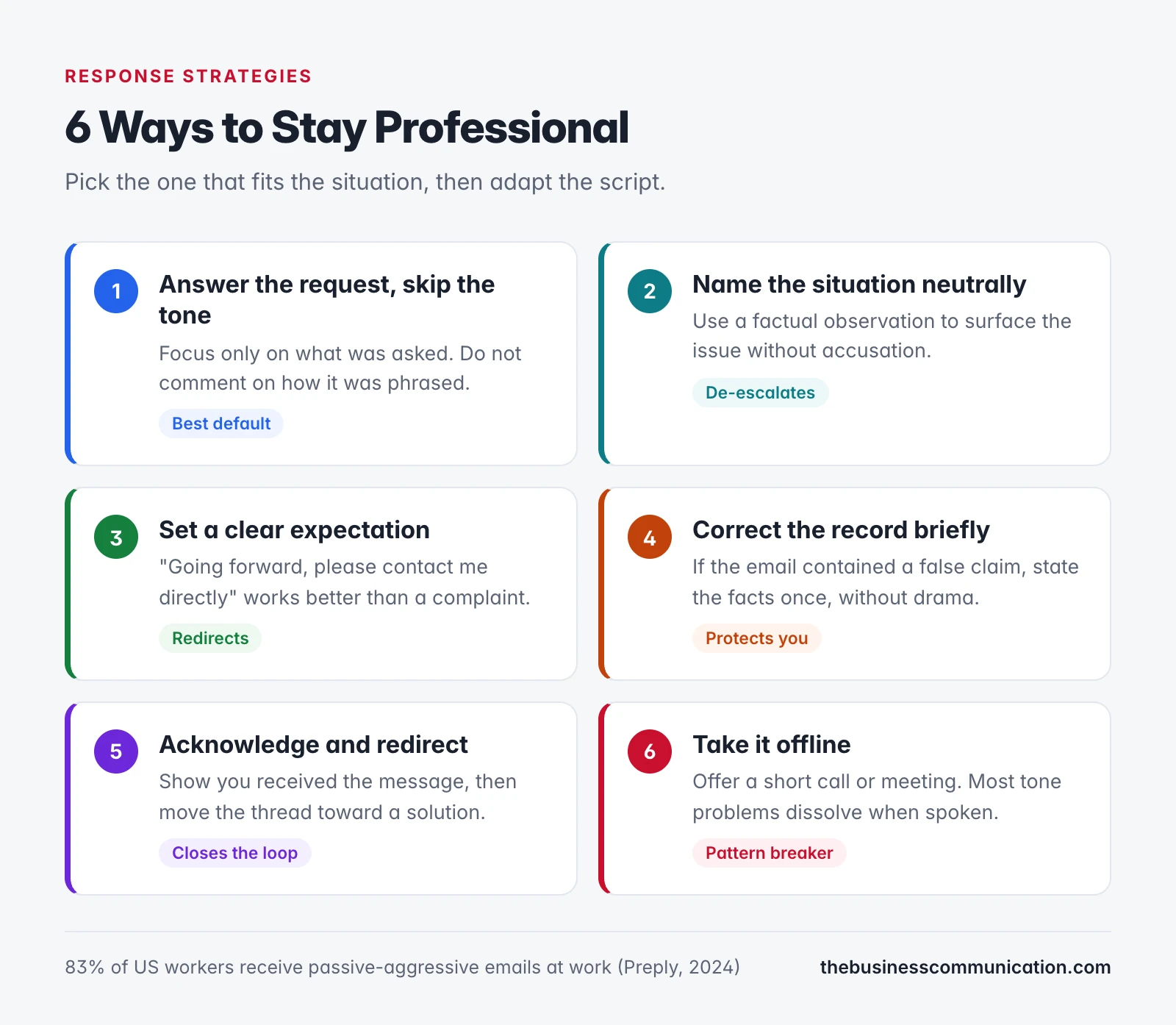
    6 strategies for responding professionally to a passive-aggressive email

    1. Answer the request, skip the tone

    This is the default move for most situations. Reply to the substance of the email. Say nothing about the phrasing. A calm, factual reply is frequently the most effective: it gives the other person nothing to work with.

    2. Name the situation neutrally

    Sometimes the tension needs naming. You can do this without accusation. A single, calm observation surfaces the issue and invites a direct conversation. This works well when the other person may not realize how their message landed.

    3. Set a clear expectation going forward

    If the pattern is about process, such as repeated reminders or surprise escalations, redirect it. State clearly how you prefer direct contact. Address what you want going forward, not what already happened.

    4. Correct the record briefly

    When an email contains a factual error that affects your reputation, correct it once, briefly, and without emotion. State the accurate facts. Do not go into long justifications. One clear sentence beats three defensive paragraphs.

    5. Acknowledge and redirect

    This strategy works when the sender clearly wants a reaction. Acknowledge that you received the message, then steer the conversation toward a concrete next step. It shows engagement without giving them the confrontation they may be pushing for.

    6. Take it offline

    Email is a poor medium for emotional conversations. Offer a short call or a quick chat. Most tone issues dissolve when people speak directly. This approach also signals confidence: you are not avoiding the issue, just moving it to a better channel.

    6 Ready-to-Use Scripts

    Each script matches one of the six strategies. Replace the names and details to fit your situation. All examples use fictional names.

    Script 1: The “Per My Last Email” Reminder

    Situation: A colleague sends a second (or third) email referencing what they “already explained.” The tone implies you ignored them or missed something obvious.

    Strategy: Answer the request, skip the tone.

    Hi Jordan, Thanks for the follow-up. To confirm: [restate what you have done or will do, with a specific date]. Please let me know if you need anything else. Best, Alex

    Notice what this does not include: no apology for the delay, no comment on the phrasing, no justification. Keep it clean.

    Script 2: Your Manager Is CC’d Without Warning

    Situation: A colleague copies your manager on a minor issue, either to create pressure or to put you in a bad light. The Preply survey found that 47% of US workers have experienced this.

    Strategy: Correct the record briefly, then set an expectation.

    Hi Jordan, Thanks for looping in [Manager’s name]. To give the full picture: [brief factual summary, one or two sentences]. Going forward, if you have a concern about my work, please come to me directly first. I will always make time to sort things out quickly. Best, Alex

    This reply corrects the narrative calmly and sets a clear boundary. It also puts your professionalism on record in front of your manager.

    Script 3: “As I Mentioned” / Repeated Criticism

    Situation: Someone keeps referencing a past mistake or decision, and each email implies you should have known better.

    Strategy: Name the situation neutrally.

    Hi Jordan, I notice we keep coming back to [the issue]. I want to resolve it properly so it does not keep coming up. Could we set aside 15 minutes to talk through it directly? A quick call would be faster and clearer than going back and forth over email. Best, Alex

    Script 4: The Cold or Dismissive Reply

    Situation: You receive a one-line reply that is technically polite but clearly cold. Examples: “Sure.” “Noted.” “If you say so.” The subtext is usually contempt or frustration.

    Strategy: Acknowledge and redirect.

    Hi Jordan, Got it. To make sure we are aligned: [restate the agreed action or decision in one clear sentence]. If anything is unclear, I am happy to jump on a quick call. Best, Alex

    You are not calling out the coldness. You are creating clarity and leaving the door open, which removes any ambiguity the other person might try to use later.

    Script 5: The Pressure “Gentle Reminder”

    Situation: You receive a “just a gentle reminder” email about a deadline or task. The word “gentle” rarely matches the tone. This phrase often signals frustration that the sender will not state directly.

    Strategy: Answer the request, skip the tone.

    Hi Jordan, Thanks for the heads-up. [State your plan: “I’ll have this to you by [date/time]” or “This is already in progress — I’ll update you by [date].”] Best, Alex

    Script 6: A Vague Blame Email

    Situation: Something went wrong on a project. A colleague implies fault without naming it directly. You feel accused, but there is nothing specific to address.

    Strategy: Correct the record and take it offline.

    Hi Jordan, Thanks for flagging this. For context: [one or two factual sentences about your role in the situation]. I want to make sure we learn from what happened. Could we set up a short debrief call this week? Best, Alex

    What to Do After You Reply

    Once you send your response, a few habits will protect you and reduce the chance of a repeat.

    • Save the thread. If the exchange could matter in a performance review or HR conversation, keep a copy somewhere you control.
    • Do not re-read it. Once you have replied, move on. Revisiting the exchange keeps the irritation alive.
    • Watch for patterns. A single passive-aggressive email can usually be handled with one reply. A pattern warrants a private, direct conversation off email. Review the main barriers to effective communication for context on why these patterns develop.
    • Check your own tone first. Grammarly’s 2024 State of Business Communication report found that knowledge workers now spend 88% of their workweek communicating. That volume makes it easy to slip into reactive language without noticing.
    • Use the seven Cs of communication as a filter. Clear, concise, and courteous replies rarely get misread.

    When the Problem Is Bigger Than One Email

    Passive-aggressive communication has real consequences. The University of Rochester Medical Center (May 2025) notes that it contributes to poor morale, higher turnover, and lower productivity. The Preply data found that 23% of workers have left a job partly because of this kind of communication from colleagues.

    If the behavior is consistent and affecting your work, it may be time to raise it with your manager or HR. Document specific examples before that conversation. Bring dates, topics, and the actual language used. Vague complaints are easy to dismiss.

    For help keeping your own messages professional, see the guide to polite follow-up alternatives and the full guide to writing professional emails.

    Frequently Asked Questions

    How do you professionally respond to a passive-aggressive email?

    Reply to the substance, not the tone. Address the request or the factual issue clearly. Keep your message short, neutral, and forward-focused. Do not acknowledge the passive-aggressive phrasing unless it has become a serious recurring problem.

    What is the best response to passive-aggressive behavior?

    In writing, the best response is usually the calmest one. State facts, answer the question, and leave no emotional opening for the other person to use. Consistent neutral replies often reduce the frequency of passive-aggressive messages over time.

    How do you shut down passive-aggressive behavior at work?

    The most effective approach is a private, direct conversation. Name the specific behavior (not the person’s character), explain the impact on your work, and suggest a clearer way to communicate going forward. Email is rarely the right place for that conversation.

    What is the six-word phrase to stop passive-aggressive behavior?

    The phrase commonly cited in workplace advice is: “I notice that, and I wonder.” It invites the person to explain themselves without accusation. It opens a direct dialogue rather than extending the cycle.

    Should you ignore a passive-aggressive email?

    Sometimes, yes. If there is no concrete request and the email is a one-off venting message, a reply may do more harm than good. Use the decision guide above to decide. If the message contains false information or a surprise CC to your manager, always reply to correct the record.

    Why do people send passive-aggressive emails instead of speaking directly?

    Passive-aggressive communication often comes from stress, discomfort with conflict, or a belief that direct feedback is risky. The Preply survey found that 94% of workers believe the sender’s own stress or anxiety drives passive-aggressive language. That context helps you respond with less frustration and more detachment.

    Is it passive-aggressive to use “per my last email”?

    Usually, yes. Most readers hear it as “you ignored what I already told you.” Even when used neutrally, the phrase carries enough negative baggage to do more harm than good. See the full guide to passive-aggressive email phrases for clearer alternatives.

    What if the passive-aggressive email comes from my manager?

    The same principles apply, but the stakes are higher. Reply professionally to the content. If the tone is a pattern that affects your wellbeing, consider a private conversation with your manager or a discussion with HR. Keep records of specific exchanges before raising the issue.

    Share. Facebook Twitter Pinterest LinkedIn WhatsApp Reddit Email
    Previous ArticlePassive-Aggressive Email Phrases and What to Say Instead
    Masudur Rashid
    • Facebook
    • X (Twitter)
    • Instagram
    • LinkedIn

    👋 Hi, I am Masudur Rashid. I studied Management (Honors and Masters) but my real passion has always been Business Communication. Through this blog, I share simple tips, lessons, and resources to help students and professionals communicate with confidence.

    Related Posts

    Written Communication 09 Mins Read

    Passive-Aggressive Email Phrases and What to Say Instead

    Written Communication 09 Mins Read
    Written Communication 09 Mins Read

    Polite Alternatives to “Just Following Up” and “Per My Last Email”

    Written Communication 09 Mins Read
    Written Communication 013 Mins Read

    How to Follow Up on an Email With No Response: 20 Templates

    Written Communication 013 Mins Read
    Written Communication 015 Mins Read

    How to Write a Professional Email (With 15 Examples)

    Written Communication 015 Mins Read
    Add A Comment
    Leave A Reply Cancel Reply

    This site uses Akismet to reduce spam. Learn how your comment data is processed.

    Subscribe to Updates

    Get the latest business communication news from TBC.

    Write better at work. Get practical guides with real email, letter and report examples.

    One email on Mondays when a new guide is out. Unsubscribe anytime. See our Privacy Policy.

    Almost done! Check your inbox (or spam folder) and click the confirm button.

    Top Picks

    Medical Appointment Inquiry Email (Clinics/Hospitals)

    Trying to call a clinic and being stuck on hold for ten minutes can be…

    Business Communication – Importance of Business Communication

    Business communication is the structured exchange of information within an organization and between the organization…

    Guidelines to Improve effectiveness of Cross Cultural Communication

    Effective cross-cultural communication is not automatic, even in organizations with diverse teams. You need deliberate…

    Types of Communication Skills: Essential Abilities for Workplace Success

    Have you ever met someone who is brilliant but cannot explain their ideas? They have…

    Welcome to TheBusinessCommunication.com, your guide to clear and effective business communication. Here you will find simple lessons on report writing, letters, meetings, oral and written communication, and modern tools like email or virtual meetings. Our mission is to make learning communication easy, practical, and fun, so you can apply it in your studies, career, and everyday life.
    We're social. Connect with us:

    Facebook X (Twitter) YouTube LinkedIn RSS
    Top Insights

    How to Respond to a Passive-Aggressive Email (Scripts That Stay Professional)

    Passive-Aggressive Email Phrases and What to Say Instead

    Polite Alternatives to “Just Following Up” and “Per My Last Email”

    Subscribe to Updates

    Get the latest business communication news from TBC.

    Write better at work. Get practical guides with real email, letter and report examples.

    One email on Mondays when a new guide is out. Unsubscribe anytime. See our Privacy Policy.

    Almost done! Check your inbox (or spam folder) and click the confirm button.

    Copyright © 2026 TheBusinessCommunication. All Rights Reserved.
    • Home
    • About Us
    • Contact US
    • Our Authors
    • Privacy Policy
    • Terms and Conditions

    Type above and press Enter to search. Press Esc to cancel.