


You sent the email. You got nothing back. Now what?
Sending a follow up email after no response is one of the most effective moves you can make at work. A 2025 B2B study by Belkins found that follow-up emails account for 58.6% of all replies in email sequences. The first message rarely does the job alone.
This guide covers timing, wording, and tone. The 20 copy-ready templates below handle the most common scenarios.
Quick answer: Wait 3 to 5 business days, then send one short email. Briefly mention your original message. Remind the reader of the value or the deadline. Ask one clear question. Keep the tone friendly, not frustrated. Most non-responders are simply busy, and a well-timed nudge usually brings them back.
Why Emails Go Unanswered
People miss emails for practical reasons. Their inbox is full. Your message arrived on a Friday. The subject line looked like a newsletter. They planned to reply and simply forgot.
Research from Artisan shows that a well-crafted follow-up increases response rates by 65.8%. Silence is not always a no. Understanding how email fits into your communication toolkit helps you use it more effectively.
Mindset matters here. Go in with curiosity, not frustration. Your reader is probably not ignoring you on purpose.
When to Send a Follow Up Email After No Response
Timing matters more than most people expect. Send too soon and you seem impatient. Wait too long and the conversation loses its thread.
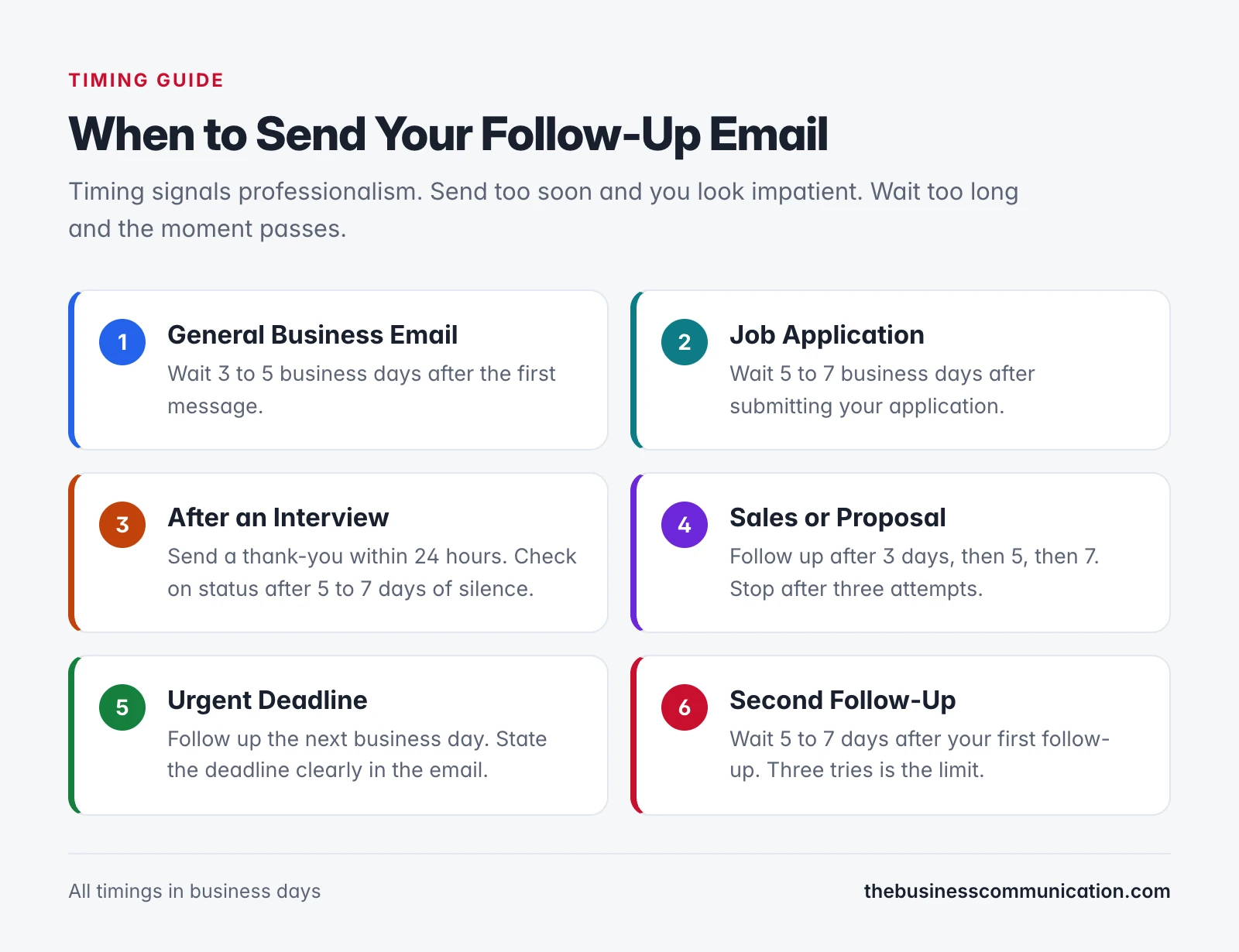
Use the guide above as a baseline. Adjust based on urgency. If the other person mentioned a specific deadline or decision date, use that as your anchor.
Weekend emails and public holidays do not count as business days. If you send on a Friday, your clock starts the following Monday.
How to Write a Follow-Up Email: 5 Parts
A strong follow-up email is short. It does not repeat the original message in full. It has five parts, each with a specific job to do. Understanding the 7 Cs of communication helps you make every word count.
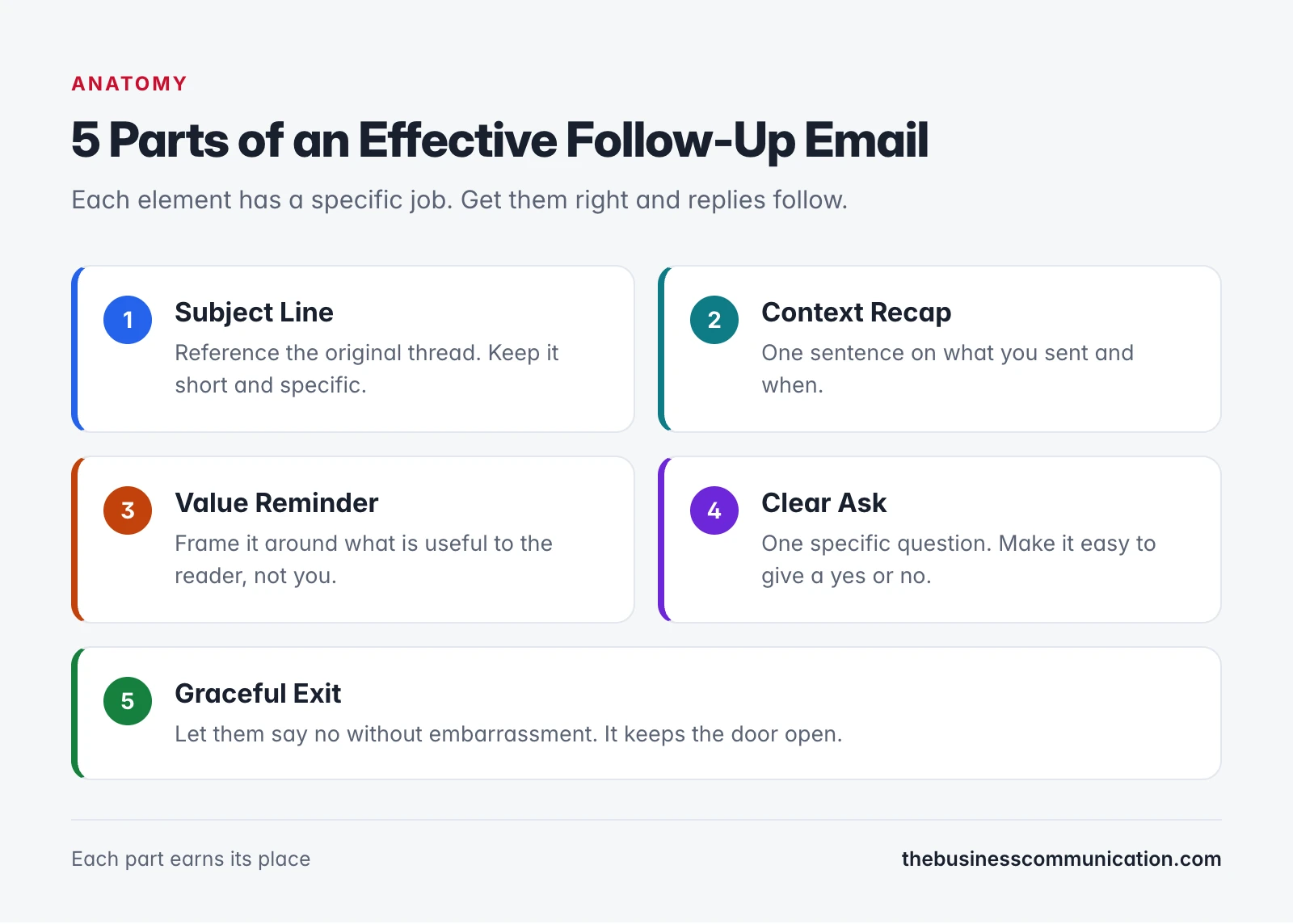
For the subject line, reference the original thread. Something like “Re: Q3 proposal – any questions?” is stronger than just “Following up.” For more options, browse these ready-to-use subject line examples.
The context recap is one sentence: what you sent and when. Then shift to the value reminder. Frame it around what the outcome means for the reader.
End with a single clear question. Then add a graceful exit line, such as “If now is not the right time, please just let me know.” It keeps the door open either way.
20 Follow-Up Email Templates
Each template is ready to copy and adapt. Replace the bracketed details with your own. The examples use fictitious names.
General Situations (Templates 1 to 5)
Use these when you sent a general business email and heard nothing back.
Template 1: Friendly First Follow-Up
Warm and low-pressure. Good for colleagues or contacts you know well.
Template 2: Professional First Follow-Up
Slightly more formal. Works well for external contacts or senior colleagues.
Template 3: Urgent Deadline Follow-Up
Use this when a real deadline is approaching and you need a response.
Template 4: Second Follow-Up (Brief Bump)
Short and low-key. Acknowledges you have already followed up once.
Template 5: Final Follow-Up (Closing the Loop)
Signals you are not chasing further. Leaves the door open without pressure.
Job Applications and Interviews (Templates 6 to 10)
These templates cover the job search process from application to offer stage. For letters rather than emails, see our job inquiry letter samples.
Template 6: Job Application Follow-Up
Send this 5 to 7 business days after submitting your application.
Template 7: Post-Interview Thank-You and Status Check
Send within 24 hours of the interview. Doubles as both a thank-you and a subtle follow-up.
Template 8: Second Follow-Up After Interview
Use this 5 to 7 days after your post-interview thank-you if you still have not heard anything.
Template 9: Recruiter Status Request
Polite and direct. Good when you spoke with a recruiter but the process has gone quiet.
Template 10: Offer or Compensation Follow-Up
Use this after sending a counter-offer or acceptance, to confirm it arrived.
Sales and Business Proposals (Templates 11 to 15)
These templates work for proposals, quotes, invoices, and meeting requests. See also our thank-you letter templates for clients for after the deal is done.
Template 11: Sales Proposal Follow-Up
Follow up 3 business days after sending a proposal. Open with a question, not a push.
Template 12: Client Quote Follow-Up
Useful after sending a price quote with no reply.
Template 13: Business Partnership Follow-Up
For when you proposed a collaboration and heard nothing back.
Template 14: Invoice Payment Reminder
Polite but clear. Send a few days before the payment due date.
Template 15: Meeting Request Follow-Up
For a calendar invite or meeting suggestion that received no reply. See our tips on post-meeting follow-up actions for after the meeting happens.
Other Professional Scenarios (Templates 16 to 20)
These cover vendor follow-ups, customer service, networking, academic emails, and information requests.
Template 16: Vendor or Supplier Follow-Up
Chase a supplier when your stock or service inquiry has not been answered.
Template 17: Customer Service Complaint Follow-Up
Reference your ticket number. Keep the tone firm but respectful.
Template 18: Networking Follow-Up
For when you promised to share something after meeting someone at an event.
Template 19: Academic or Instructor Follow-Up
Respectful and brief. Useful for students emailing a professor or course coordinator.
Template 20: Request for Information Follow-Up
For internal data or report requests that have stalled.
Before You Hit Send: a Quick Diagnostic
Before writing anything, pause and ask a few questions. Did the original email reach the right person? Was your ask clear the first time? Did the subject line look like a bulk send?
Several common communication barriers can prevent a reply. A vague call to action, a busy subject line, or a CC that confused the chain are frequent culprits.
Run through this checklist before you send your follow-up:
- Sent to the right person (not just the one who forwarded the original).
- Subject line is specific and not spammy.
- Original email contained a clear, single ask.
- Waited the appropriate number of business days.
- Follow-up adds new information or reframes the value.
This step takes two minutes. It often reveals a quick fix that makes the follow-up unnecessary.
How Many Follow-Ups Should You Send?
Three is the standard limit for most professional situations. According to Instantly.ai, 70% of senders stop after the first email, yet multiple follow-ups can triple reply rates. Most eventual responders will not reply to the first email.
After three attempts with no response, send a polite closing note and move on. You have done your part. For meetings specifically, our guide on post-meeting follow-up actions shows how to close the loop professionally.
Space your follow-ups properly. Three or four emails on the same day damage your professional reputation and rarely help.
Common Mistakes to Avoid
- Apologizing for following up. Phrases like “Sorry to bother you” undermine your message. You have a legitimate reason to be there.
- Repeating the original email word for word. Paste a one-line summary instead, not the full body.
- Expressing frustration. Even mild impatience reads worse in text than it sounds in your head.
- Vague subject lines. “Just following up” tells the reader nothing. Name the topic.
- No clear ask. Every follow-up needs one question or one action. More than one creates hesitation.
- Sending too many. Four or five attempts signal desperation. Three is the limit.
Frequently Asked Questions
How do you politely follow up on an email with no response?
Wait 3 to 5 business days, then send a short email. Mention what you sent originally and ask one clear question. Keep the tone friendly and assume good faith. Avoid phrases like “as I mentioned” or “I still have not heard back,” which can read as passive-aggressive.
How do you politely say “just following up”?
Replace it with something more specific. Try “I wanted to check in on my email from [date]” or “I am circling back on the [topic] we discussed.” These phrases are more informative and less likely to irritate a busy reader.
How to write a follow-up email after not getting a response?
Start with a specific subject line that references the original thread. Open by reminding the reader what you sent and when. Add a brief value reminder, then ask one clear question. Close with a graceful exit that lets them say no without awkwardness.
How to write a follow-up message after no response?
Keep it short, under 100 words if possible. Reference the original message in the subject line. State one reason why your request matters to the reader. Ask a yes-or-no question if you can. Then stop. A concise message is far more likely to get a reply than a long one.
Is it rude to follow up if someone hasn’t replied?
Not at all. One or two follow-ups are expected in professional settings. People miss emails. What matters is tone. A respectful, patient follow-up is a normal part of doing business. Sending four or five messages in a short period crosses into pressure territory, so stick to two or three attempts.