


Close Menu
The Business CommunicationThe Business Communication
    What's Hot

    Passive-Aggressive Email Phrases and What to Say Instead

    October 25, 2026

    Polite Alternatives to “Just Following Up” and “Per My Last Email”

    October 14, 2026

    How to Follow Up on an Email With No Response: 20 Templates

    October 7, 2026
    Facebook X (Twitter)
    The Business CommunicationThe Business Communication
    Button
    • Basics
      1. Introduction
      2. Communication Skills
      3. Modern Communication
      4. View All

      Medical Appointment Inquiry Email (Clinics/Hospitals)

      September 22, 2025

      Business Communication – Importance of Business Communication

      September 26, 2019

      Guidelines to Improve effectiveness of Cross Cultural Communication

      August 8, 2018

      Types of Communication Skills: Essential Abilities for Workplace Success

      June 7, 2015

      What Is Communication Style | Classification Of Communication Style

      January 1, 2022

      Meaning Of Cross-Cultural Communication

      July 9, 2018

      Various Styles Reading or Techniques of Reading

      March 26, 2017

      8 Ways To Improve Your Listening Skills

      August 8, 2015

      Role Of Technology In Business Communication

      June 24, 2023

      What Is Communication Satellite?

      January 3, 2023

      What Is Multimedia In Communication | Importance Of Multimedia

      November 24, 2022

      What Is The Video Conference? Advantages & Disadvantages of Video Conferencing

      September 19, 2022

      Passive-Aggressive Email Phrases and What to Say Instead

      October 25, 2026

      Polite Alternatives to “Just Following Up” and “Per My Last Email”

      October 14, 2026

      How to Follow Up on an Email With No Response: 20 Templates

      October 7, 2026

      How to Write a Professional Email (With 15 Examples)

      October 4, 2026
    • Forms of Communication
      • Oral Communication
      • Non-Verbal Communication
      • Report Writing
    • Written Communication
      1. Letter Writing
      2. Circular Letter
      3. inquiry letter
      4. Ultimatum Letter
      Featured
      Written Communication

      Passive-Aggressive Email Phrases and What to Say Instead

      By Masudur RashidOctober 25, 2026
      Recent

      Passive-Aggressive Email Phrases and What to Say Instead

      October 25, 2026

      Polite Alternatives to “Just Following Up” and “Per My Last Email”

      October 14, 2026

      How to Follow Up on an Email With No Response: 20 Templates

      October 7, 2026
    • In Business
      1. Company Meeting
      2. Secretarial Functions
      3. View All

      Future of Company Meetings: Hybrid, AI & Trends for 2026

      October 19, 2025

      After the Meeting: Follow-Up, Action Items & Accountability

      October 19, 2025

      How to Facilitate Productive Project Meetings

      October 19, 2025

      Daily Standup vs Weekly Staff Meeting: Which One is Better?

      October 19, 2025

      What Is Organizational Communication – Types of Organizational Communication

      September 17, 2015

      What is Secretary? Types of secretary

      July 11, 2014

      Passive-Aggressive Email Phrases and What to Say Instead

      October 25, 2026

      Polite Alternatives to “Just Following Up” and “Per My Last Email”

      October 14, 2026

      How to Follow Up on an Email With No Response: 20 Templates

      October 7, 2026

      How to Write a Professional Email (With 15 Examples)

      October 4, 2026
    • Internal Communication
      1. Downward Communication
      2. Horizontal Communication
      3. Upward Communication
      4. View All

      Advantages and Disadvantages of Downward Communication

      November 21, 2013

      Key Objectives of Downward Communication in an Organization

      November 20, 2013

      Essential Elements of Downward Communication: A Complete Guide for Managers

      November 20, 2013

      What Is Downward Communication? Definition, Objectives, Advantages, and How to Make It Effective

      October 31, 2013

      Importance of Horizontal Communication (With Real-Life Examples)

      November 30, 2013

      Advantages and Disadvantages of Horizontal Communication (With Real Examples)

      October 23, 2013

      Upward vs Downward vs Horizontal Communication: Key Differences

      March 13, 2013

      What is Horizontal Communication: Definition, Examples & Importance

      March 13, 2013

      Future of Upward Communication in Remote/Hybrid Workplaces

      September 13, 2025

      Leadership Styles That Encourage Employees to Speak Up

      September 13, 2025

      Strategies to Enhance Upward Communication in Organizations

      September 8, 2025

      How Informal Communication Spreads Rumor

      December 3, 2013

      Passive-Aggressive Email Phrases and What to Say Instead

      October 25, 2026

      Polite Alternatives to “Just Following Up” and “Per My Last Email”

      October 14, 2026

      How to Follow Up on an Email With No Response: 20 Templates

      October 7, 2026

      How to Write a Professional Email (With 15 Examples)

      October 4, 2026
    The Business CommunicationThe Business Communication
    Home » Written Communication » Passive-Aggressive Email Phrases and What to Say Instead

    Passive-Aggressive Email Phrases and What to Say Instead

    By Masudur RashidOctober 25, 2026No Comments9 Mins Read Written Communication
    Facebook Twitter Reddit WhatsApp Telegram Pinterest LinkedIn Email
    Share
    Facebook Twitter Pinterest WhatsApp Email

    Passive aggressive email phrases are lines that look polite but carry a hidden edge. Common examples include “per my last email,” “friendly reminder,” and “thanks in advance.” Each signals frustration or impatience without naming it directly.

    This guide covers 12 of the most common ones, with a direct alternative for each one.

    A Preply survey of 1,000 professionals found that 83% of workers have received passive-aggressive emails. The most common venue is email, accounting for 76% of those interactions. Two-thirds of respondents said the experience impaired their ability to work. Many senders never realize how the tone lands.

    Many of these phrases slip into emails out of habit, not intent. Knowing where your tone goes wrong is part of writing a good professional email.

    What Makes a Phrase Passive-Aggressive in Email?

    A phrase turns passive-aggressive when its surface meaning differs from its intent. The words stay polite. Readers often take away something different. Three patterns show up most often.

    • Hidden receipts: The sender signals they are keeping records. (“Per my last email,” “reattached for your convenience.”)
    • Loaded politeness: The politeness is doing extra work. (“Friendly reminder,” “kindly note.”)
    • Pressure in disguise: The phrase looks helpful but pushes the reader to act. (“Just checking in,” “any updates on this?”)

    12 Passive Aggressive Email Phrases and What to Write Instead

    1. “Per my last email” / “As previously stated”

    What it signals: “You ignored what I said before.”

    Both phrases announce frustration without moving the conversation forward. The reader lands on the defensive. This phrase gets a deeper look in our guide to alternatives to “just following up.”

    Say this instead: Repeat the information without comment. “To recap: the deadline is Friday, March 7. Please confirm by Wednesday.” Giving the information again is more useful than noting you already gave it.

    Instead of: Per my last email, the report is due Friday. Please ensure it is submitted on time. Try: The report is due this Friday, March 7. Let me know if you need anything before then.

    2. “Friendly reminder” / “Gentle reminder”

    What it signals: “This is not friendly at all.”

    Adding “friendly” or “gentle” does not soften the message. It highlights that the reminder is anything but. The qualifier is the giveaway.

    Say this instead: Drop the qualifier. “A reminder that the invoice is due Wednesday” is clear and direct.

    Instead of: Just a friendly reminder that the invoice is due Wednesday. Try: A reminder that the invoice is due Wednesday. Let me know if there are any issues.

    3. “Thanks in advance”

    The message it sends: “I assume you will do this. You have no real choice.”

    It removes the reader’s right to say no before you have even asked. It assumes compliance before the reader can confirm.

    A clearer close: End with an open question instead. “Would you be able to review this by Thursday?” gives the reader a genuine choice and is much easier to reply to.

    4. “Please advise”

    The subtext: “Sort this out. It is your problem now.”

    Used alone at the end of an email, “please advise” offers no direction. It signals a problem but gives the reader no clue what kind of response you need from them.

    A precise ask instead: State it directly. “Could you confirm approval of the invoice?” is specific and easy to act on.

    5. “Just checking in” / “Circling back”

    What it signals: “You have not replied, and I’m not happy about it.”

    These phrases add nothing new to the thread. They apply pressure without adding information. If you need to follow up after silence, our guide on how to follow up when there is no response covers this in detail.

    Say this instead: Bring something new. “I wanted to confirm the timeline before Thursday’s meeting” gives the reader a clear reason to respond.

    6. “Reattached for your convenience”

    The reader hears: “You lost my attachment, and I noticed.”

    This phrase implies carelessness on the reader’s part, even when the tone stays formally polite.

    The better approach: Re-attach the file without comment. If you need to say something, “Attaching this again in case it got lost in the thread” works and stops there.

    7. “Going forward”

    What it signals: “You did this wrong. Do not repeat it.”

    Senders use “going forward” to correct past behavior without naming the original problem. That indirectness can feel sharper than a direct conversation would.

    Say this instead: State the expectation clearly. “For future invoices, please send them to billing@example.com before the 5th” is a clean instruction, not a veiled rebuke.

    8. “Correct me if I’m wrong” / “Let me clarify”

    The implication: “I am right. You had it wrong.”

    These phrases frame a correction as a question. The reader must either agree or defend themselves, which puts them at a disadvantage no matter who is actually right.

    A direct version: State your understanding plainly. “My understanding is that the deadline is Friday. Is that still the case?” is a genuine question without the undertone.

    9. “As you know” / “As no doubt you are aware”

    The subtext: “This should be obvious. Why don’t you already know?”

    Each of these phrases frames information as common knowledge. That can make the reader feel talked down to, even when the intent is neutral.

    Say this instead: Just state the fact. “The contract renews on the 30th” is enough. The preamble adds nothing to it.

    10. “Any updates on this?”

    The signal it sends: “Why haven’t you replied yet?”

    Sent alone, this line reads as impatient. It gives no context and puts the reader on the spot without a reason to respond.

    A more focused ask: Tie the request to a reason. “I wanted to check on this before I finalize the project scope on Friday” gives the reader something specific to act on.

    11. “FYI”

    What it signals: “I am documenting this and copying you in.”

    “FYI” can be neutral. But senders often use it to copy someone on a problem without offering a solution, which reads as a paper-trail move.

    Say this instead: State what is needed, if anything. “Sharing this for your records. No action required” is clear. So is “Flagging this because it may affect your timeline.”

    12. “Kindly note” / “Kindly be informed”

    What it implies: “Comply. I will frame it as a request.”

    “Kindly” sounds formal, but it adds an edge here. Senders often use it in templates to appear polite while issuing a firm directive.

    A simpler option: Use plain language. “Please note that our office will be closed on Monday” works without the loaded formality.
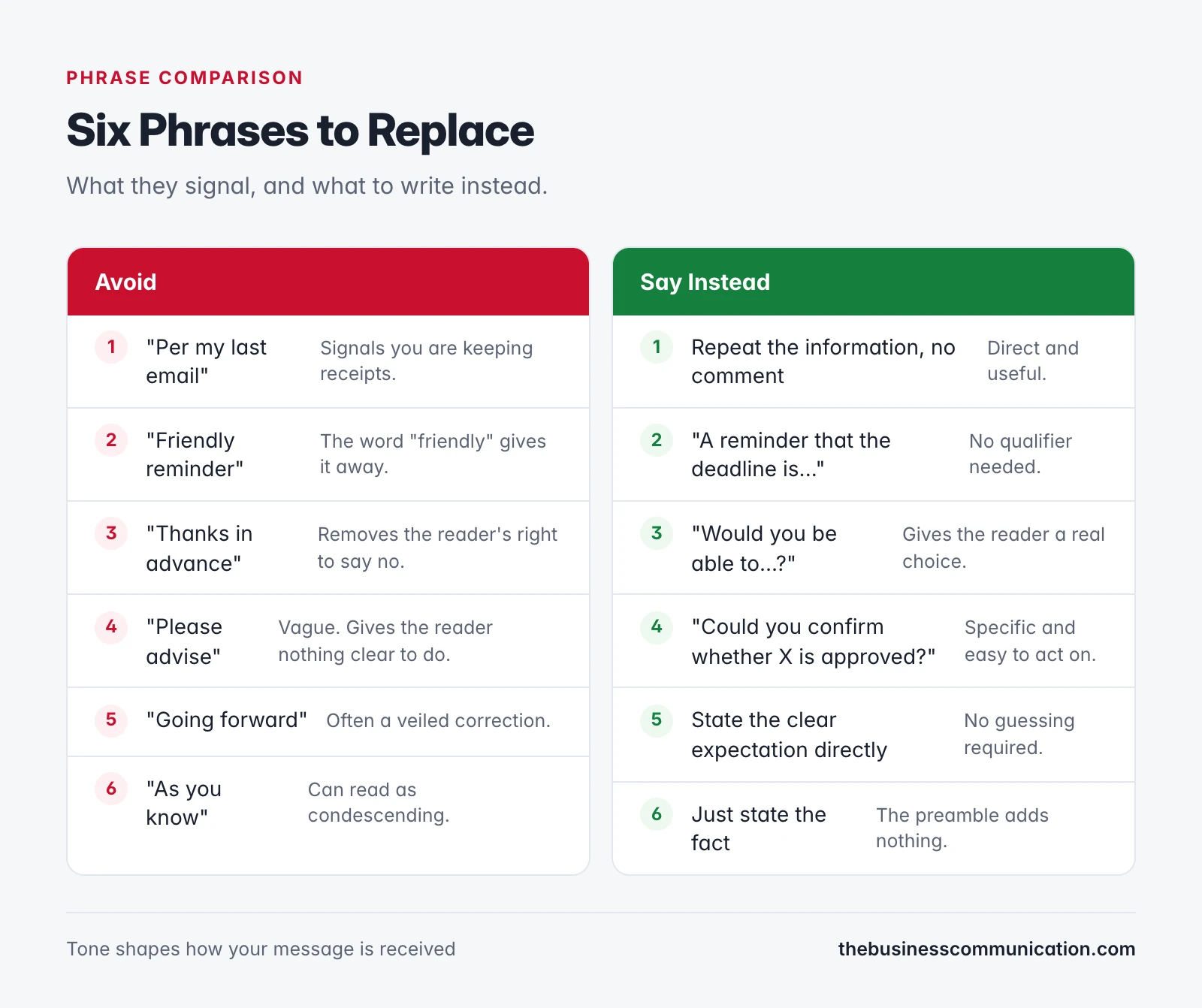
    Side-by-side comparison of six passive-aggressive email phrases and their direct alternatives

    Why Professionals Write This Way

    These phrases did not start as tools of hostility. They spread through offices because they let people signal displeasure without risking confrontation, for several reasons.

    Conflict avoidance. Many workplaces discourage directness. Indirect phrases become a way to express frustration without naming it openly.

    Stress. The Preply survey found that 94% of employees believe a sender’s stress contributes to passive-aggressive language. Under pressure, people reach for familiar phrases without considering how they land.

    Constant miscommunication. A 2024 Grammarly report found that 100% of knowledge workers experience miscommunications at least once a week. That frequency erodes patience and makes shortcut phrases more tempting.

    Habit and modeling. The communication style someone uses at work often reflects what they see modeled around them. If passive-aggressive phrasing is common in a team, it becomes the default.

    A 2024 Mailsuite survey of 2,000 Americans found that 47% of workers received passive-aggressive emails in the past year. Of those messages, 86% came from within the recipient’s own company. The cycle tends to stay internal and self-reinforcing.

    How to Respond to a Passive-Aggressive Email

    You receive a “per my last email” or a “just a friendly reminder that this is my third follow-up.” Three things help.

    Do not mirror the tone. Preply found that one in two workers admits to replying with the same passive-aggressive tone. Matching it keeps the cycle going.

    Answer the request, not the subtext. Address what the sender asked. Leave the tone alone in your reply. If the pattern matters, raise it in a direct conversation or call, not in the email thread.

    Name what you need when it matters. If you feel the follow-ups are unfair, say so in a short private message. A direct conversation resolves more than a long email chain.
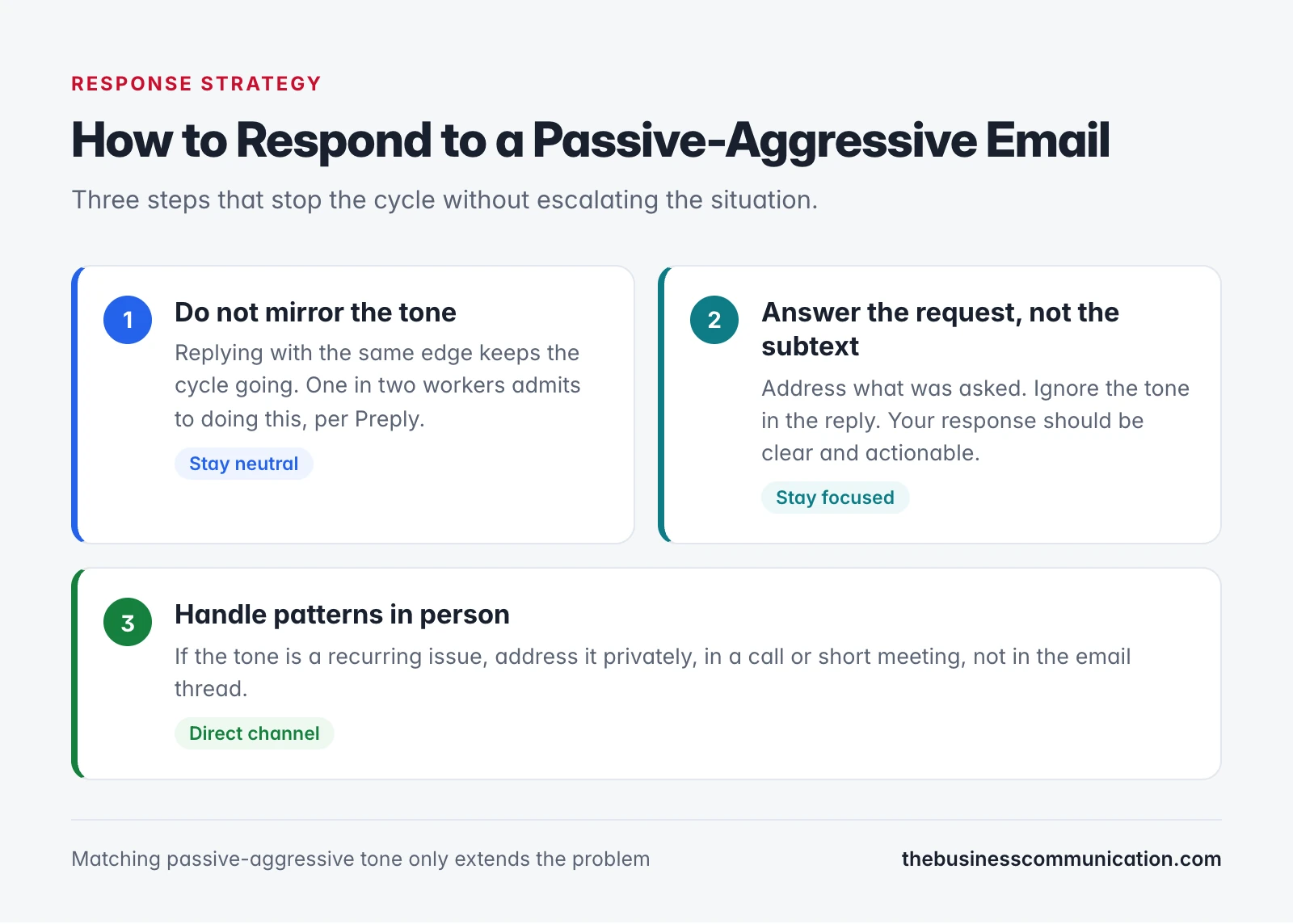
    Three-step framework for responding to passive-aggressive emails without escalating the situation

    A Quick Tone Check Before You Send

    Before sending any email that involves a deadline or a correction, read the last line back to yourself. Ask these three questions.

    • Does it carry hidden blame?
    • Am I pointing out that this is not the first time?
    • Have I added “friendly” or “kindly” to soften something that is not soft?

    One read-through is often enough to catch the problem. Understanding how email works as a communication channel helps explain why tone is harder to read in text than in person.

    Frequently Asked Questions

    What are some common passive-aggressive email phrases?

    Preply found “per my last email” tops the list of phrases workers most often flag. Other common examples include “friendly reminder,” “please advise,” “as you know,” and “circling back”.

    What are six of the most passive-aggressive phrases?

    Survey data most often points to these six: “per my last email,” “friendly reminder,” “thanks in advance,” “going forward,” “please advise,” and “as you know”. Each carries a subtext the words do not state. All six appear above with direct alternatives.

    What are five passive-aggressive phrases?

    Workplace research most often names “per my last email,” “friendly reminder,” “thanks in advance,” “please advise,” and “going forward”. All five appear above with alternatives.

    How do you professionally respond to a passive-aggressive email?

    Answer the request as stated and keep your own tone neutral. Do not call out the phrasing in the reply. If the pattern continues, handle it in a private, direct conversation. Matching the passive-aggressive tone, which half of workers admit to doing, only extends the cycle.

    What are some unhinged ways to start an email?

    “As per my last 12 emails…” or “As I have explained on four separate occasions…” are the unhinged versions of these phrases. They state the frustration openly instead of hiding it. Most passive aggressive email phrases keep the frustration hidden, which is exactly what makes them hard to call out.

    Share. Facebook Twitter Pinterest LinkedIn WhatsApp Reddit Email
    Previous ArticlePolite Alternatives to “Just Following Up” and “Per My Last Email”
    Masudur Rashid
    • Facebook
    • X (Twitter)
    • Instagram
    • LinkedIn

    👋 Hi, I am Masudur Rashid. I studied Management (Honors and Masters) but my real passion has always been Business Communication. Through this blog, I share simple tips, lessons, and resources to help students and professionals communicate with confidence.

    Related Posts

    Written Communication 09 Mins Read

    Polite Alternatives to “Just Following Up” and “Per My Last Email”

    Written Communication 09 Mins Read
    Written Communication 013 Mins Read

    How to Follow Up on an Email With No Response: 20 Templates

    Written Communication 013 Mins Read
    Written Communication 015 Mins Read

    How to Write a Professional Email (With 15 Examples)

    Written Communication 015 Mins Read
    Letter Writing 09 Mins Read

    Memo vs. Business Letter: Key Differences & When to Use Which

    Letter Writing 09 Mins Read
    Add A Comment
    Leave A Reply Cancel Reply

    This site uses Akismet to reduce spam. Learn how your comment data is processed.

    Subscribe to Updates

    Get the latest business communication news from TBC.

    Write better at work. Get practical guides with real email, letter and report examples.

    One email on Mondays when a new guide is out. Unsubscribe anytime. See our Privacy Policy.

    Almost done! Check your inbox (or spam folder) and click the confirm button.

    Top Picks

    Medical Appointment Inquiry Email (Clinics/Hospitals)

    Trying to call a clinic and being stuck on hold for ten minutes can be…

    Business Communication – Importance of Business Communication

    Business communication is the structured exchange of information within an organization and between the organization…

    Guidelines to Improve effectiveness of Cross Cultural Communication

    Effective cross-cultural communication is not automatic, even in organizations with diverse teams. You need deliberate…

    Types of Communication Skills: Essential Abilities for Workplace Success

    Have you ever met someone who is brilliant but cannot explain their ideas? They have…

    Welcome to TheBusinessCommunication.com, your guide to clear and effective business communication. Here you will find simple lessons on report writing, letters, meetings, oral and written communication, and modern tools like email or virtual meetings. Our mission is to make learning communication easy, practical, and fun, so you can apply it in your studies, career, and everyday life.
    We're social. Connect with us:

    Facebook X (Twitter) YouTube LinkedIn RSS
    Top Insights

    Passive-Aggressive Email Phrases and What to Say Instead

    Polite Alternatives to “Just Following Up” and “Per My Last Email”

    How to Follow Up on an Email With No Response: 20 Templates

    Subscribe to Updates

    Get the latest business communication news from TBC.

    Write better at work. Get practical guides with real email, letter and report examples.

    One email on Mondays when a new guide is out. Unsubscribe anytime. See our Privacy Policy.

    Almost done! Check your inbox (or spam folder) and click the confirm button.

    Copyright © 2026 TheBusinessCommunication. All Rights Reserved.
    • Home
    • About Us
    • Contact US
    • Our Authors
    • Privacy Policy
    • Terms and Conditions

    Type above and press Enter to search. Press Esc to cancel.