


The average employee receives 117 emails a day, according to Microsoft’s 2025 Work Trend Index. Readers skim most of them in under 60 seconds. Your follow-up competes with dozens of other messages for a few seconds of attention.
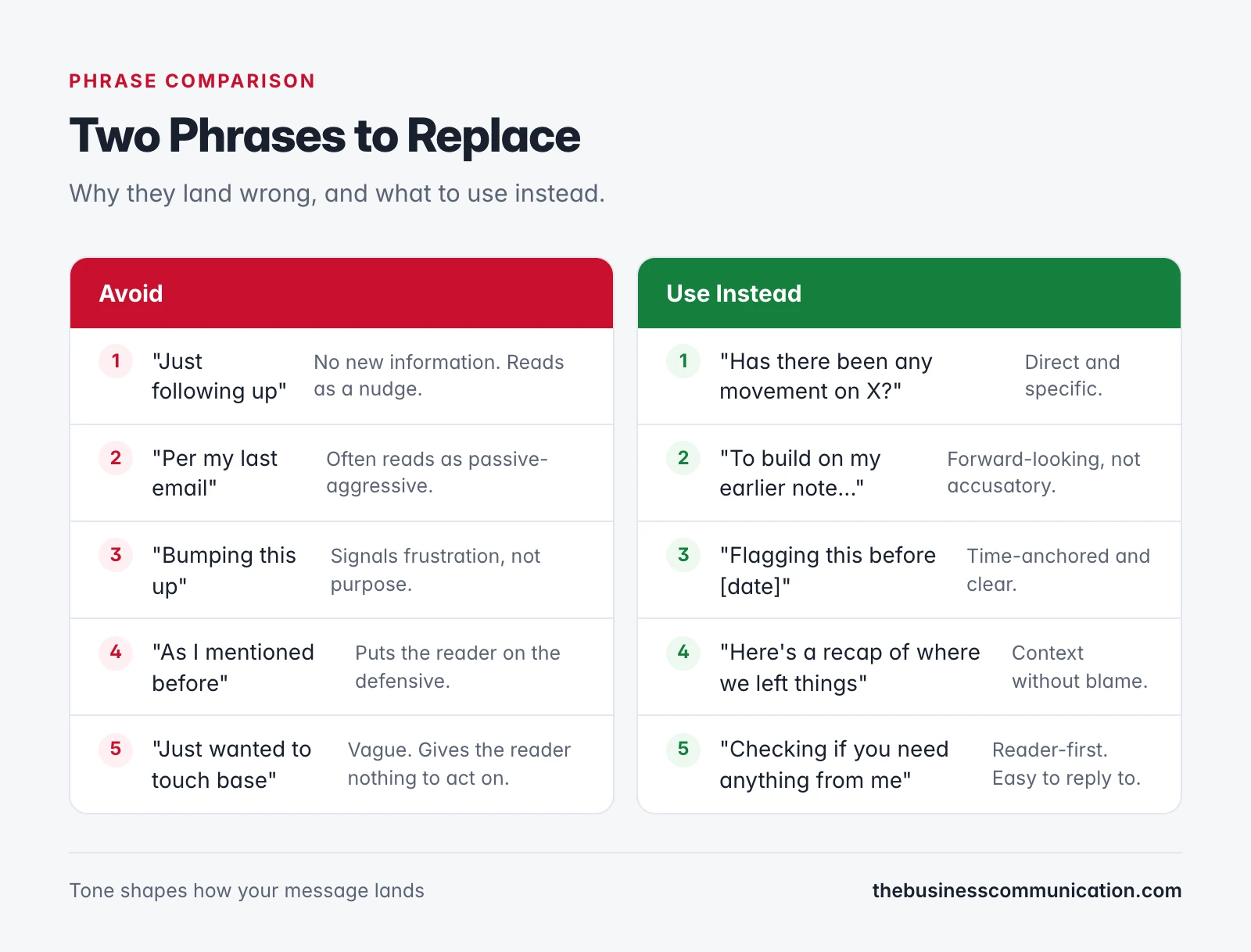
Opening with “just following up” adds nothing new. It signals only that you want a reply. This guide covers the most effective just following up alternatives and the clearest swaps for per my last email. Both phrases are easy to fix once you know what goes wrong.
Why these two phrases fall flat
“Just following up” is one of the most common email openers in professional life. It also does the least work. It tells the reader you want something but gives no reason to act. It reads as a nudge with no reason attached.
“Per my last email” carries a sharper edge. Many readers take it to mean they already had this information and chose to ignore it. Even when you did not mean it that way, the phrase creates friction before the reader reaches your actual question.
Grammarly’s 2024 State of Business Communication report found that every knowledge worker experiences miscommunication at least once a week. Tone is a big part of why. A phrase that feels neutral to the sender often lands very differently with the reader.
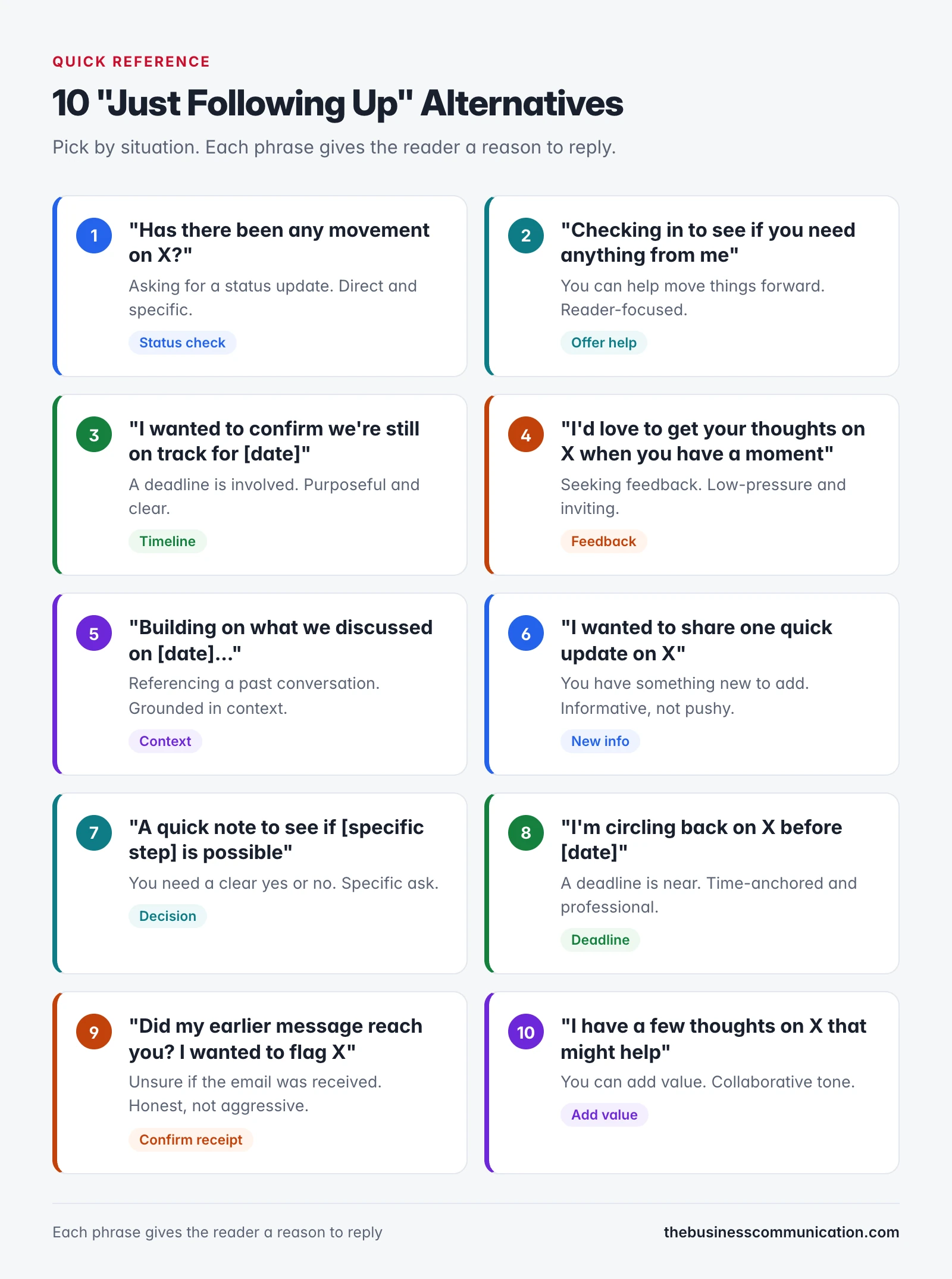
Just following up alternatives: 10 phrases that work
1. “Has there been any movement on [X]?”
When you need a status update and have nothing new to add, this asks a direct question without implying blame. The reader can answer with a quick yes or no.
2. “Checking in to see if you need anything from me on [X]”
If you can offer help, this works well. It reframes the follow-up as support rather than pressure. The reader feels no obligation to justify a delay because the focus is on what you can do.
3. “I wanted to confirm we’re still on track for [date]”
Ideal when a deadline or meeting is in play. Tying the follow-up to a specific date gives it an obvious purpose. The reader immediately knows why you wrote.
4. “I’d love to get your thoughts on [X] when you have a moment”
For feedback or a reaction, this is low-pressure and inviting. It tells the reader you value their opinion, not just their approval or action.
5. “Building on what we discussed on [date]…”
Best when picking up from a previous conversation. This grounds your message in shared context and shows the reader you were paying attention when they spoke.
6. “I wanted to share one quick update on [X]”
When you have something new since your last message, lead with it. A genuine update makes the follow-up feel worth reading. The reader opens it expecting information, not a nudge.
7. “A quick note to see if [specific step] is possible”
Need a clear yes or no on one thing? A narrow ask is far easier to answer than a vague check-in. It cuts reply time because the reader knows exactly what they are deciding.
8. “I’m circling back on [X] before [date]”
With a deadline close and an item still pending, naming the date adds urgency without sounding accusatory. It also helps the reader prioritize your message against everything else.
9. “Did my earlier message reach you? I wanted to flag [X]”
When you genuinely are not sure your first email arrived, this phrasing is honest without being passive-aggressive. It gives the reader an easy out if they simply missed it.
10. “I have a few thoughts on [X] that might help”
Positioning your follow-up as help for the reader, rather than a request for yourself, tends to get a faster response. This works when you genuinely have something useful to add.
For complete email templates built around these openers, see our guide to follow-up emails when there is no response.
How to write a strong follow-up (example)
Here is how phrase 8 looks in a real email. The sender follows up on a proposal sent three days earlier.
No “just following up,” no pressure language, no apology for writing again. It states the deadline, offers help, and makes the reply easy. Learning how to write a professional email well means treating every sentence as something that earns its place.
7 alternatives to “Per My Last Email”
“Per my last email” is the follow-up phrase most likely to damage a working relationship. Most people use it when they feel ignored, which is understandable. But it signals frustration rather than clarity. Seven alternatives follow.
| Instead of “Per my last email” | Use when | Tone |
|---|---|---|
| As we discussed… | Referencing a shared conversation | Neutral, collaborative |
| To build on my earlier note… | Moving the thread forward | Professional, constructive |
| As previously mentioned… | Formal written record needed | Formal, factual |
| I may not have been clear; let me clarify… | Possibility of misunderstanding | Accountable, humble |
| Here’s a recap of where we left things… | Long thread or complex topic | Helpful, clear |
| Please see the details I shared on [date] below | Forwarding or quoting earlier email | Neutral, no blame |
| I wanted to flag this again before [date] | Urgency involved | Purposeful, time-aware |
That fourth option, “I may not have been clear; let me clarify,” is worth calling out. It removes blame entirely by accepting partial ownership of the gap.
Even if the reader missed your message, offering to clarify costs you nothing. It often gets a faster reply than a pointed reminder does.
Example: replacing “per my last email” in practice
A project manager sent a brief to a vendor last week and still has not received confirmation. Here is what not to write, followed by a better version.
Avoid:
Better:
Version two does the same job. It reminds the reader of the earlier message, asks for confirmation, and opens the door for discussion. No accusation, no friction.
As the 7 Cs of communication show, clear and considerate language almost always gets a faster reply than language that puts people on guard.
Timing matters as much as wording
What you write matters, but so does when you send it. A well-worded follow-up sent too soon still feels like pressure. A 2026 Belkins study of 7.5 million emails found that follow-ups collectively generate 58.6% of all replies. First emails alone rarely close the loop.
- Wait 2 to 3 business days before a first follow-up on a non-urgent item.
- Space subsequent follow-ups at least 5 days apart.
- After a third unanswered follow-up, step back. A phone call or a different contact often works better.
Strong email subject lines also play a large role in whether your follow-up gets opened. Your opening phrase matters less if the subject line goes unread first.
Frequently asked questions
Is there a better way to say “just following up”?
Yes. The best replacement connects your message to a specific reason: a deadline, a question, or new information. “Has there been any movement on X?” and “I’m circling back before [date]” are two reliable options. Both give the reader something concrete to respond to.
What can I say instead of “I’m following up”?
Open with the actual purpose. Confirm your Thursday call. Ask whether the draft from Monday works for them. State what you need clearly. That is almost always more effective than announcing you are following up.
How do I say I am just following up in a formal email?
In a formal context, use factual language. Write something like: I am writing to follow up on my email of [date] regarding [topic]. Then state your specific question or request.
Formal does not mean vague. The more precisely you state what you need, the easier it is for the reader to act.
How do you say follow up in a nice way?
Keep the focus on the reader, not yourself. “Let me know if there is anything I can do to move this forward” feels warmer than “waiting for your reply.” Phrases that offer help rather than request action tend to get a faster response.
What can I say instead of “per my last email”?
“As we discussed,” “to build on my earlier note,” and “here’s a quick recap” all do the same job without the passive edge. If the reader missed your message, “I may not have been clear; let me clarify” removes the assumption of blame entirely.
Is saying “per my last email” rude?
Not necessarily rude, but often risky. Most people read it as a subtle way of saying they already had this information. Whether that was the intent or not, the phrase creates a defensive reaction. A neutral alternative almost always gets a better result.
Is “per my last email” passive-aggressive?
It depends on context and relationship, but many workplaces read it that way. It has become shorthand for frustration dressed up as professionalism. If there is any chance it will land that way, the alternatives above achieve the same goal without the risk.
How do I politely say “as per my previous email”?
A straightforward recap works well: “To summarize what I sent on [date]…” or “As discussed in my previous message…” Both are clear and professional. Quote or summarize the original rather than telling the reader they already have the information.
Putting it together
Both phrases have the same fix: give the reader a reason to reply. Vague check-ins get vague non-responses. Specific questions, named deadlines, and offers of help all make it easier for a busy person to respond quickly.
Any follow-up’s goal is not to prove you sent the earlier message. It is to make the next step easy for the other person. That difference separates follow-ups that get replies from ones that get ignored.
For a deeper look at tone and structure, formal business writing follows the same principles across letters and emails alike.