


Effective cross-cultural communication is not automatic, even in organizations with diverse teams. You need deliberate strategies to prevent misunderstandings, build psychological safety, and establish shared expectations across cultural differences. This guide walks you through eight evidence-based approaches to improve communication outcomes in global and multicultural workplaces.
Why cross-cultural communication effectiveness matters
Organizations with strong cross-cultural communication practices see measurable gains in productivity, employee engagement, innovation, and retention. Teams with high psychological safety, where members feel safe to take interpersonal risks, tend to generate more creative solutions and adapt faster to market changes.
Poor cross-cultural communication, on the other hand, creates real organizational risk. Miscommunication leads to project delays, internal conflict, and costly market failures. eBay’s 2004 entry into China collapsed partly because the company failed to understand local communication norms around negotiation and trust-building. The platform assumed Western-style transactional communication would work universally; it did not.
These strategies apply whether you manage a remote team spread across continents, lead a multinational with offices in multiple countries, or work in a diverse local office. Cultural differences in communication style exist within national borders, too, shaped by region, ethnicity, generation, and professional background.
Identify communication style differences: high-context vs. low-context
One of the most useful diagnostic tools for predicting cross-cultural friction is the high-context versus low-context communication framework. High-context cultures, common in East Asia, the Middle East, Latin America, and parts of Africa, rely heavily on implicit meaning, relationship history, and nonverbal cues. What is not said often matters as much as what is said. Directness can be perceived as rude or unsophisticated.
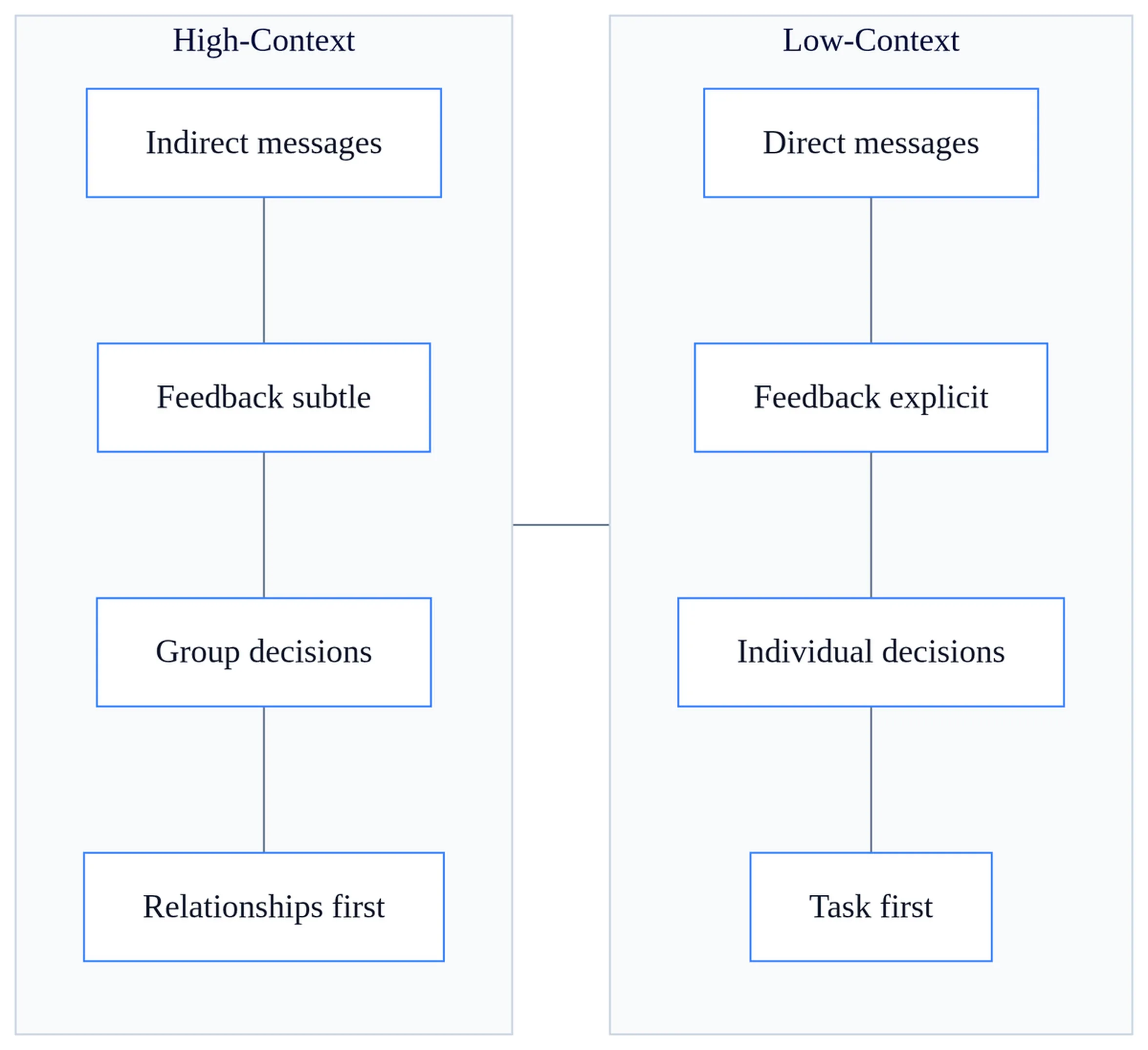
Low-context cultures, typical in North America, Northern Europe, and Australia, prefer explicit, direct language. People value clarity and documentation. Ambiguity is seen as inefficient or evasive.
The friction point is predictable. A high-context communicator may view a low-context colleague’s directness as blunt or disrespectful. Meanwhile, the low-context communicator may find the high-context colleague’s indirectness vague or time-wasting. Neither interpretation is correct; both are culturally conditioned.
Map your team’s cultural communication styles early. If you manage a team with members from Japan, Germany, and Brazil, expect different baseline assumptions about how feedback should be delivered, how decisions are made, and how disagreement is expressed. Acknowledging these differences openly, without labeling one style as “better”, reduces the likelihood that people will interpret style differences as personal slights.
Set clear behavioral expectations and communication standards
Most cross-cultural communication breakdowns stem from unstated assumptions. What counts as a reasonable email response time? When should you escalate a concern to your manager? Is it acceptable to disagree openly in a meeting, or should dissent be raised privately afterward?
Define what effective communication looks like in your organization. Write it down. Discuss it during onboarding and revisit it in team meetings. For example, you might establish that all meeting agendas will be shared 24 hours in advance, that written summaries will follow verbal decisions, and that team members are expected to ask clarifying questions if instructions are unclear.
Organizations that set deliberate, ongoing behavioral expectations tend to see better inclusion outcomes than those that rely on passive approaches. “Winging it” does not work. One-off antiprejudice campaigns don’t work either; they can backfire by triggering defensiveness.
Pair your communication standards with accountability. If you say that all voices should be heard in meetings, rotate who speaks first. If you commit to accommodating religious holidays, maintain a shared calendar and adjust deadlines accordingly. Behavioral expectations without follow-through erode trust faster than no expectations at all.
Build psychological safety for open feedback loops
Psychological safety is the foundation for honest cross-cultural feedback. People need to feel they can raise concerns, admit confusion, or point out miscommunication without fear of embarrassment or retaliation. Without this safety, cultural misunderstandings go underground and fester.
Establish multiple communication feedback channels to accommodate different cultural preferences. Some team members will feel comfortable voicing concerns in group meetings; others will prefer one-on-one conversations, written feedback forms, or anonymous surveys. Offering variety signals that you understand not everyone communicates the same way.
Leadership behavior sets the tone. Model vulnerability. When you make a cultural mistake, mispronounce a name, schedule a meeting during a religious holiday, misinterpret someone’s communication style, acknowledge it openly and adjust. This gives others permission to do the same and normalizes the reality that cross-cultural communication requires ongoing learning, not perfection.
Avoid treating feedback as a one-way street. Ask for input on your own communication style. “I tend to be very direct in emails, does that work for you, or would you prefer a different approach?” This kind of meta-conversation makes cultural differences discussable rather than taboo.
Invest in language and cultural competency training
Language training remains one of the most practical ways to improve cross-cultural communication effectiveness, but it needs to go beyond basic vocabulary. Teach a common organizational language, often English in multinational companies, but also address accent bias, idiom avoidance, and listening comprehension.
Many native English speakers assume that if someone can speak English, they can understand rapid-fire idioms, cultural references, and complex syntax. This assumption creates barriers to effective communication. Train everyone, not just non-native speakers, to slow down, simplify sentence structure, and avoid phrases like “let’s circle back and touch base after we’ve moved the needle.” Use “let’s meet again after we make progress” instead.
Cultural training should move beyond one-time diversity workshops. Build ongoing, role-specific modules that address real workplace scenarios: How do negotiation styles differ across cultures? How do decision-making processes vary? How should managers deliver performance feedback to employees from high-context cultures?
Treating cultural competency as continuous learning, not a checkbox event, tends to work better. Competency includes cultural awareness, empathy, curiosity, flexibility, and respect. These are skills that deepen with practice, not knowledge you acquire once and never revisit.
Cultural competency framework
| Competency | Description | Practical application |
|---|---|---|
| Cultural awareness | Understanding that your own cultural norms are not universal | Recognize when your communication style reflects cultural conditioning, not objective “correctness” |
| Empathy | Ability to see situations from another cultural perspective | Ask yourself why a colleague might interpret your message differently than you intended |
| Curiosity | Genuine interest in learning about other cultures | Ask open-ended questions about communication preferences without making assumptions |
| Flexibility | Willingness to adapt your communication style | Adjust meeting formats, feedback methods, and decision-making processes based on team composition |
| Respect | Treating all communication styles as valid, not inferior | Avoid labeling indirect communication as “evasive” or direct communication as “rude” |
Audit and adapt communication templates and policies
Your organization’s communication templates and policies likely contain hidden cultural assumptions. Review email templates, meeting agendas, written policies, performance review forms, and decision-making processes. Ask: Does this assume a low-context communication style? Does it privilege native speakers? Does it accommodate different time zones and work schedules?
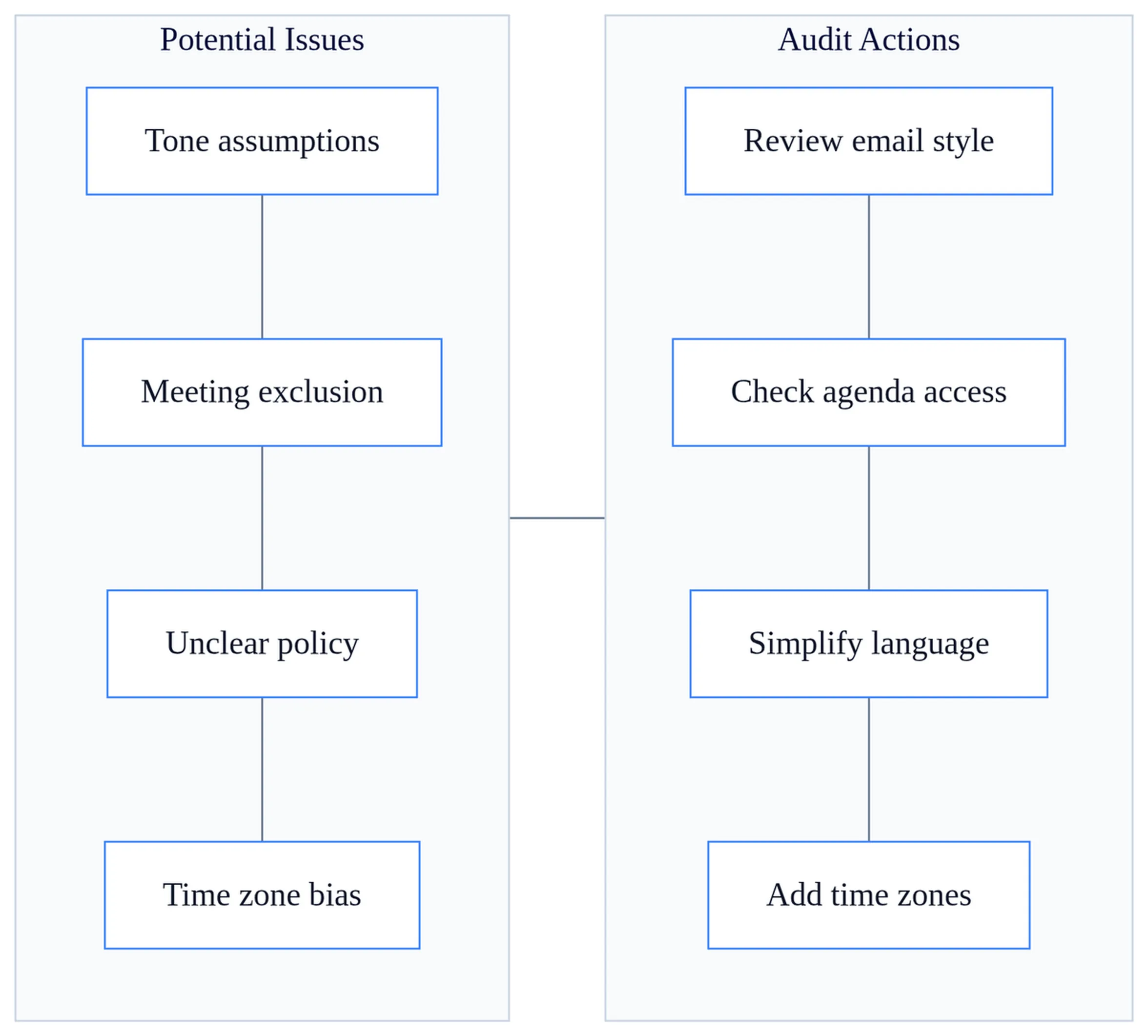
Simplify language across all written materials. Use familiar, concrete words. A 300-word policy written in plain language is more inclusive than a 150-word policy dense with jargon and cultural references. Avoid phrases like “hit the ground running,” “low-hanging fruit,” or “think outside the box”, these mean nothing to someone who learned English as a second language.
For distributed teams, accommodate time zones deliberately. Rotate meeting times so the burden of early-morning or late-night calls does not always fall on the same people. Provide asynchronous alternatives: record meetings, share written summaries, and allow team members to contribute via shared documents rather than requiring real-time participation. If you’re sitting on the fence about whether to record a meeting, the answer is usually yes. The cost is negligible; the inclusion benefit is real.
Nonverbal communication norms vary widely by culture, and what feels natural to you may confuse or offend someone else. Eye contact, gestures, personal space, and tone of voice all carry different meanings across cultures. When possible, make communication expectations explicit rather than assuming everyone shares your nonverbal vocabulary. For a deeper look at how nonverbal cues function and sometimes fail across cultures, see our guide on the advantages and disadvantages of non-verbal communication.
Practice active listening and curiosity across differences
Cross-cultural communication requires more than just speaking clearly; it demands listening with intention. Active listening skills form the foundation for understanding across cultural differences, but they must be paired with curiosity about why someone communicates the way they do.
When you encounter a communication style that feels unfamiliar or frustrating, pause before assuming misunderstanding is intentional. Ask clarifying questions: “Can you help me understand what you mean by that?” or “I want to make sure I’m interpreting this correctly, are you saying X or Y?” These questions signal respect and reduce the chance of misinterpretation.
Seek to understand the cultural logic behind different communication styles, not just the surface behavior. If a colleague never disagrees with you in meetings but later sends detailed written critiques, they may come from a culture where public disagreement is seen as disrespectful. If another colleague seems to ignore your emails but responds immediately to phone calls, they may prioritize relationship-building over transactional efficiency.
Reflect back what you heard, especially in high-stakes conversations.
“So if I understand correctly, you’re concerned that the timeline doesn’t allow for sufficient stakeholder consultation. Is that right?” This technique, common in mediation, prevents small misunderstandings from snowballing into larger conflicts.
Measure and iterate on cross-cultural communication effectiveness
Most organizations invest in cross-cultural communication training but never measure whether it works. You need concrete metrics to know if your strategies are improving outcomes or just checking a compliance box.
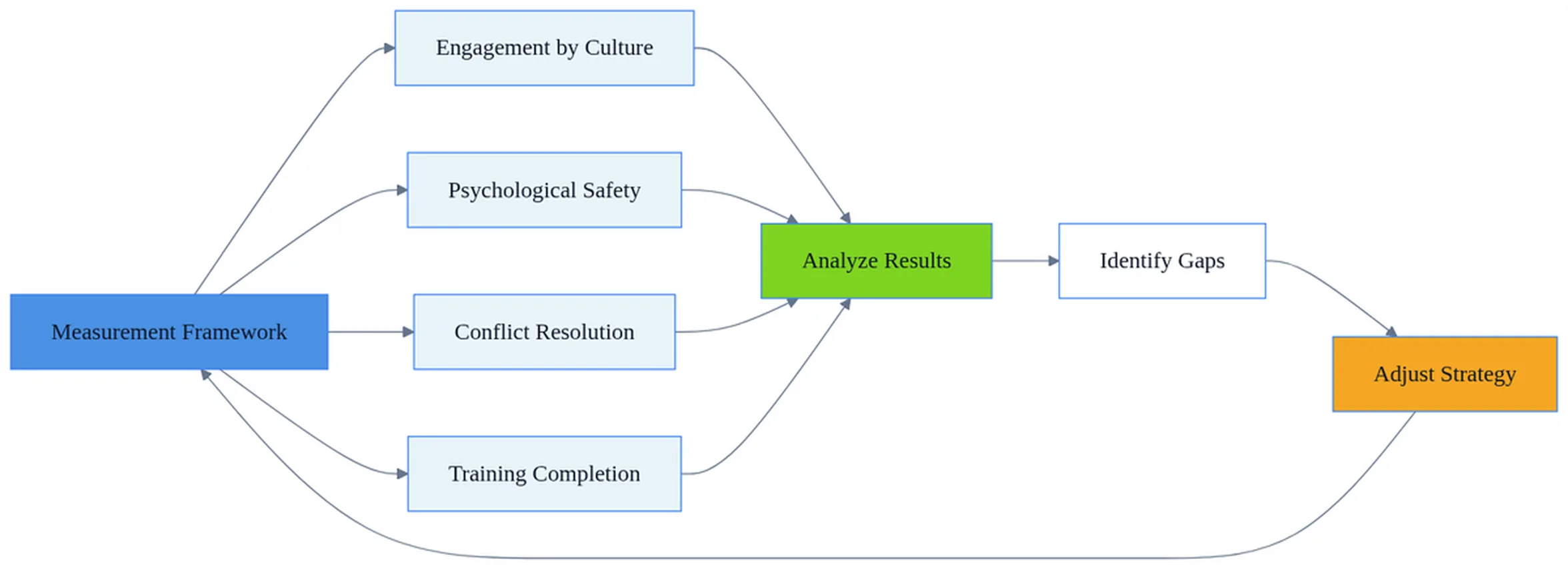
Track employee engagement scores by cultural or demographic group. If one segment consistently reports lower satisfaction with internal communication, dig deeper. Conduct pulse surveys that ask specific questions: Do you feel psychologically safe raising concerns? Are communication expectations clear? Do you feel your communication style is respected?
Measure operational outcomes tied to communication. How long does it take to resolve cross-cultural conflicts? Are meeting notes and decisions documented consistently? Do employees from different cultural backgrounds participate equally in discussions, or do some voices dominate while others stay silent?
Audit communication patterns for signs of exclusion. Review email tone, meeting participation logs, and decision-making records. Are certain team members consistently left out of informal communication channels? Do some employees receive feedback more frequently or more constructively than others?
Iterate based on what you learn. If surveys reveal that your “open-door policy” is not working for employees from hierarchical cultures, introduce structured office hours or anonymous feedback forms. If time-zone rotation is not happening despite written policy, assign a rotating meeting scheduler and hold leaders accountable. Measurement without adjustment is performative, not strategic.
Start with one or two strategies from this guide: set clearer expectations, build a feedback channel that accommodates different styles, or audit your templates for hidden assumptions. Small, deliberate changes compound over time into organizations where people from all backgrounds can communicate without constantly translating their instincts into someone else’s cultural framework.
Frequently asked questions
What if my team has both high-context and low-context communicators?
Acknowledge the difference openly without labeling one style as superior. Set explicit behavioral expectations that work for both: require written summaries after decisions, establish clear email response times, and create space for both direct feedback and private conversations. This prevents high-context members from feeling rushed and low-context members from feeling unheard.
How do I give critical feedback across cultural communication styles?
Adapt your approach to the recipient’s style. With high-context communicators, provide feedback privately, use indirect language, and emphasize the relationship before the critique. With low-context communicators, be direct and specific in writing. In both cases, separate the feedback from the person and focus on behavior, not character.
Should I require everyone to communicate the same way for consistency?
No. Standardizing communication style erases cultural strengths and creates resentment. Instead, standardize outcomes and expectations (response times, documentation, escalation paths) while allowing flexibility in how people get there. This respects different styles while maintaining clarity.
What’s the fastest way to rebuild trust after a cross-cultural miscommunication?
Acknowledge the mistake quickly and specifically. Explain what you misunderstood and why, without making excuses. Ask the other person how they prefer to communicate going forward. Follow through visibly. Delayed responses or vague apologies signal you don’t take the mistake seriously.
Can anonymous feedback channels actually work in high-context cultures?
Yes, but supplement them with one-on-one conversations. High-context cultures value relationship and face-saving, so anonymous surveys alone may feel impersonal. Offer both options and explicitly invite private feedback. This respects cultural preference while still capturing honest input.