


Company meetings are a fact of organizational life, but most teams run them poorly. This guide explains what company meetings are, their formal types, the legal requirements you need to follow, and how to run meetings that actually accomplish something instead of wasting everyone’s time.
What is a company meeting?
A company meeting is a formal gathering of members, directors, or employees convened to discuss, debate, and decide on matters affecting the organization. The word “formal” matters here. Unlike a hallway conversation or a Slack thread, a company meeting follows structured procedures: advance notice, a written agenda, documented meeting minutes, and often voting mechanisms.
The core purpose is alignment. Without meetings, your finance team might approve a budget that contradicts your operations team’s capacity, or your board might lack the information needed to fulfill its fiduciary duty. Meetings create shared understanding and accountability across people who otherwise work in silos.
Not every gathering qualifies as a company meeting. A spontaneous brainstorming session over coffee is not one. A scheduled quarterly business review with documented outcomes is. The distinction hinges on intent, structure, and record-keeping.
Why company meetings matter: key objectives
Organizations hold meetings for five primary reasons, and understanding which objective you’re pursuing helps you choose the right format.
Information sharing and updates. Status reports, project progress, market changes, or policy announcements flow through meetings. A sales team might gather weekly to review pipeline metrics and discuss customer feedback trends.
Decision-making and approvals. Some decisions require collective input or formal authorization. Approving a capital expenditure, greenlighting a product launch, or selecting a vendor often happens in meetings where stakeholders can debate trade-offs before committing.
Problem-solving and brainstorming. When a supply chain disruption threatens delivery deadlines, a cross-functional meeting brings operations, logistics, and customer service together to identify solutions. The real-time exchange surfaces options faster than email chains.
Legal compliance and governance. Certain meetings are mandatory. Public companies must hold Annual General Meetings. Boards must meet to approve financial statements. Failing to conduct these meetings can expose directors to personal liability or trigger regulatory penalties.
Team alignment and accountability. Meetings clarify who owns what and by when. They prevent duplicated effort and ensure everyone understands strategic priorities. A product team might meet bi-weekly to confirm that design, engineering, and marketing are building toward the same launch date.
Most meetings serve multiple objectives. A board meeting might share financial updates, approve a new hire, and solve a compliance issue, all in 90 minutes.
Types of company meetings and when to use them
Not all meetings are created equal. The format you choose should match the business goal and the stakeholders involved.
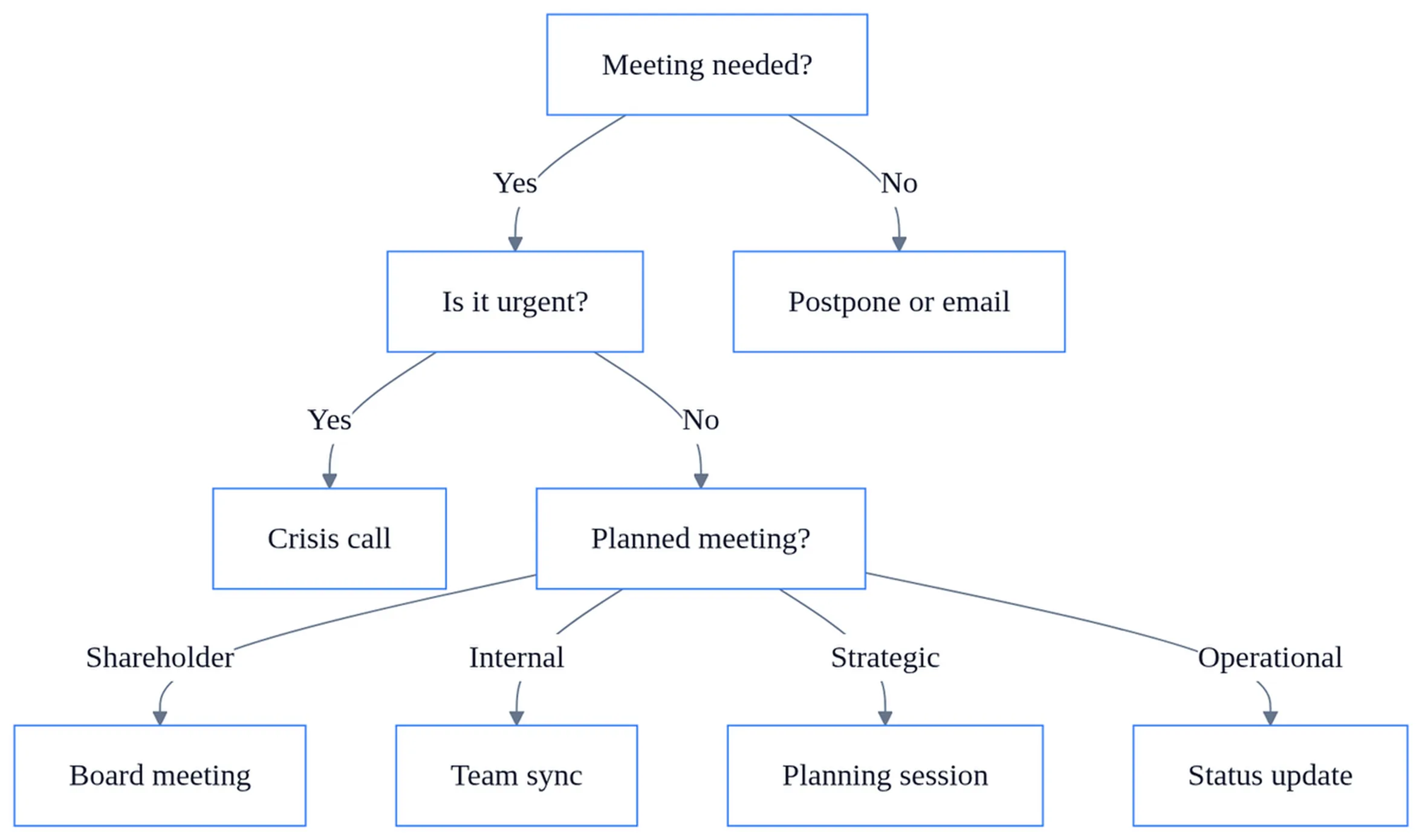
Board meetings convene directors to oversee strategy, financial performance, and governance. These meetings address high-level questions: Should we enter a new market? Is our risk management adequate? Are we complying with fiduciary duties? For practical execution guidance, see our article on board meeting best practices.
Annual General Meetings (AGMs) are mandatory yearly gatherings of shareholders. Directors present audited financials, declare dividends if applicable, and shareholders elect or re-elect board members. AGMs are the primary accountability mechanism between ownership and management.
Extraordinary General Meetings (EGMs) handle urgent matters that cannot wait until the next AGM. Mergers, major asset sales, or changes to the company’s constitution typically require an EGM. For a detailed comparison of these two formats, read our guide on AGM vs EGM.
Statutory meetings occur once in a company’s lifetime, shortly after incorporation. Shareholders receive a report on the company’s initial setup, share allotment, and early progress. This meeting is less common in modern practice but remains a legal requirement in some jurisdictions.
Committee and staff meetings are the workhorses of daily operations. Project teams, department heads, and working groups meet to coordinate execution. A marketing committee might meet monthly to review campaign performance, while a product team holds daily standups to unblock progress. For specialized guidance on project-focused gatherings, see our article on project meeting facilitation.
Choosing the wrong meeting type is a common mistake. A team trying to brainstorm creative solutions in a formal board meeting format will feel stifled. Conversely, attempting to approve a major capital expenditure in a casual staff meeting lacks the rigor and documentation needed for accountability.
Meeting structure and process: from planning to follow-up
Meetings follow a predictable three-phase structure. Skip any phase and you risk wasted time or unimplemented decisions.

Pre-meeting preparation starts with the notice. Members must receive advance notification of the meeting date, time, location (or virtual platform), and agenda. For formal meetings, notice periods are legally mandated, often 14 to 21 days for AGMs. The agenda lists topics in order and allocates time to each. A well-crafted agenda prevents scope creep and keeps discussion focused. For step-by-step guidance, read how to write a meeting agenda.
During the meeting, the chairperson maintains order and ensures the agenda is followed. Participants engage in discussion, ask questions, and contribute ideas. The secretary records key points, decisions, and action items in real time. Voting may occur on resolutions, using methods like show of hands, proxy votes, or secret ballot depending on the matter’s sensitivity.
Post-meeting follow-up is where many organizations fail. Minutes must be documented, reviewed, and distributed promptly, ideally within 48 hours. Action items need clear owners and deadlines. Without follow-up, decisions remain theoretical. For detailed guidance on this phase, see our article on meeting follow-up and action items.
This structure applies whether you’re running a 15-minute standup or a four-hour board meeting. Scale the formality to match the stakes, but never skip the phases.
Legal requirements and compliance essentials
Certain company meetings carry legal weight. Get the formalities wrong and your decisions may be invalid, or worse, expose directors to personal liability.
Notice requirements vary by meeting type and jurisdiction. AGMs typically require 14 to 21 days’ written notice. Board meetings might need only 7 days. The notice must specify the date, time, location, and agenda. Sending notice to the wrong address or omitting a required agenda item can invalidate the meeting.
Quorum is the minimum number of participants required for valid decision-making. Without quorum, the meeting cannot proceed. For a private company board, quorum might be two directors. Check your company’s articles of association or bylaws for the exact threshold.
Voting mechanisms must be specified in advance. Show of hands works for routine matters. Proxy voting allows absent shareholders to delegate their vote. Secret ballot protects confidentiality in sensitive decisions like director elections. Each method has procedural requirements, proxy forms must be submitted by a deadline, for example.
Minutes and record-keeping create the official record. Minutes document attendance, resolutions passed, votes cast, and dissenting opinions. In the event of a dispute or audit, minutes are the primary evidence of what the company decided and why. Poor documentation is a common reason decisions never get implemented.
Resolutions are binding decisions. Once passed in a properly convened meeting, they obligate the company to act. Directors who fail to implement validly passed resolutions risk breach-of-duty claims.
For a comprehensive overview of what makes a meeting legally valid, read our guide on prerequisites of a valid meeting.
Roles and responsibilities: who does what in a meeting
Three roles define a well-run meeting: chairperson, secretary, and participants.
Chairperson
The chairperson leads the meeting. They open proceedings, introduce agenda items, facilitate discussion, manage time, and maintain order. A skilled chair knows when to let debate run and when to call for a vote. They also handle disruptions, whether that’s a participant monopolizing airtime or a heated disagreement threatening to derail progress. The chair’s neutrality matters. They should not dominate discussion but instead draw out quieter voices and ensure all perspectives are heard.
Secretary
The secretary handles administrative duties. They prepare and distribute the notice and agenda, take minutes during the meeting, and manage official records. The secretary also tracks action items and follows up with owners after the meeting. In formal settings, the secretary advises the chair on procedural matters and ensures compliance with legal requirements.
Participants: what every attendee is responsible for
Participants are responsible for preparation, engagement, and follow-through. They should review the agenda and supporting materials in advance, contribute ideas during discussion, vote on resolutions, and complete assigned action items after the meeting.
Participants do more than complete the quorum. What each member does before, during and after the meeting decides whether the proceedings are worthwhile.
Before the meeting
- Read the notice, the agenda and any supporting papers so you know the background to each item.
- Pick the one or two items where you can add something useful and prepare your points on them.
- If you are presenting an item, prepare any visual aids, send them in advance if needed, and rehearse beforehand.
- Confirm your attendance, or appoint a proxy where the rules allow it.
During the meeting
- Sign the attendance sheet, take your seat, and follow the chair’s rulings on who speaks and when.
- Speak only when the chair recognises you.
- Timing matters: a good point raised at the wrong moment is often lost. If you have prepared on an item, raise your point early in the discussion of that item.
- Keep contributions short so that others also get the floor.
- Keep your temper. Disagree with the idea, not the person; flat opposition only provokes angry reactions.
- Stay open to other views and avoid lecturing, patronising or point-scoring remarks.
- Vote on resolutions as directed by the chair.
After the meeting
- Read the draft minutes and tell the secretary about any errors.
- Complete your action items by the agreed deadline.
In virtual meetings the same duties apply. The platform roles usually map onto them: the organizer (often the chair or secretary) sends the invitation, presenters share their material, and attendees join, speak when invited and vote through the platform.
Who does what: before, during and after
| Role | Before | During | After |
|---|---|---|---|
| Chairperson | Reviews the agenda and papers | Opens proceedings, manages time, keeps order, calls votes | Reviews the draft minutes before they are circulated |
| Secretary | Prepares and sends the notice, agenda and papers | Records key points, decisions and action items; advises on procedure | Distributes minutes and follows up on action items |
| Participant | Reads the papers and prepares points | Signs in, speaks when recognised, keeps it short, votes | Checks the draft minutes and completes action items |
In smaller organizations, one person might wear multiple hats. A startup founder might chair the board meeting while also taking notes. As organizations grow, separating these roles improves outcomes and reduces conflicts of interest.
How to run an effective meeting: best practices
Theory is one thing. Execution is another.
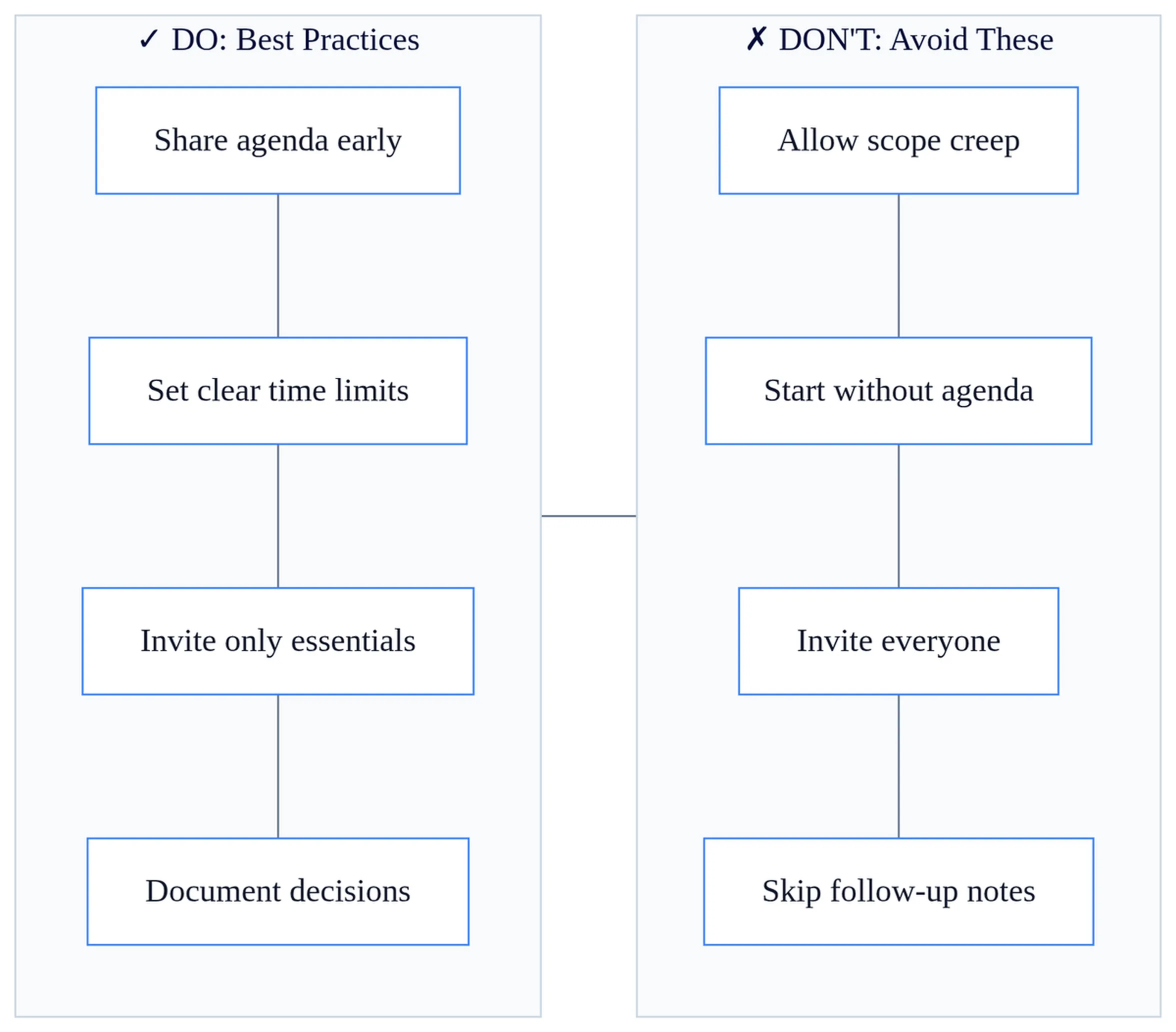
Pre-meeting: set the stage. Share the agenda at least 48 hours in advance. Attach any documents participants need to review, budget spreadsheets, project plans, policy drafts. Confirm attendance the day before. If you’re using video conferencing, test the technology 15 minutes early. Nothing kills momentum like a 10-minute delay while someone troubleshoots their microphone.
During the meeting: respect time and focus. Start on time, even if two people are missing. Waiting rewards latecomers and punishes the punctual. Stick to the agenda. If a new topic arises, note it for a future meeting rather than letting it hijack the current one. Encourage participation from quieter members. A simple “Priya, you’ve worked on similar projects, what’s your take?” can surface valuable insights. End on time. If you consistently run over, people will stop preparing because they assume the meeting is poorly managed anyway.
Post-meeting: close the loop. Distribute minutes within 48 hours. List action items with owners and deadlines in a separate section so they’re easy to scan. Follow up individually with action owners if deadlines approach without progress.
| Common Pitfall | Why It Fails | How to Avoid |
|---|---|---|
| Unclear purpose | Participants don’t know why they’re there or what success looks like | State the meeting objective in the first sentence of the agenda |
| Wrong attendees | Decision-makers are absent or people without relevant input waste time | Invite only those who can contribute or decide; make others optional |
| No structure | Discussion wanders; important topics get skipped; meetings run long | Allocate time per agenda item; use a timer if necessary |
| Scope creep | New topics derail the agenda; original objectives are forgotten | Park off-topic items in a “future topics” list; revisit them later |
One thing most people get wrong: they treat all meetings as equally important. A 30-minute project check-in does not require the same formality as a board meeting approving a merger. Match your process rigor to the stakes.
Synchronous vs. asynchronous: choosing the right format
Not every decision requires a meeting. The rise of remote work has forced organizations to rethink when real-time gatherings are actually necessary.
Hold synchronous meetings when: the decision requires real-time debate and negotiation, the matter is urgent and cannot wait for asynchronous input, or relationship-building is a secondary goal. Brainstorming sessions, conflict resolution, and strategic planning benefit from synchronous interaction. Tone of voice, body language, and immediate back-and-forth clarify nuance that text cannot convey.
Use asynchronous alternatives when: you’re sharing information that doesn’t require discussion, collecting feedback or votes on a straightforward decision, or providing status updates. A weekly progress report can be a shared document that team members review and comment on at their convenience. A policy approval might happen via email vote if the draft has already been discussed.
Meeting fatigue is real. Executives spend nearly 23 hours a week in meetings, according to research published in Harvard Business Review (source). That’s nearly 60% of a standard work week. If your team complains about back-to-back meetings, audit your calendar. Which recurring meetings could be consolidated? Which could shift to asynchronous updates?
A hybrid approach often works best. Hold a monthly synchronous strategy meeting but share progress updates asynchronously between meetings. Conduct annual planning in person but collect input via surveys beforehand. The key is intentionality. Ask “Does this require real-time discussion?” before scheduling.
For organizations managing distributed teams, virtual meetings introduce additional considerations around technology, time zones, and engagement.
The strongest meeting cultures are the ones that kill meetings aggressively. If a recurring meeting has lost its purpose, cancel it. If the same three people dominate every discussion, shrink the invite list. Your goal is not to hold meetings. Your goal is to make decisions and drive action. Meetings are just one tool for getting there, and often not the best one.
Before your next meeting, write a one-sentence objective at the top of the agenda. If you can’t articulate what success looks like, you probably don’t need the meeting.
Frequently asked questions
What happens if we skip taking meeting minutes?
Skipping minutes creates legal and operational risk. For formal meetings (board, AGM, EGM), documented minutes are legally required and protect directors from liability claims. Even informal staff meetings benefit from written records—they clarify who committed to what and by when, preventing misunderstandings later. Minutes don’t need to be transcripts; key decisions and action items suffice.
Can we hold a board meeting without all directors present?
Most jurisdictions require a quorum—a minimum number of directors—for board decisions to be valid. Check your bylaws and local corporate law for your specific requirement, often 50% or more of board seats. If quorum isn’t met, the meeting can proceed for information sharing, but votes and formal decisions are void. Absent directors should be notified in advance.
Should we send an agenda before a casual team standup?
Yes. Even brief standups benefit from a simple agenda: what each person accomplished, what they’re working on, and blockers. It takes 30 seconds to share and keeps the 15-minute meeting focused. Casual doesn’t mean unstructured. Without direction, standups drift into tangents and waste time for people not involved in every discussion.
What if a decision made in a meeting gets challenged later?
Detailed minutes protect you. If minutes clearly document the decision, who voted for it, and the reasoning, challenges are harder to sustain. For major decisions (capital spend, policy changes), confirm the decision in writing after the meeting and ask attendees to acknowledge. This creates an audit trail and prevents “I didn’t agree to that” disputes.
Is it acceptable to hold a shareholder meeting entirely online?
Many jurisdictions now permit fully virtual AGMs and EGMs, especially post-2020. Check your local corporate law and company bylaws first—requirements vary. If allowed, ensure the platform supports secure voting, real-time Q&A, and reliable connectivity. Hybrid (in-person and virtual) is also common. Document the platform and voting method in your notice to shareholders.
How do we handle a meeting that’s running over time?
The chairperson should table lower-priority agenda items and schedule a follow-up meeting. Continuing past the scheduled end time signals poor planning and disrespects attendees’ calendars. If a topic genuinely needs more time, pause, agree on next steps, and reconvene. Respect for time builds trust and encourages participation in future meetings.
18 Comments
Am cool TG
im very glad to receive such information
thank alot. Points are well explained
Very informative. Well presented
meeting is formal or informal coming together of people to deliberate over an issue to resolution.
It is very usefull thx 🙂
it is easy to learn
Very good information on the important issue of meetings. I have shared it with my group members so that they can begin to appreciate the importance of meetings in any organization.
I found it very informative as well as very useful…thanks
Very amazing ppresention of merits and dimerits of meeting
Meeting is a situation whereby people seet together and discuss a specific problems and some issues about the company
good
Thank you ,work well done
I love this….
I am a BMS student…this information was very beneficial and on point… I highly appreciate them who have made such an informative article…thank you!
What is the advantages & disadvantages of thill & bovee model
how do I know
The advantage disadvantages of meetings are well researched except on the definition which is some what shallow