


Do you remember when meetings meant everyone sitting in the same room, passing around notepads, and fighting over the last doughnut? Those days feel like ancient history now. Today, meetings happen across time zones, screens, and even in virtual reality spaces. And guess what? They are still evolving.
The future of meetings is not just about gathering people. It is about creating smarter, faster, and more engaging ways to collaborate. By 2026, we will see meetings shaped by hybrid models, artificial intelligence, virtual reality, and data-driven tools. If that sounds like science fiction, let me assure you, it is already happening.
This article explores the trends, technologies, and cultural shifts that will define company meetings in the near future. Along the way, we will connect to useful resources such as virtual meeting best practices and meeting follow-up actions to give you a complete picture.
The Evolution of Company Meetings
Meetings have come a long way. Traditionally, they were formal, often lengthy, and always in person. Then technology introduced conference calls, video meetings, and collaborative software.
The pandemic accelerated the rise of remote meetings. Suddenly, companies had to adopt online platforms like Zoom, Teams, and Google Meet. This was not just a temporary shift. It permanently changed how we view workplace collaboration.
If you revisit the types of company meetings, you will see how formats vary. From board meetings to daily standups, each serves a purpose. But the medium of delivery is changing faster than ever.
Defining the Future of Meetings
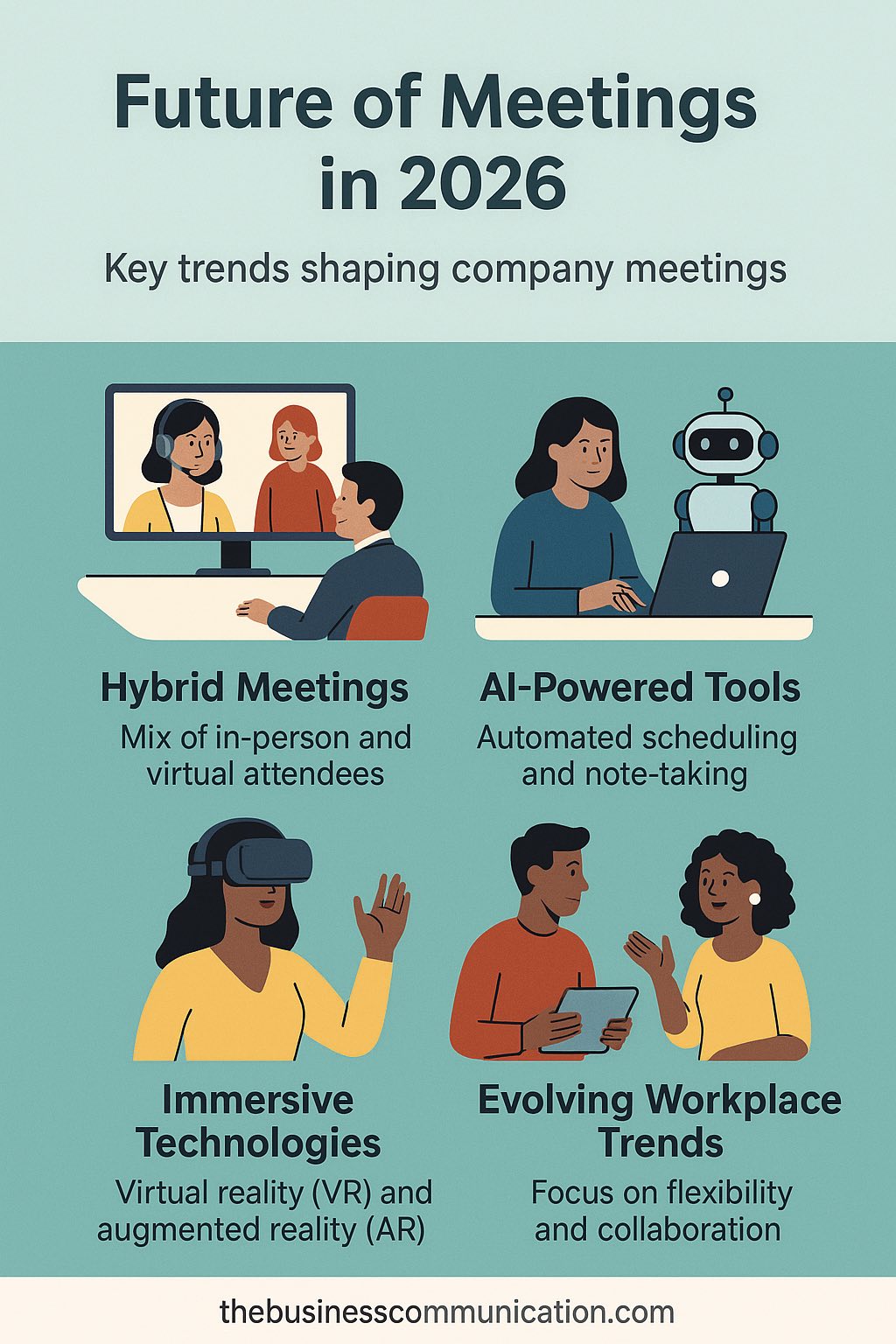
So what exactly will the future of company meetings look like in 2026? Here are the defining features:
- A mix of physical and digital interactions.
- Greater reliance on AI to handle repetitive tasks.
- Inclusive designs that prioritize both in-person and remote participants.
- Shorter, sharper, and more purpose-driven sessions.
In other words, the future is about smarter, not longer, meetings.
Rise of Hybrid Meetings
One major trend is hybrid meetings, where some participants join in person while others connect remotely.
Advantages
- Flexibility: People can attend regardless of location.
- Inclusivity: Remote members feel just as valued.
- Cost Savings: Less travel means lower expenses.
Challenges
- Technology Dependence: A poor connection can ruin the experience.
- Engagement Gap: Remote participants may feel left out.
- Facilitation Complexity: Moderators must balance voices in two settings.
Compared to daily standups and weekly staff meetings, hybrid meetings offer more flexibility but also demand more structure.
Artificial Intelligence in Meetings
AI is no longer a futuristic buzzword. It is already reshaping the way we meet.
- Automated Agendas: AI tools can draft meeting agendas from project updates.
- Transcription and Summaries: Meetings can be recorded and instantly summarized.
- Engagement Analytics: AI can analyze speaking time and participation.
- Task Tracking: AI automatically assigns follow-up tasks.
However, there are concerns too. Privacy, data storage, and over-reliance on algorithms remain issues. Still, the advantages are hard to ignore.
Virtual and Augmented Reality Meetings
Imagine putting on a VR headset and sitting across a table from a colleague in another country. That is the promise of VR and AR in meetings.
- Use Cases: Training sessions, client presentations, and immersive brainstorming.
- Benefits: Greater sense of presence compared to flat video calls.
- Challenges: High cost of equipment, learning curves, and accessibility issues.
These innovations may not replace all meetings, but they will supplement traditional formats for creative and global teams.
Sustainability in Future Meetings
The future of meetings is not just digital, it is also sustainable.
- Reduced Travel: Virtual and hybrid meetings cut down on carbon footprints.
- Eco-Friendly Spaces: Offices are being designed with energy efficiency in mind.
- ESG Alignment: Companies use sustainable meeting practices to meet environmental goals.
This trend shows that smarter meetings can also mean greener meetings.
Employee-Centric Meetings
Unlike the past, where meetings often revolved around hierarchy, the future focuses on employee experience.
- Shorter Meetings: Long marathons are replaced by focused, time-boxed sessions.
- Inclusivity: Encouraging diverse voices and perspectives.
- Psychological Safety: Employees feel free to share without judgment.
This connects back to participants’ responsibilities, which highlight fairness and active contribution.
Smart Meeting Rooms
Another exciting development is the rise of smart meeting rooms.
- IoT Devices: Sensors track room usage and adjust lighting or sound.
- Smart Whiteboards: Notes can be saved and shared instantly.
- AI Assistants: Voice commands can pull up documents or schedule follow-ups.
These features reduce manual work, especially tasks like documenting meeting follow-up actions.
The Role of Data in Future Meetings
Data is becoming the silent player in meeting rooms.
- Tracking Participation: Who spoke the most, who stayed silent.
- Measuring Productivity: Comparing time spent vs outcomes achieved.
- Predictive Insights: Identifying risks in projects based on meeting discussions.
Data-driven insights allow companies to move beyond “gut feeling” and make meetings evidence-based.
Trends Shaping the Future of Meetings
Several trends are already visible today, and they will only grow by 2026.
- Asynchronous Communication: Updates shared without requiring everyone to meet at the same time.
- Remote-First Policies: Some companies design their workflows around remote collaboration.
- Collaborative Documentation: Shared files that evolve during discussions.
These trends reduce dependence on live meetings and keep workflows smoother.
Challenges Ahead
Of course, the future will not be without problems.
- Digital Fatigue: Too many online sessions can exhaust employees.
- Information Overload: Recording everything may overwhelm teams with data.
- Privacy Concerns: AI and VR raise questions about security.
- Balancing Human Connection: Technology must not replace genuine interaction.
The key will be balance: using technology to support, not dominate, human collaboration.
Preparing for the Future: What Companies Can Do Now
Want to future-proof your company meetings? Here are some practical steps:
- Invest in Tools: Adopt reliable platforms and smart technology.
- Train Leaders: Facilitation in hybrid settings requires skill.
- Encourage Accountability: Build habits like assigning action items, just like in project meetings.
- Promote Flexibility: Let teams choose when synchronous meetings are truly necessary.
By taking these steps now, companies will be ready for the changes ahead.
Conclusion
The future of company meetings is dynamic, digital, and people-focused. By 2026, expect hybrid models, AI-driven assistance, VR collaboration, and data analytics to dominate the landscape.
Yet, amid all the innovation, one principle will remain timeless: meetings are only as good as the outcomes they produce. Technology can help, but preparation, accountability, and human connection will always matter.
For a complete understanding of meetings, explore related guides like company meeting basics, meeting minutes, and agenda writing. Together, they provide the full toolkit to master both present and future meetings.
So, the next time you attend a meeting, ask yourself: Is this just a conversation, or is it a glimpse of the future of work?
Frequently asked questions
Should we invest in VR meeting equipment now or wait until 2026?
Wait unless your team does creative work or global training regularly. VR equipment remains expensive and has a steep learning curve. By 2026, costs will likely drop and adoption will be clearer. Start with hybrid video meetings first, then explore VR for specific use cases like immersive brainstorming or client presentations.
What if remote participants still feel left out in hybrid meetings?
The gap exists because moderators often favor in-room voices. Fix this by rotating who speaks first, using chat for remote input, and ensuring cameras show remote faces equally. Assign a facilitator to watch remote engagement specifically. Consider splitting into separate video calls if the in-person group dominates.
Can AI summarize meetings without creating privacy or security risks?
Yes, but only with proper safeguards. Use AI tools that encrypt data, comply with GDPR or CCPA, and let employees opt out. Review vendor policies before adopting. Start with non-sensitive meetings to test the tool. Many platforms now offer privacy-first transcription, so evaluate options carefully.
How do we measure whether shorter meetings actually improve productivity?
Track outcomes, not just time saved. Compare project completion rates, decision speed, and employee satisfaction before and after switching to shorter, focused meetings. Use meeting analytics to see participation levels. Ask teams directly if they feel more productive. Data beats assumptions.
Is it worth redesigning our office for smart meeting rooms right now?
Only if you’re already renovating. Smart rooms reduce manual tasks like note-taking and scheduling, but the ROI depends on meeting frequency and team size. Start small with one smart room to test adoption. Hybrid flexibility matters more than gadgets for most companies in 2026.