


Have you ever left a meeting and thought, “Wait, what did we actually decide?” If so, you are not alone. Many meetings end with a lot of discussion but no clear record of decisions or responsibilities. This is where meeting minutes come in.
Meeting minutes are the official record of what happened. They keep everyone on the same page, hold people accountable, and serve as legal documents when required. In this guide, you will learn exactly how to write effective minutes. We will cover definitions, importance, structure, examples, and best practices. Along the way, we will also connect with other helpful guides such as agenda preparation and notice of meeting, since minutes cannot exist without these essential steps.
So, grab your metaphorical pen, and let’s master the art of writing meeting minutes.
What are Meeting Minutes?
A meeting minute is a written record of everything that happens in a meeting. Unlike casual notes, minutes are formal, structured, and usually stored for future reference. They capture not just what was said but also the decisions taken, the actions assigned, and sometimes the voting outcomes.
Think of them as the “memory” of the meeting. If the agenda is the roadmap, then the minutes are the travel diary. They show what route was taken, what stops were made, and where the journey ended.
Earlier, we discussed the principles of drafting minutes. This article builds on that foundation but focuses more on practical writing and examples.
Importance of Meeting Minutes
Why spend time writing minutes when everyone was present in the meeting? Good question. The answer is simple: people forget, but paper (or digital text) does not.
Here are some reasons why minutes matter:
- Official Record
They provide a permanent record of decisions, discussions, and commitments. - Legal Compliance
For board meetings or shareholder meetings, keeping minutes is a legal requirement in many countries. - Transparency
Minutes prevent misunderstandings by clearly showing what was agreed upon. - Action Tracking
Assignments and responsibilities are easier to follow up when documented. - Historical Reference
Imagine trying to remember what was decided a year ago. Minutes save you from that headache.
Interestingly, their role is as important as the objectives of meetings. One cannot be separated from the other.
Key Elements of Meeting Minutes
So, what should minutes actually include? Let’s break it down into simple parts.
- Basic Details: Date, time, place, type of meeting, and attendees.
- Agenda Items: Each topic discussed should match the agenda.
- Discussions: A brief summary of what was said, without unnecessary detail.
- Decisions: The outcomes, resolutions passed, or agreements reached.
- Voting Results: If any decision was put to a vote, the result must be recorded.
- Action Items: Who is responsible for what, and the deadlines.
- Next Meeting: Date and time for the next session if scheduled.
Unlike notice of meetings, which only announce, minutes show what truly happened.
Step-by-Step Guide: How to Write Effective Minutes
Step 1: Prepare Before the Meeting
A good secretary does not arrive unprepared. Review the agenda, get a copy of the notice, and know who is attending. Preparing in advance helps you know what to listen for.
Step 2: Take Notes During the Meeting
Keep your notes clear and concise. Write down important points, not every single word. For example, if someone says, “We should increase the marketing budget by 20%,” write “Marketing budget increase, 20%, agreed.”
Step 3: Stick to the Agenda
Your notes should follow the sequence of the agenda. This makes drafting the final minutes easier.
Step 4: Write the Draft Minutes
Use simple language, short sentences, and objective tone. Avoid words like “I think” or “He angrily shouted.” Instead, write “The member raised an objection.”
Step 5: Get Approval
Usually, the chairperson reviews and approves the minutes before they are circulated.
Step 6: Distribute the Final Copy
Share the approved minutes with all participants. Store a copy for future reference.
This process is similar to the steps in writing business reports. Both require structure, clarity, and objectivity.
Common Mistakes to Avoid
Even experienced professionals sometimes write poor minutes. Let’s look at the common pitfalls.
- Too Much Detail
Writing down word-for-word speeches wastes time and makes the minutes unreadable. - Vague Language
Writing “discussion happened” says nothing. Instead, specify the decision. - Bias or Opinion
Minutes must be neutral. Avoid adjectives like “excellent” or “boring.” - Forgetting Action Items
If you do not record who is responsible for tasks, the meeting loses impact. - Late Distribution
Sending the minutes weeks later defeats their purpose.
These mistakes are quite similar to errors in business letters. In both cases, clarity and accuracy are key.
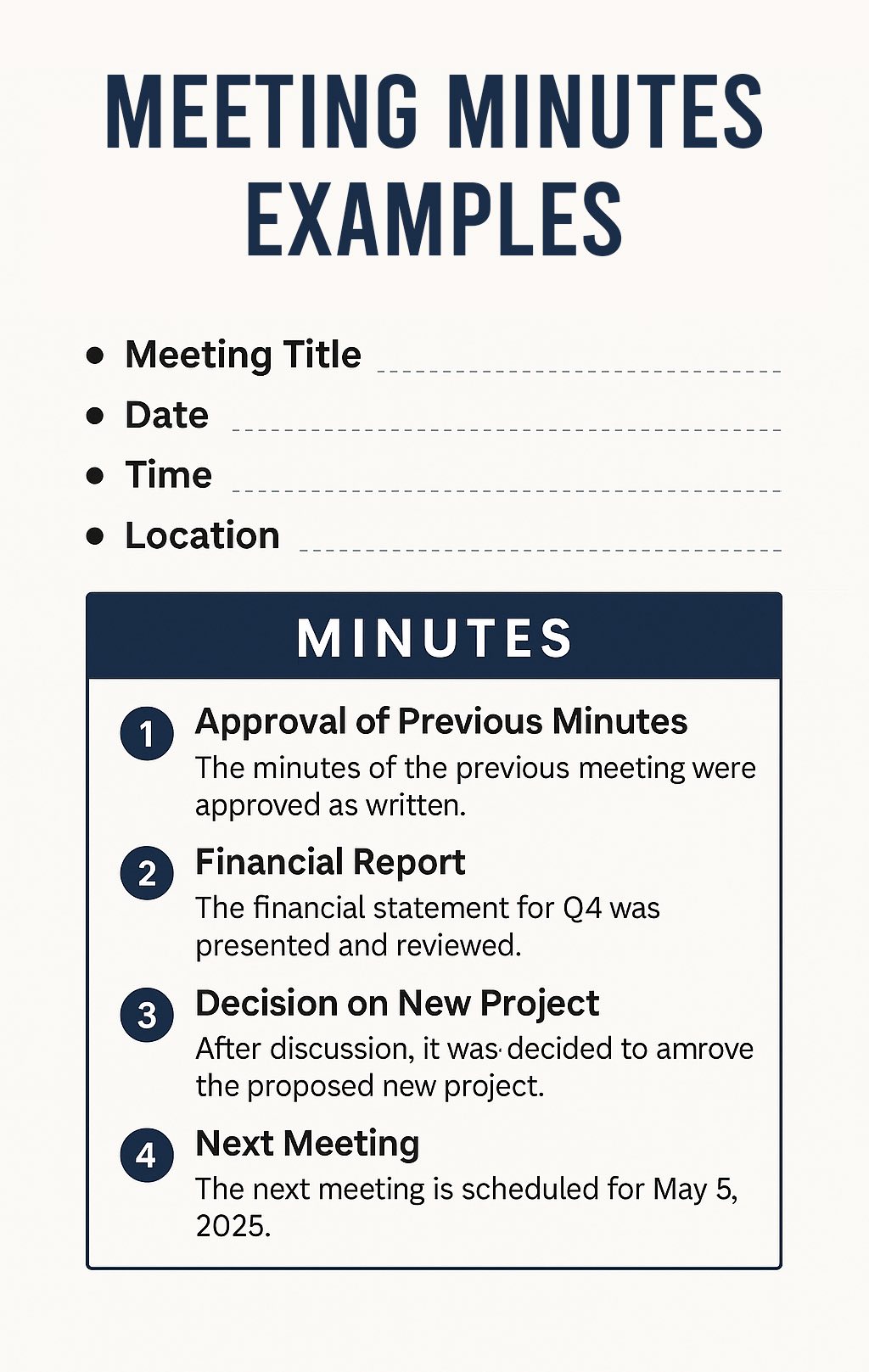
Meeting Minutes Examples
Example 1: Formal Board Meeting Minutes
Meeting Title: Board of Directors Quarterly Meeting
Date: April 15, 2025
Time: 10:00 AM
Location: Company Headquarters, Room A
Attendees: Mr. A (Chairperson), Ms. B, Mr. C, Ms. D
Agenda:
- Approval of previous minutes
- Financial report presentation
- Decision on new branch opening
Minutes:
- Previous minutes were approved without amendments.
- CFO presented the financial report showing a 15% increase in revenue.
- Decision: New branch opening approved, location selected as City X. Vote: 4 in favor, 0 against.
- Next meeting scheduled for July 20, 2025.
Example 2: Informal Team Meeting Minutes
Meeting Title: Weekly Project Phoenix Review
Date: April 18, 2025
Platform: Zoom
Attendees: Project Manager, 5 Team Members
Minutes:
- Each member shared progress on assigned tasks.
- Technical issue with software update identified, deadline extended by 3 days.
- Action: Member A to resolve bug, Member B to update documentation.
- Next meeting scheduled for April 25, 2025.
These examples show both the formal structure and the informal style. They complement your earlier post on types of company meetings.
Best Practices for Accurate Minutes
If you want your minutes to shine, here are some best practices.
- Write action-oriented sentences, like “The committee approved” rather than “There was approval.”
- Be consistent in format for all meetings.
- Use bullet points for readability.
- Distribute minutes within 48 hours.
- Store them digitally for easy search.
These habits align with the 7 Cs of communication, especially clarity and conciseness.
Role of the Secretary in Drafting Minutes
The secretary is the hero of minutes writing. While the chairperson controls the discussion, the secretary ensures it is documented.
Responsibilities include:
- Drafting the minutes.
- Ensuring accuracy and neutrality.
- Getting approval from the chairperson.
- Circulating the final copy.
You can read more about the company secretary’s role to understand why this job is critical.
Digital Tools for Meeting Minutes
Technology has made the job of writing minutes easier. Here are some tools that can help:
- Google Docs for collaborative editing.
- Microsoft OneNote for note-taking.
- Otter.ai for automated transcription.
- Evernote for organizing notes.
Digital archives also prevent the risk of losing important records. This is another example of how visual communication and digital tools improve workplace efficiency.
Conclusion
Meeting minutes are not just paperwork. They are essential for clarity, accountability, and legal compliance. In this guide, you learned what minutes are, why they matter, their elements, the writing process, common mistakes, examples, best practices, and the role of technology.
The next time you attend a meeting, try writing the minutes using these steps. You will find that discussions become clearer, responsibilities easier to track, and future decisions more informed.
If you want to strengthen your basics further, do check the guide on essentials of a valid meeting. It connects directly with everything you learned here.
So, are you ready to turn your meeting notes into powerful, effective minutes? Give it a try in your very next meeting.
Frequently asked questions
Should I record verbatim what people say or summarize their points?
Summarize. Minutes are not transcripts. Capture the key decision or point in one or two sentences, not word-for-word speeches. For example, if someone gives a 5-minute explanation about budget concerns, write “Budget concerns raised regarding Q3 spending.” This keeps minutes concise and readable.
What if the chairperson disagrees with how I recorded a decision?
Ask for clarification immediately. Request the chairperson explain what was actually decided, then revise the draft before final approval. This prevents confusion later. If there’s genuine disagreement about what was decided, note that in the minutes and let leadership resolve it.
How detailed should action items be in the minutes?
Include the specific task, the person responsible, and the deadline. Example: “John Smith to finalize vendor contracts by May 10.” Vague assignments like “Team to handle logistics” create confusion. Be specific enough that the responsible person knows exactly what they own.
Can I skip recording a discussion that didn’t lead to a decision?
Only if it truly added nothing. However, if the discussion informed a decision or revealed important context, briefly note it. Example: “Team discussed market trends before approving the new pricing strategy.” This shows why decisions were made, not just that they were.
How soon after the meeting should I distribute the minutes?
Within 2-3 business days while details are fresh. Waiting weeks reduces their usefulness for action items and follow-up. Circulate the draft to the chairperson first for approval, then send the final version to all attendees and relevant stakeholders.
Should I note who disagreed with a decision in the minutes?
Only if the disagreement was formal or if voting occurred. For example, record “Vote: 3 in favor, 1 against” if there was a vote. For casual objections, note the concern raised but not the person’s name unless they formally dissented on record.