


A public company’s annual report contains two critical documents that many stakeholders confuse: the director’s report and the auditor’s report. The director’s report is the board’s narrative on performance, strategy, and dividend decisions. The auditor’s report is an independent professional’s opinion on whether the financial statements are accurate and fair. Understanding both, and how they differ, helps you evaluate a company’s financial health and governance quality.
Both reports appear together in the annual report, but they serve distinct purposes and come from different sources. One tells the story; the other verifies the numbers behind it.
Director’s report: definition and purpose
The director’s report is a formal statement prepared by the board of directors at the end of each financial year. It describes the company’s activities, business performance during the past year, and outlook for the future. In Bangladesh, the Companies Act 1994 and the Dhaka Stock Exchange Listing Regulations 1997 require this report for all public limited companies.
The report addresses shareholders directly and covers both operational and financial matters. It must indicate the amount recommended as dividend and the amount proposed to be carried to reserves. If the company’s nature of business changed during the year, say, a textile manufacturer expanded into retail, the director’s report must disclose that shift.
Think of it as the board’s formal communication channel to explain what happened and why.
A small Dhaka-based pharmaceutical company might use its director’s report to explain why it allocated 40% of profits to reserves instead of dividends: perhaps it’s funding a new manufacturing facility or preparing for regulatory changes.
Contents of a director’s report
The Companies Act 1994 and DSE Listing Regulations specify what must appear in a director’s report. These requirements ensure consistency and transparency across all public companies. The mandatory contents include a formal opening that acknowledges the ownership structure and sets the tone for the report, a statement of general objectives and how the year’s activities aligned with them, and an overview of the company’s current state, including any material changes. The report must describe what the company does, how the market evolved, and where competition intensified or eased. It must disclose any significant changes in strategy, expansion plans, or operational approach, along with how net profit was divided among dividends, reserves, and other uses. Tax contributions to government revenue, any significant lease arrangements or loans taken, and names of directors during the financial year appear as well. The report closes with employment policy details and the total number of employees at year-end.
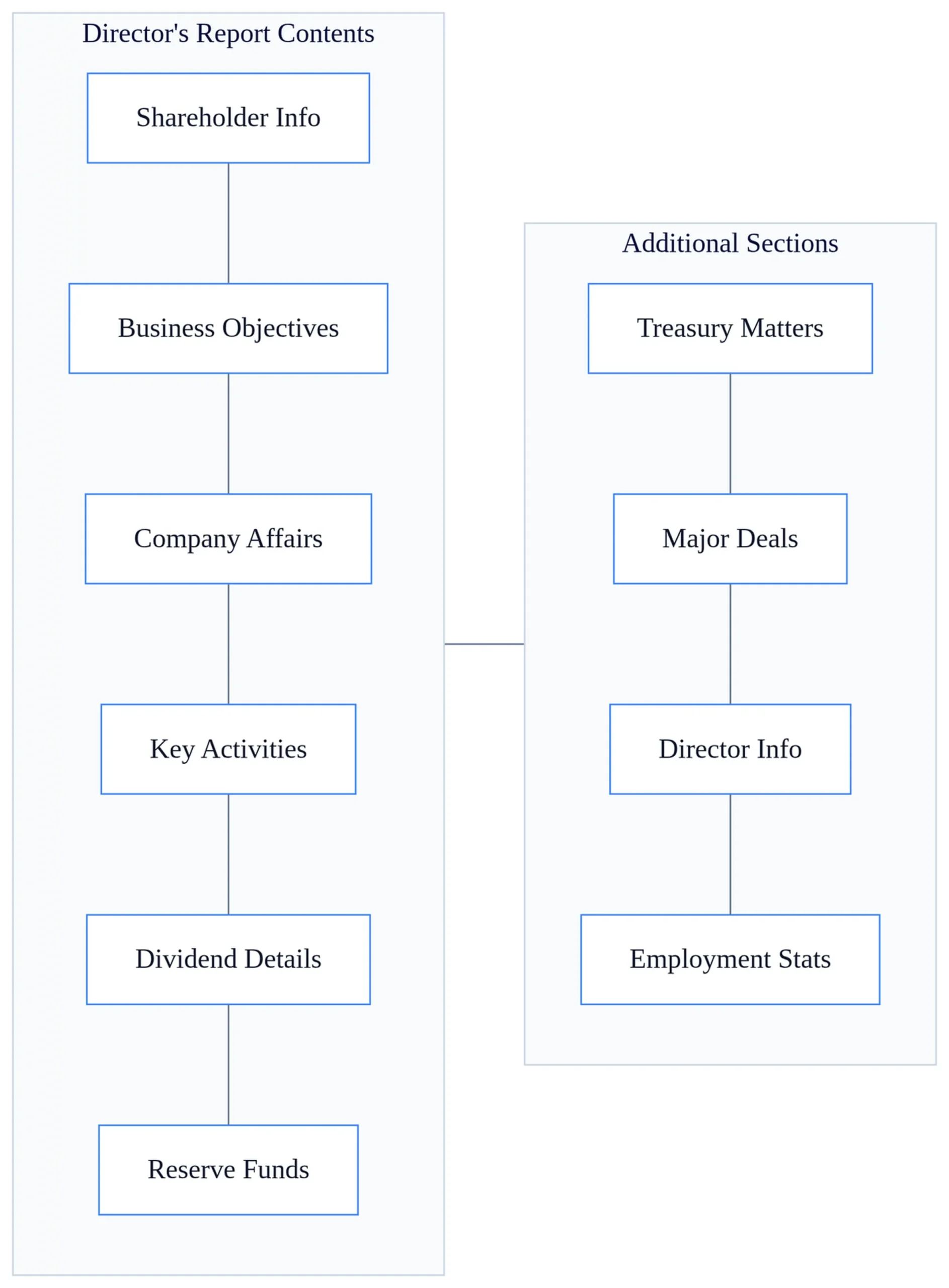
This content overlaps with broader principles of formal written communication in corporate settings, where clarity, structure, and regulatory compliance matter equally.
For example, when a director’s report states “We allocated 15% of net profit to general reserves and recommend a 10% cash dividend,” it’s not just reporting numbers. It signals to shareholders that the board prioritizes financial stability while still rewarding ownership.
Auditor’s report: definition and purpose
An auditor’s report is a certified professional’s formal opinion on the accuracy and fairness of a company’s financial statements. Unlike the director’s report, which the board prepares, an independent auditor, someone with no financial interest in the company, creates this document.
The auditor examines the balance sheet, profit and loss account, cash flow statement, and all supporting schedules. After verification, the auditor issues a report stating whether these documents present a “true and fair view” of the company’s financial position.
This report provides assurance to shareholders, regulators, lenders, and potential investors. When a bank considers a loan application from a manufacturing firm, the auditor’s opinion carries more weight than management’s own claims about profitability. An unqualified opinion reduces perceived risk; a qualified or adverse opinion raises red flags.
The Public Company Accounting Oversight Board and the International Auditing and Assurance Standards Board set global standards for auditor reporting, ensuring consistency across jurisdictions.
What auditors verify: the audit checklist
Auditors don’t simply review financial statements at face value. They conduct detailed verification procedures to assess whether the numbers are reliable. The auditor’s report must confirm several points: proper books of accounts, meaning the company maintained complete and accurate accounting records as required by law (missing transaction logs or incomplete ledgers trigger concerns); accepted accounting principles, so financial statements follow Generally Accepted Accounting Principles or International Financial Reporting Standards (if a company uses non-standard methods to recognize revenue, booking sales before goods ship for instance, the auditor notes the deviation); consistent application of policies year-over-year (if a company switches from FIFO to LIFO inventory valuation without disclosure, the auditor flags it); agreement with underlying records, so the balance sheet and profit and loss account match the books of account and returns filed with regulators; and access to information, confirming the auditor received all necessary documents and explanations.
This verification process is what separates an auditor’s report from management’s self-assessment. It’s an independent check on the accuracy of financial disclosure.
Types of auditor opinions and what they mean
Not all auditor’s reports deliver the same message. The type of opinion issued signals different levels of confidence in the financial statements. According to international auditing standards, there are four main opinion types (source).
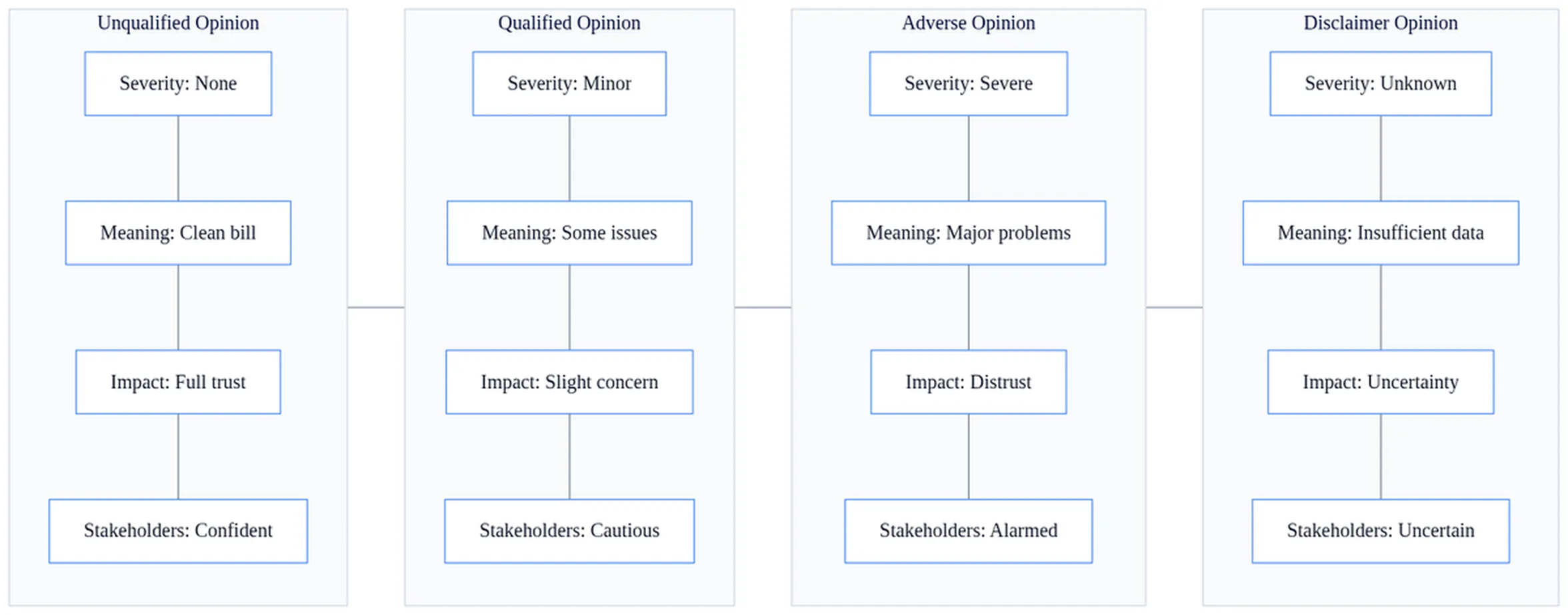
An unqualified opinion (clean opinion) is the best outcome. The auditor found no material misstatements, and the financial statements fairly represent the company’s position. Investors and lenders treat this as a green light. A multinational with Indian and US offices that receives an unqualified opinion can negotiate better loan terms and attract more investors.
A qualified opinion means the auditor identified one or more issues, but they’re not severe enough to invalidate the entire report. For example, the auditor might note that inventory valuation methods don’t fully comply with IFRS, but the impact is limited. This opinion says “mostly accurate, but watch this area.” Lenders often proceed but may impose stricter covenants.
An adverse opinion is a red flag. The financial statements contain material misstatements so severe that they don’t fairly represent the company’s affairs. An adverse opinion often triggers regulatory scrutiny, credit downgrades, and investor flight. If a textile manufacturer overstates inventory by 40% to hide losses, the auditor issues an adverse opinion.
A disclaimer of opinion means the auditor couldn’t obtain sufficient evidence to form an opinion. This happens when management restricts access to records or when accounting systems are so chaotic that verification is impossible. A disclaimer is almost as damaging as an adverse opinion because it signals either incompetence or concealment.
What most people get wrong: they assume a qualified opinion is “good enough.” Sophisticated investors treat qualified opinions as warning signs. They want to know why the company couldn’t meet full compliance standards.
Director’s report vs. auditor’s report: key differences
The two reports serve complementary but distinct functions. Here’s how they differ across five dimensions:
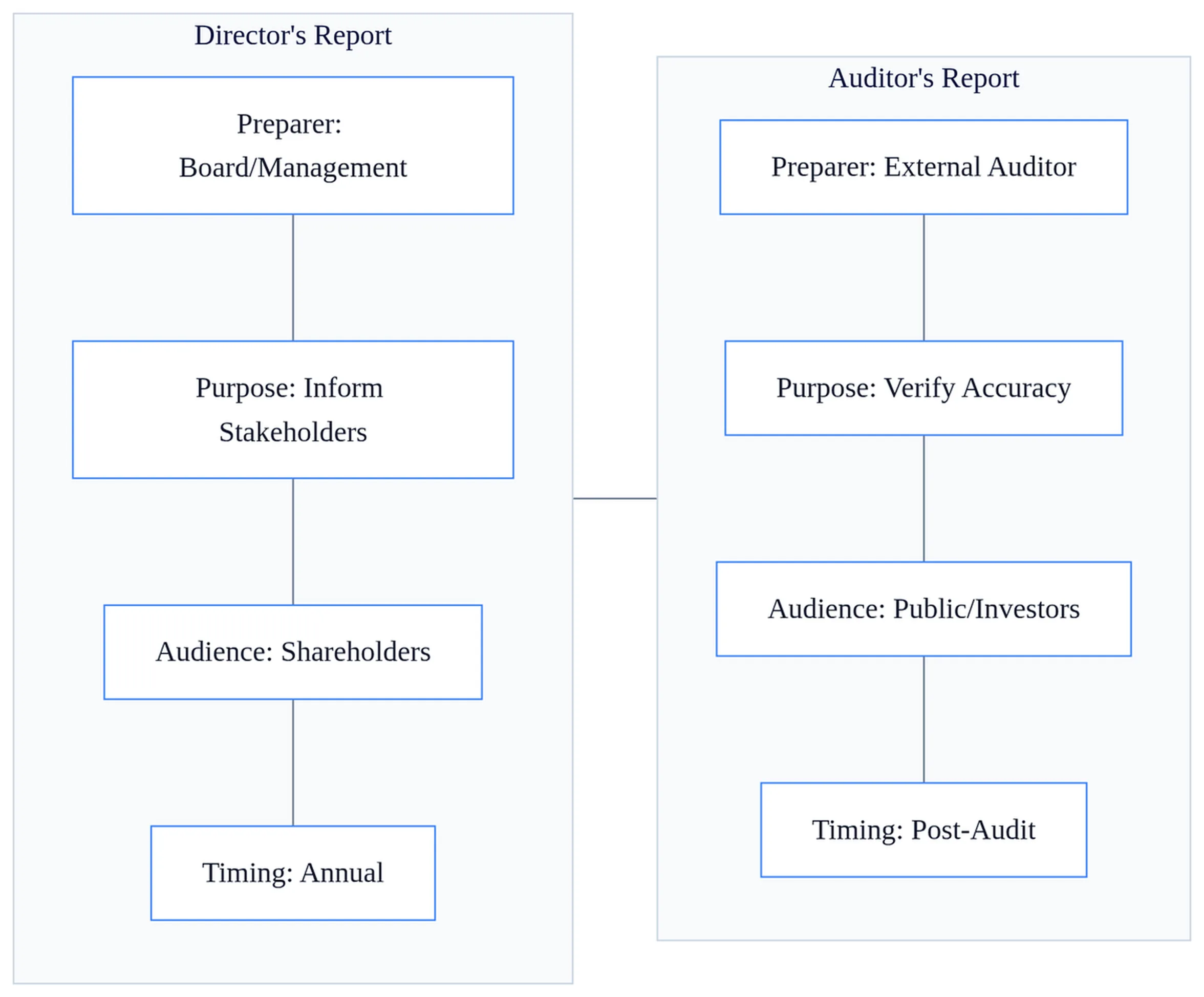
| Dimension | Director’s Report | Auditor’s Report |
|---|---|---|
| Preparer | Board of directors (company insiders) | Independent certified auditor (external professional) |
| Purpose | Narrative on performance, strategy, and dividend policy | Assurance on accuracy and fairness of financial statements |
| Audience | Primarily shareholders, with secondary interest from regulators | Shareholders, regulators, lenders, investors, and creditors |
| Timing | Prepared during year-end financial close | Issued after audit completion, which follows financial close |
| Scope | Qualitative: business activities, competition, employment, dividends | Quantitative: verification of balance sheet, P&L, cash flow accuracy |
This table makes one thing clear: the director’s report is advocacy; the auditor’s report is verification. The board tells you what they accomplished and where they’re headed. The auditor tells you whether the numbers backing those claims are trustworthy.
How director’s report and auditor’s report work together
In practice, these two reports function as a system. The director’s report provides context and narrative. It explains why revenue grew 15%, why the company opened three new branches, and why dividend payout dropped from 12% to 8%. The auditor’s report validates the numbers underlying those claims.
Consider a small Dhaka-based software firm that reports 25% revenue growth in its director’s report. The board attributes this to new enterprise clients and a successful product launch. The auditor’s report then confirms that revenue recognition methods comply with accounting standards and that the reported figures match the books. Together, they form a complete picture.
Regulatory frameworks require both reports in the annual report precisely because they complement each other. The director’s report without an auditor’s opinion is just management’s word. The auditor’s opinion without narrative context is just numbers. Stakeholders need both to make informed decisions.
This dual-report structure is a cornerstone of business communication in corporate governance, balancing management’s perspective with independent verification.
Why both reports matter to stakeholders
Different stakeholders use these reports for different purposes, but everyone benefits from having both available.
Investors read the director’s report to understand strategy and future plans. They check the auditor’s report to confirm the financial statements are reliable. An unqualified opinion gives investors confidence that reported earnings are real, not accounting fiction.
Lenders focus heavily on the auditor’s opinion when evaluating credit risk. A bank considering a 50 million taka loan to a manufacturing company will scrutinize the auditor’s report for any qualifications or concerns about asset valuation. The director’s report helps lenders assess dividend capacity and cash flow commitments.
Regulators use both reports to monitor compliance with corporate governance standards. Stock exchanges review director’s reports for disclosure completeness and auditor’s reports for opinion type. Repeated qualified opinions may trigger delisting procedures or investigations.
Employees and potential hires check the director’s report for employment policy details and workforce size. A director’s report that mentions “strengthening labor relations” and shows 15% headcount growth signals stability. An adverse auditor opinion, however, might warn employees that layoffs are coming.
The reality is messier than textbooks suggest. Sometimes director’s reports paint rosy pictures while auditor’s reports reveal problems. Sometimes both reports look fine, but the company still fails due to market shifts or poor execution. Smart stakeholders read both critically, looking for consistency between narrative and numbers. When you review a company’s annual report, don’t skip either document. The director’s report tells you where management thinks the company is going. The auditor’s report tells you whether the financial foundation supporting that journey is solid or cracked.
Frequently asked questions
If the auditor’s report is qualified, should I avoid investing in that company?
A qualified opinion doesn’t automatically mean avoid the company. It signals the auditor found a specific issue—perhaps a disputed liability or incomplete information—but still believes the statements are mostly fair. Review what triggered the qualification. Some qualifications are minor accounting disagreements; others reflect deeper problems. Compare it against the director’s report and industry peers before deciding.
Can a director’s report contradict what the auditor’s report says?
Yes, and it’s a red flag. If the director’s report claims strong profitability but the auditor issues a qualified opinion citing accounting errors, that mismatch warrants investigation. The auditor’s independent verification carries more weight than the board’s narrative. Contradictions suggest either poor governance or intentional misrepresentation. Always read both documents side by side.
Why would a company’s auditor change from year to year?
Auditor changes happen for legitimate reasons: rotation policies, fee disputes, or the company outgrowing a smaller firm. However, frequent changes can signal problems. If a company fires auditors after a qualified opinion and hires a new firm that issues an unqualified one, that’s suspicious. Check regulatory filings for the stated reason and audit history.
Should I trust the dividend recommendation in the director’s report?
Only if the auditor’s report confirms the underlying profit figures are accurate. The director’s report states what dividend the board recommends, but that recommendation is only reliable if the auditor verified the net profit it’s based on. If the auditor raised concerns about revenue recognition or asset valuation, the dividend calculation itself becomes questionable.
What does it mean if an auditor’s report mentions ‘going concern’ issues?
A going concern warning means the auditor doubts the company can continue operating for the next 12 months without major restructuring or external support. This is serious and overrides a clean opinion on current numbers. It signals potential insolvency risk. Shareholders and creditors should treat this as a major warning, not a minor disclosure.
1 Comment
thanks for helping me may God bless you lnshaallah