


In every organization, people need to exchange information to get work done. This exchange can flow upward, downward, or sideways. When it flows between people of the same level or rank, we call it horizontal communication.
Imagine the marketing manager discussing a campaign with the sales manager or the HR officer coordinating with the finance officer. That’s horizontal communication in action.
It helps employees coordinate, share ideas, and avoid unnecessary confusion — which is vital for any business to succeed.
Definition of Horizontal Communication
Horizontal communication refers to the exchange of information, ideas, or feedback between employees or departments that are on the same hierarchical level. It’s also called lateral communication or sideways communication.
Unlike vertical communication, which moves up or down through ranks, horizontal communication happens across peers. It emphasizes equality and collaboration instead of authority and instruction.
In simpler words, it’s like teammates talking directly to each other instead of going through the coach every time.
Characteristics of Horizontal Communication
Horizontal communication has a few defining features that make it unique:
- It happens between equals, such as team leaders, department heads, or employees of the same level.
- It usually follows an informal and friendly tone.
- It is two-way, meaning both parties exchange ideas and feedback freely.
- The goal is to coordinate efforts, solve problems, and avoid duplication of work.
- It enhances team spirit and mutual understanding.
Unlike top-down orders, it creates an environment of cooperation where everyone’s input matters.
If you’d like to understand how different communication forms compare, you might also enjoy reading about the differences between horizontal and vertical communication.
Objectives and Purposes
Horizontal communication serves several practical purposes inside an organization. Let’s go through some key objectives:
- Coordination of Work: Departments often depend on each other. For instance, production must align with sales forecasts. Communication ensures both stay in sync.
- Problem Solving: Employees share ideas and feedback to overcome obstacles faster.
- Sharing Information: It helps keep everyone informed without unnecessary delays.
- Reducing Misunderstandings: When people talk directly, errors and assumptions drop dramatically.
- Building Team Spirit: It encourages trust and collaboration.
Without it, a company can become a maze of isolated silos that hardly interact.
Examples of Horizontal Communication in the Workplace
Let’s look at some real-world examples to make things clearer:
- Cross-departmental meetings: For example, HR collaborating with the IT team to automate employee onboarding.
- Emails or chat messages: Exchanging quick updates through tools like Slack or Microsoft Teams.
- Team collaborations: Marketing and sales teams planning joint campaigns.
- Peer discussions: Employees brainstorming ideas for problem-solving or improvement.
In each of these examples, communication moves sideways, not upward or downward.
You can explore more on team collaboration in this related post about organizational communication, which explains how different communication flows work together.
Process of Horizontal Communication
Horizontal communication usually follows a simple process:
- Initiation: An employee identifies a need to share information.
- Message Formation: The sender decides what to say and how to say it.
- Transmission: The message is delivered through email, phone call, meeting, or chat.
- Feedback: The receiver responds, clarifies, or provides input.
- Adjustment: Both sides make necessary changes to align better.
For example, imagine two project managers discussing resource allocation. They exchange messages, refine details, and adjust plans accordingly — that’s effective horizontal communication at work.
Importance of Horizontal Communication
Horizontal communication plays a crucial role in building harmony among employees. It eliminates unnecessary barriers and brings everyone closer to common goals.
Some key points that show its importance are:
- It enhances cooperation and collaboration.
- It encourages innovation and creative problem-solving.
- It boosts employee morale.
- It helps reduce work duplication and delays.
To explore this further, you can read the detailed post on the importance of horizontal communication.
Advantages of Horizontal Communication
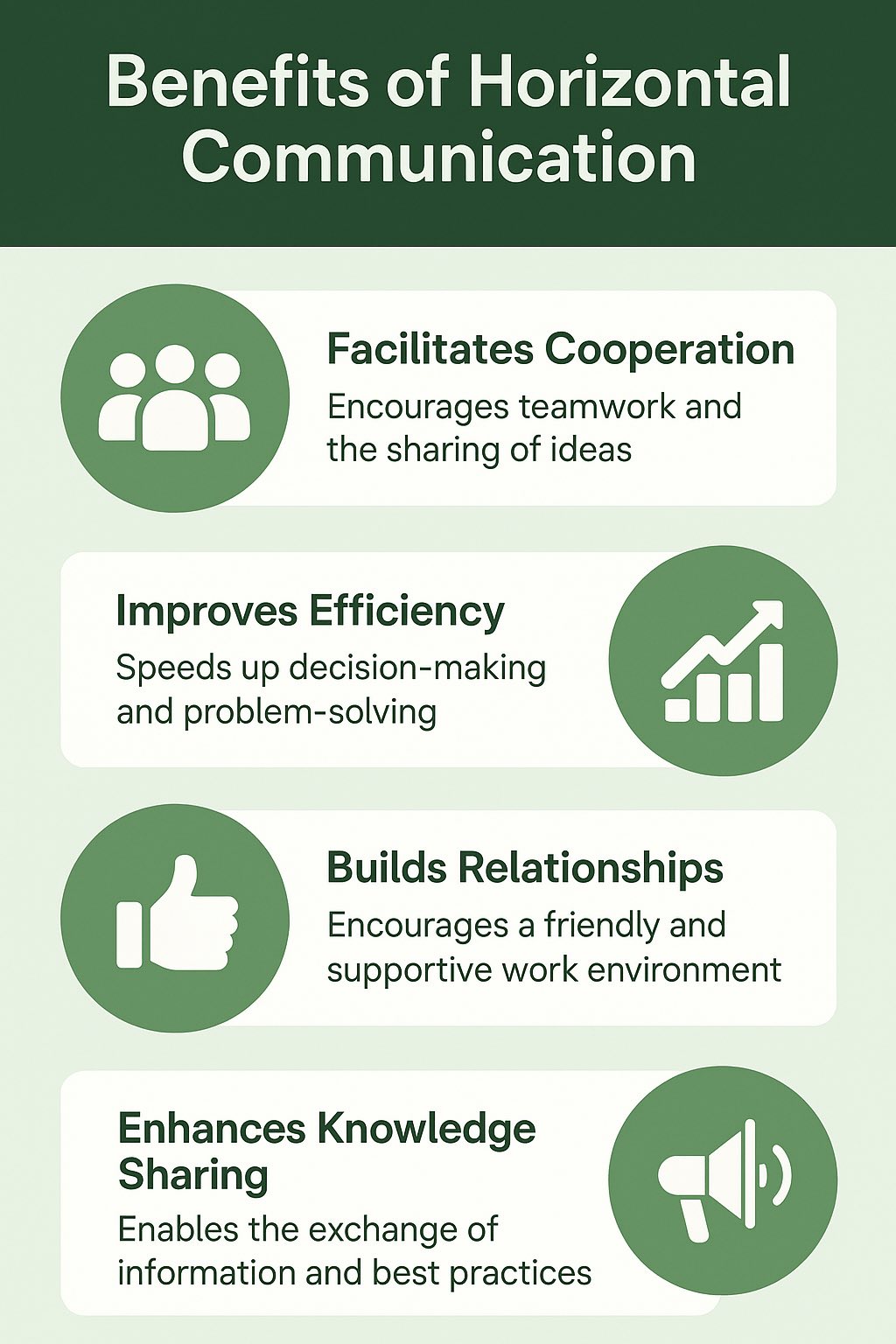
Horizontal communication brings many benefits that make workplaces more efficient and happier:
- Quick Decision-Making: Since peers interact directly, decisions are faster.
- Encourages Teamwork: Teams feel more connected and responsible.
- Promotes Innovation: Free flow of ideas helps generate creative solutions.
- Builds Relationships: It strengthens bonds and mutual respect.
- Improves Efficiency: Less paperwork and fewer misunderstandings save time.
If you’re curious about both the positive and negative sides, check out this article on the advantages and disadvantages of horizontal communication.
Limitations and Disadvantages
Of course, like any communication method, it has a few downsides too:
- Bypassing Authority: Sometimes employees may ignore formal channels.
- Risk of Rumors: Informal chats can spread misinformation.
- Coordination Problems: In large organizations, it’s harder to maintain smooth cross-departmental communication.
- Time Consumption: Too many meetings can slow down progress.
These issues can be minimized with clear communication policies and a culture of trust.
You can learn how to overcome similar communication issues from this post on overcoming barriers to communication in business.
Horizontal vs Vertical Communication
Let’s make a quick comparison to understand the differences:
| Basis | Horizontal Communication | Vertical Communication |
|---|---|---|
| Direction | Sideways | Upward or Downward |
| Participants | Peers or Colleagues | Superiors and Subordinates |
| Objective | Coordination and Cooperation | Command and Control |
| Formality | Often Informal | Usually Formal |
| Speed | Faster | Slower due to hierarchy |
| Feedback | Instant | May take longer |
Both types are necessary. Vertical communication ensures discipline, while horizontal communication builds teamwork.
For more depth, you might like upward vs downward vs horizontal communication, which covers how these directions interact.
Techniques to Improve Horizontal Communication
If your workplace struggles with coordination, try these strategies:
- Encourage Open Dialogue: Promote a culture where everyone can speak freely.
- Use Collaboration Tools: Tools like Slack, Trello, or Asana make teamwork easy.
- Hold Regular Meetings: Short weekly syncs keep everyone updated.
- Define Clear Objectives: When everyone knows their goal, communication improves naturally.
- Promote Trust: Trust ensures honest and direct communication.
Want to explore related techniques? You can check out how to make downward communication effective.
Modern Context: Digital and Cross-Functional Communication
In today’s digital world, horizontal communication has expanded beyond office walls. Teams can work from different countries yet collaborate as if they’re in the same room.
Thanks to video conferencing and messaging tools, employees share updates instantly, reducing gaps in understanding. This has made organizations more agile and globally connected.
You can also read about the future of meetings to understand how technology is transforming communication in the modern workplace.
Conclusion
Horizontal communication is like the invisible bridge that connects every corner of an organization. It ensures that employees from different departments can work together efficiently, share ideas freely, and solve problems faster.
Without it, workplaces would turn into isolated islands where no one knows what others are doing. So, whether it’s brainstorming between marketing and design or coordinating between HR and finance, horizontal communication keeps the flow smooth and efficient.
If you’ve understood this concept well, you might also enjoy exploring how internal communication and organizational communication play vital roles in building strong company culture.
Frequently asked questions
What if my peer and I disagree on how to solve a problem?
Use horizontal communication to work through it directly. Share your reasoning, listen to their perspective, and collaborate on a solution. If you can’t agree, document both viewpoints and escalate to your manager for a final decision. Avoid going around them or complaining to others first.
Should I email a peer or talk in person for urgent coordination?
For urgent matters, talk in person or via phone first to ensure immediate understanding. Follow up with an email to document the discussion and next steps. This combines speed with clarity and creates a record both parties can reference later.
How do I prevent horizontal communication from becoming office gossip?
Keep conversations focused on work goals and facts, not opinions about people. Stick to relevant channels like meetings or direct messages rather than hallway chats. If someone shares unverified information, redirect the conversation back to actionable topics.
Can horizontal communication replace reporting to my manager?
No. Horizontal communication complements vertical reporting but doesn’t replace it. Always keep your manager informed about decisions and outcomes from peer discussions, especially those affecting your department’s goals or resources.
What if my organization discourages peer-to-peer communication?
This limits efficiency and morale. Gently advocate for it by showing how direct coordination saves time and reduces errors. Start small with low-stakes peer meetings, document the benefits, and share results with leadership to demonstrate its value.
2 Comments
A diagram of a vertical communication relating to the hospital
Thank you 🙂🙂 this note is help me to understand this topic ..