


Written communication is the backbone of professional documentation, coordination, and decision-making. This guide explains the main types of written communication you’ll encounter in business, how to choose the right format for your audience and purpose, and what tone works best in each context.
What is written communication?
Written communication is the transmission of messages using written words, whether on paper or digital screens. Unlike conversation, it’s permanent and asynchronous. You draft, send, and wait for a reply. The recipient reads on their schedule, not yours.
This permanence changes everything. You can’t read body language or adjust mid-sentence based on a confused look. Every word must carry its own weight.
The scope of written communication includes traditional formats like business letters, memos, and reports, plus digital channels such as email, Slack messages, and shared Google Docs. Each format serves different needs, and choosing poorly wastes time or damages credibility.
Written communication by direction: upward, downward, and horizontal
The direction your message travels shapes its tone and structure. Vertical communication flows up or down the organizational chart, while horizontal communication connects peers.
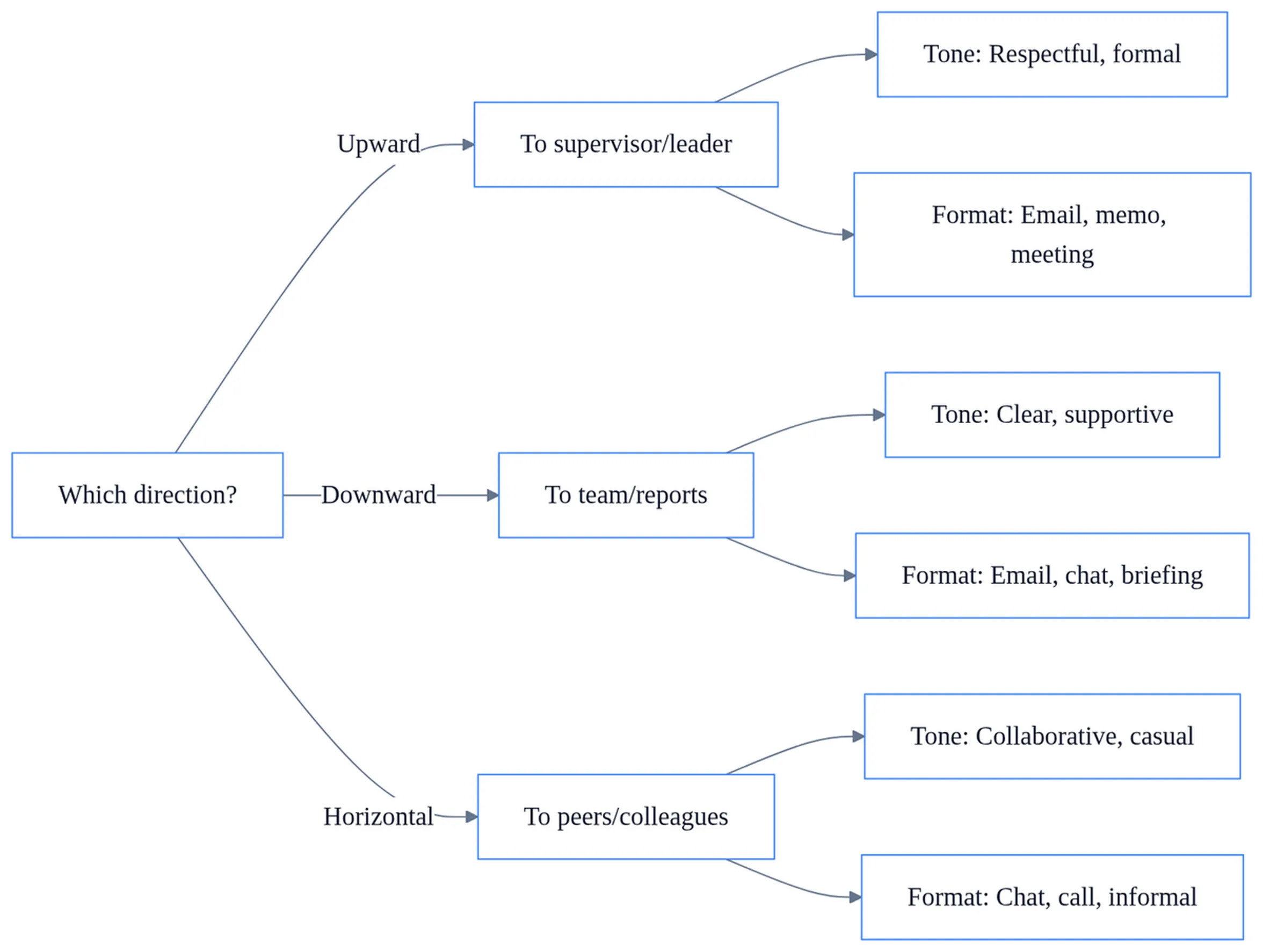
Upward communication includes reports to your manager, budget proposals to executives, or feedback forms sent to senior leadership. These documents require a formal tone and careful documentation. You’re building a case or providing evidence, so precision matters. A quarterly sales report sent to the regional director should include hard data, clear headings, and recommendations backed by analysis.
Downward communication flows from management to employees: policy announcements, procedural updates, performance reviews, and directives. The goal is accessibility. Avoid jargon when explaining a new leave policy to frontline staff. Use bullet points and plain language. A 2,000-word memo written in legalese will sit unread.
Horizontal communication happens between colleagues at similar levels: project updates between department heads, coordination emails between team members, or shared notes in a collaborative document. The tone here is collaborative, not hierarchical. You’re coordinating, not commanding.
Each direction carries distinct expectations. Send a casual Slack message upward to your VP, and you signal poor judgment. Send a stiff, legalistic memo sideways to a peer, and you create unnecessary distance.
Formal written communication formats
Formal formats signal importance, create legal records, or communicate with external parties. They follow established structures and professional language conventions.
Business letters remain the standard for external formal communication and high-stakes internal messages. A vendor contract, a job offer, or a formal complaint all warrant a letter. The format includes your address, date, recipient’s address, salutation, body paragraphs, closing, and signature. Letters create a documented trail and convey seriousness. For guidance on when to choose a letter over email, see our comparison of email vs. business letters.
Memos serve internal announcements, policy changes, and procedural updates. They’re shorter and less ceremonial than letters but still structured. A typical memo includes a header (To, From, Date, Subject), followed by the message. Use memos when you need a documented record but don’t require the full formality of a letter.
Reports deliver detailed findings, analysis, and recommendations. A market research report might run 30 pages with charts, data tables, and appendices. Reports require clear organization: executive summary, methodology, findings, conclusions, and recommendations. They’re time-intensive to write and read, so reserve them for decisions that justify the investment.
Contracts and agreements are legally binding documents that demand precision. Ambiguity in a contract can cost thousands in disputes. Every term must be defined, every obligation spelled out. Use plain language where possible, but prioritize accuracy over brevity.
Formal emails blend the accessibility of email with professional tone and structure. When emailing a potential client, a board member, or a government agency, treat the email like a letter: proper greeting, complete sentences, formal closing. Avoid abbreviations and emoji.
Informal and digital written communication formats
Informal formats prioritize speed over permanence. They dominate day-to-day workplace coordination.
Instant messages on platforms like Slack or Microsoft Teams handle quick questions, status updates, and casual coordination. “Can you send me the client file?” doesn’t need a formal email. The tone is conversational. Sentences fragment. Emoji appear. But remember: informal doesn’t mean careless. Messages live in searchable archives, and screenshots travel.
Informal emails sit between instant messages and formal letters. An email to a colleague about lunch plans or a quick project check-in uses conversational language but maintains professionalism. You still use proper grammar and avoid all-caps rants, but you skip the “Dear Sir or Madam” formality.
Social media posts and internal social platforms extend your organization’s voice to employees or the public. A LinkedIn post announcing a new hire, an internal Yammer update about a company event, or a Twitter thread explaining a service outage all count as written communication. They require brand consistency and awareness that your audience is broad and diverse.
Collaborative documents like Google Docs or shared drives enable real-time co-authoring. Multiple people can draft a proposal, leave comments, suggest edits, and track changes. This format works well for iterative work: drafting a team charter, building a project plan, or compiling research notes. Version control becomes critical. Without it, you lose track of who changed what and when.
Choosing the right written format: a decision framework
Most communication failures start with format mismatch. You send a Slack message when you needed a memo, or write a 1,200-word email when a two-sentence text would suffice.
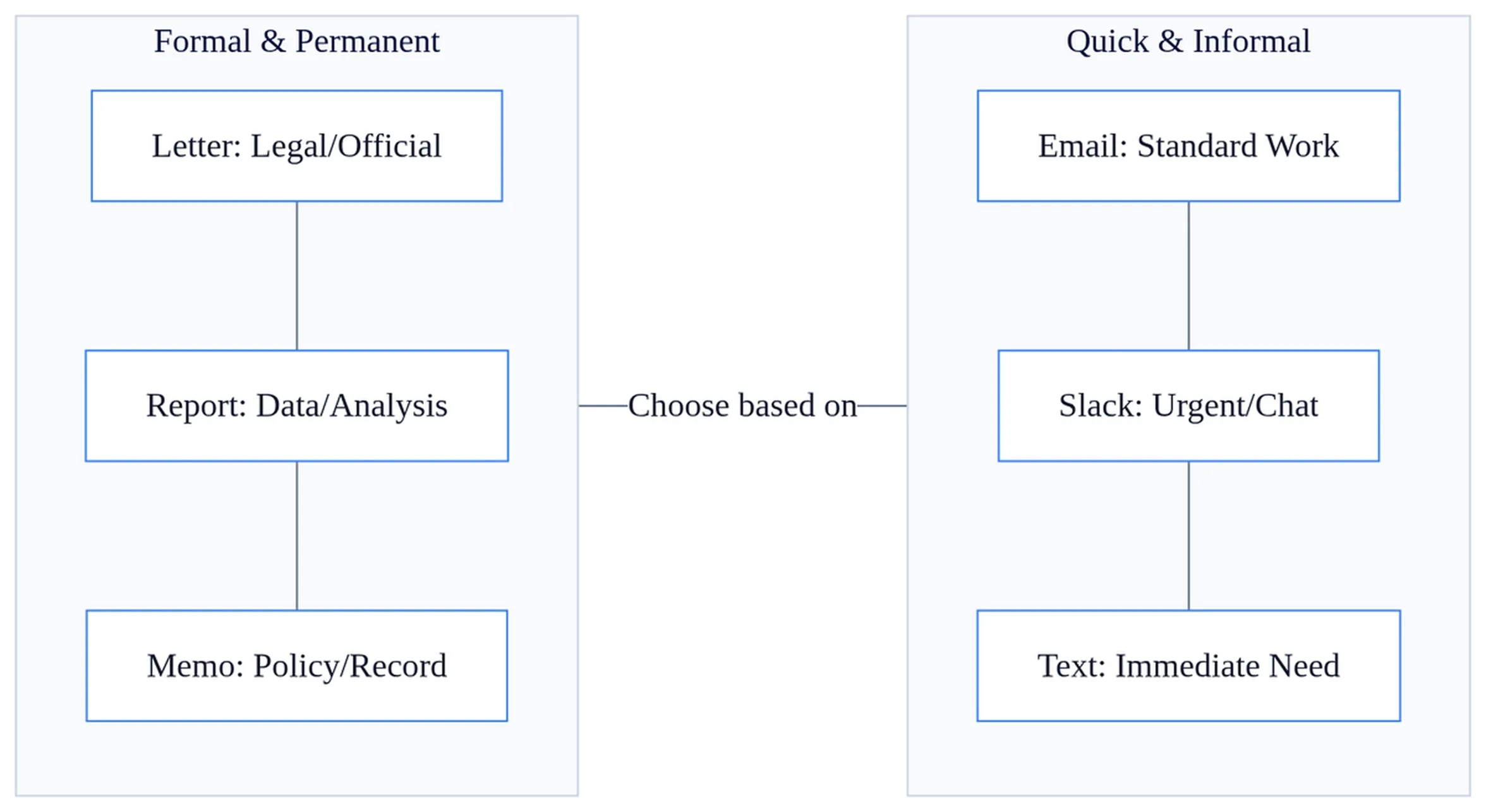
Audience comes first. Are you writing to someone inside or outside your organization? To a peer, a subordinate, or a superior? To a technical expert or a general reader? External audiences and upward communication demand formality. Peer-to-peer messages allow flexibility. A message to your company’s legal counsel requires different language than one to your cubicle neighbor.
Urgency determines speed. Need an answer in 10 minutes? Send a Slack message or text. Need a documented response within 48 hours? Email works. Building a case for a decision that won’t happen for three months? Write a report. Urgency and formality often trade off: the faster the channel, the less formal it tends to be.
Permanence matters for legal, compliance, and accountability reasons. Contracts, policy announcements, and performance reviews require formats that create durable records. Letters and formal memos serve this need. Slack messages and informal emails disappear into archives. If you might need to reference the communication in an audit or legal proceeding, choose a format with staying power.
Tone requirements vary by direction. Upward communication skews formal. Horizontal communication allows informality. Downward communication should be clear and accessible, not condescending. A directive from the CEO about layoffs demands careful, empathetic language. A project update to your team can be casual.
Scope shapes format, too. One-to-one messages work well in email or instant messaging. One-to-many announcements call for circulars, bulletins, or newsletters. Broadcasting a policy change to 500 employees via individual emails creates confusion and inbox clutter. A single circular or internal announcement post reaches everyone at once and ensures consistency.
| Scenario | Best Format | Why |
|---|---|---|
| Quarterly sales analysis for executives | Formal report | Detailed data, permanence, upward communication |
| Quick question about meeting time | Slack or instant message | Immediate response needed, low stakes |
| New remote work policy announcement | Memo or internal circular | One-to-many, documented, applies to all employees |
| Job offer to external candidate | Formal business letter | External audience, legally significant, high formality |
| Collaborative draft of team charter | Shared Google Doc | Multiple contributors, iterative editing, version control |
| Feedback to peer on draft proposal | Informal email or doc comments | Horizontal communication, collaborative tone |
Internal communication documents and notices
Organizations rely on a variety of internal communication methods to keep employees informed and aligned. These formats create shared understanding and document decisions.
Circulars and bulletins broadcast organization-wide announcements. A circular might inform all staff about a change in health benefits or a new safety protocol. Bulletins often address urgent matters: an office closure due to weather, a security alert, or an emergency procedure update. Both formats reach everyone simultaneously and create a single source of truth.
Notices invite employees to meetings, announce procedural updates, or post reminders about deadlines. Traditionally pinned to physical bulletin boards, notices now appear on intranets, Slack channels, or email distribution lists. A notice about the annual performance review cycle or an upcoming town hall meeting ensures everyone receives the same information.
Employee handbooks and guidelines serve as reference documents for policies, procedures, benefits, and expectations. These are permanent resources employees consult when they have questions about leave policies, expense reimbursement, or code of conduct. Handbooks reduce repetitive questions and ensure consistency in how policies are applied.
Internal newsletters provide regular updates on company news, employee achievements, project milestones, and culture initiatives. A monthly newsletter might feature a profile of a new team member, celebrate a successful product launch, or share upcoming training opportunities. Newsletters build connection and keep distributed teams informed.
Each of these formats has trade-offs. For a detailed look at the advantages and disadvantages of written communication, including permanence, scalability, and feedback limitations, see our dedicated guide.
Tone and formality by communication context
Tone mismatch damages credibility faster than a typo. A casual tone in a formal context signals carelessness. Excessive formality in a casual context creates distance and slows collaboration.
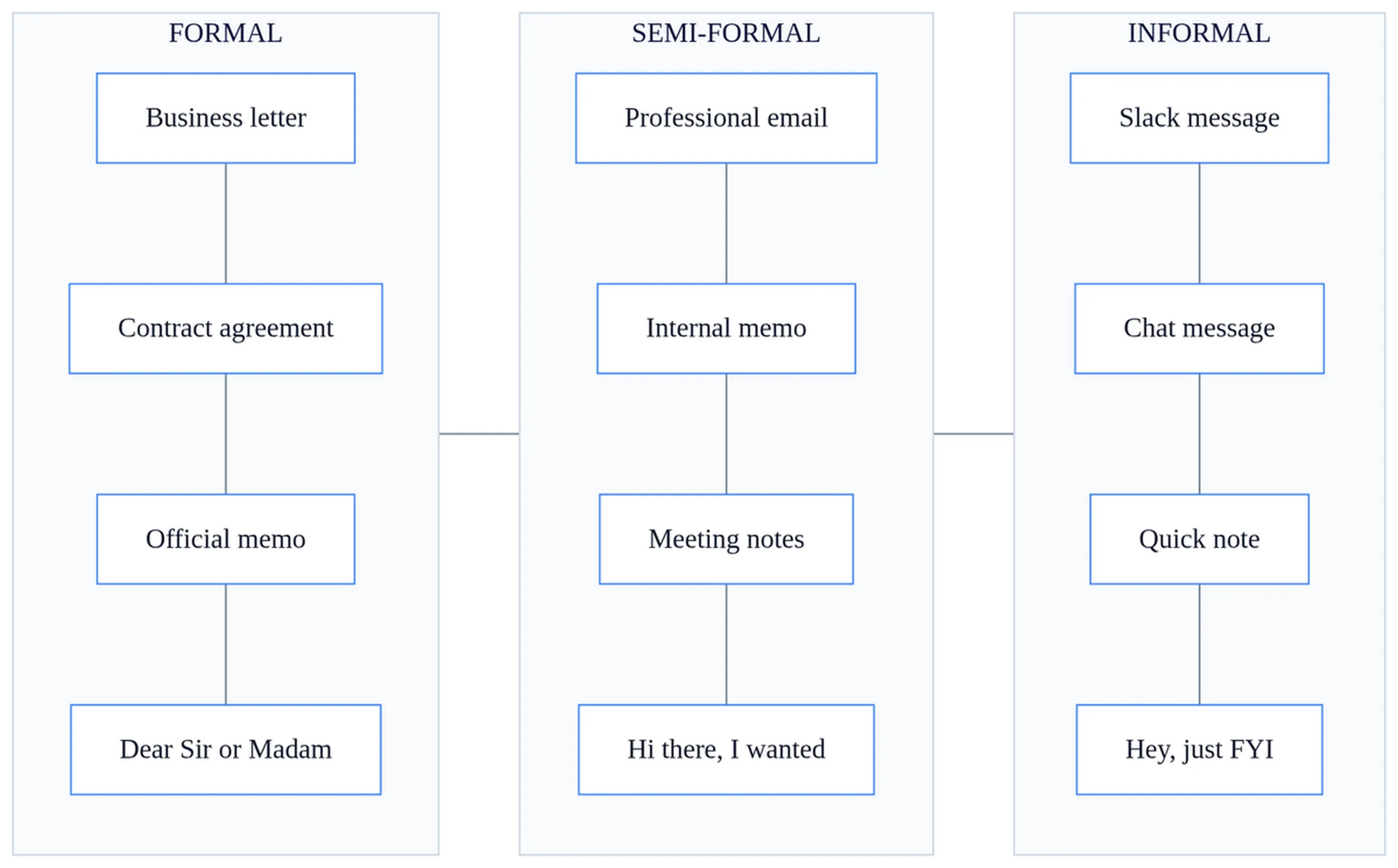
Formal written communication (business letters, reports, contracts) uses professional language, complete sentences, and structured formats. You write “I am writing to inform you” rather than “Just a heads-up.” You avoid contractions, slang, and emoji. Formality signals respect and seriousness. Leaders who adapt their communication style to the context tend to build stronger trust with their teams.
Semi-formal written communication (memos, professional emails, internal announcements) strikes a middle ground. You use direct language but allow some conversational phrasing. “Please submit your timesheets by Friday” works better than “It is requested that all employees ensure timely submission of timekeeping documentation.” Semi-formal writing respects the reader’s time.
Informal written communication (Slack messages, internal chat, casual emails) adopts a conversational tone. Sentence fragments are fine. Emoji clarify intent. “Got it, thanks!” replaces “I acknowledge receipt of your message and express my gratitude.” Informal writing builds rapport and speeds coordination. For a deeper exploration of when to use each style, see our guide to formal vs. informal communication.
The risk of tone mismatch is real. A casual email forwarded to an external auditor can embarrass your organization. Informal language in a performance review can undermine its seriousness. Conversely, overly formal language in a quick Slack message to a teammate creates unnecessary friction. Most people err on the side of too formal, especially early in their careers. With experience, you learn to calibrate.
One mistake people make: assuming digital equals informal. An email is still written communication, even if it arrives in seconds. Treat external emails, emails to senior leaders, and emails that might be forwarded with the same care you’d give a letter.
Common written communication mistakes to avoid
Even experienced professionals fall into predictable traps.
Unclear purpose tops the list. If your reader finishes your message and thinks, “What am I supposed to do with this?” you’ve failed. State your purpose in the first two sentences. “I’m writing to request approval for the Q3 marketing budget” beats three paragraphs of background before you get to the ask. Bury the lead in conversation, and people interrupt. Bury it in writing, and they stop reading.
Tone inconsistency confuses readers. Mixing formal and informal language in the same document (“Dear Sir or Madam, just wanted to give you a heads-up about the contract issue, lol”) signals poor judgment. Pick a tone and stick with it.
Poor formatting makes even good content hard to absorb. Long paragraphs without breaks, no headings, tiny fonts, and walls of text all discourage reading. Use white space. Break content into scannable chunks. Add headings. Use bullet points. Your reader is busy and likely skimming. Make it easy for them to find what they need. Formatting directly impacts productivity.
Lack of proofreading undermines your credibility. Spelling errors, grammar mistakes, and punctuation problems distract from your message and suggest carelessness. If you can’t be bothered to proofread a memo, why should the reader trust your analysis or recommendations? Read your draft aloud. Use spell-check. Ask a colleague to review high-stakes documents.
Oversharing in informal channels creates risk. Sensitive information (employee performance issues, confidential financial data, legal matters) doesn’t belong in Slack or casual email. A quick message about a struggling team member can be screenshotted and shared. When in doubt, choose a more formal, secure channel. If the information could damage someone or your organization if leaked, don’t put it in a low-permanence, high-circulation format.
Choose your format based on audience, urgency, and the permanence you need. Match your tone to the direction of communication. Proofread, format for scannability, and state your purpose early. If you’re sitting on the fence about formality, err formal until you know your audience well enough to relax. The right format, delivered with clarity and appropriate tone, turns written communication from a chore into a tool that moves work forward.
Frequently asked questions
Should I send a formal letter or email to an external vendor?
Use a formal letter for contracts, legal disputes, or formal complaints that need a documented record. Use formal email for routine inquiries, quotes, or initial contact. If the matter involves money, liability, or a binding agreement, print and sign a letter. For everything else, a professional email works fine and is faster.
What if I need to give critical feedback to my manager?
Upward communication requires careful documentation. Use a formal email or memo rather than instant message. State facts clearly, avoid emotional language, and include specific examples. Keep it brief and solution-focused. If the feedback is sensitive, request a meeting first to discuss verbally, then follow up with a written summary.
Can I use casual language in a memo to my team?
Memos are semi-formal, so tone depends on your workplace culture and the message’s importance. A procedural update or policy change warrants professional language and clear structure. A team announcement about a social event can be warmer. Always use complete sentences and avoid slang, even in informal memos. Professionalism protects the document’s credibility if it’s referenced later.
Why did my complaint letter get ignored or dismissed?
Complaint letters fail when they lack specifics, documentation, or a clear ask. State exactly what happened, when, and who was involved. Include dates and reference numbers. Explain the impact and what resolution you want. Use neutral, factual language—emotional or accusatory tone makes recipients defensive. Address it to the right person with authority to act.
Is it OK to mix formal and informal writing in one document?
No. Mixing formats confuses your audience and weakens credibility. Choose one tone and stick with it. A report with formal sections but casual asides looks unprofessional. A memo that starts stiff then turns conversational signals inconsistency. Match the format to your purpose: formal for external or high-stakes, informal for internal coordination.
How do I know if a message belongs in Slack or email?
Use Slack for quick questions, status updates, and casual coordination that don’t need a permanent record. Use email for decisions, approvals, feedback, or anything you might need to reference later. If your manager asks for documentation, email is safer. When in doubt, email—it’s more formal and creates a searchable trail.
1 Comment
Good work