


Written communication is durable and scalable, which makes it the default channel in business. But it also takes time to produce well and conveys tone poorly, which means a badly handled email can undo what a phone call could have fixed in minutes.
Below you’ll find the advantages and disadvantages of written communication, its defining characteristics, the main formats, and practical guidance on when to write and when to call.
What is written communication?
Written communication is any exchange of information captured in text. It includes letters, memos, reports, emails, instant messages, and social media posts, across a range that runs from a formal signed contract to a three-line Slack message.
What separates it from speech is that the message stays: you can retrieve, share, and cite it later.
This permanence is what separates written from oral vs. written communication, where spoken words fade unless someone records them. Written formats dominate formal settings because they create accountability that outlasts the moment of transmission.
Advantages of written communication
There are ten main advantages.
- Permanent record. Written documents survive the moment of transmission. A signed contract, an email confirming a transaction, or a memo documenting a decision can protect your organization in disputes, audits, and compliance reviews. No one can claim the conversation never happened.
- Legal protection. In regulated industries, written records are mandatory. The U.S. Equal Employment Opportunity Commission requires employers to keep written personnel records for specific periods. Those documents often decide the outcome of discrimination or wrongful termination claims, making them a direct legal asset.
- Accuracy. Writing gives you time to choose words carefully, structure arguments logically, and remove ambiguity before sending. A finance manager drafting a budget proposal can review figures and ensure every stakeholder receives identical, verified information. That editing step isn’t available in live speech.
- Wide reach at low marginal cost. One email costs the same to send to ten people as to ten thousand. This scalability makes written communication cost-effective for announcements, training materials, and policy rollouts where the audience is large but the message is fixed.
- Reduced distortion. Oral messages shift as they travel from person to person. Written text stays fixed. If you confirm a project deadline in writing, no one can claim they heard a different date. This matters most in supply chain coordination, where a single miscommunication about quantities or delivery dates can cause significant downstream losses.
- Formal accountability. Written communication creates a clear trail of who said what and when. When a manager delegates authority in a written memo, both parties have documented proof. The manager has evidence of the delegation; the team lead has documented authority to act. Neither can dispute it later.
- Asynchronous delivery. Written messages cross time zones without requiring both parties to be available at the same moment. A developer documents a code change at night; a colleague in another time zone reads it the next morning. The message travels and waits.
- Supports complex information. Tables, numbered lists, diagrams, and appendices let writers organize large volumes of detail that would overwhelm a listener. A quarterly financial report or a technical specification benefits directly from this structure, and the reader can scan, re-read, and refer back at will.
- Easy future reference. You can retrieve a five-year-old email as easily as one sent yesterday, if archives exist. This makes written communication ideal for policies, procedures, and technical specifications that teams consult repeatedly. Oral agreements rely on memory; written ones do not.
- Evidence in disputes. Customer service chat logs, supplier contracts, and HR correspondence create accountability. When someone disputes a billing issue, the written record resolves the conflict. Courts accept written evidence in ways they cannot accept a recollection of a phone call.
Disadvantages of written communication
- Slow feedback loops. Written exchanges lack the immediacy of conversation. You send an email, wait hours or days for a reply, then respond again. A five-minute discussion can stretch into a week-long thread. If a client has an urgent contract question, a phone call resolves it instantly; an email chain drags out the uncertainty.
- Time-consuming to compose. Writing well takes effort. A 1,200-word report might require several hours of drafting, editing, and formatting, and that extends further when a document passes through multiple reviewers. In fast-moving environments, this overhead can slow decisions significantly.
- No tone or non-verbal cues. Written words carry no vocal inflection, facial expression, or gesture. “We need to discuss your performance” sounds neutral on paper but can feel threatening or supportive depending on how it lands in person. This absence of body language and non-verbal cues leads to frequent misinterpretation.
- Literacy barriers. Written communication excludes people who cannot read fluently, whether due to low literacy, language differences, or visual impairments. A worksite with multilingual workers may struggle if safety instructions appear only in English text. These barriers to effective communication are often invisible to those who write and read easily.
- Risk of misinterpretation. Sarcasm, humor, and empathy all flatten in text. Recipients often assume the worst intent when tone is ambiguous. A blunt request reads as aggressive; a brief reply reads as dismissive. Oral communication lets speakers correct misunderstandings in real time.
- Inflexibility once sent. Once you distribute a written document, changing it is difficult. If a clause in a sent memo is unclear, you must issue a correction or amendment, which creates confusion. A spoken message can be adjusted mid-conversation based on how the listener reacts.
- Security and confidentiality risks. Documented information is hard to keep secret. Emails can be forwarded, screenshots shared, and files leaked. A sensitive HR matter discussed verbally leaves no trace. The same conversation in writing creates a permanent record that may be subpoenaed or accessed without authorization.
- Impersonal tone. Writing lacks the warmth of human presence. A typed email feels less engaging than a face-to-face conversation. This makes written communication weaker for relationship-building, especially in early-stage client development or during sensitive personal conversations where empathy matters most.
- Documentation gaps raise liability. According to Candello, the malpractice-research division of Harvard’s Risk Management Foundation, documentation failures appear in roughly 20% of malpractice cases and more than double the odds of a payout. Unclear written records are a direct patient safety issue, not a minor inconvenience. (Candello 2024)
- Information overload. Organizations that rely heavily on written channels generate large volumes of messages, emails, memos, and reports. This volume makes it hard for recipients to separate priorities. When every update arrives in writing, urgent messages compete with routine ones for attention.
Advantages vs disadvantages at a glance
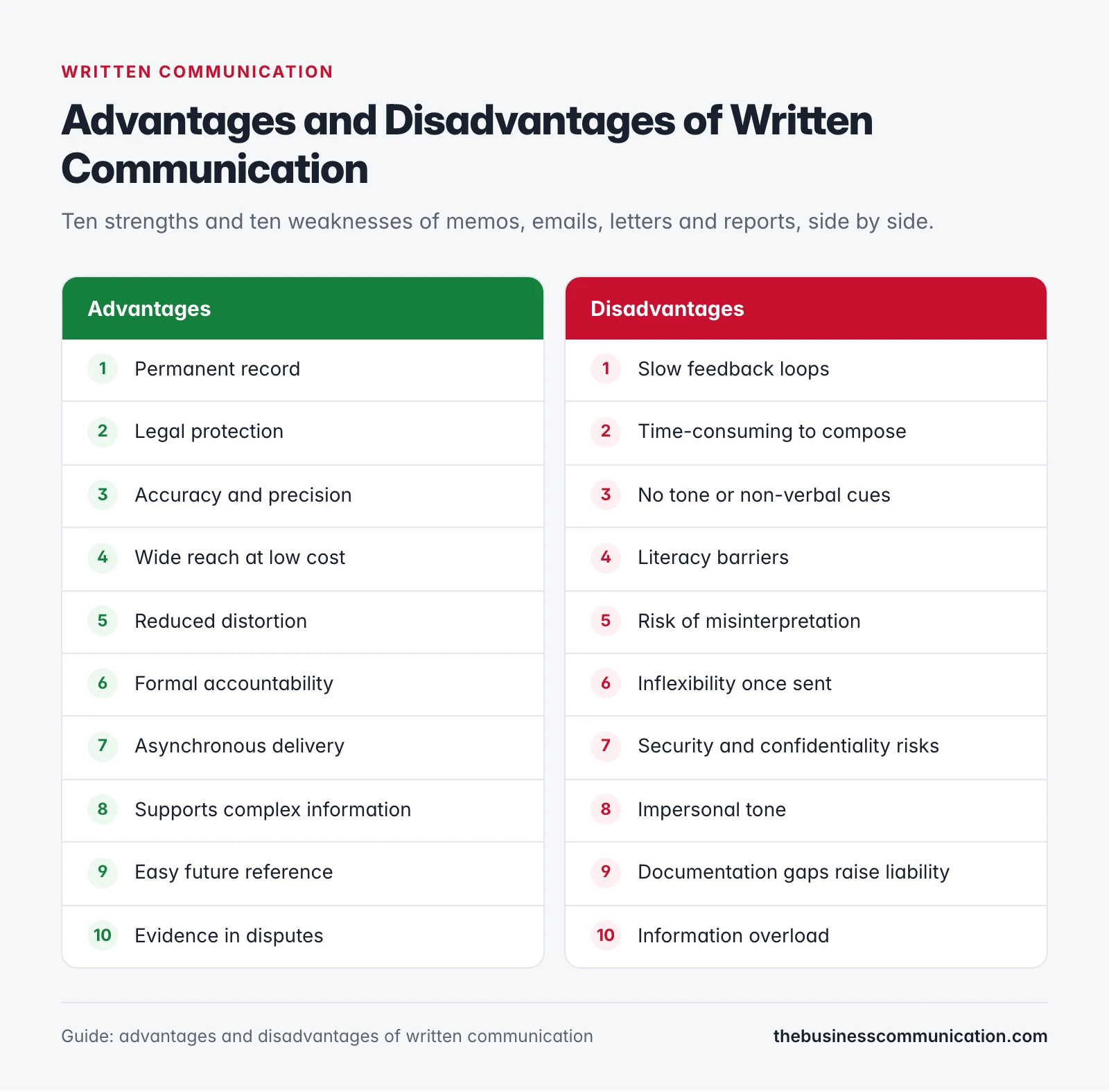
The table below gives a quick side-by-side comparison, useful for exam revision or fast reference.
| Advantage | Disadvantage |
|---|---|
| Permanent record | Slow feedback loops |
| Legal protection | Time-consuming to compose |
| Accuracy and precision | No tone or non-verbal cues |
| Wide reach at low cost | Literacy barriers |
| Reduced distortion | Risk of misinterpretation |
| Formal accountability | Inflexibility once sent |
| Asynchronous delivery | Security and confidentiality risks |
| Supports complex information | Impersonal tone |
| Easy future reference | Documentation gaps raise liability |
| Evidence in disputes | Information overload |
Is written communication cheap or expensive? Both, and here is why
Textbook lists sometimes call written communication cost-effective, then list “expensive” as a separate disadvantage. Both claims are true, but they describe different costs.
On a per-recipient basis, writing is cheap. One email costs the same to send to one person as to one thousand. Digital written messages carry near-zero marginal cost per additional reader.
Time and skill are the other cost. A detailed contract or polished policy document can take days to draft, review, and approve. In professions where time is billed by the hour, that labor adds up quickly.
What you measure determines which answer you get. Per additional recipient, writing is nearly free. Per hour of professional labor to produce it well, writing can be one of the more expensive communication channels available.
Characteristics of written communication
Seven features distinguish written communication from oral and non-verbal forms.
- Permanence. Written records remain accessible for future reference. Unlike spoken words, they do not fade with time or depend on anyone’s memory.
- Formality. Written communication usually follows a structured format and tone. A formal business letter follows conventions of layout, salutation, and signature that casual speech does not require.
- Clarity. Writers can review and edit before sending, which reduces ambiguity. This editing stage is available in writing but not in live speech.
- Delayed feedback. Written messages do not produce an instant response. This can slow decisions but also allows thoughtful, well-researched replies.
- Precision. Writers choose words deliberately to avoid confusion. The 7 Cs of communication (clarity, conciseness, correctness, courtesy, completeness, consideration, concreteness) apply most naturally to written formats.
- Organization. Information flows logically from one idea to another. Headers, paragraphs, and numbered lists impose structure that live oral delivery cannot replicate easily.
- Visual elements. Formatting, bullet points, tables, and highlights make written content easier to scan and understand at speed.
Types of written communication
Two main categories exist: formal and informal.
Formal written communication
Formal communication follows a defined structure and serves professional or official purposes. Common forms include:
- Business letters. Official correspondence for formal requests, complaints, or announcements. Our guide on business letter format covers structure and examples.
- Memos. Short internal messages for announcing decisions, sharing updates, or delegating tasks within an organization. To see when they help and when they hurt, read our guide on memo strengths and limits.
- Reports. Structured documents that present findings, analysis, or recommendations. Annual reports, project updates, and audit summaries all fall here.
- Emails. The most common modern form. Emails blend speed with a degree of formality, making them suitable for most business communication.
- Circulars. Notices sent to a wide internal or external audience to announce a policy change or share a standard update.
- Proposals and tender documents. Written plans submitted for approval, funding, or procurement decisions.
Our article on types of written communication covers each format in more detail.
Informal written communication
Informal written communication is casual and personal. Text messages, chat threads, handwritten notes, and friendly emails between colleagues fall into this category. Tone and relationship matter more than structure in these formats.
Modern written communication formats and their trade-offs
Business writing runs from formal letters to real-time chat, each format with its own speed, permanence, and tone trade-offs.
Traditional letters. Physical letters on letterhead carry maximum formality. Delivery takes days, but a letter on official stationery signals importance in a way email cannot. Law firms, government agencies, and executives use them for high-stakes correspondence.
Email. Email balances formality with speed and serves as the default channel for most business communication. Our article on email advantages and disadvantages covers the trade-offs in detail.
Instant messaging. Platforms like Slack, Microsoft Teams, and WhatsApp offer near-real-time feedback while keeping a written record. They are less formal than email, which encourages quick exchanges. The downside is that messages scroll away quickly and the expectation of an immediate reply can create pressure.
Social media. LinkedIn updates, company blog posts, and public threads reach wide audiences but sacrifice privacy. Once published, they are hard to retract, and public visibility amplifies mistakes.
Reports. Structured documents handle complex information through sections, headers, tables, and appendices. They are formal, usually circulated internally, and serve as reference material long after the initial distribution.
| Format | Formality | Speed | Permanence | Best use case |
|---|---|---|---|---|
| Traditional letter | High | Slow (days) | Very high | Legal notices, contracts, official correspondence |
| Medium-high | Fast (minutes-hours) | High | General business communication, project updates | |
| Instant messaging | Low-medium | Very fast (seconds) | Medium | Quick questions, team coordination, informal updates |
| Reports and memos | High | Slow (days-weeks) | Very high | Complex analysis, policy documentation, strategic plans |
| Social media | Low | Very fast (seconds) | High (public) | Marketing, announcements, thought leadership |
Industry-specific considerations
Each industry tilts the trade-off differently.
Legal and compliance. Written communication is non-negotiable in legal practice. Contracts, regulatory filings, court documents, and audit trails all require documentation. The permanent record advantage outweighs speed concerns, and a law firm might spend weeks drafting a merger agreement precisely because that thoroughness protects clients from ambiguity.
Healthcare. Patient records, treatment plans, and prescription orders require written documentation for continuity of care. A nurse’s note in a chart may reach a different provider days later.
According to Candello, the malpractice-research division of Harvard’s Risk Management Foundation, documentation failures appear in roughly 20% of malpractice cases and more than double the odds of a payout. Unclear written records are a direct patient safety issue. (Candello 2024)
Finance and banking. Transaction records, account statements, and loan agreements need written form for fraud prevention. A bank cannot rely on verbal confirmation that a customer authorized a wire transfer; written proof is mandatory.
Remote teams. For teams spread across time zones, written communication is the primary channel. A developer documents a code change at night; a colleague in another time zone reads it the next morning. The feedback delay that counts as a disadvantage elsewhere becomes a practical convenience here.
Customer service. Email and chat logs create accountability and allow quality monitoring. When a customer disputes a billing issue, the written record resolves the conflict. Many organizations offer both phone and written support to balance the accountability of writing with the empathy of voice.
How to reduce the disadvantages
Technique handles most of the disadvantages.
- Write short, active sentences. Break long paragraphs into bullets. Add headers to guide readers through complex documents. Instead of writing “The project timeline has been extended due to unforeseen circumstances,” write “We extended the deadline to March 15 because the vendor delayed delivery.” Specific language prevents misinterpretation.
- Manage tone consciously. Choose words that match your intent. “Please send the report by Friday” is neutral. “Could you send the report by Friday?” softens the request. Use bold text sparingly for emphasis; overuse of capitals reads as shouting.
- Write for accessibility. Use plain language and avoid jargon unless your audience shares your technical background. Use readable fonts, sufficient contrast, and alt text for images so screen readers work properly.
- Build in feedback loops. Invite questions explicitly. End emails with “Let me know if anything is unclear.” For critical messages, request confirmation: “Please confirm you can meet the new deadline.” This restores the communication feedback loop that written formats otherwise lack.
- Match the channel to the situation. If an email thread runs past three exchanges, switch to a call. Use writing for announcements, documentation, and formal decisions. Use voice for negotiation, conflict resolution, and relationship-building. For guidance on choosing the right channel, see our comparison of formal vs. informal communication.
- Protect sensitive information. Encrypt sensitive documents. Use access controls so only authorized recipients can open files. Establish retention policies that delete outdated records automatically. Train employees on which conversations should stay verbal and which need a paper trail.
Frequently asked questions
What are the advantages and disadvantages of written communication?
The advantages and disadvantages of written communication divide along a single axis: how well the situation tolerates delay and the absence of tone. The main advantages are a permanent record, legal protection, accuracy, wide reach, and formal accountability.
The main disadvantages are slow feedback, the time it takes to compose, the absence of tone, literacy barriers, and security risks. Formal business settings favor writing; urgent or emotionally sensitive situations usually favor speech.
What are the 5 advantages and disadvantages of written communication?
Five advantages: (1) permanent record, (2) legal protection, (3) accuracy and precision, (4) wide reach, (5) formal accountability. Five disadvantages: (1) slow feedback, (2) time-consuming to compose, (3) no tone or non-verbal cues, (4) literacy barriers, (5) risk of misinterpretation.
What are the 10 disadvantages of written communication?
The 10 main disadvantages are: slow feedback loops, time-consuming composition, no tone or non-verbal cues, literacy barriers, risk of misinterpretation, inflexibility once sent, security and confidentiality risks, impersonal tone, documentation gaps that raise liability, and information overload.
Is written communication better than oral communication?
Neither is universally better. Written communication works best for records, complex messages, and cross-time-zone coordination. Oral communication works better when you need immediate feedback, when the topic is sensitive, or when you are building trust with someone.
For most important decisions, combining both works well: discuss first, then document the outcome in writing.
Should I write or call to make a complaint?
Call first if you need an immediate resolution. A phone call lets you establish tone and reach agreement quickly.
Follow up with an email that records what you both agreed to. For formal complaints where evidence matters, lead with writing: a written complaint creates a record that protects you legally and forces a formal, traceable response.
77 Comments
Excellent, helps a lot.
Just wanted to ask when this was published? I seem to not be able to find the year.
Best wishes
good i love it.
Communication skills
How can I find the reference s
How can I find references
helpful indeed helped me with my assignment
thank u so much this is more than enought
Thanks. Assignment #bam#.
explain the advantages and disadvantages of written communication over oral communication
kindly need your help guys
I have enjoyed my assessment
Wow,indeed have been helped nowni can conclude my assignment and able to explain to ma fellows..tnx
Comment:thank you I have done my assignment
I have enjoyed writing my assignment
Well done
its good then other means
Thanks so much the information helps me alot
It is very useful,
I have done my assignment of Communication Skills.
I’ll come back later, it is good and it made me happy as Charles Kaandila
wow.
This disadvantage is associated with an all text-based consultation processes, particularly the traditional statutory “submission” processes.
Good job I have done my assignment with it. Thanks
Have done my assignment s a.m. doing electrical engineering
Good info.Thanx.
thnx to u….my assignment is complete
So good to communicate with people and to brain storming to be communicate bring confidence and unity
Thanks I have done my assignment
Is so convinance to use your website. I also beg you to provide more. Thxs
What are the reference of this
How can I find reference?
What has been written is helpful for readers. I will be grateful if you can provide the full references for the texts you have mentioned
Thanks
Thanks i got any point from it.
short note about the right resumes for effective job hunting
Help me a lot to complete my assignment
name of author please
greatful indeed!
It is useful
Very usefuk made it easy to answer my shcool assignments. Thanx very much
it really helps me to prepare for my examination
Good work
Good work thanks
Super
thank you so much finally im done
i like your site thanks for the effort.
widden my knowledge, thanks a lot
WHAT IS CYCLE OR PROCSS OF COMMUNICATION AND EXPLAIN ITS COMPONENTS?
its clear,i lyk y
I have passed my tests
Thank so much for this infor
i like it
I need the questions and answers for the whole syllabus please .Am writing In May
i have done my assignment am doing Hospitality
Thanks a lot..t has been of a great help…
lt was really helpful, my assignment is done.
thank you
with this I have done my assignment
This was very helpful
What an extraordinary article. I learn a lot from it.
I have read so many posts on the topic of the
blogger lovers however this article is genuinely a good paragraph, keep it
up.
This post provides a great overview of the pros and cons of written communication. I especially appreciated the point about how it allows for careful thought and clarity, but it’s also true that tone can be easily misunderstood. It’s a delicate balance we must navigate in our digital conversations!
Who is the author and what is the publication date?
with this am done with my course work.
Tell us also about “electronic communication” as another type of communication.
Thanks alot
assignment check
Thnx that true
Wow I have loved dis site
Thanks for your afford.
i got it guys keep up,very helpfull
Thank you I have done my assignments easily
Thanks my assignment is done
Thank you my assignment is complete
thanx a lot for ur post
Thank you I am done with my assignment
Comment: Thanks i have learn alot on this day of COVID-19
Thanks it has helped me to write assignment
More to know about it
Thankyou because of this thing I’ve finished my ass.
Keep it up.. 😁