


If you have ever sat in a meeting that felt endless and confusing, chances are it lacked a proper agenda. A meeting agenda is more than a list of topics. It is the backbone of a productive discussion. Without it, even the smartest team can wander off track.
In this guide, you will learn how to write a meeting agenda that is clear, useful, and effective. We will look at the meaning, importance, key elements, common mistakes, and some ready-to-use templates. By the end, you will feel confident about preparing an agenda that works for any type of company meeting.
Before we dive in, remember that a meeting agenda is closely related to other essentials like the notice of a meeting and the minutes of a meeting. But here, our focus will be only on the agenda itself.
What is a Meeting Agenda?
A meeting agenda is a structured list of items that need discussion during a meeting. Think of it as a roadmap that guides participants from the beginning to the end. It outlines the purpose, topics, time allocations, and responsibilities.
Unlike a casual checklist, an agenda follows a formal pattern. For instance, a notice of a meeting only announces the event, but the agenda tells you what exactly will happen inside the room.
A fun way to understand it is to compare a meeting to a train journey. The agenda is the timetable. It tells you where you start, the stops along the way, and the final destination. Without it, you might never reach the right station.
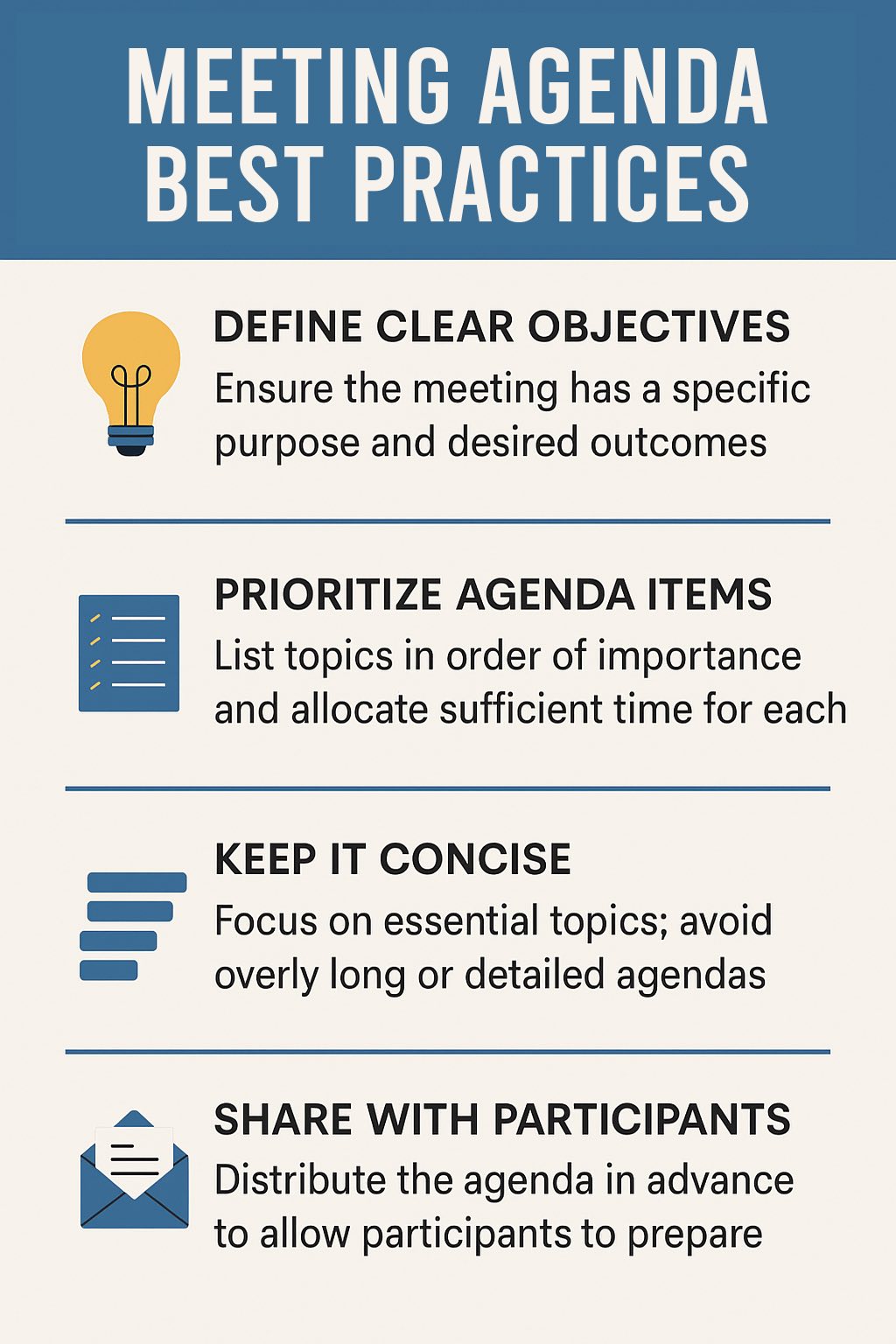
Importance of a Meeting Agenda
Why is an agenda so important? Couldn’t we all just meet and talk? The answer is simple: without structure, meetings can waste both time and energy.
Here are the main reasons an agenda matters:
- Clarity of Purpose
Every participant knows why they are attending and what outcomes are expected. - Time Management
When topics are allotted specific time slots, it prevents endless debates. - Preparation
Participants can prepare their points in advance, leading to more meaningful discussions. - Focus
An agenda acts as a reminder to stick to the plan rather than drift into unrelated issues. - Record Keeping
Agendas help in tracking what was planned and comparing it with what was achieved.
In one of your earlier articles, you discussed the definition and objectives of meetings. A well-prepared agenda directly supports those objectives.
Key Elements of a Meeting Agenda
A strong agenda includes more than just topics. It contains several important elements. Let’s break them down.
- Basic Information
- Title of the meeting
- Date, time, and location
- List of participants
- Purpose or Objective
Why is the meeting being held? For example, “to review quarterly sales results.” - Discussion Items
The core of the agenda. Each item should be specific and action-oriented. - Time Allocation
Assigning time to each topic avoids wasting hours on minor issues. - Roles
Mention who will lead each discussion or present a report. - Follow-up Section
Space to note what actions need to be taken after the meeting.
These elements are closely linked with the participants’ responsibilities in a meeting. For example, the secretary often drafts the agenda while the chairperson approves it.
Step-by-Step Guide: How to Write a Meeting Agenda
Now, let’s get practical. Here is a step-by-step process to create an effective meeting agenda.
Step 1: Identify the Meeting Objectives
Ask yourself, why is this meeting happening? Is it to solve a problem, share updates, or make a decision? The objective sets the tone.
Step 2: Collect Input from Participants
Encourage team members to suggest topics. This ensures the agenda is relevant and inclusive.
Step 3: Prioritize the Topics
Not all issues are equal. Put the most urgent or important items first. Less critical matters can wait.
Step 4: Assign Time Slots
Decide how long each topic should take. For example, budget review may need 20 minutes, while project updates may need only 10.
Step 5: Define Roles and Responsibilities
Note who will present, who will record, and who will lead the discussion.
Step 6: Finalize and Share
Send the agenda in advance with the meeting notice. Give participants enough time to prepare.
If you compare this process with the prerequisites of a valid meeting, you will see how much an agenda adds to the overall validity and efficiency of the session.
Common Mistakes to Avoid
Writing an agenda seems easy, but many fall into common traps. Here are some mistakes you should avoid.
- Being Vague
Writing “discuss project” is too general. Instead, write “review project milestones for Q2.” - Overloading the Agenda
Trying to cover too much in one meeting leads to frustration. - Ignoring Time Management
Without time limits, discussions drag on endlessly. - Not Sharing in Advance
If participants see the agenda for the first time during the meeting, they will not be prepared.
Interestingly, these errors are similar to mistakes in writing circular letters. Both need clarity, brevity, and proper timing.
Sample Templates of Meeting Agendas
Theory is good, but templates make life easier. Here are two simple formats you can adapt.
Template 1: Formal Board Meeting Agenda
- Meeting Title: Quarterly Board Meeting
- Date and Time: July 15, 2025, 10:00 AM
- Location: Conference Room A
- Participants: Board of Directors, CEO, CFO
Agenda Items:
- Approval of Previous Minutes (5 min)
- Review of Quarterly Financial Report (20 min, presented by CFO)
- Discussion on Expansion Plans (15 min, led by CEO)
- Voting on Dividend Declaration (10 min)
- Any Other Business (5 min)
Template 2: Team Project Meeting Agenda
- Meeting Title: Project Phoenix Weekly Review
- Date and Time: July 18, 2025, 2:00 PM
- Platform: Zoom
- Participants: Project Team
Agenda Items:
- Progress Updates from Team Leads (15 min)
- Discussion on Technical Challenges (20 min)
- Planning Next Sprint Tasks (15 min)
- Assigning Responsibilities (10 min)
- Wrap-up and Next Meeting Schedule (5 min)
For more downloadable resources, you can check your popular business letter samples page. Offering templates always increases user engagement.
Best Practices for Effective Agendas
Once you know how to write an agenda, follow these best practices to make it truly effective.
- Keep the language clear and concise.
- Limit the number of agenda items.
- Ensure every item ties back to the meeting objectives.
- Share the agenda early, ideally 48 hours before the meeting.
- Use bullet points rather than long paragraphs.
- Review and adjust before finalizing.
These best practices are similar to the 7 Cs of communication. Clear, concise, complete, and concrete communication always leads to better outcomes.
Role of the Chairperson and Secretary in Agenda Setting
The chairperson and secretary play vital roles in creating and circulating the agenda.
- Chairperson: Decides which topics should be included, ensures they align with company goals, and approves the final draft.
- Secretary: Drafts the agenda, formats it, and distributes it to participants along with the notice.
These roles are explained in more detail in your post about the meaning and appointment of a company secretary.
Digital Tools for Creating and Sharing Agendas
Gone are the days of handwritten agendas. Today, digital tools make agenda preparation faster and more collaborative.
Some popular tools include:
- Google Docs: Great for real-time collaboration.
- Microsoft Word: Professional and widely used.
- Trello or Asana: Ideal for project meetings where tasks need tracking.
- Notion: Flexible for both formal and informal meetings.
- AI Tools: Now, AI can even generate draft agendas based on your meeting purpose.
These tools ensure that agendas are not only well-prepared but also accessible to everyone. It is similar to how visual communication uses modern tools to make information clearer.
Conclusion
A meeting agenda may seem like a small detail, but it can make or break the success of a meeting. From defining the purpose to assigning roles and time slots, every step adds value.
In this guide, you learned what a meeting agenda is, why it matters, its key elements, and how to write one effectively. You also saw common mistakes, sample templates, best practices, and the role of technology.
The next time you prepare for a meeting, take a few extra minutes to create a thoughtful agenda. Your colleagues will thank you, and your meetings will be shorter, sharper, and more successful.
If you want to strengthen your understanding of meeting-related documents, check out the detailed guide on agenda in business communication. It complements everything you learned here.
Frequently asked questions
Should I send the agenda before or during the meeting?
Send it before. Participants need time to prepare their points and gather relevant materials. Sharing the agenda during the meeting defeats its purpose. Aim to distribute it at least 24 hours in advance, or longer for complex topics. This gives attendees a fair chance to contribute meaningfully rather than scrambling to catch up.
What if a critical topic comes up that’s not on the agenda?
Acknowledge it briefly, but don’t derail the meeting. Suggest adding it to the next agenda or scheduling a separate discussion. If it’s truly urgent, ask the group if they want to extend time for it. Sticking to the agenda shows respect for everyone’s time while staying flexible enough to handle genuine emergencies.
How many topics can fit in a one-hour meeting?
Typically three to five items, depending on complexity. A simple update might take 5 minutes, while a decision-making discussion could need 20. Build in a 5-minute buffer for transitions. Overloading leads to rushed conversations and incomplete decisions. It’s better to schedule a follow-up meeting than cram too much into one.
Who should write the meeting agenda—the organizer or the chairperson?
Usually the organizer or administrative assistant drafts it based on input from the chairperson and participants. The chairperson then reviews and approves it. This division of labor ensures the agenda reflects leadership priorities while staying grounded in practical details. Always confirm approval before sending it out.
Should I include agenda items that are just informational updates?
Yes, but keep them brief. Label them clearly as “updates” or “announcements” and allocate minimal time. Consider sending detailed updates in writing beforehand so meeting time focuses on discussion and decisions. This respects attendees’ time while ensuring everyone stays informed.
4 Comments
Hi all, here every one is sharing such know-how, so it’s nice to read this blog, and I used to pay a visit this weblog daily.
Ya i is very useful to study also these things are in simple English so it helps more to improve our knowledge thnk u oll behind this
Very helpfull for the preparation of my 1st presentation.thanks
his s very helpful thank you