


A notice of meeting is a formal written document that informs members, directors, or shareholders of an upcoming meeting and provides essential details such as date, time, venue, and agenda. It serves both as a legal compliance tool and a practical communication device that ensures participants have adequate time to prepare, review materials, and plan their attendance. Unlike informal calendar invitations or email reminders, a notice of meeting carries legal weight and creates a documented record of proper notification.
Drafting a valid notice requires attention to specific elements, timing requirements, and distribution protocols. Get it wrong, and you risk legal non-compliance, reduced participation, or even invalidating decisions made during the meeting.
What is a notice of meeting?
A notice of meeting is a formal written communication issued by an authorized person, typically a company secretary, board chair, or administrative officer, to inform eligible members of an upcoming meeting. It contains the particulars necessary for attendance: when, where, and what will be discussed.
The notice differs from other meeting documents. An agenda outlines the topics in detail; meeting minutes record what happened after the fact. The notice is the first formal touchpoint. It establishes that a meeting will occur and that members have been properly notified according to organizational bylaws or statutory requirements.
Most formal business meetings require a notice: board meetings, annual general meetings, shareholder meetings, committee sessions. Informal team huddles or project check-ins typically do not. The formality of the notice reflects the formality and legal standing of the meeting itself.
Why notice of meeting matters: legal and practical importance
A notice of meeting is not administrative busywork. It is a legal requirement for most formal corporate and organizational meetings, and it protects both the organization and its members.
Many jurisdictions and corporate bylaws mandate advance notice for shareholder meetings, board meetings, and annual general meetings. Failure to provide proper notice can render meeting decisions void or expose the organization to legal challenges. A properly issued notice creates documented evidence that all entitled members were informed in compliance with applicable law. Second, notice gives members time to prepare. Directors need to review financial statements before a board meeting. Shareholders need to understand resolutions before voting. A rushed or last-minute notice reduces informed participation and undermines the quality of decisions made. Third, the notice sets expectations. It signals the seriousness of the meeting, clarifies who should attend, and establishes accountability. Members who receive formal notice understand they are expected to participate or formally decline.
Consider a small Dhaka-based manufacturing company preparing for its AGM vs. EGM. The company secretary issues notice 25 days in advance, as required by the Companies Act. Shareholders receive the notice by registered mail and email, along with the audited financial statements. This advance notice allows shareholders to review the financials, prepare questions, and arrange travel if needed. Without it, the AGM could be challenged as improperly convened, and any resolutions passed could be invalidated.
Essential elements of a valid notice
A valid notice of meeting must include specific elements to meet legal and practical standards. Missing even one can create compliance risk or reduce participation.
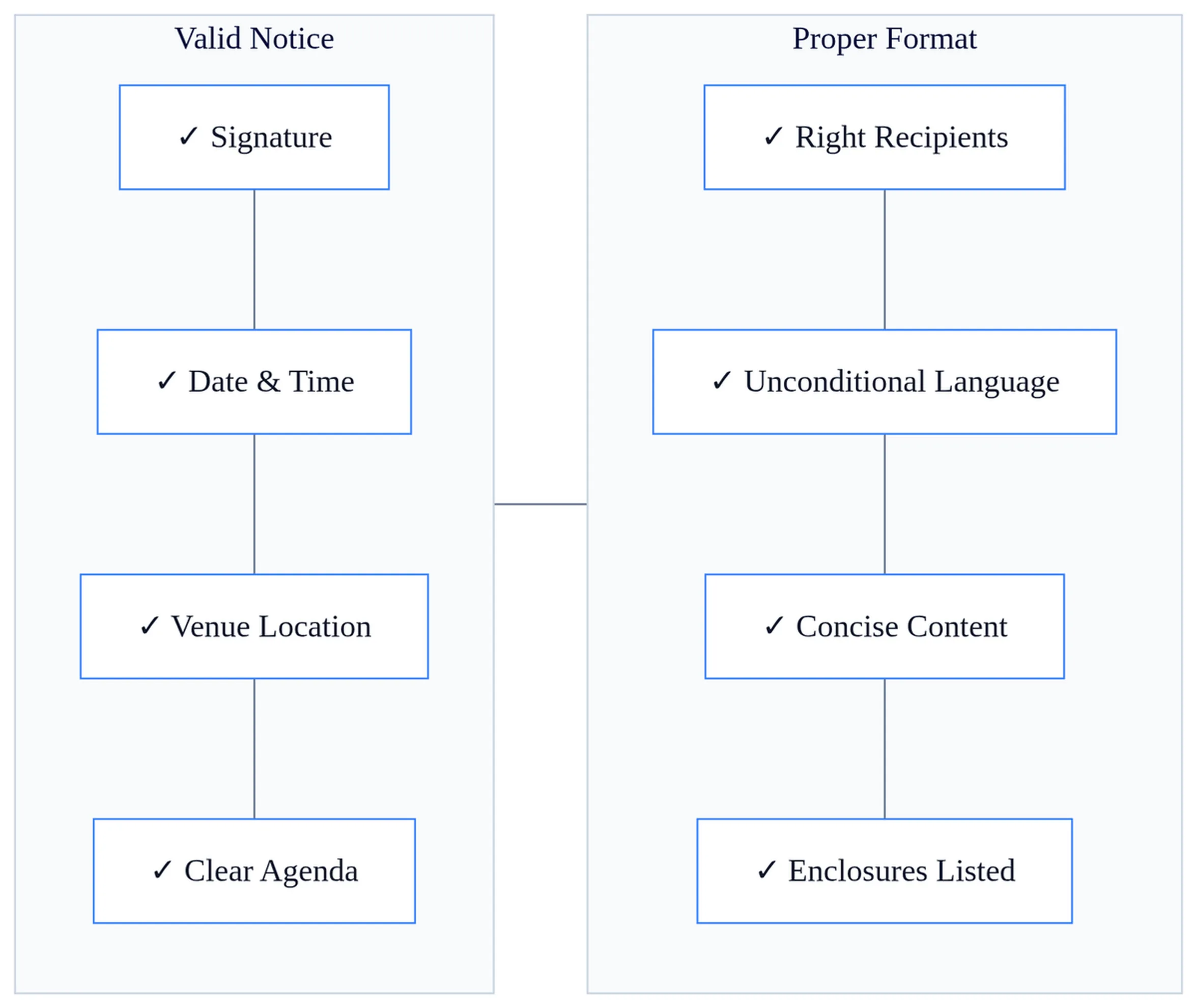
Signature and authority: The notice must be signed by a person with proper authority, typically the company secretary, board chair, or authorized officer. An unsigned notice or one issued by an unauthorized person lacks legal standing. The signature confirms that the notice has been issued on behalf of the governing body and that the meeting is officially convened.
Date, time, and venue: Specify the exact date, start time, and location of the meeting. For physical meetings, include the full address and room number if applicable. For virtual meetings, provide the platform name, meeting link, and access instructions. Ambiguity here leads to confusion and reduced attendance. If your organization operates across time zones, state the time zone explicitly: “10:00 a.m. Bangladesh Standard Time (BST)” or “2:00 p.m. Eastern Standard Time (EST)”.
Agenda: List the topics to be discussed in the meeting. The agenda need not be exhaustive in the notice itself, but it should summarize key items so members understand the meeting’s purpose. For example, “Approval of audited financial statements,” “Election of directors,” or “Review of Q3 marketing performance.” For detailed guidance on structuring agendas, see our guide on how to write a meeting agenda.
Unconditional language: The notice should be a straightforward request to attend, not a conditional invitation. Avoid phrases like “if you wish to attend” or “subject to your availability.” The notice assumes attendance is expected unless a member formally declines or is unable to attend. Conditional language undermines the formal nature of the notice and can create ambiguity about whether attendance is required.
Proper recipients: Serve the notice only to members entitled to attend. For a board meeting, this means directors and any invited officers. For a shareholder meeting, it means all registered shareholders. Sending notice to ineligible parties wastes resources and can create confusion; failing to notify entitled members is a compliance failure.
Conciseness: Keep the notice clear, simple, and professional. Use plain language and avoid jargon. The notice should fit on one or two pages. Lengthy explanations belong in enclosures, not in the notice itself.
Enclosure: Include or reference supporting documents that members need to prepare for the meeting. This might include financial statements, proxy forms, bylaws, draft resolutions, or explanatory notes. List enclosures at the bottom of the notice so members know what to review before the meeting.
| Element | Why it matters | Common mistake |
|---|---|---|
| Signature and authority | Confirms legal standing of the notice | Unsigned notice or issued by unauthorized person |
| Date, time, and venue | Ensures members know when and where to attend | Vague location or missing time zone |
| Agenda | Allows members to prepare and understand meeting purpose | Generic agenda with no specific topics listed |
| Unconditional language | Establishes expectation of attendance | Conditional phrasing like “if you are available” |
| Proper recipients | Ensures only entitled members receive notice | Sending to ineligible parties or missing entitled members |
| Conciseness | Keeps notice clear and easy to read | Multi-page notice with excessive detail |
| Enclosure | Provides supporting documents for informed participation | No reference to attached documents or missing materials |
Notice timing and advance notice requirements
The timing of your notice is not arbitrary. Most organizations and jurisdictions set minimum advance notice periods to ensure members have adequate time to prepare and attend.
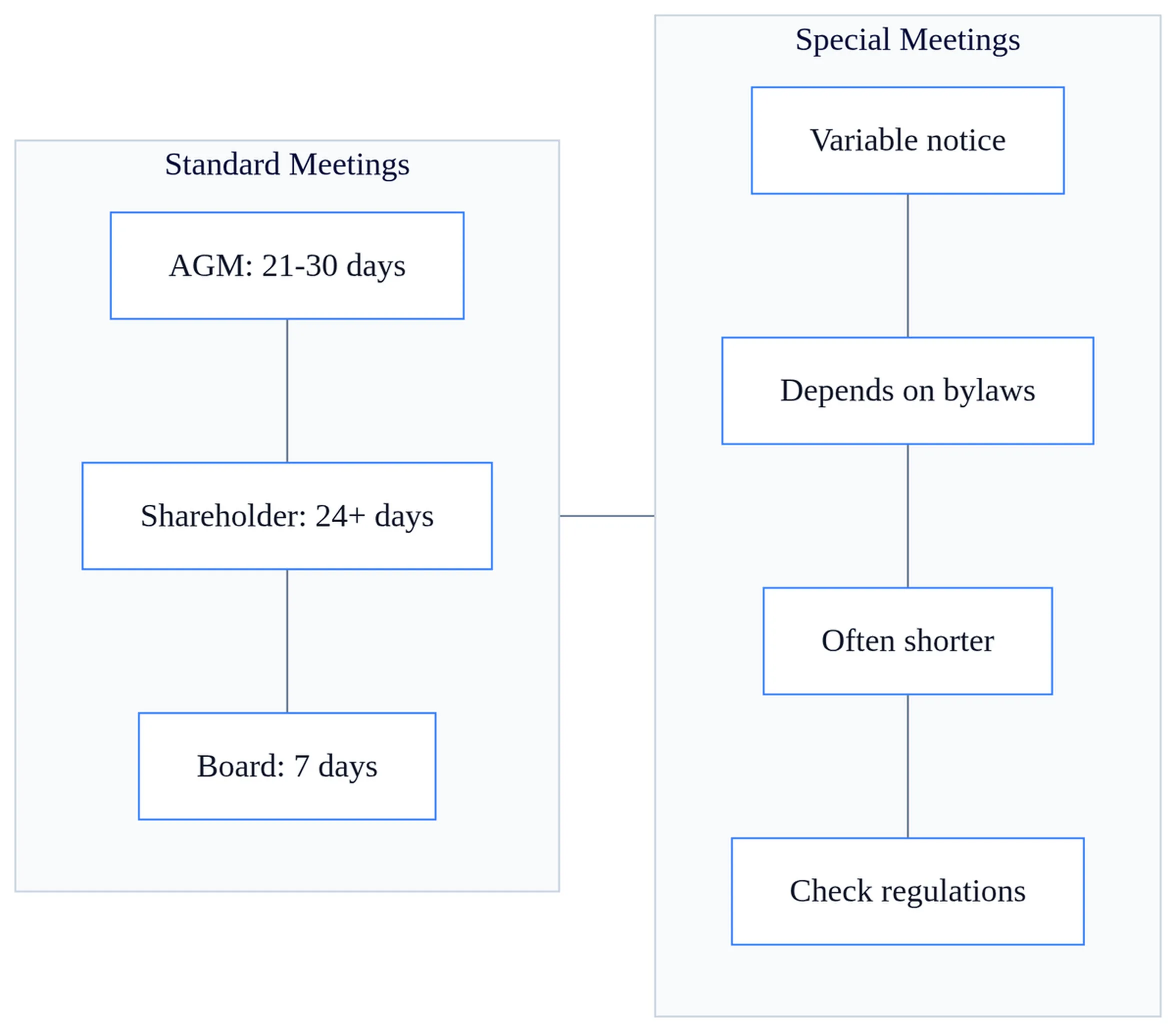
For annual general meetings (AGM), many jurisdictions require 21 to 30 days advance notice. In Bangladesh, for example, the Companies Act mandates at least 21 days’ notice for an AGM. Some bylaws require 30 days. This extended period allows shareholders to review annual financial statements, arrange travel, and consider resolutions that will be voted on.
For shareholder meetings generally, expect 24 days or more. The exact period depends on corporate law in your jurisdiction and your organization’s articles of association. Public companies often face stricter requirements than private companies.
For board meetings, advance notice is typically shorter, often 7 days. Regular board meetings that occur on a fixed schedule (e.g., the first Monday of each month) may require even less notice, since directors already expect the meeting. However, the notice still is a formal reminder and provides the agenda.
For special or emergency meetings, notice periods may be shortened if circumstances demand it. However, this usually requires a waiver of notice signed by all or a majority of members, or explicit provisions in the bylaws allowing shorter notice for urgent business. Emergency meetings should be used sparingly and only when delay would harm the organization.
Proper timing is not just about legal compliance. It directly affects meeting effectiveness. A director who receives notice only three days before a board meeting reviewing complex financial data will be underprepared. A shareholder who receives notice two weeks before an AGM has time to consult advisors and formulate questions. Adequate notice respects members’ time and improves the quality of participation.
Regular vs. special meeting notices: key differences
Not all meetings follow the same notice protocol. Understanding the difference between regular and special meetings helps you apply the correct procedures.
Regular meetings follow standard notice protocols. They occur on a predictable schedule: quarterly board meetings, monthly committee meetings, annual shareholder meetings. The notice period is governed by bylaws or statute, and the agenda typically covers routine business such as approving minutes, reviewing reports, and making standard decisions. Regular meetings rarely surprise members.
Special meetings address urgent or extraordinary business that cannot wait for the next regular meeting. Examples include emergency board meetings to approve a merger, special shareholder meetings to vote on a major transaction, or ad hoc committee meetings to address a crisis. Special meetings may require shorter notice if the bylaws allow it, but they must still meet minimum legal requirements unless members waive notice.
A waiver of notice is a written document signed by members confirming they waive the advance notice requirement for a specific meeting. This is common in small organizations or when all members are available and agree to meet on short notice. The waiver must be documented and filed with meeting records. It allows the meeting to proceed without the standard notice period and creates a legal record that all members consented.
For example, a small software startup with three directors may need to approve an urgent funding agreement. Rather than wait seven days for proper notice, the directors sign a waiver of notice and convene a special board meeting the next day. The waiver protects the validity of the meeting and any decisions made.
What most people get wrong: they assume special meetings can bypass notice requirements entirely. They cannot. Either you provide proper notice (even if shortened), or you obtain a waiver. Skipping both exposes the organization to legal risk, especially if a member later challenges decisions made at the meeting.
Emergency business ratification
In rare cases, a board or committee may need to act before a meeting can be convened. This is emergency business ratification. The board takes action by written consent or informal agreement, then ratifies the action at the next properly noticed meeting. This approach is a fallback, not a routine practice, and it requires careful documentation to demonstrate the urgency and the subsequent ratification.
How to write and format a notice of meeting
Writing a notice of meeting follows a consistent structure. The format mirrors formal business letter format, but with specific meeting-related content.
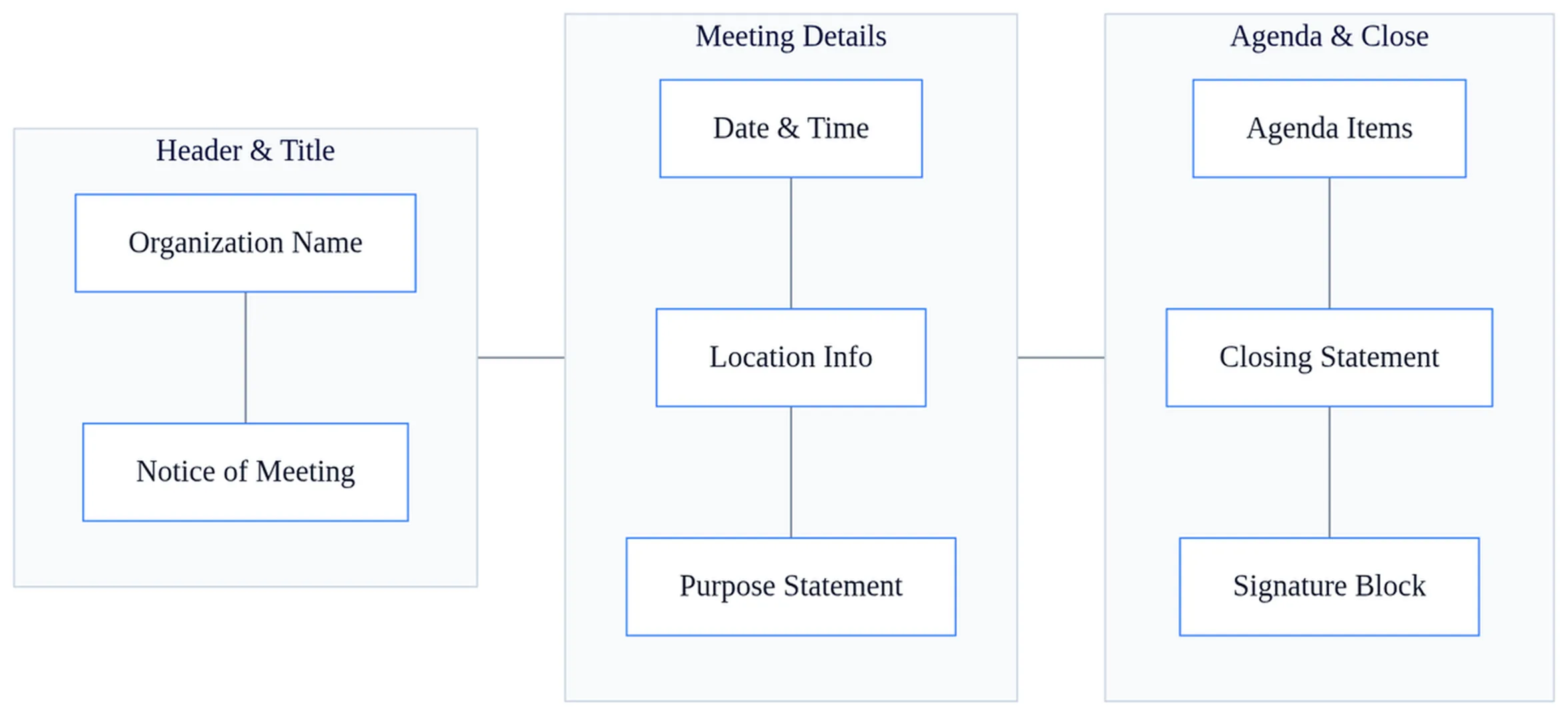
Header: Start with your organization’s name, address, and the date the notice is issued. This establishes the official source of the notice.
Title: Use a clear, descriptive title such as “Notice of Annual General Meeting” or “Notice of Board of Directors Meeting.” The title immediately tells the recipient what the document is.
Opening: Begin with formal language: “Notice is hereby given that…” This phrasing is standard in legal and corporate documents and signals the formal nature of the communication.
Meeting details: State the date, time, and venue. If the meeting is virtual, include the platform name, meeting link, meeting ID, and passcode. For hybrid meetings, provide both physical and virtual access details.
Agenda: List the topics to be discussed, numbered for clarity. Keep each item brief. If detailed explanations are needed, include them in an enclosure rather than in the notice itself.
Closing: Request attendance in clear terms: “All members are requested to attend.” If an RSVP or confirmation is required, state the deadline and contact information. End with the signature block: the name, title, and signature of the person issuing the notice.
Tone: Maintain a professional, formal tone. Avoid casual language or overly complex legal jargon. The notice should be accessible to all members, regardless of their familiarity with corporate procedures.
Notice distribution and delivery methods
Issuing the notice is only half the task. You must ensure it reaches all entitled members in time and in a manner that complies with legal requirements.
Email: Email is fast, cost-effective, and trackable. Use read receipts or delivery confirmation to document that members received the notice. For organizations with members in multiple locations, email is often the most practical option. However, some jurisdictions or bylaws may require postal mail as the primary or backup method.
Postal mail: Registered or certified mail creates a formal paper trail and is often required for statutory meetings or when bylaws mandate it. It is slower and more expensive than email, but it provides strong evidence of delivery. Some shareholders, particularly older members, may prefer postal mail.
Website or member portal: Posting the notice on the organization’s website or a secure member portal makes it accessible to all members and creates transparency. However, this should supplement, not replace, direct delivery via email or mail. Not all members check the website regularly.
Media or public notice: Public companies or organizations holding statutory meetings may be required to publish notice in newspapers or other media. This is less common for private companies but remains a legal requirement in some jurisdictions. Check your local corporate law and organizational bylaws.
Hybrid approach: Many organizations combine methods. For example, send the notice by email for speed and convenience, follow up with postal mail for legal compliance, and post it on the website for transparency. This redundancy ensures that all members receive the notice, even if one delivery method fails.
Document your distribution. Keep records of when the notice was sent, to whom, and by what method. If a member later claims they did not receive notice, your records will be your defense.
Common mistakes in notice drafting and how to avoid them
Even experienced administrators make mistakes when drafting notices. Here are the most common errors and how to avoid them.
Insufficient advance notice: Sending notice too late is the most frequent compliance failure. It denies members adequate time to prepare and may invalidate the meeting. Always calculate the notice period from the date of dispatch, not the date of receipt, unless your bylaws specify otherwise. Build in extra time for postal delays or email delivery issues.
Vague or incomplete agenda: A notice that says “General business” or “Various matters” tells members nothing. They cannot prepare, and participation suffers. List specific topics: “Approval of Q2 financial statements,” “Election of three directors,” or “Discussion of new marketing strategy.” If the agenda is long, summarize key items in the notice and attach a detailed agenda as an enclosure.
Conditional language: Phrases like “if you wish to attend” or “subject to your availability” weaken the notice. The notice is not an invitation you can decline casually; it is a formal notification of a meeting you are expected to attend. Use clear, unconditional language: “You are requested to attend” or “All shareholders are hereby notified.”
Wrong recipients: Sending notice to ineligible members wastes time and creates confusion. Failing to notify entitled members is a legal violation. Maintain an accurate, up-to-date list of members, directors, or shareholders entitled to attend each type of meeting. Review the list before each notice is issued.
Missing signature or authority: An unsigned notice or one issued by someone without authority is invalid. Always ensure the company secretary, board chair, or other authorized officer signs the notice. If the authorized person is unavailable, document the delegation of authority in writing.
Unclear venue or time: “Conference room” is not specific enough. “Conference Room B, 3rd Floor, 123 Main Street, Dhaka 1000” is. For virtual meetings, include the full meeting link, not just “Zoom meeting.” For international meetings, state the time zone. Ambiguity reduces attendance.
No supporting documents: Members cannot make informed decisions without context. If the meeting will discuss financial statements, attach them. If resolutions will be voted on, include the text of the resolutions. List all enclosures at the bottom of the notice so members know what to review.
Notice of meeting specimens and templates
Below are annotated specimens showing proper formatting and required elements. Adapt these templates to your organization’s bylaws and meeting type.
Statutory meeting notice (Annual General Meeting)
Eastern Manufacturing Ltd.
102 Motijheel C/A
Dhaka-1000, Bangladesh
Date: March 20, 2024
NOTICE OF ANNUAL GENERAL MEETING
Notice is hereby given that the Annual General Meeting of Eastern Manufacturing Ltd. will be held on April 15, 2024 at 10:00 a.m. (Bangladesh Standard Time) at the registered office of the company, 102 Motijheel C/A, Dhaka-1000, in accordance with Section 81 of the Companies Act, 1994.
Agenda:
- Approval of audited financial statements for the year ended December 31, 2023
- Declaration of dividend
- Election of three directors
- Appointment of auditors for the fiscal year 2024
- Any other business with the permission of the Chair
All shareholders are requested to attend the meeting. Proxy forms are enclosed and must be submitted to the company secretary by April 10, 2024.
Sincerely,
Kamal Hossain
Company Secretary
On behalf of the Board of Directors
Enclosures: Audited financial statements, Proxy form, Director nomination form
Board meeting notice
Innovate Tech Solutions Ltd.
45 Gulshan Avenue
Dhaka-1212, Bangladesh
Date: March 5, 2024
NOTICE OF BOARD OF DIRECTORS MEETING
Dear Director,
Notice is hereby given that the quarterly meeting of the Board of Directors will be held on March 18, 2024 at 2:00 p.m. (Bangladesh Standard Time) at the company’s head office, 45 Gulshan Avenue, Dhaka-1212.
Agenda:
- Approval of minutes from the previous board meeting
- Review of Q1 2024 financial performance
- Approval of proposed budget for Q2 2024
- Discussion of strategic partnership with XYZ Corporation
- Any other business
You are requested to attend the meeting. If you are unable to attend, please notify the undersigned by March 15, 2024.
Sincerely,
Ayesha Rahman
Company Secretary
Enclosures: Q1 financial report, Proposed Q2 budget, Partnership proposal summary
Virtual meeting notice
Global Consulting Partners
88 Banani Road
Dhaka-1213, Bangladesh
Date: April 1, 2024
NOTICE OF SPECIAL SHAREHOLDER MEETING (VIRTUAL)
Notice is hereby given that a Special Meeting of Shareholders will be held virtually on April 20, 2024 at 3:00 p.m. (Bangladesh Standard Time) via Zoom videoconference.
Meeting access details:
Platform: Zoom
Meeting link: https://zoom.us/j/123456789
Meeting ID: 123 456 789
Passcode: GCP2024
Technical support: support@globalconsulting.com | +880-2-1234567
Agenda:
- Approval of proposed merger with ABC Consulting Ltd.
- Amendment to Articles of Association
- Authorization of the Board to execute merger documents
All shareholders are requested to attend. Please test your connection 15 minutes before the meeting start time. Detailed merger documents are enclosed.
Sincerely,
Farhana Chowdhury
Company Secretary
Enclosures: Merger agreement summary, Proposed amendments to Articles, Shareholder voting instructions
Each specimen demonstrates proper structure, clear language, and inclusion of all essential elements. Notice how the virtual meeting specimen includes technical details and support contact information, a necessary addition for hybrid or remote meetings.
For additional context on different types of company meetings and their specific requirements, consult our comprehensive meeting guide. Understanding the distinctions between AGMs, board meetings, and special meetings will help you tailor your notice to the appropriate format and legal standard. A well-drafted notice of meeting is a legal safeguard, a communication tool, and a sign of organizational professionalism. It ensures that members are properly informed, that meetings are legally valid, and that participants arrive prepared to contribute.
Frequently asked questions
What if I can’t deliver notice by the deadline my bylaws require?
Contact entitled members immediately by the fastest available method—email, phone, or in-person notification—and document each contact. Then send formal written notice as soon as possible. Bylaws often allow for waiver of notice if all members consent in writing. For legally mandated meetings, delays may require postponement. Check your jurisdiction’s rules; some allow shortened notice periods in emergencies if members agree.
Should I send notice via email, registered mail, or both?
Check your bylaws and local law first; they often specify acceptable methods. Registered mail provides legal proof of delivery but is slower. Email is faster and creates a timestamped record. Best practice: use both for high-stakes meetings (AGMs, shareholder votes). For routine board meetings, email alone typically suffices if your bylaws permit it. Always confirm receipt for critical notices.
Can I include voting instructions or director recommendations in the notice itself?
No. The notice should remain neutral and factual. It informs members that a meeting will occur and what topics will be discussed. Voting guidance, director endorsements, or persuasive language belong in separate proxy statements or board circulars. Mixing them in the notice blurs the line between notification and advocacy, and may violate corporate governance rules.
What happens if a member claims they never received the notice?
This is why documentation matters. Keep records of how and when notice was sent—email delivery confirmations, registered mail receipts, or signed acknowledgments. If your bylaws allow multiple delivery methods, use them. If a member disputes receipt, your documented proof protects the organization. Without it, meeting decisions could be challenged as improperly convened, even if notice was actually sent.
Is a notice of meeting required for emergency or urgent board meetings?
Most bylaws and laws allow shortened notice for emergencies if all directors consent or if the bylaws explicitly permit it. However, you still need to issue written notice, even if it’s brief and sent by email or phone. Document the emergency reason and all consents. Never skip notice entirely; the risk of invalidating decisions is too high.
Should the notice state what happens if a quorum isn’t met?
No. The notice should assume a quorum will be present. Details about quorum, adjournment procedures, or contingency plans belong in your bylaws and meeting rules, not the notice itself. The notice focuses on informing members that the meeting will occur as scheduled. Keep it straightforward and professional.
7 Comments
This awesome and clear for,because i have learnt this in one day.
Really reliable
Great post! I found the specimen of notice really helpful in understanding how to format my own. It’s clear and concise—thanks for the insights!
it has helped me but i would love to know more about the types of notice in academic writing
Subscribe to our email newsletter email newsletter and get all types of article update. Thanks
This post clarifies the concept of a notice really well! The specimen provided helps in understanding the format and essential elements. Thanks for breaking it down so clearly!
well well well to me this is the first beutfull mahindra.thanx for design this type.it is brilland,nice,wonderfull