


Imagine a ship sailing through a storm. The captain stands on the bridge and spots an iceberg ahead. He shouts an order to the crew below to turn the wheel. The crew hears the order, understands the urgency, and acts immediately. The ship turns, and disaster is averted.
This is a perfect example of downward communication in action.
In the corporate world, things are rarely this dramatic. However, the principle remains the same. Information flows from the top management down to the supervisors and finally to the frontline employees.
Many people think this type of communication is just about giving orders. They believe it is simply a way for bosses to flex their authority. That is a huge misconception.
The true purpose goes much deeper. It is about alignment, clarity, and motivation. Without it, an organization is just a group of confused people running in different directions.
If you are new to this concept, you might want to start with our definition of what is downward communication. It covers the basic framework you need to know.
In this guide, we will explore the specific objectives of downward communication. We will look at why managers use it and what they hope to achieve.
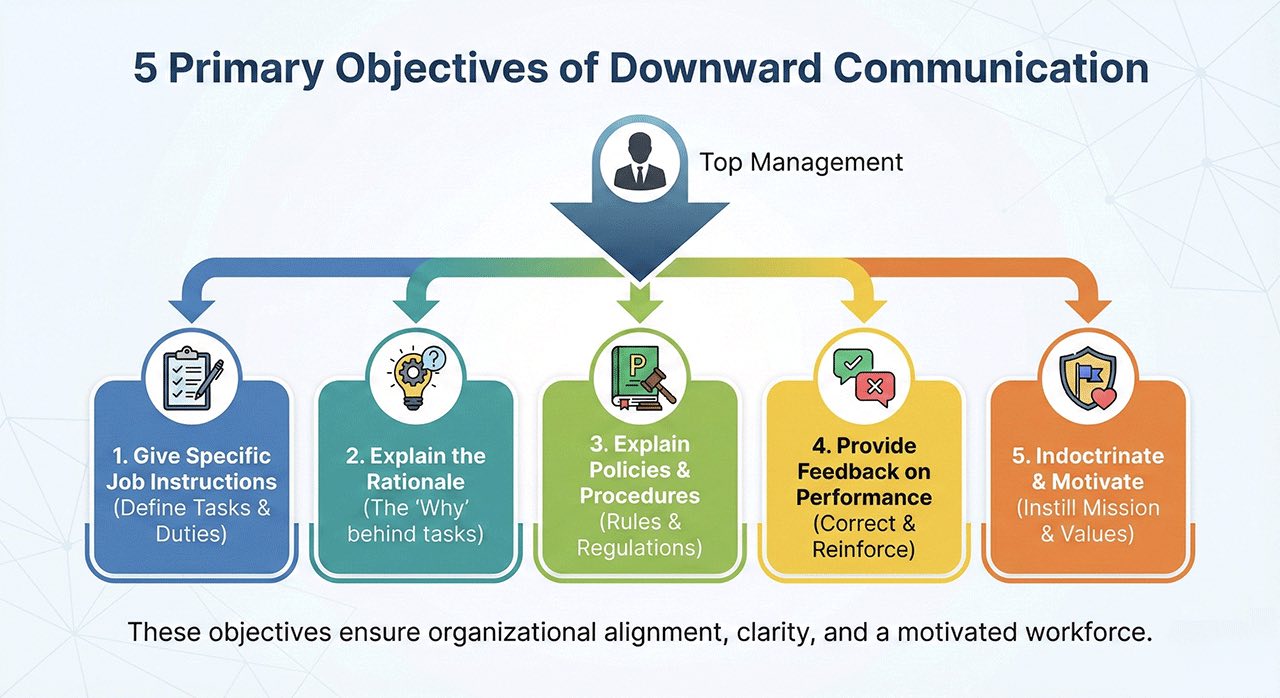
The Primary Objectives of Downward Communication
Downward communication is the nervous system of an organization. It sends signals from the brain (management) to the muscles (employees). There are five primary objectives that this flow seeks to achieve.
1. To Give Specific Job Instructions
The most obvious objective is to get things done. This is the directive function of management.
When a new employee joins the team, they don’t know what to do by magic. They need specific instructions. Downward communication provides the roadmap. It defines the tasks, duties, and responsibilities associated with a specific role.
For instance, a sales manager tells a representative to “Call 20 clients by noon.” This is a clear, actionable instruction.
Without this clarity, employees are left guessing. Guessing leads to mistakes, and mistakes cost money. Therefore, the first goal is to ensure that everyone knows exactly what is expected of them on a daily basis.
2. To Explain the Rationale (The ‘Why’)
This is where good managers separate themselves from average ones. Giving an order is easy. Explaining the logic behind the order takes effort.
One of the key objectives of downward communication is to explain the “job rationale.” This means telling employees why a task is important. It connects their individual work to the broader goals of the company.
For example, imagine telling a construction worker to dig a hole. He might do it grudgingly. Now, imagine telling him that he is digging the foundation for a hospital that will save lives. Suddenly, the work has meaning.
Understanding the relationship between a task and the organizational goal boosts morale. It creates a sense of purpose. This concept is deeply tied to the essential elements of downward communication, which emphasizes the need for logical explanation.
3. To Explain Organizational Policies and Procedures
Every game has rules. If you don’t know the rules, you can’t play the game. The workplace is no different.
Organizations run on policies, regulations, benefits, and standard operating procedures (SOPs). Another major objective of downward communication is to disseminate this information.
Employees need to know about:
- Safety regulations.
- Leave policies.
- Overtime rules.
- Promotion criteria.
This ensures consistency. If every manager made up their own rules, there would be chaos. By standardizing these procedures and communicating them downward, the organization ensures fair treatment for everyone.
4. To Provide Feedback on Performance
How do you know if you are doing a good job? You need someone to tell you.
Feedback is a critical objective of the downward flow. It involves appraising employee performance and letting them know where they stand. This creates a loop of improvement.
Feedback serves two purposes here. First, it corrects behavior that is off track. If an employee is constantly late, a manager needs to communicate that this is unacceptable.
Second, and perhaps more importantly, it reinforces good behavior. Praise is a powerful motivator. Sadly, many leaders forget this part.
If you are interested in why this is so vital for growth, you should read our article on the necessity or importance of feedback. It explains how constructive criticism builds better teams.
5. To Indoctrinate and Motivate
The word “indoctrinate” sounds a bit scary, doesn’t it? In business terms, it simply means teaching the company’s culture.
The final primary objective is to instill the mission, vision, and values of the organization into the workforce. This is often called “missionary” communication.
Management wants employees to feel like they belong to something special. They want loyalty. When a CEO sends a video message talking about the company’s future, they are trying to rally the troops.
They are trying to convert employees from simple wage-earners into dedicated team members. This emotional buy-in is essential for long-term retention.
Secondary Objectives
Aside from the big five mentioned above, there are other secondary goals. These are equally important for the smooth operation of a business.
To Maintain Discipline and Control
An organization is a hierarchy. For it to function, there must be a respect for authority. Downward communication reinforces the chain of command.
It reminds employees who is accountable for what. By clearly establishing authority, it prevents power struggles and maintains discipline.
To Prepare Employees for Change
The business world changes fast. Companies merge, technologies evolve, and markets shift.
One of the objectives is to prepare the workforce for these changes. If a company plans to introduce new software, they cannot just spring it on everyone on Monday morning. They need to communicate the plan weeks in advance.
Proper downward communication reduces resistance to change. It helps employees adjust their mindset before the actual shift happens.
To Delegate Authority
Managers cannot do everything themselves. They must delegate.
Downward communication is the vehicle for delegation. When a manager assigns a project to a subordinate, they are essentially passing down a portion of their authority. This empowers lower-level staff and frees up the manager to focus on strategy.
How Objectives Differ from Elements
You might be wondering, “Is this the same as the elements of communication?” Not exactly.
Think of it this way: The elements are the ingredients. They are what you are communicating (instructions, rationale, procedures).
The objectives are the meal you are trying to cook. They are why you are communicating (to align the team, to motivate, to control).
Understanding this distinction adds depth to your management style. You aren’t just sending a memo because it’s an element of your job. You are sending it with the objective of clarifying a policy.
Consequences of Unclear Objectives
What happens when these objectives are not met? What if the communication is vague or absent?
The result is confusion. The dreaded “telephone game” effect kicks in. Messages get distorted as they move down the chain. Employees start relying on rumors instead of facts.
If the objective of “Job Rationale” is missed, employees become demotivated robots. If the objective of “Feedback” is ignored, bad habits become permanent.
Furthermore, a lack of clear downward flow can lead to suspicion. Employees might feel that management is hiding something. To explore the risks involved, take a look at the advantages and disadvantages of downward communication.
Mediums Used to Achieve These Objectives
To achieve these objectives, managers use various tools. You wouldn’t use a megaphone to have a private conversation, right? Choosing the right medium is key.
- Written Mediums: These are best for “Policies and Procedures” and “Job Instructions.” They provide a permanent record. Examples include manuals, emails, and circulars. For formal announcements, managers often use notices. You can check a specimen of notice to see how they are structured.
- Oral Mediums: These are best for “Indoctrination” and “Feedback.” Face-to-face meetings or phone calls allow for emotional connection and immediate questions.
Frequently Asked Questions (FAQ)
What is the main purpose of downward communication?
The main purpose is to direct and control the activities of employees while ensuring they are aligned with the organization’s goals.
Why is explaining job rationale important?
It gives employees a sense of purpose. When they know why a task matters, they are more likely to do it well and feel satisfied with their work.
How does downward communication help in delegation?
It clarifies the scope of authority being passed down. It ensures the subordinate knows exactly what their new responsibilities are.
Can downward communication happen via video?
Absolutely. Video messages from leadership are increasingly used for “Indoctrination” objectives, as they are more personal than emails.
Conclusion
Downward communication is not just about shouting orders from the top of the mountain. It is a strategic tool with specific objectives.
Its goal is to translate the vision of the boardroom into the reality of the breakroom. It seeks to instruct, explain, motivate, and correct.
When these objectives are met, the organization moves like a well-oiled machine. Everyone knows what to do, why they are doing it, and how they are performing.
So, the next time you draft an email or call a meeting, ask yourself: “What is my objective here?” Am I just giving info, or am I building alignment?
If you want to learn practical ways to achieve these goals, read our guide on how can you make downward communication effective. It offers actionable steps to improve your leadership communication today.
Frequently asked questions
What if employees ignore downward communication from management?
Ignored communication usually signals a breakdown in trust or clarity. First, verify the message was actually received and understood—not just transmitted. Then assess whether employees see the relevance. If a manager explains the ‘why’ behind instructions, compliance typically improves. If problems persist, the issue may be deeper: unclear expectations, poor manager credibility, or misaligned incentives. Address the root cause, not just repeat the message.
Should managers give job instructions verbally or in writing?
Use both. Verbal instructions allow for immediate questions and clarification, building engagement. Written follow-ups (email, documentation) create a record and let employees reference details later. For complex tasks or critical safety procedures, written is essential. For quick daily directives, verbal works fine if the employee confirms understanding. The combination ensures clarity and accountability.
How often should managers explain the ‘why’ behind every task?
Explain the ‘why’ when it’s not obvious or when motivation matters. Routine daily tasks don’t need lengthy explanations each time. But new initiatives, policy changes, or work that feels disconnected from company goals absolutely do. A good rule: if an employee might wonder ‘why does this matter?’, take 30 seconds to explain. This prevents resentment and builds buy-in.
Can downward communication be too frequent and overwhelm employees?
Yes. Constant messages create noise, not clarity. Employees tune out when flooded with information. Prioritize: distinguish between urgent directives, important policy updates, and motivational content. Use appropriate channels—not everything needs a company-wide email. Batch routine updates into weekly digests. Quality and timing matter more than frequency. Overwhelmed employees miss critical information.
What if an employee disagrees with a policy communicated downward?
Disagreement doesn’t negate the need to follow policy. However, good managers acknowledge concerns. Explain the reasoning behind the policy and its broader context. If the employee has legitimate feedback, create a channel for upward communication—don’t shut them down. This maintains respect for authority while showing you value their input. Compliance and dialogue aren’t mutually exclusive.
3 Comments
The points are clear and direct
the points are understandable
Hi there colleagues, its impressive post about culture and entirely explained, keep it up all the time.