


Reading is more than scanning words on a page. The right reading technique can help you extract key insights from a 2,000-word business report in minutes, or retain complex concepts from a textbook for months. Below, you’ll find seven practical techniques, when to use each, and how to match your approach to your reading goal.
What are reading techniques and why they matter
Reading techniques are deliberate methods for engaging with text based on your purpose and the material at hand. They’re not the same as reading skills. Skills are automatized abilities, like recognizing words quickly or understanding sentence structure, that you develop over time. Techniques are intentional strategies you choose and apply.
When you pick up a legal contract, you need word-by-word accuracy. When you’re triaging 40 emails before a meeting, you need to scan for action items. When you’re learning a new framework from a business book, you need deep engagement and retention tactics. The technique you choose determines how much you understand, how long you remember it, and how efficiently you process the material.
Mastering multiple techniques matters because business communication depends on your ability to absorb and respond to information quickly. Whether you’re reviewing competitor analysis, drafting a proposal based on client feedback, or staying current with industry research, your reading approach shapes the quality of your output.
Active reading: deep engagement with complex material
Active reading is the foundation for extracting maximum understanding from difficult material. Instead of passively moving your eyes across the page, you interact with the text: ask questions, annotate margins, highlight key ideas, link new information to what you already know, and test yourself as you go.
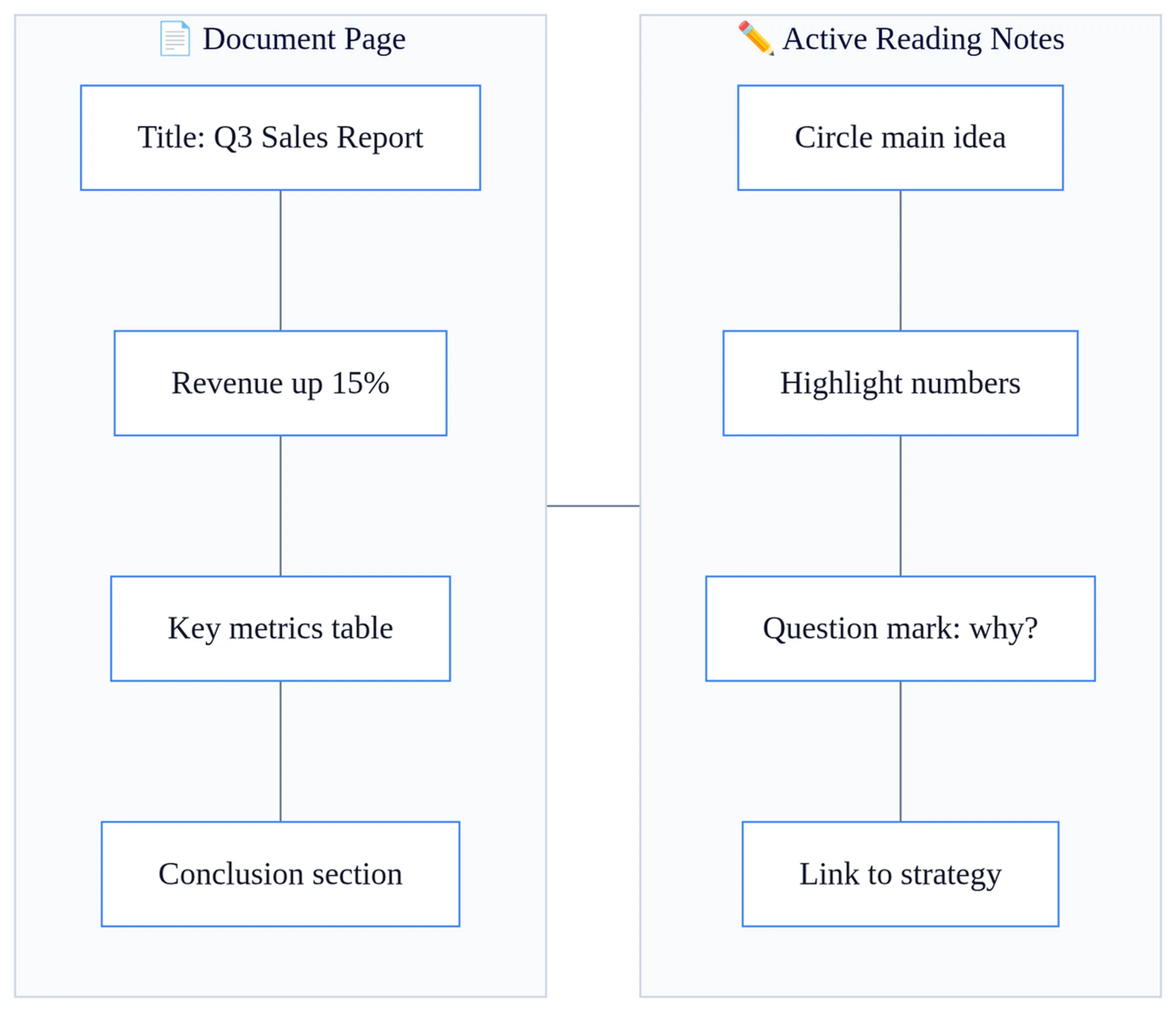
Here’s what active reading looks like in practice. You’re reviewing a business proposal from a vendor. As you read, you underline cost assumptions, write “evidence?” next to unsupported claims, and draw arrows connecting related points across different sections. You pause after each major section to summarize the argument in your own words. You note questions in the margin: “How does this compare to our current solution?” or “What’s the implementation timeline?”
Active reading works best for textbooks, research papers, business reports, policy documents, and any material where you need to retain information long-term or evaluate arguments critically. The trade-off is speed. You’ll read more slowly than with other techniques, but your comprehension and retention will be significantly higher.
The technique builds the critical thinking skills that separate superficial understanding from genuine insight. When you actively question what you read, you’re less likely to accept weak arguments or miss unstated assumptions.
Most people underestimate how much annotation improves retention. Research on reading comprehension shows that engaging multiple cognitive processes (reading, writing, questioning) creates stronger memory pathways than reading alone.
Skimming and scanning: quick information retrieval
Skimming and scanning are often confused, but they serve different purposes. Skimming means reading quickly to grasp main ideas while skipping details. You read the introduction, headings, topic sentences, and conclusion to understand what the document covers. Scanning means searching for specific data points or keywords without reading the surrounding text, like looking up a phone number or finding a particular statistic in a report.
The key distinction: skimming gives you an overview; scanning targets specific information.
Skimming works well for newspapers, email subject lines, product reviews, and tables of contents. It’s your go-to technique when you need to decide whether a document deserves closer attention. Scanning is ideal when you know exactly what you’re looking for: a name in a directory, a date in a timeline, a policy clause number, or a specific product feature in a comparison chart.
When not to use these techniques: complex technical material, legal documents, detailed instructions, or anything where missing a single word could lead to errors. A Dhaka-based manufacturing firm once misinterpreted a quality specification by scanning a technical manual instead of reading it carefully, leading to a costly production error. Both techniques are essential for managing information overload in modern workplaces, but they’re tools for triage, not comprehension.
Speed reading: balancing pace and comprehension
Speed reading aims to increase your reading pace while maintaining adequate understanding. Techniques include minimizing subvocalization (the inner voice that “speaks” words as you read), identifying key words without reading every word, and reducing the time your eyes fixate on each point.
Here’s what most people get wrong about speed reading: it’s not universally beneficial. Speed reading works for narrative content and familiar material where you already understand the concepts. It fails for dense, unfamiliar material that requires careful thought. You can speed-read a news article about a topic you follow regularly. You cannot speed-read a technical specification for equipment you’ve never used.
The retention caveat is significant. Speed reading often reduces comprehension and critical analysis. You might remember the gist but miss nuance, underlying assumptions, or logical flaws in arguments. This makes speed reading appropriate for preliminary research screening, familiar business updates, or content where missing details won’t cause problems. The technique trades depth for pace, which is sometimes exactly what you need, but recognize the trade-off.
SQ3R method: structured reading for retention
The SQ3R method is a five-step framework designed to maximize retention: Survey, Question, Read, Recite, Review. Developed in 1946 by educational psychologist Francis P. Robinson, it remains one of the most effective techniques for learning from textbooks and long-form documents.

Here’s how it works in practice. Survey: Preview the material by reading the introduction, headings, summary, and any highlighted or bolded terms. This gives you a mental framework before diving into details. Question: Turn headings into questions. If a heading says “Market Entry Strategies,” ask yourself “What are the main market entry strategies and when is each appropriate?” Read: Read selectively with your questions in mind, focusing on sections that answer them. Recite: After each section, answer your questions in your own words using only key terms. Review: Go back over the entire material, testing yourself on the main concepts.
The retention science behind SQ3R is compelling. Without review, you’ll forget approximately 80% of what you read within 24 hours. The 24-hour review rule says you should review material within a day of first reading it to prevent this knowledge loss. Then apply spaced repetition: review again at 3 days, 1 week, and 2 weeks to move information into long-term memory.
SQ3R works best for textbooks, training manuals, business books, and any material where you need to learn and retain new concepts. It’s more time-intensive than passive reading, but the retention gains are substantial. A marketing professional using SQ3R to study a new analytics platform will remember the procedures months later, while someone who simply read through the manual once will need to relearn repeatedly.
| Reading Technique | Best For | Speed | Retention | When NOT to Use |
|---|---|---|---|---|
| Active Reading | Complex reports, textbooks, research papers | Slow | Very High | Routine updates, familiar content |
| Skimming | Newspapers, email previews, overviews | Very Fast | Low | Legal documents, technical specs |
| Scanning | Finding specific data, names, dates | Very Fast | Low | Learning new concepts |
| Speed Reading | News, familiar topics, background research | Fast | Moderate | Dense material, critical evaluation needed |
| SQ3R | Textbooks, training materials, learning | Slow | Very High | Quick reference, casual reading |
| Detailed Reading | Contracts, specifications, policy documents | Very Slow | High | Casual content, time-sensitive previews |
| Structure-Proposition-Evaluation | Business books, opinion pieces, strategic docs | Slow | High | Casual reading, entertainment |
Detailed reading: word-by-word comprehension
Detailed reading means reading every word carefully to extract precise meaning and catch nuance. You use a dictionary for unfamiliar terms, re-read difficult passages, and pay attention to qualifiers, exceptions, and subtle distinctions. This is the slowest reading technique but delivers the highest accuracy.
Use detailed reading for legal contracts, technical specifications, academic papers, policy documents, safety instructions, and financial disclosures. Any material where missing a single word could lead to misunderstanding or costly errors requires this approach.
An efficiency tip: combine detailed reading with skimming. First skim the document to understand its structure and identify critical sections. Then return to read those sections in detail. You don’t need to read every word of a 40-page contract if only three sections directly affect your decision, but those three sections demand word-by-word attention. This hybrid approach is common in professional settings where documents are long but only certain sections require precision.
Structure-Proposition-Evaluation: critical analysis of non-fiction
Structure-Proposition-Evaluation is an advanced technique from Mortimer Adler’s 1940 book “How to Read a Book.” It’s designed for critical analysis of non-fiction, particularly business books, research papers, opinion pieces, and strategic documents.
The process works like this. First, analyze the work’s structure: How is the argument organized? What are the main sections and how do they connect? Second, identify logical propositions: What claims does the author make? What evidence supports each claim? How does one point lead to the next? Third, evaluate the argument’s quality: Is the evidence strong? Are there logical gaps? Do the conclusions follow from the premises?
This technique moves you beyond passive comprehension to active judgment. Instead of simply understanding what an author says, you evaluate whether they’ve proven their case. This matters in business contexts where you’re reading competitor analysis, industry forecasts, or strategic recommendations. You need to assess the quality of reasoning, not just absorb information.
Structure-Proposition-Evaluation requires a foundation. Master active reading first; this technique builds on those skills.
Matching technique to reading goal and text type
The most important skill is knowing which technique to use when. Start by clarifying your purpose before you open the document. Are you previewing material to decide if it’s relevant? Searching for specific information? Trying to understand a new concept? Learning something you need to retain long-term? Evaluating the quality of an argument?
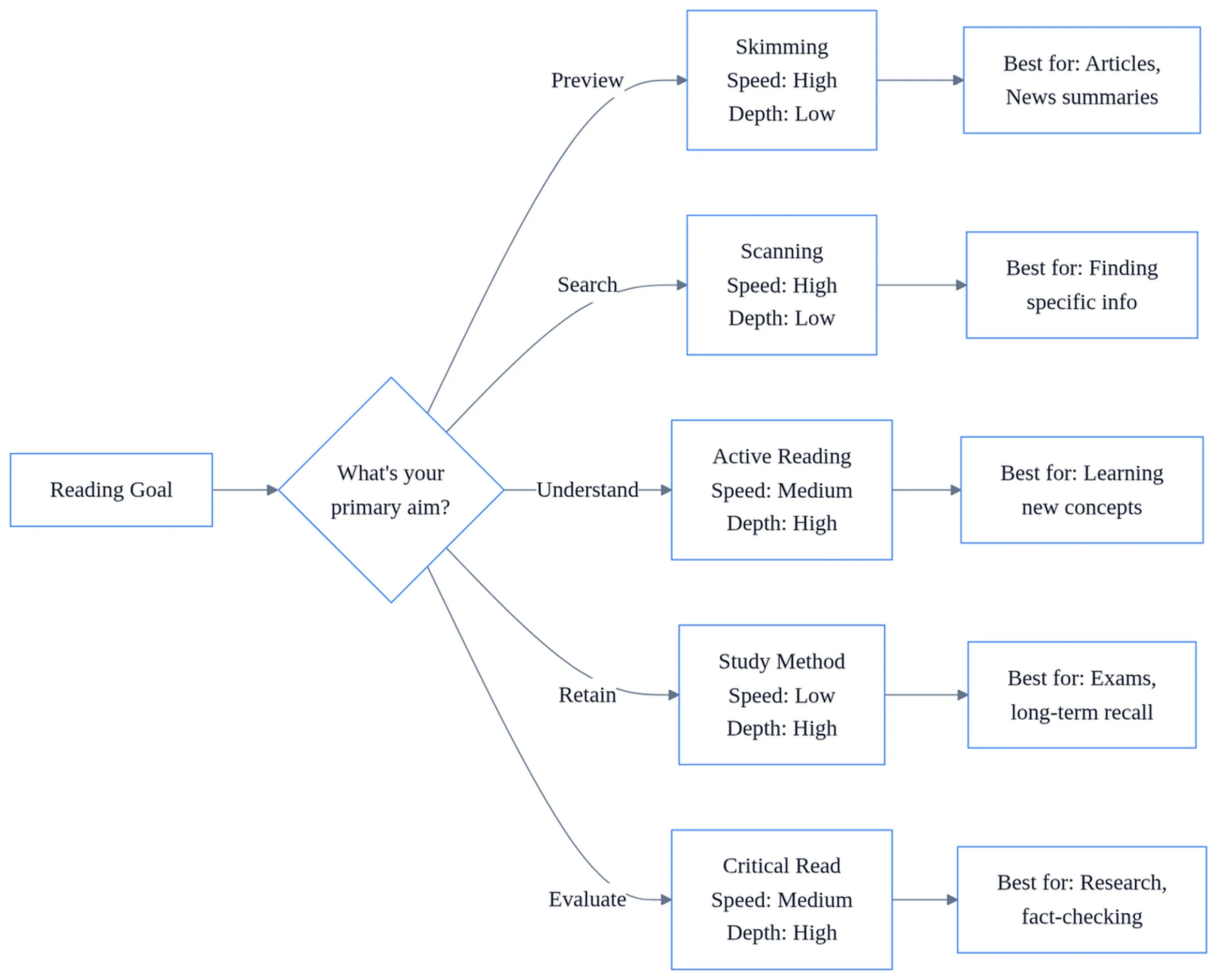
Your purpose determines your technique.
Text type also matters. Narrative and familiar content suits speed reading. Dense technical material requires detailed reading. Business reports and proposals benefit from active reading. Reference documents call for scanning. Academic textbooks work well with SQ3R.
Real-world reading often requires a hybrid approach. Consider a multinational company reviewing a market entry proposal. The executive team might first skim the executive summary to understand the recommendation. Then scan the financial projections for specific metrics. Then actively read the competitive analysis section, annotating assumptions and evidence. Then use Structure-Proposition-Evaluation to assess the strategic reasoning. Finally, use detailed reading for the legal and compliance sections.
This is how professionals actually read in business contexts. You don’t use one technique for an entire document. You shift techniques based on what each section requires. The skill is recognizing those shifts and making them deliberately rather than defaulting to one approach for everything.
Just as active listening helps you absorb spoken information strategically, strategic reading techniques help you process written communication efficiently. Both are essential components of effective communication in professional environments.
Building reading habits and improving technique mastery
Start with one technique and master it before adding others. Active reading is the best foundation because it teaches you to engage critically with text, which improves all other techniques. Develop a personal annotation system (underline for main ideas, circle for unfamiliar terms, question marks for confusing passages, asterisks for important points) and use it consistently until it becomes automatic.
Set reading goals before you open any document. Ask yourself: “What do I need to get from this?” Then choose your technique based on that answer. This conscious decision-making builds technique selection skill over time. You’ll eventually recognize patterns: “This looks like a document where I should skim first, then actively read Section 3.”
Track your retention to measure effectiveness. Use the 24-hour review rule. If you read something important today, schedule 15 minutes tomorrow to review your notes and test yourself on the main concepts. Then schedule reviews at 3 days, 1 week, and 2 weeks. This spaced repetition approach, supported by Cornell University’s learning center research, moves information into long-term memory far more effectively than a single reading session.
Adapt techniques for digital reading. Screen reading reduces comprehension compared to print for most people, so compensate with more active strategies. Take notes in a separate document as you read. Use digital highlighting and annotation tools. Break long documents into shorter reading sessions with breaks. The physical act of writing notes (even typed notes) improves retention compared to passive screen reading.
If you’re sitting on the fence about which technique to practice first, start with active reading on a single business article this week. Annotate, question, summarize. Then try the same article with speed reading and compare what you retained. This comparative practice builds awareness of each technique’s strengths faster than abstract study ever will.
Frequently asked questions
Should I use active reading for every business document I receive?
No. Active reading is best for complex material where you need long-term retention or critical evaluation—proposals, policy documents, research reports. For routine emails, status updates, or documents you’ll reference once, skimming or scanning is more efficient. Match the technique to your actual need, not the document type.
What if I speed-read something important and miss a detail?
Speed reading trades depth for pace, so it carries risk with high-stakes material. Use it only for preliminary screening or familiar content. For technical specs, contracts, or unfamiliar concepts, slow down and use active reading or careful line-by-line review instead. The cost of missing one detail often outweighs the time saved.
Can I combine multiple reading techniques in a single document?
Yes, and you should. Skim the introduction to assess relevance, then switch to active reading for critical sections, then scan for specific data points. Adapt your approach as you read. This hybrid method lets you read efficiently while maintaining comprehension where it matters most.
How do I know if I’m annotating too much or too little?
Annotate enough to capture your thinking—questions, connections, disagreements—but not so much that you’re rewriting the text. A good test: can you review your notes weeks later and reconstruct your understanding? If your annotations feel like busywork, you’re doing too much. If you can’t remember why you marked something, you’re doing too little.
Is scanning acceptable for legal contracts or compliance documents?
No. Scanning for specific clauses is fine once you’ve read the full document carefully, but scanning as your primary method is risky. One missed word in a contract can create liability. Always read legal and compliance material thoroughly, even if it takes longer. The stakes are too high for speed.
1 Comment
Wonderful goods from you, man. I’ve understand your
stuff previous to and you’re just extremely
wonderful. I actually like what you have acquired here, certainly like what you’re stating and the way in which you say it.
You make it enjoyable and you still take care of to keep it sensible.
I can’t wait to read much more from you. This is actually a great web site.