


Internal communication is the exchange of information, messages, and ideas among employees, teams, and leadership within an organization. It shapes how work gets done, how culture forms, and whether your team trusts leadership. This article explains what internal communication is, why it directly affects productivity and retention, and how to build a system that works for diverse workforces.
What is internal communication?
Internal communication refers to all formal and informal information exchanges among organizational members. It includes emails between colleagues, quarterly town halls, Slack messages, project updates, and even hallway conversations. The purpose is to ensure smooth operations, alignment on goals, and a shared understanding of what the organization is trying to achieve.
Internal communication is the structured exchange of messages within an organization that helps it achieve its work goals. P. Arora describes it as “information exchanged among executives, officials and employees of a same organization.”
Unlike external business communication, which targets customers, investors, or the public, internal communication is confined to your organizational boundaries. It flows through formal channels like intranets and official announcements, as well as informal networks such as team chats and water-cooler discussions.
Poor internal communication costs large companies (100,000+ employees) an average of $62.4 million per year in lost productivity, according to a Holmes Report/Grossman Group survey of 400 companies (source).
Why internal communication matters: Business impact
Internal communication drives measurable business outcomes. When employees understand what they need to do and why it matters, operational efficiency improves. Missed tasks, double-booking, and project delays decrease. A Towers Watson study found that organizations with highly effective communication practices are 3.5 times more likely to outperform their peers (source).
Employee engagement climbs when communication is clear and consistent. Workers who feel informed about company goals and changes report higher job satisfaction. Engagement translates directly into retention: employees who trust their leadership are far less likely to leave.
Trust depends on transparency. Leaders often believe they are communicating well, while frontline staff feel left in the dark. If you’re wondering whether your team feels informed, the answer is usually no. Closing this gap requires intentional, two-way communication systems.
Internal communication also shapes organizational culture. The tone, frequency, and honesty of messages signal what the company values. A Dhaka-based software agency that holds weekly open Q&A sessions with founders builds a different culture than one where updates arrive only via quarterly email blasts.
Key characteristics of effective internal communication
Not all internal communication works. Effective communication shares several characteristics that distinguish it from noise.
Clarity means the receiver understands the message as the sender intended. Jargon-heavy emails confuse rather than inform. A project manager who writes “use synergies across workstreams” wastes everyone’s time. “Coordinate with the design team by Friday” is clearer.
Simplicity and economy apply to both language and medium. A 2,000-word memo explaining a minor policy change is overkill. A two-paragraph email or a 90-second video often works better. Choose the least expensive, least disruptive channel that gets the job done.
Integrity requires following proper organizational channels. Announcing layoffs via Slack before informing managers directly erodes trust. Respect the chain of command when the message demands it, even if informal channels feel faster.
Conciseness combats information overload. Employees receive hundreds of messages weekly. A concise update respects their attention. Strip out filler, get to the point, and include only what the audience needs to act.
Timeliness ensures information arrives when it is useful. Telling your sales team about a product update after the client meeting is too late.
Goal-oriented messaging aligns with organizational objectives. Every communication should answer: why does this matter to our work? Random updates without context create noise, not alignment.
Mutual understanding and trust depend on psychological safety. Employees need to feel they can ask questions, admit confusion, or raise concerns without penalty. One-way broadcasts do not build trust; dialogue does.
Direction and flow of internal communication
Internal communication flows in three primary directions, each serving distinct purposes within organizational communication systems.
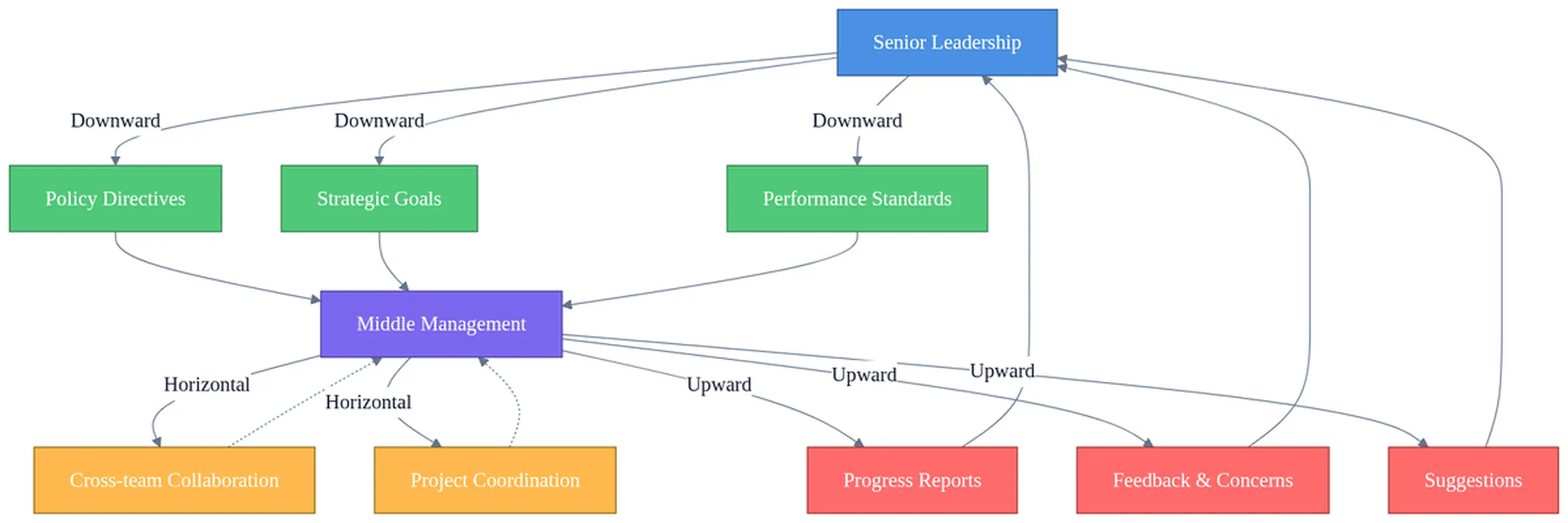
Downward communication moves from leadership to employees. It includes strategic announcements, policy changes, performance feedback, and task assignments. A CEO’s quarterly video update or a manager’s project brief both qualify. Downward messages set direction but risk feeling one-sided if no feedback mechanism exists.
Upward communication carries employee insights, concerns, and feedback to leadership. Surveys, town hall Q&A sessions, and open-door policies enable this flow. Upward channels surface on-the-ground realities that executives might otherwise miss. A frontline retail worker knows customer pain points better than the VP in headquarters.
Horizontal communication occurs among peers at the same organizational level. Cross-departmental collaboration, team brainstorming, and inter-office coordination all rely on horizontal exchanges. When marketing and product teams align on a launch timeline, that is horizontal communication at work.
For deeper exploration of these flows, see our guides on vertical communication and horizontal communication.
Formal vs. informal channels
Internal communication travels through both formal and informal channels, and both matter.
Formal channels include company-wide emails, intranet posts, official meetings, newsletters, and policy documents. These channels provide structure, create records, and ensure consistency. A formal announcement about benefits enrollment deadlines reaches everyone systematically.
Informal channels encompass casual conversations, team chat threads, coffee break discussions, and the organizational grapevine. Informal communication often spreads faster than formal messages and can accelerate adoption of new ideas. It also fills gaps when formal communication lags.
Smart organizations recognize that informal networks complement rather than compete with formal systems. A policy change announced via email gains traction faster when managers discuss it informally with their teams afterward.
Audience segmentation and modern communication challenges
One-size-fits-all internal communication fails in today’s diverse workforces. Employees vary by location, role, and access to technology. Segmentation improves relevance and engagement.
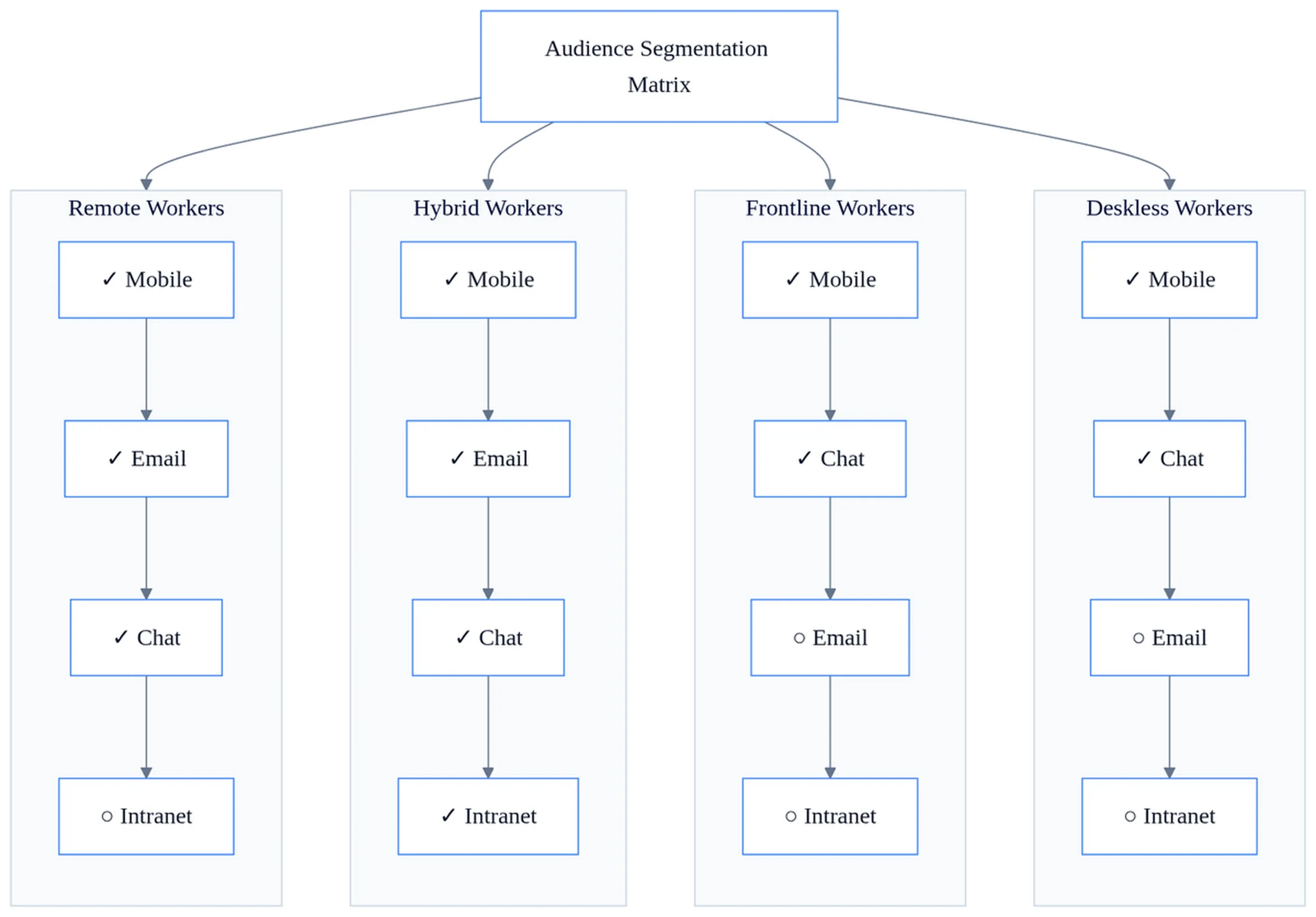
Remote workers depend on digital channels and miss the informal exchanges that happen in physical offices. They need intentional inclusion in video calls and asynchronous updates that respect time zones.
Hybrid employees toggle between office and home, requiring communication that works in both contexts. A policy that assumes everyone checks the office bulletin board excludes remote days.
Frontline and deskless workers often lack email access. Warehouse staff, retail associates, and field technicians need mobile-first solutions like SMS updates or app-based notifications. Ignoring this segment leaves a large portion of your workforce uninformed.
Information overload is a growing problem. Employees juggle email, Slack, Microsoft Teams, intranet portals, and project management tools. IDC research shows workers spend 2.5 hours daily searching for information across fragmented systems (source). Too many channels create noise, not clarity. Most teams over-rely on adding new communication platforms when the real problem is poor coordination across existing ones.
Message fatigue sets in when the same announcement arrives via five different channels within an hour. Repetition aids retention, but it must be spaced and adapted, not copied and pasted. The seven-times rule suggests people need to encounter a message seven times before it sticks, but those exposures should vary in format and timing.
| Audience Type | Primary Challenge | Recommended Channel |
|---|---|---|
| Remote workers | Lack of informal touchpoints | Video calls, async messaging, recorded updates |
| Hybrid employees | Inconsistent access to office-based info | Cloud-based intranet, mobile app |
| Frontline/deskless | No email or desktop access | SMS, mobile-first apps, digital signage |
| Office-based staff | Channel overload and notification fatigue | Consolidated platform, scheduled digests |
Common barriers to internal communication
Even well-intentioned communication efforts hit obstacles. Recognizing these barriers to effective communication is the first step toward fixing them.
Communication style differences across departments create friction. Engineers prefer data-heavy reports; sales teams want quick bullet points. Finance speaks in numbers; HR shows people. Mismatched styles lead to misunderstanding.
Low engagement happens when employees tune out. Notification fatigue, irrelevant content, and one-way broadcasts all reduce attention. If your internal newsletter has a 12% open rate, the problem is not the employees.
Silos and fragmentation trap information in departmental bubbles. Marketing does not know what product is building. Customer service lacks visibility into upcoming feature releases. Silos waste time and create redundant work.
Lack of feedback mechanisms turns communication into monologue. Employees need ways to ask questions, share concerns, and confirm understanding. Without feedback loops, leadership operates blind.
Building an effective internal communication strategy
A deliberate strategy prevents communication from becoming reactive noise.
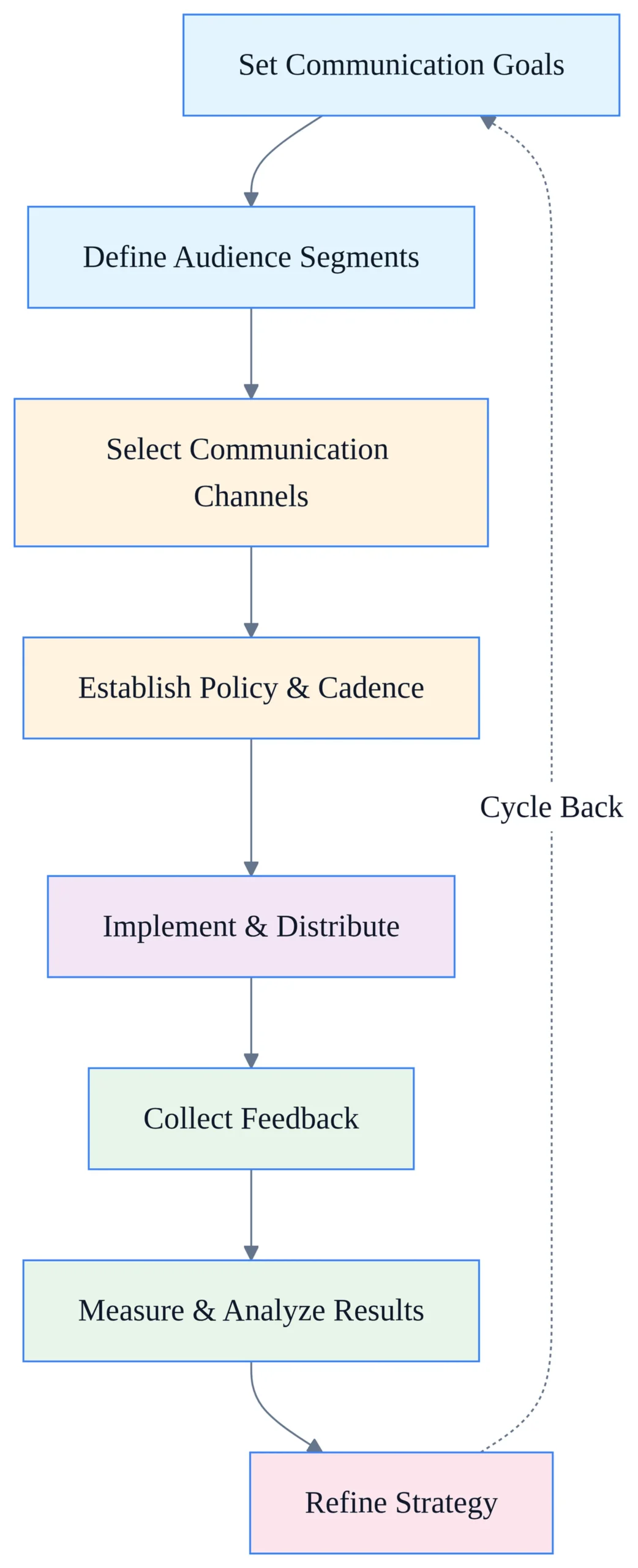
Set clear goals aligned with business strategy. Are you trying to improve project coordination? Boost engagement scores? Reduce turnover? Your communication goals should map to organizational priorities. A manufacturing company focused on safety might prioritize incident reporting channels.
Segment audiences by role, location, and preference. Not everyone needs every message. A product launch update matters to sales and marketing but is irrelevant to finance. Tailor content and channels to each group. Use the methods of internal communication that fit each audience.
Choose appropriate channels for message type. Urgent operational updates work via instant messaging. Strategic vision fits a quarterly video. Policy changes need written documentation. Match medium to message urgency and complexity.
Establish communication policies and cadence. How often will leadership share updates? What qualifies as urgent enough for a company-wide email? Policies prevent overload and set expectations. A weekly digest consolidates minor updates instead of interrupting daily work.
Create feedback loops and measure engagement. Track open rates, survey responses, and participation in Q&A sessions. Ask employees what is working and what is not. Adjust based on data, not assumptions.
Train staff on communication expectations and tools. Do not assume everyone knows how to write a clear email or run an effective meeting. Communication skills training improves quality across the organization.
The goal is ensuring the right information reaches the right people at the right time through the right channel. When you get it right, projects move faster, employees feel valued, and the organization operates as a coordinated whole rather than a collection of disconnected parts.
Frequently asked questions
What if my team uses multiple platforms like email, Slack, and Teams?
Multiple platforms are normal in modern workplaces. The key is consistency: establish which platform handles which message type. Use email for formal announcements, Slack for quick questions, Teams for project updates. Document these guidelines so employees know where to look. This reduces confusion and ensures important messages don’t get lost in the wrong channel.
How do I know if my internal communication is actually working?
Measure both engagement and outcomes. Survey employees on whether they feel informed and trusted. Track retention rates, project completion times, and error rates—these drop when communication improves. Listen during one-on-ones and team meetings for whether people understand company goals. If you hear confusion or surprise about decisions, your system needs adjustment.
Should I communicate bad news differently than good news?
Yes. Bad news requires more context, empathy, and advance warning to managers. Never announce layoffs or major changes via mass email or chat. Brief leadership first so they can support their teams. Be direct about what happened and what comes next. Employees respect honesty over spin. Good news can move faster through informal channels, but major positive updates still deserve formal confirmation.
What if employees ignore company-wide announcements?
One-way broadcasts often fail because they lack urgency or personal relevance. Instead, tie announcements to what employees actually care about. Have managers discuss updates in team meetings and invite questions. Use multiple formats—video, email, in-person—to reach different learning styles. Make it clear what action, if any, each person needs to take. Repetition across channels increases retention.
How do I encourage upward communication without it feeling forced?
Psychological safety matters more than the mechanism. Leaders must visibly act on feedback and admit when they don’t know something. Start small: ask specific questions in team meetings and wait for honest answers. Protect anonymity in surveys so people feel safe being candid. When an employee raises a concern, thank them publicly. Over time, people will trust that speaking up is safe and valued.
Is it better to over-communicate or under-communicate?
Over-communicate, but with strategy. Employees consistently report feeling under-informed, even when leaders think they’ve communicated enough. However, avoid spam—every message should have purpose. Repeat key messages in different formats and channels. A quarterly goal mentioned once gets forgotten; mentioned five times across email, video, and meetings, it sticks. Quality repetition beats silence.
4 Comments
Helpful
May I know the name of the person who wrote this article, please?
This article is written by: Mr. Masudur Rashid.
which year was it written please