


Have you ever wondered why business letters are still taught in schools when everyone is busy typing emails and sending instant messages? The truth is, a well written business letter is more than just a piece of paper. It is a formal document that holds weight in professional communication, builds credibility, and often seals the deal in many business transactions. Above all, it is the foundation of polished written communication that every student and professional must learn.
So, let’s dive deep into understanding what a business letter really is, why it is still relevant, and how you can master it.
What Is a Business Letter? (Definition)
A business letter is a formal written document exchanged between organizations, clients, employees, or individuals in a professional context. Unlike casual notes or friendly emails, a business letter carries an official purpose. It may inform, request, complain, persuade, or acknowledge something important.
Think of it this way, if an email is a quick chat at the office coffee machine, a business letter is like a signed contract handed across the conference table. It is serious, structured, and leaves a record for future reference.
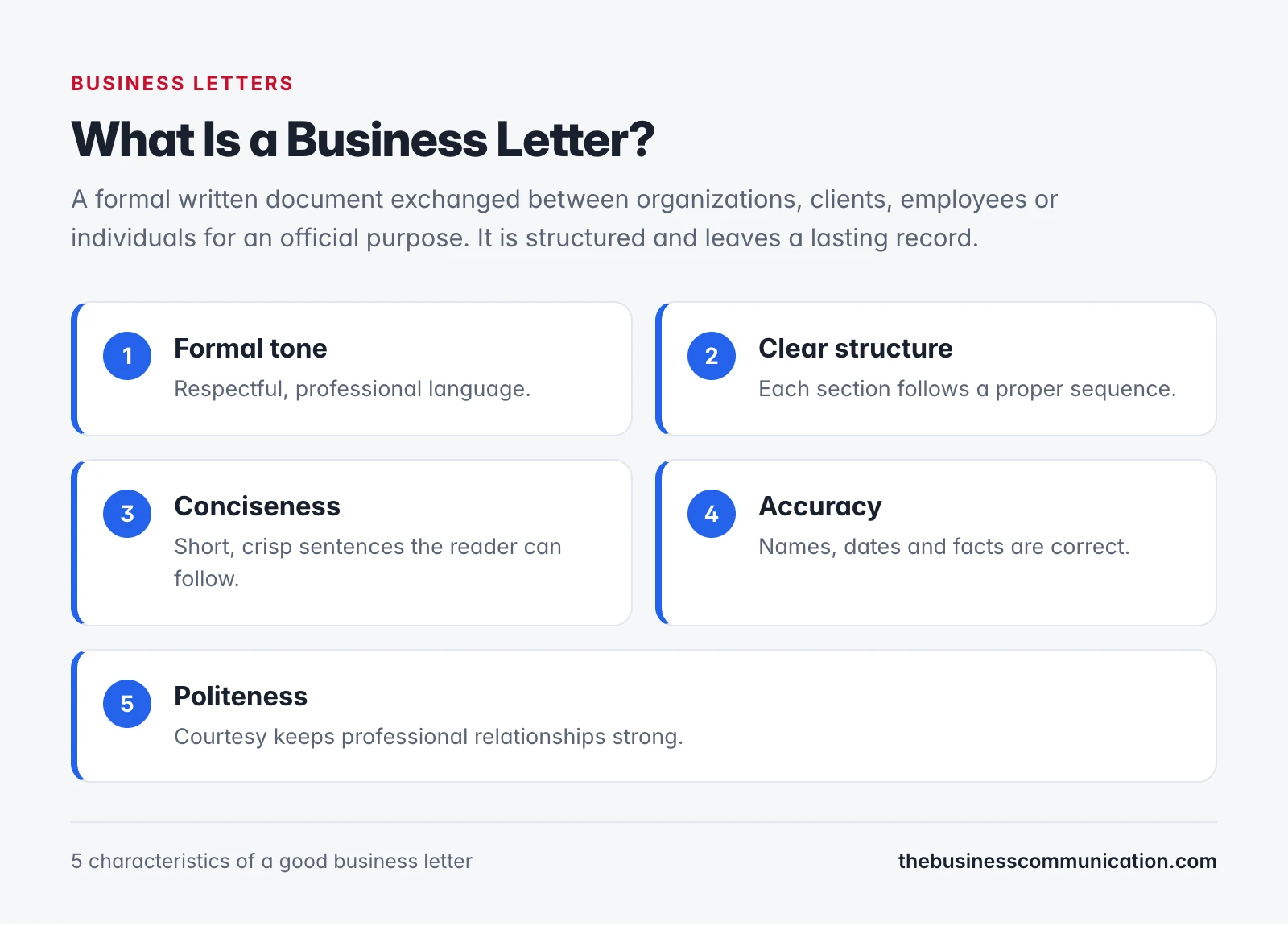
Characteristics of a Good Business Letter
Not every letter that you scribble down qualifies as a strong business letter. There are certain features that make it stand out:
- Formal tone – The language should be respectful and professional.
- Clear structure – Each section should follow a proper sequence.
- Conciseness – Long-winded sentences confuse the reader. Keep it crisp.
- Accuracy – Names, dates, and facts must be correct.
- Politeness – Courtesy goes a long way in maintaining professional relations.
Above all, the letter should leave no room for misinterpretation. Imagine writing to a supplier and accidentally ordering 500 boxes instead of 50. That mistake could cost more than a month’s salary.
Importance of Business Letters in Professional Communication
Why should anyone still bother with business letters when emails arrive in seconds? Good question. Let’s explore.
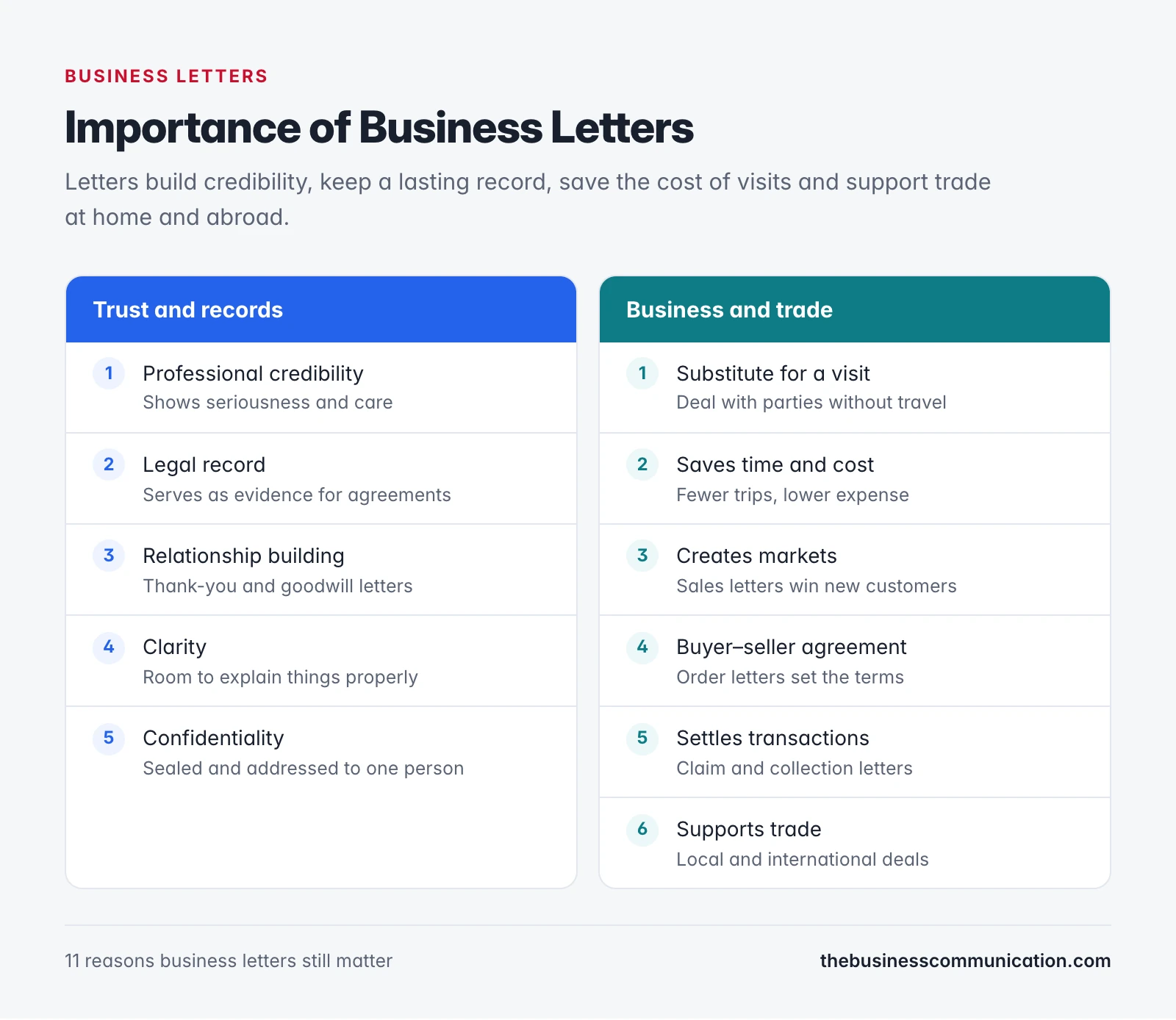
In short, business letters build credibility, create a lasting record, save the time and cost of personal visits, and support buying, selling and settling transactions at home and abroad.
- Professional credibility: A properly written business letter reflects seriousness and professionalism.
- Legal record: Many contracts and agreements are still formalized through letters that serve as evidence.
- Relationship building: Sending thank you or goodwill letters helps maintain long term relationships.
- Clarity: Unlike rushed messages, business letters give space to communicate thoughts clearly and formally.
- Substitute for a personal visit: A letter lets managers deal with customers, suppliers, creditors and other parties without travelling to meet them.
- Saving time and cost: Because fewer personal visits are needed, busy executives save both travel time and expense.
- Confidentiality: A sealed letter addressed to a named person keeps sensitive information with the intended recipient.
- Creation of markets: Circular and sales letters describe a product’s features and uses and persuade new customers to buy.
- Formal agreement between buyer and seller: An order letter records the items, price, quantity, delivery time and mode of payment, and these details become the terms of the deal.
- Settlement of transactions: A buyer raises complaints through a claim letter, and a seller recovers dues through a collection letter.
- Support for local and international trade: Traders at home and abroad use letters to ask about products and prices, place orders, collect payments and settle claims.
On the other hand, skipping formal letters in situations that require them may make your company look careless or unprofessional.
Exam Tip: Answering an “Importance of Business Letter” Question
For a 10-mark answer, open with a one-line definition of a business letter. Then write eight to ten of the points above as short headings, each with one sentence of explanation and, where possible, the letter type it relates to (order letter, claim letter, collection letter, circular letter). Finish with a two-line conclusion on why businesses rely on letters.
Functions of a Business Letter
Business letters serve multiple purposes, and once you recognize them, you will see why they are indispensable.
- To inform: Sharing important updates or company news.
- To request: Asking for information, services, or payment.
- To persuade: Encouraging clients to buy products or services.
- To complain: Addressing issues politely and seeking resolution.
- To confirm: Documenting agreements, orders, or acknowledgments.
For instance, if a customer complains about a defective product, the company’s response in letter form is not only a courtesy but also a record of accountability.
Parts of a Business Letter (Structure)
Every business letter has a skeleton. Without these bones, it simply won’t stand. Here are the standard parts:
- Heading: Your address or letterhead.
- Date: The day the letter is written.
- Recipient’s address: Who you are writing to.
- Salutation: Polite greeting, such as “Dear Mr. Smith.”
- Body: The main message, usually divided into introduction, main content, and conclusion.
- Closing: Respectful sign off such as “Sincerely.”
- Signature: Your name and designation.
- Optional parts: CC or enclosures, when necessary.
Unlike emails, skipping one of these parts makes the letter look incomplete and careless.
Types of Business Letters
Business letters are not one size fits all. Different situations call for different types:
- Letter of Inquiry
- Letter of Complaint
- Letter of Adjustment
- Sales Letter
- Thank You Letter
- Recommendation Letter
- Resignation Letter
- Collection Letter
- Order Letter
- Claim Letter
- Circular Letter
Each type has its own purpose. A resignation letter, for example, is formal proof that an employee chose to leave, whereas a sales letter attempts to convince a customer to buy something.
Business Letter Formats
How you arrange the parts of a letter is called the format. Three common styles dominate:
- Block format: All text is aligned to the left, simple and widely used.
- Modified block format: Similar to block, but the date and closing are aligned to the right.
- Semi block format: Paragraphs are indented, giving a slightly less rigid appearance.
Fun fact, the block format is considered the most professional, and many companies stick to it as their standard.
How to Write a Business Letter (Step by Step)
Ready to craft your own business letter? Follow these steps:
- Plan your purpose: Know why you are writing.
- Choose the format: Pick block, modified, or semi block.
- Write clearly: Use short, simple sentences.
- Be polite: Even when complaining, maintain respect.
- Proofread: A typo in a business letter can be embarrassing.
Imagine sending a proposal to a client and writing “We are exited to work with you.” That missing “c” in “excited” might make them wonder about your attention to detail.
Common Mistakes to Avoid in Business Letters
Writing a business letter is simple, yet many people stumble. Here are pitfalls to avoid:
- Using casual language like “Hey buddy.”
- Forgetting the subject or purpose.
- Spelling or grammar mistakes.
- Poor formatting, such as uneven margins.
- Copy pasting generic content without personalization.
Remember, your letter reflects your professionalism. If it looks sloppy, people may assume your work is sloppy too.
Examples of Business Letters
Let’s bring theory into practice with a few sample snippets.
Example 1: Letter of Inquiry
“Dear Sir, I am writing to inquire about the availability of your office furniture catalog. Kindly send the details at your earliest convenience.”
Example 2: Letter of Complaint
“Dear Customer Care, I recently purchased a laptop from your store. Unfortunately, it has stopped functioning within a week. Please advise on replacement or repair options.”
Example 3: Thank You Letter
“Dear Mr. Johnson, Thank you for trusting our company with your recent project. We truly appreciate your support and look forward to future collaborations.”
These short samples show you how simple and direct a business letter can be.
Business Letters vs Emails
In today’s digital age, you might ask, why not just email everything? Good point.
- Formality: Business letters are more formal, while emails are often informal.
- Structure: Letters follow a rigid format, emails are flexible.
- Purpose: Use letters for official, legal, or formal communication. Use emails for quick, casual updates.
So, while you might email your colleague about lunch, you would definitely send a business letter when applying for a loan.
For a fuller comparison and advice on when to use each, see our guide on business letter vs email.
Tips for Writing Effective Business Letters
Before you send off your letter, keep these tips in mind:
- Choose professional fonts like Times New Roman or Arial.
- Keep sentences short and paragraphs small.
- Personalize the letter for the recipient.
- Use active voice for clarity.
- Always close with a call to action, such as “We look forward to your response.”
Conclusion
Now you know what a business letter is, why it matters, and how to write one effectively. From definitions and formats to examples and tips, this guide has given you everything you need to start crafting professional letters with confidence.
So, the next time someone asks, “What is a business letter?” you will not only know the answer but also have the skills to write one that impresses. Ready to try? Start with a simple thank you letter to someone who has helped you recently. It is a small step, yet it could open big doors.
Frequently asked questions
What is the importance of a business letter?
A business letter gives a company credibility, creates a written record that can serve as evidence, and helps build relationships. It also saves the time and cost of personal visits, records the terms of orders, helps settle claims and dues, and supports local and international trade.
What are the main parts of a business letter?
The standard parts are the heading (your address or letterhead), date, recipient’s address, salutation, body, closing and signature. CC and enclosures are added when needed.
Should I print and mail a business letter or send it as a PDF email?
Print and mail when the situation demands legal weight or formality—contracts, formal complaints, or official notices. Send as PDF email for routine requests, inquiries, or internal communication. If unsure, check your industry standard or the recipient’s preference. A printed letter on company letterhead carries more gravitas; email is faster and acceptable for most day-to-day business.
What if I don’t know the recipient’s name or correct title?
Call the organization’s main line or check their website to find the correct name and title. If you cannot find it, use a generic salutation like “Dear Hiring Manager” or “Dear Customer Service Team” rather than “To Whom It May Concern.” Avoid guessing pronouns or titles—a quick phone call takes seconds and shows professionalism.
Can I use a business letter format for a personal note to a client?
Yes, but keep the tone slightly warmer while maintaining structure. Use the standard business letter format for the opening and closing, but allow your personality to show in the body. This works well for thank-you notes or relationship-building messages. The formal structure ensures professionalism while the content can be more genuine. For a full side-by-side comparison, see the guide to the difference between a business letter and a personal letter.
Why might my complaint letter get ignored by the company?
Complaint letters fail when they lack specifics, use an angry tone, or skip proper formatting. Include dates, reference numbers, and what you want resolved. Stay calm and professional—companies take formal, well-structured complaints seriously. Send it to the right department or person, not a generic address. A vague or hostile letter signals you are not serious.
Is block format always better than modified block or semi-block?
Block format is the most professional and widely accepted standard, especially in corporate settings. Modified and semi-block formats are acceptable and sometimes preferred in certain industries or companies. Check your organization’s style guide or the recipient’s expectations. When in doubt, block format is the safest choice.
6 Comments
really thanks for this blog its useful for my profession
sounds good buddy
thank you
you r welcome friend
great blog,thank you so much
wow very helpful and awesome