


You-Attitude in Business Communication: Definition, Examples, and Common Mistakes
You attitude in business communication is a writing technique that frames every message around the reader’s needs and benefits rather than the writer’s own goals. It is not simply replacing “we” and “I” with “you.” It is a genuine shift in perspective.
This guide covers the definition, side-by-side examples, when “you” language backfires, and the most common mistakes writers make.
What is you-attitude in business communication?
You-attitude is reader-focused writing that prioritizes your audience’s needs over your own interests or organizational agenda. Instead of showing what you (the writer) want or what your company achieved, you frame messages around what matters to the person reading them.
Me-attitude is the opposite approach. It leads with “I,” “we,” or organizational accomplishments without explaining why the reader should care. A company announces a product by saying it is excited about its new line. A you-attitude version tells the reader what three new options they now have.
Most writers mistake you-attitude for literal pronoun substitution. Mechanically replacing “we” with “you” does not make a message reader-focused. Academic sources from Miami University’s Farmer School of Business to Purdue OWL flag this error consistently.
A sentence can use “you” throughout and still be entirely me-attitude if it focuses on the writer’s goals. The difference is perspective, not pronouns.
Before you write, ask: What does this person care about? What problem am I solving for them? Those two questions force a perspective shift. When a message addresses what the reader cares about, they pay attention. When it focuses on the sender’s agenda, they skim or delete.
Research confirms the gap is real. Axios HQ’s 2025 internal communications report found that only 50% of employees consider workplace communications “clear and engaging,” while 80% of leaders believe theirs are. Most writers draft from their own perspective. You-attitude closes that gap.
You-attitude vs. me-attitude: side-by-side examples
The difference often comes down to a single sentence rewrite. Here is how the same information looks through each lens:
| Me-Attitude (Writer-Focused) | You-Attitude (Reader-Focused) |
|---|---|
| We are pleased to offer a new discount policy that we believe will be attractive to customers. | You’ll save 15% on bulk orders starting next month. |
| I am happy to hear that you have selected our firm for your accounting needs. | Thank you for trusting us with your accounting needs. |
| I will give you a 10% discount if you order by Friday. | You can secure a 10% discount by placing your order before Friday. |
| We have updated our software to improve our internal efficiency. | Your support requests will now be resolved 30% faster thanks to our updated system. |
Me-attitude sentences highlight the sender’s actions or changes. You-attitude sentences shift focus to what the reader gains or can do. The information is often identical. Only the framing changes.
You-attitude vs. we attitude: what is the difference?
Some teachers frame this as “you attitude vs. I/we attitude.” The distinction: me-attitude writing centers the writer’s organization, accomplishments, or feelings. You-attitude centers the reader’s needs and benefits.
But “we” is not always me-attitude. Inclusive “we” that genuinely includes the reader works fine. “We can resolve this together” builds partnership. Exclusive “we” that means only your company is me-attitude. The test: does this “we” include the reader or exclude them?
The “you versus I/we attitude” comparison is consistently popular in commerce-student communities online. That tells you it is a real learning gap, not just an academic distinction.
How to apply you-attitude in your writing
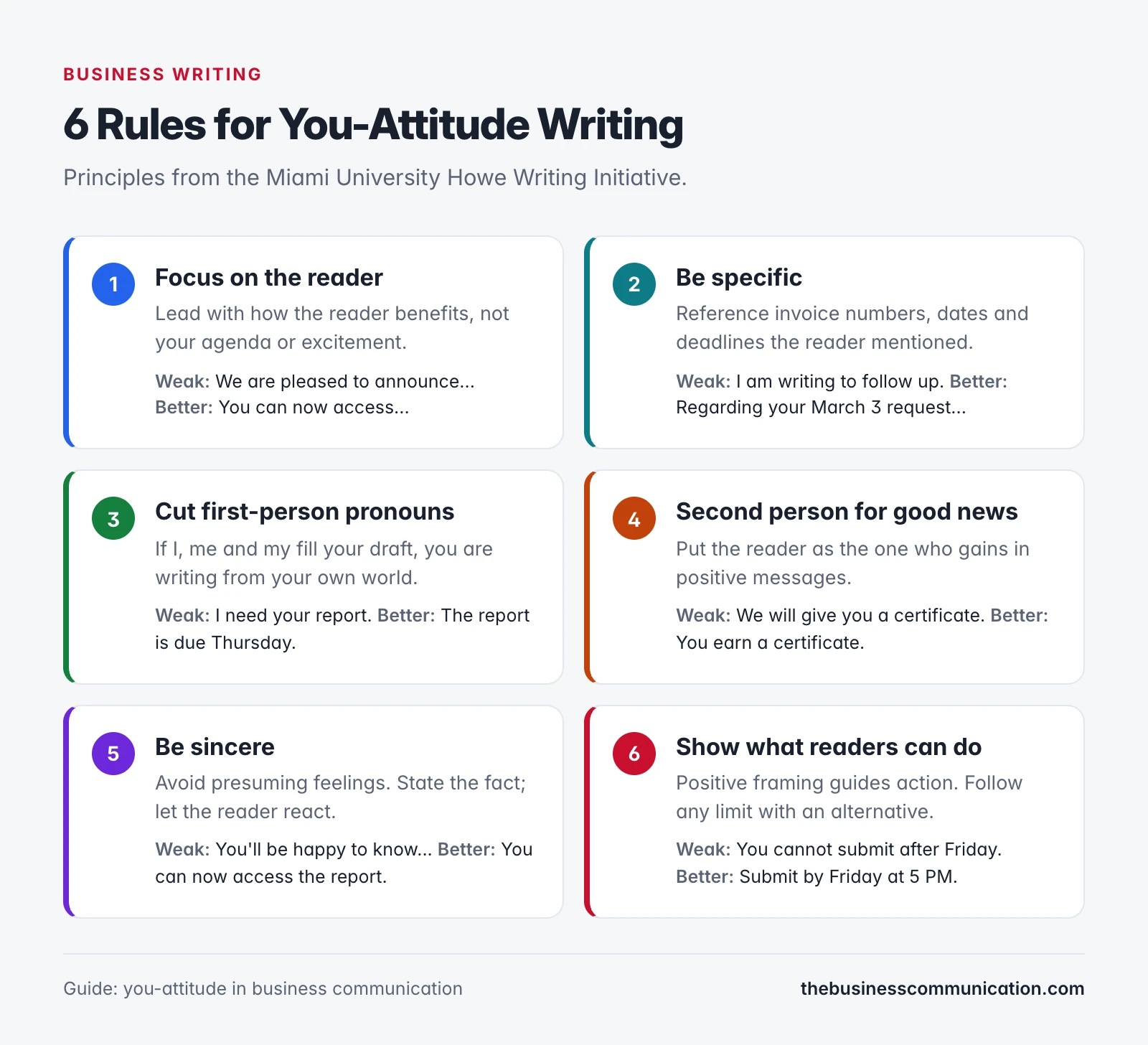
The Miami University Howe Writing Initiative identifies six principles for applying you-attitude. Each principle has a weak version and an improved version so the shift is concrete, not just theoretical.
- Keep the focus on the reader. Ask how the reader benefits from the information you are sharing. Lead with that benefit, not with your own excitement or agenda.
- Be specific and clear. Reference invoice numbers, prior conversations, or deadlines the reader mentioned. “Regarding your March 3 request for updated pricing on Model X-200” beats “I am writing to follow up.” Specificity prevents confusion.
- Minimize first-person singular pronouns. If “I,” “me,” “my,” and “mine” fill your draft, you are writing from your own world, not the reader’s. Make the reader’s action or benefit the subject of the sentence instead.
- Use second person for positive information. “You have the opportunity to earn a certificate” works better than “We will give you a certificate.” Put the reader in the sentence as the one who gains.
- Be sincere, and avoid presuming feelings. “You’ll be happy to know…” presumes the reader’s reaction. “You can now access the report” states the fact and lets the reader feel what they feel. Sincerity also means not burying bad news in vague, overly polite language.
- Show what readers can do, not what they cannot. “You can submit expense reports until Friday at 5 PM” is more helpful than “You cannot submit after Friday.” Positive framing guides action. When you must state a limitation, follow immediately with an alternative.
Word choice and framing shape how readers perceive your message and your organization. For a deeper look at how this connects to overall tone, see our guide on tone in business writing.
Quick self-check before you send
Run through these four questions on your draft before hitting send:
- Does any sentence start with “I” or “we” without explaining what the reader gains?
- Am I using “you” in a negative context where it might sound accusatory?
- Does this “we” include the reader, or does it only mean my company?
- Would the reader know what to do next after reading this message?
If the answer to question 1, 2, or 3 is yes, revise before sending. If the answer to 4 is no, add a clear next step.
The you-attitude paradox: when ‘you’ backfires
Most guides miss this: using “you” in negative contexts sounds accusatory and damages relationships. “You failed to submit the report on time” puts the reader on the defensive. “You did not include the required documentation” feels like a personal attack, even if it is factually accurate.
Bad news and denials have the same problem. “You are not eligible for this benefit” singles out the individual and assigns blame. Readers feel disrespected, even when the policy is fair.
Categorical language or passive voice solves this. Instead of targeting the reader directly, make the policy the actor. Saying the applications received after May 15 cannot be processed is less harsh than telling someone they submitted too late. Same information, different emotional effect.
Compare these two versions of the same rejection:
Same information, different framing. Categorical language acknowledges the policy constraint rather than the reader’s shortcoming.
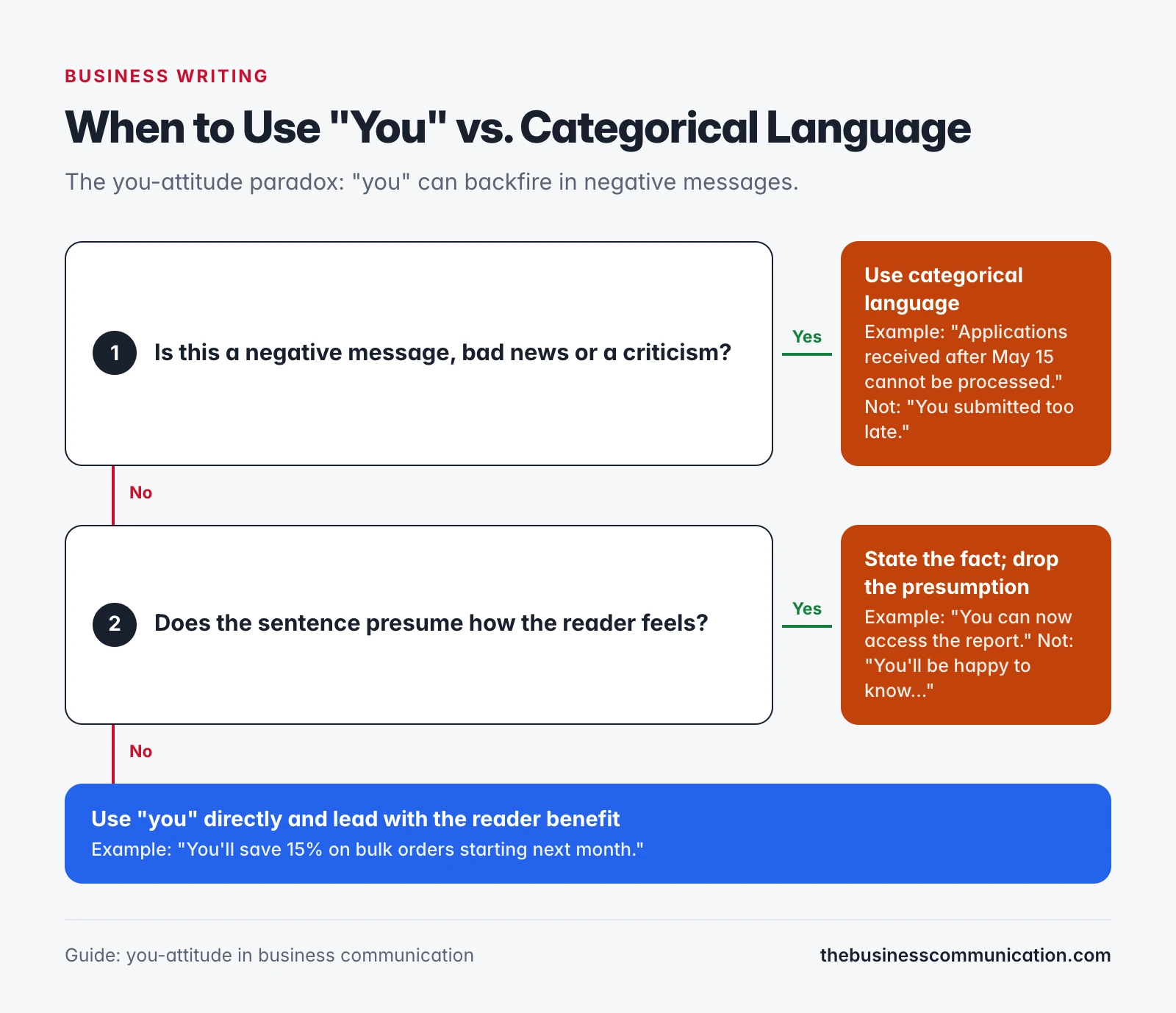
One note: sincerity beats euphemism. Do not bury bad news in vague, overly polite language. Readers detect insincerity quickly and trust erodes. If the answer is no, say so clearly, and frame it categorically rather than personally. Purdue OWL offers solid guidance on balancing directness with tact in professional writing.
You-attitude across different business letter types
Sales and persuasive letters demand you-attitude from the first sentence. Lead with reader benefits, not product features. A benefit-first opener like “You’ll cut invoice processing time by 60%” works better than a feature description. The reader wants to know what changes for them, not what your product does.
Complaint letters benefit from the same approach. Frame from the recipient’s perspective even when you’re upset. Stating impact invites resolution. Venting emotion does not.
Bad-news letters require the categorical approach described above. Use empathy without direct “you” blame. “We understand this outcome is disappointing” acknowledges reader feelings without assigning fault. Follow with clear next steps or alternatives where possible.
Adjustment and apology letters focus on reader impact and resolution. Address what the reader experienced and what will fix it. Skip internal failures and excuses. The model: the reader’s situation first, the solution second. No supply-chain backstory, no self-justification.
For detailed templates and format guidance, see our guide to business letter writing.
Reader-focused writing builds trust and drives action
Reader-centered messages create goodwill because readers feel understood, not lectured or sold to. When a message addresses your specific needs, you feel the sender respects your time and interests.
Relevance drives engagement. Two versions of the same internal policy update prove the point. One explains new procedures in company terms. One opens with a sentence telling employees what this change saves them per report. The second version gets read and acted on faster every time.
Bad-news situations also benefit from this mindset. A policy rejection delivered with categorical language and genuine empathy feels fair. The reader may not like the answer, but they do not feel dismissed or attacked.
Reader-focused writing also builds organizational goodwill over time. People remember considerate communication. They stay loyal customers and willing partners because they feel your organization values them as people, not just as transactions.
Common pitfalls and how to avoid them
False or insincere you-language is easy to spot. “You’re going to love our new policy!” sounds manipulative when the policy clearly benefits the company more than the customer. Readers detect this immediately. Be genuine: if you’re asking for something, acknowledge it honestly.
Overusing “you” in negative contexts creates blame and defensiveness. When delivering criticism or bad news, switch to categorical language. Let the policy or requirement be the actor, not the reader.
Confusing inclusive “we” with exclusive “we” muddies your message. “We can resolve this by Friday” (you and I together) builds partnership. “We have a policy against that” (my company) can feel exclusionary. When in doubt, substitute “you and I” or “my company” and see which fits.
Accuracy matters as much as tone. “You’ll get your money back soon!” is friendly but useless. “You’ll receive your refund within five business days” is both reader-focused and exact.
Practice rewrite exercise
Rewrite this me-attitude paragraph using you-attitude principles:
The revised version leads with the reader’s invitation, names concrete benefits, and ends with a specific action. The 25 years of experience disappeared entirely because the reader does not care about that.
You-attitude in emails and digital communication
Email subject lines benefit from you-attitude more than almost any other writing context. “Your invoice #3491 is ready for review” tells the reader exactly why to open the message. “Invoice processed” focuses on what you did, not what the reader needs to know.
Opening sentences should state why the email matters to the recipient before explaining your request or news. “You asked for updated pricing on Model X-200. Here’s the breakdown for orders over 50 units” orients the reader immediately. “I am writing to follow up on our conversation” wastes time and attention.
Brevity is a form of you-attitude. Short, scannable emails show you value reader time. Use bullets for lists, bold for key points, and white space to guide the eye. Avoid walls of text.
Tone matters even more in digital contexts. Without voice or facial expressions, reader-focused language prevents misinterpretation.
Compare three versions of the same request. “Please send the report by Thursday” is neutral. “You need to send the report by Thursday” sounds demanding. Asking the person to send it so the team can include it in Friday’s presentation explains the reason and invites cooperation.
For more on format and medium, see our guide on business email vs. letter and when each is most appropriate.
None of this is a formula. It is a perspective shift. Before you write, think about what your reader needs to know and how to frame your message around their interests.
When you’re unsure whether a sentence needs rewriting, ask whether it explains what the reader gains or what you accomplished. That question usually tells you which way to revise.
Short note on you-attitude (for exam or quick reference)
You-attitude is a business writing principle that places the reader’s perspective at the center of every message. It means framing sentences around reader benefits rather than the writer’s goals or achievements.
Four key points: it is not just pronoun substitution; avoid direct “you” in negative contexts; inclusive “we” is fine when it genuinely includes the reader; sincerity is non-negotiable. You-attitude improves comprehension and trust across all business letter types.
Frequently asked questions
What is the you attitude in business communication?
You-attitude is a writing technique that frames messages around the reader’s needs and benefits instead of the writer’s interests or achievements.
A you-attitude message asks “What does the reader gain?” before deciding how to phrase every sentence. It is the opposite of me-attitude, where the writer’s goals and company accomplishments take center stage.
What is attitude in communication?
In communication, attitude refers to the writer’s or speaker’s orientation toward the audience. It shapes word choice, tone, and framing.
A reader-focused attitude produces messages that feel considerate and relevant. A self-focused attitude produces messages that feel impersonal. You-attitude is one specific application: it prioritizes the reader’s perspective over the writer’s own goals in every sentence.
Can you give me examples of how to use the you attitude in business communication?
Yes. Compare these pairs: “We are pleased to offer a discount” (me-attitude) vs. “You’ll save 15% on bulk orders” (you-attitude). Or: “We updated our software” (me-attitude) vs. “Your support requests will resolve 30% faster” (you-attitude). The information is the same. You-attitude frames it from the reader’s point of view.
What is the difference between you attitude and we attitude?
We-attitude (or me-attitude) focuses on the writer’s organization, goals, or feelings. You-attitude focuses on the reader’s needs and benefits. Inclusive “we” (meaning the writer and the reader together) is compatible with you-attitude. It is exclusive “we” (meaning only the writer’s company) that signals me-attitude.
Does you-attitude just mean using the word “you” instead of “we” or “I”?
No. This is the most common misconception about you-attitude. You can fill every sentence with “you” and still be writing me-attitude if the focus stays on the writer’s agenda.
You-attitude is a perspective shift: write from the reader’s point of view and center their needs. Pronouns follow naturally from that shift.
Should I use “you” in negative messages like rejections or policy violations?
No. Direct “you” in negative contexts sounds accusatory and damages trust. Use categorical language instead. Frame it as a policy constraint, not a personal failure. That way the bad news lands without making the reader feel blamed or attacked.
What if I don’t know what the reader cares about or needs?
Ask directly or research their context before writing. Reference prior conversations, their role, or stated deadlines.
Still uncertain? Frame your message around the most common reader benefit in your context. In customer service, most readers care about speed and clarity. In internal memos, they care about what changes for them and what action to take.
Can I use “we” in you-attitude writing, or does it sound like me-attitude?
It depends on context. Inclusive “we” (meaning you and the reader together) works fine. Exclusive “we” (meaning only your company) signals me-attitude.
Quick test: substitute “you and I” or “my company” and see which fits. If only “my company” works, the sentence needs reframing around what the reader gains.
12 Comments
I can’t get past the typo in the first line.
Great content. I am really thankful
But it has a lot of grammatical errors. Please make sure to rectify.
You attitude means
communication ki buckchodi dena
Great article! It’s interesting to learn about the importance of having a positive attitude in business communication and how it can greatly impact our success.
I really enjoyed this post! It highlights how our attitude can shape our communication in business. I especially liked the examples you provided – they really illustrate the impact a positive attitude can have on team dynamics and relationships with clients. I’ll definitely be more mindful of my attitude moving forward!
I am happy to hear that you havr selected our firm
Unfortunately, I will not be able to give you any definite price until you let me know the size and quantity of cartons you need.
can anyone plz help me out to Change the following sentences and eliminate the negative aspects.
Thank you for giving us an opportunity to server you. Kindly share the size and quantity of cartons you need, so that accordingly we can provide you the price.
*serve
Rewrite thisi sentence using “you” attitude to make it mor positive:
1.you shouldn’t have put the blender into the dishwasher
1. The blender should not have been placed in the dishwasher.
In the case of something negative you will want to careful with the “you viewpoint”; it can be confrontational.