


Have you ever wondered why some people can express their ideas so clearly while others struggle to get their message across? The answer lies in understanding the principles of communication. These principles act like invisible tools that help you convey your thoughts clearly, politely, and effectively.
Communication is not just about speaking or writing, it’s about being understood. Whether you are giving a presentation, writing a business letter, or simply having a chat with a friend, knowing these principles can make all the difference.
So, let’s dive into the 14 principles of effective communication that can help anyone become a better communicator.
Understanding the Concept of Communication Principles
Communication is the process of sharing ideas, facts, or emotions between people. The principles of communication are guidelines that make this process successful.
Without principles, communication becomes messy. Words might be heard but not understood. That’s why these principles ensure that your message is clear, complete, and considerate.
If you are new to the basics, you might first like to understand the communication process, which explains how messages move from sender to receiver and how feedback completes the loop.
Why Communication Principles Matter
Imagine giving a speech where half your audience looks confused. Or sending an email that causes misunderstanding. Frustrating, right?
That’s what happens when communication principles are ignored. These principles help you:
- choose the right words,
- select the right tone, and
- deliver your message at the right time.
In professional life, these principles are the backbone of effective communication. They ensure your message creates the impact you intend, not confusion.
The 14 Principles of Effective Communication
Let’s now explore each of the 14 principles in detail, with simple examples and practical insights.
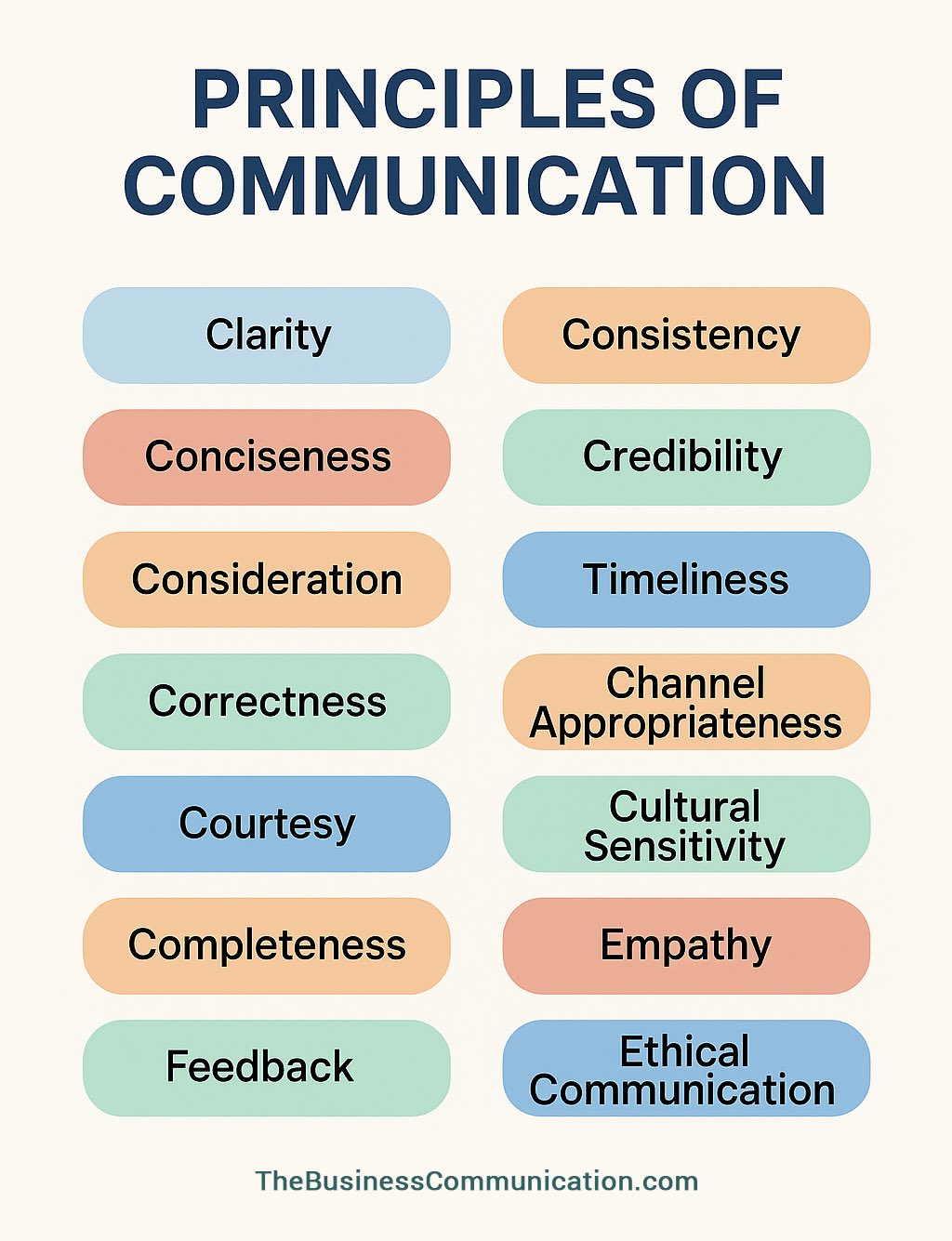
1. Clarity
Clarity means expressing your message in a simple, direct, and understandable way. Avoid vague words or long, complicated sentences.
For example, instead of saying “Our organization is considering potential strategies to maximize operational output,” say “We are finding ways to improve our work efficiency.”
Clear communication removes confusion and builds confidence.
2. Conciseness
Conciseness is about saying more with fewer words. Long, wordy sentences make readers lose interest.
For instance, replace “Due to the fact that” with “Because.”
Short sentences save time and hold the listener’s attention. You can apply this idea easily while writing emails or reports.
3. Consideration
This principle is also known as the You-attitude. It means focusing on the receiver rather than yourself. Think about what the other person needs, feels, or expects.
Instead of writing “We cannot deliver the order before Monday,” say “Your order will reach you by Monday.”
A small change like this makes your communication more audience-friendly and polite.
4. Correctness
Correctness is the foundation of credibility. Always check your facts, grammar, and spelling before sending a message.
A single mistake can change the meaning completely. Imagine writing “You’re performance was great” instead of “Your performance was great.” It changes how professional you sound.
Correctness also applies to tone. Make sure your words fit the situation.
5. Courtesy
Courtesy means being polite, respectful, and positive. Polite language creates goodwill and strengthens relationships.
Use phrases like “Thank you for your time” or “We appreciate your feedback.” Even when the message is negative, courtesy keeps it professional.
If you’re looking for how courtesy can change business relationships, you might enjoy the post on business thank you letters to clients.
6. Completeness
A complete message answers all the possible questions a reader may have. It avoids confusion and reduces the need for follow-up communication.
For example, while writing an order confirmation, include details like item name, quantity, and delivery date. A complete message builds trust and efficiency.
7. Feedback
Communication is not a one-way street. It becomes meaningful only when feedback is received. Feedback tells you whether your message was understood or not.
Ask questions, encourage responses, and listen actively. Feedback is especially useful in team communication where misunderstanding can lead to mistakes.
You can explore this idea further in the article on principles of feedback.
8. Consistency
Consistency ensures that your words and actions match. Contradictory messages confuse people and reduce trust.
If your organization values transparency, your communication should always reflect honesty and clarity. Consistency helps in maintaining a professional image over time.
9. Credibility
Credibility grows when you are truthful and reliable. People trust communicators who speak honestly and deliver what they promise.
For instance, if you announce a deadline, meet it. If there is a delay, inform early. Credibility takes time to build but can be lost with one careless message.
10. Timeliness
The timing of your message can decide its success. A relevant message sent late loses its value.
In business, prompt replies show respect and responsibility. Timeliness also helps you avoid confusion, especially during urgent situations.
11. Channel Appropriateness
Every message has its right medium. Choosing the correct communication channel saves time and ensures accuracy.
For instance, you wouldn’t send a company policy via text message, right? For formal communication, emails or memos work better.
If you want to explore this concept in detail, check out the post on types of business communication.
12. Cultural Sensitivity
As workplaces become global, we often interact with people from different cultures. Being culturally aware helps you avoid misunderstandings.
Simple gestures or phrases may have different meanings in other cultures. Take time to learn and respect cultural differences. This practice shows professionalism and empathy.
You can learn more about this topic from cross-cultural communication.
13. Empathy
Empathy means understanding others’ feelings and perspectives. It is the heart of emotional intelligence.
For example, when giving feedback to a colleague, balance criticism with appreciation. Say, “Your report was detailed, maybe next time we can simplify the visuals.”
Empathy makes your communication warm, human, and motivating.
14. Ethical Communication
Ethical communication means being honest, fair, and responsible. Never share confidential information without permission, and always give credit for others’ work.
Ethical communicators build long-lasting relationships based on respect. If you are interested in this subject, the post on ethics in informal communication offers some good insights.
Relationship Between the 14 Principles and the 7 Cs of Communication
You might already know about the popular 7 Cs of Communication — Clarity, Conciseness, Consideration, Correctness, Courtesy, Completeness, and Concreteness.
The 14 principles actually expand these seven ideas into more practical aspects. For example, “Credibility” and “Empathy” are extensions of courtesy and consideration, while “Timeliness” adds a new dimension to effectiveness.
The 7 Cs give you the core, and the 14 principles make it complete.
Applying the Principles in Real Life
Let’s take a simple example. Suppose you are writing an email to your professor requesting an extension for your assignment.
If you apply these principles:
- Use clarity to explain your reason.
- Show courtesy and empathy in your tone.
- Maintain correctness and completeness in details.
- Ask for feedback to confirm your request was accepted.
These same principles work in workplaces, classrooms, and even personal life. You can also improve your letter-writing skills by exploring how to write a business letter.
Common Mistakes That Break Communication Principles
Even great communicators make mistakes. Let’s identify a few common ones:
- Using too many words without clarity.
- Ignoring the audience’s viewpoint.
- Choosing the wrong communication channel.
- Forgetting to check grammar and facts.
- Sending messages at the wrong time.
These small errors can ruin the impact of your message. Want to learn how to avoid such barriers? Take a look at overcoming communication barriers.
Benefits of Following These Principles
When you follow the principles of communication, amazing things happen:
- Your ideas get noticed and understood.
- Relationships improve through empathy and respect.
- Workplace efficiency increases.
- Misunderstandings become rare.
In short, you start communicating like a professional.
How to Master the Principles of Communication
Mastery comes through practice. Here are a few tips to apply these principles daily:
- Listen more than you speak. Active listening improves empathy and feedback.
- Revise your messages before sending them.
- Use short, clear sentences. They are easy to read and understand.
- Be kind and respectful, no matter the situation.
- Reflect on feedback. It helps you grow as a communicator.
Regularly reading educational blogs and observing good communicators can also help you strengthen these skills.
Conclusion
Communication is a bridge that connects people. But without principles, that bridge becomes shaky. The 14 principles of communication help make that bridge strong, reliable, and beautiful.
By practicing clarity, courtesy, correctness, and empathy, you can build connections that last a lifetime.
So next time you send a message or speak to someone, pause for a second and ask yourself — “Am I being clear, kind, and complete?”
If the answer is yes, congratulations, you are already practicing effective communication.
Frequently asked questions
Should I use email or a phone call when delivering bad news?
Phone calls work better for sensitive messages because tone and immediate feedback prevent misunderstanding. Email leaves a permanent record, which is useful for documentation. For serious issues (layoffs, contract termination), a phone call followed by written confirmation respects the recipient and allows them to ask questions in real time.
What if my message is clear to me but others still misunderstand it?
Ask for feedback immediately. Request the recipient to summarize what they understood. This reveals gaps between your intent and their interpretation. Then clarify those specific points. Clarity isn’t just about your words—it’s about confirming the other person actually received your meaning.
How do I stay concise without sounding rude or dismissive?
Pair short sentences with courteous language. Instead of “No,” say “That won’t work, but here’s what we can do.” Conciseness saves time; courtesy shows respect. The two principles work together—brevity without politeness feels harsh, while courtesy without conciseness wastes attention.
Is it acceptable to send a formal email if the recipient prefers casual chat?
Match the recipient’s style when possible, but prioritize the message type. A job offer needs formality regardless of tone preference. For routine updates, adopting a casual style builds rapport. When in doubt, start formal and let the recipient set a more relaxed tone in their reply.
What should I do if I realize my message contained incorrect information after sending it?
Send a correction immediately. A brief follow-up like “I need to correct something from my earlier message” restores credibility. Ignoring the error damages trust more than admitting the mistake. Timeliness here means correcting as soon as you notice the problem, not waiting days.