


Writing a business letter is a skill that never goes out of style. Even though emails and instant messages dominate our daily communication, business letters still hold a special place in the professional world. They are formal, polished, and often serve as official records. But many learners ask the same question: how do I actually write one from start to finish?
In this guide, we will go step by step so that you know exactly how to write a professional business letter. If you are completely new to the topic, you might also enjoy my earlier post on What is a Business Letter where I explained the meaning and importance of business letters. Once you understand the basics, this step-by-step guide will make the writing process easy.
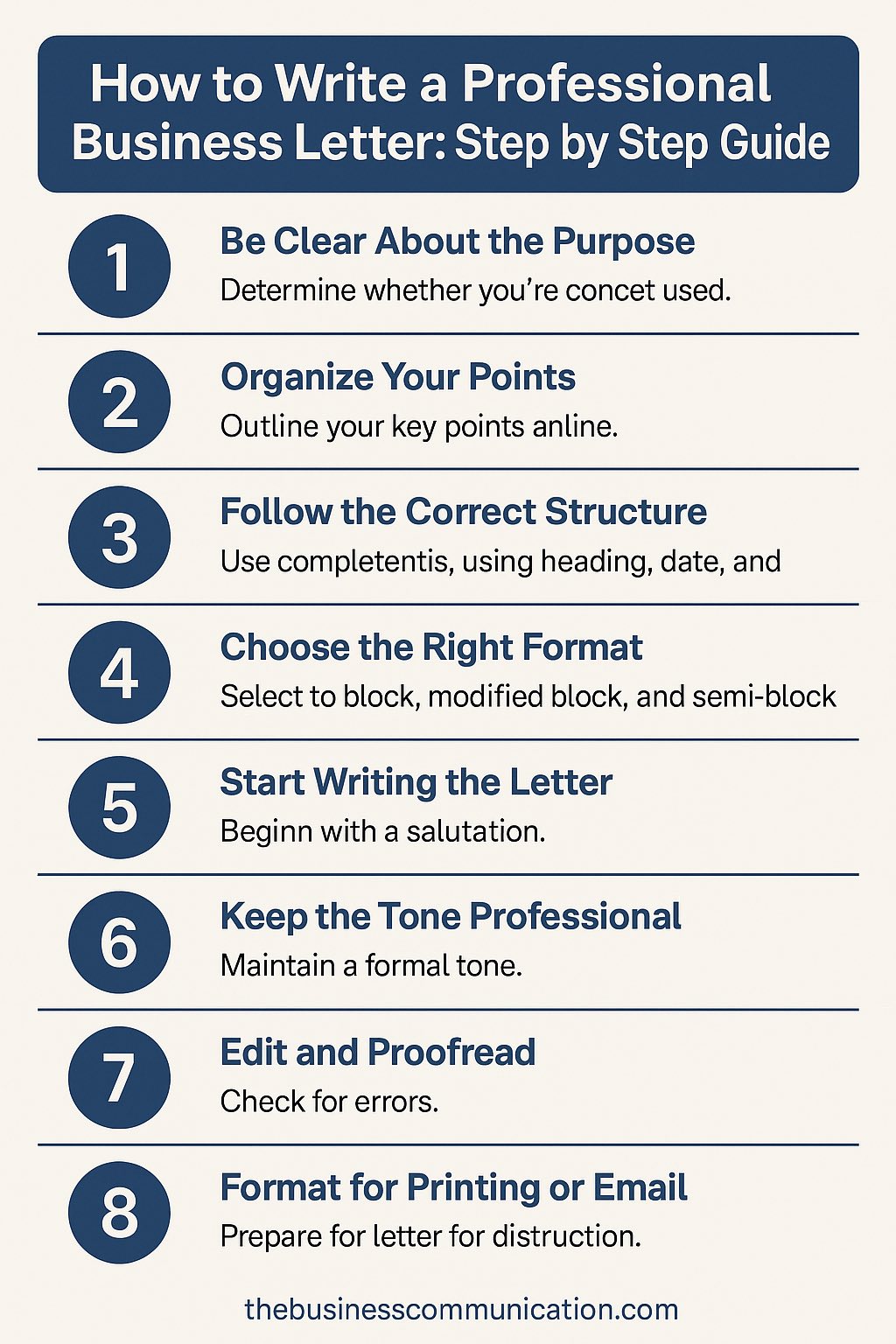
So, let’s begin with the very first step.
Step 1: Be Clear About the Purpose
Every business letter starts with a reason. Are you requesting information, applying for a job, sending a thank you note, or making a complaint? Your purpose will decide the tone, style, and even the length of the letter.
For example, if you are writing a letter of complaint, your tone will be firm but polite. If you are writing a thank you letter, your tone will be warm and appreciative. Identifying the purpose keeps your letter focused and prevents you from rambling.
A quick tip: write down the reason for your letter in one short sentence before you start. This one line will guide everything else you write.
Step 2: Organize Your Points
Before drafting, make a simple bullet list of what you need to say. Imagine you are complaining about a product. Your list might include:
- Date of purchase
- Product details
- The issue you faced
- The solution you expect
This makes writing faster and ensures you do not miss important information. Above all, it keeps your letter short and to the point, which busy professionals will appreciate.
Step 3: Follow the Correct Structure
A professional business letter is not just words on paper. It follows a specific structure: heading, date, recipient’s address, salutation, body, closing, and signature. If you want to dive deeper into these parts, check my detailed post on Parts of a Business Letter.
Here, the key point is simple: structure makes your letter easy to read. Without it, even the best words may look unprofessional.
Step 4: Choose the Right Format
Once you know the structure, it is time to decide on the layout. The business letter format affects how the text looks on the page. The three main options are block, modified block, and semi-block.
- Block format is the simplest, everything aligned to the left.
- Modified block shifts the date and closing to the right.
- Semi-block indents the paragraphs, giving a softer look.
If you are not sure which to use, start with block format. It is safe, easy, and widely accepted. For a deeper look at all three, you can read my article on Business Letter Formats.
Step 5: Start Writing the Letter
Now comes the fun part: writing. Here is the step-by-step breakdown.
- Heading: Place your address or company letterhead at the top.
- Date: Always write the full date, not abbreviations.
- Recipient’s Address: Include name, title, company, and full address. Accuracy matters here.
- Salutation: Use formal greetings such as “Dear Mr. Smith” or “Dear Hiring Manager.” Avoid “Hi” or “Hello.”
- Opening Paragraph: State the purpose directly. Example: “I am writing to apply for the position of Marketing Executive.”
- Middle Paragraphs: Provide details or background information. Keep each paragraph focused on one idea.
- Closing Paragraph: Summarize your point and state what you expect next. Example: “I would be grateful for the opportunity to discuss my application.”
- Complimentary Close: End politely with “Sincerely” or “Best regards.”
- Signature: Sign above your typed name. Add enclosures if necessary.
Notice how everything flows step by step. Each part has its role, just like players on a football team. If one is missing, the whole game feels incomplete.
Step 6: Keep the Tone Professional
Tone can make or break your letter. Even if you are upset, you should not sound rude. Instead, balance politeness with firmness.
For example:
- Rude: “You sold me a useless product.”
- Professional: “Unfortunately, the product stopped functioning within a week. I kindly request a replacement or repair.”
See the difference? The second one gets your point across without damaging the relationship.
Also, use active voice and short sentences. Instead of “The report was written by the manager,” write “The manager wrote the report.” This sounds direct and confident.
Step 7: Edit and Proofread
Never send a business letter without proofreading. A single spelling mistake can make you look careless.
Check:
- Spelling and grammar
- Correct names and titles
- Proper alignment and spacing
- Consistent font style and size
One practical trick is to read the letter aloud. If it sounds awkward, rewrite it. You can also ask a colleague or friend to review it. Fresh eyes often catch errors you missed.
Step 8: Format for Printing or Email
Your final step depends on how you send the letter.
- If printed: use clean white paper, leave margins, and sign by hand.
- If emailed: skip the letterhead, include a clear subject line, and use a professional email signature. Converting to PDF often makes it look more polished.
Regardless of the method, consistency in layout and professionalism in tone are key.
What Are the Main Parts of a Business Letter?
A standard business letter has seven required parts and a few optional ones. Textbooks count them differently, as six, seven or nine and more, because some combine the heading and date while others add optional parts such as the subject line, enclosure and CC. The letter itself is the same.
Required parts
- Heading or letterhead: the writer’s address and contact details. Companies use a printed letterhead with the name, logo and contact information. Example: ABC Corporation, 123 Main Street, New York, NY 10001.
- Date: placed below the heading, aligned left or right depending on the format. Example: March 5, 2025.
- Inside address: the recipient’s name, title, company and address. Double-check spelling, because a wrong name or title makes a poor first impression.
- Salutation: a formal greeting such as “Dear Mr. Smith,” “Dear Ms. Johnson,” or “Dear Hiring Manager,”.
- Body: an introduction that states the purpose, the main content with details or requests, and a conclusion that states the expected action.
- Complimentary close: “Sincerely,” “Best regards,” or “Yours faithfully,”. Avoid casual endings like “Cheers” or “Take care.”
- Signature: signed by hand above the typed name and title in a printed letter; a typed name and title is acceptable in a digital letter.
Optional parts
- Subject line: states the purpose at a glance. Example: Subject: Application for Marketing Executive Position.
- Enclosure: lists documents attached to the letter. Example: Enclosure: Resume.
- CC: names anyone who receives a copy. Example: CC: Mr. Alan Brown.
Examples of Well-Written Business Letters
Here is a short example of a request letter:
Mr. John Smith
HR Manager
XYZ Corporation
456 Park Avenue
Chicago, IL 60601Dear Mr. Smith,
I am writing to request an update regarding my application for the Marketing Executive position. I submitted my documents on February 15, and I would appreciate any information you could provide about the next steps in the process.
Thank you for your time and consideration.
Sincerely,
[Signature]
Jane Doe
And here is a thank you letter:
Dear Ms. Johnson,
Thank you for meeting with me yesterday to discuss the new project proposal. I truly appreciate the opportunity and look forward to future collaboration.
Best regards,
Robert Lee
Both examples are short, polite, and structured. They follow the step-by-step process we just discussed.
Here is a complete job application letter with each part labelled:
[Heading]
ABC Corporation
123 Main Street
New York, NY 10001[Date]
March 5, 2025[Inside address]
Mr. John Smith
Human Resources Manager
XYZ Enterprises
456 Park Avenue
Chicago, IL 60601[Salutation]
Dear Mr. Smith,[Body]
I am writing to apply for the Marketing Executive position advertised on your website. With five years of experience in digital marketing, I have developed strong skills in SEO, content writing and social media campaigns, and I believe these make me a strong candidate for your team.I would appreciate the opportunity to discuss my application further. Thank you for your time and consideration.
[Complimentary close and signature]
Sincerely,
[Signature]
Jane Doe[Enclosure]
Enclosure: Resume
Business Letter: Short Questions and Answers for Exams
- What are the main parts of a business letter? Heading, date, inside address, salutation, body, complimentary close and signature.
- Which parts of a business letter are optional? Subject line, enclosure and CC.
- What is the main part of a business letter? The body, because it carries the message.
- What does a letter heading contain? The name, address and contact details of the writer or organization, often printed as a letterhead with a logo.
- What is an inside address? The recipient’s name, title, company and address, written below the date.
- What are the main business letter formats? Block, modified block and semi-block.
Common Mistakes to Avoid
Even after knowing the steps, many people make common mistakes. Avoid these:
- Forgetting to include the date or recipient’s name.
- Using casual phrases like “Hey” or “See ya.”
- Writing long, heavy paragraphs.
- Mixing different formats in one letter.
- Mixing up addresses or titles.
- Ignoring proofreading.
By avoiding these errors, you automatically raise the standard of your writing.
Conclusion
Learning how to write a business letter is like learning to ride a bicycle. At first, it may feel awkward, but with practice it becomes second nature. From identifying your purpose to proofreading the final draft, every step matters.
Above all, remember that a well-written business letter can impress clients, employers, or partners. It shows professionalism, clarity, and respect. Practice these steps often, and soon writing letters will feel as simple as writing an email, only with more authority.
Frequently asked questions
What if I don’t know the recipient’s name or title?
Call the company or check their website to find the correct contact. If you cannot locate a specific person, use a general salutation like “Dear Hiring Manager” or “Dear Sir or Madam.” Avoid generic greetings like “To Whom It May Concern” in modern business letters. Taking time to find the right name shows professionalism and increases the chance your letter reaches the intended person.
Should I print and mail or send my letter by email?
Print and mail for formal situations like job applications, complaints, or official records. Email works for routine requests or when the recipient explicitly prefers it. If unsure, email is faster and acceptable for most business purposes. However, printed letters carry more weight for serious matters. Check the job posting or company guidelines for guidance on preferred method.
How long should a business letter be?
Keep it to one page whenever possible. Most business letters run 3-4 paragraphs. Busy professionals appreciate brevity. If your message requires more detail, use bullet points or attachments. Each paragraph should focus on one idea. If you find yourself writing more than one page, consider whether all information is essential or if some details can be removed.
What if I make a mistake after signing the letter?
If printing, rewrite the entire letter. Do not use white-out or handwritten corrections on formal business letters. If emailing, you can send a brief follow-up message with the correction. For minor typos in PDFs, resend the corrected version with a note: “Please disregard the previous email. Here is the corrected version.” Accuracy matters, so take time to proofread before signing or sending.
Can I use a business letter template or must I write from scratch?
Templates are helpful and widely used. They ensure you follow proper structure and formatting. However, customize the template with your specific details, tone, and message. Never send a generic template letter without personalizing it. The recipient will notice if your letter feels like a mass copy. Use templates as a starting point, not a final product.
Is it acceptable to add a personal note at the end of a formal letter?
Yes, but keep it brief and professional. A short handwritten note above your signature can add warmth to formal letters like thank-yous or job applications. However, avoid personal notes in complaint letters or official requests. The note should reinforce your message, not contradict it. Limit it to one or two sentences to maintain professionalism.