


When you sit down to write a business letter, you may already know the parts that need to be included, like the heading, salutation, body, and closing. But how you arrange those parts on the page is just as important. That arrangement is what we call the business letter format.
Think of it like dressing up for a formal event. You can wear a suit in different styles, but you still have to look polished. Similarly, a business letter can follow different formats, but the goal is always the same: clarity, professionalism, and readability.
In this article, we will look at the three main business letter formats: block, modified block, and semi-block. You will learn what they look like, when to use them, and even see sample structures. So, let’s dive in and discover which format works best for your next letter.
What Is a Business Letter Format?
A business letter format refers to the overall layout of the letter, including alignment, spacing, and indentation. Unlike the content, which changes depending on purpose, the format is about how the text appears on the page.
Why is this important? Because the first impression of your letter often comes from its appearance before the reader even begins to read the words. If the letter looks messy, the reader may assume the message is careless too. A neat format makes the letter easier to follow and gives it a professional touch.
Fun fact: Many companies adopt one format as their official style guide. That way, every letter coming from the organization looks consistent, almost like a brand signature.
Overview of the Three Main Formats
There are three widely accepted business letter formats:
- Block format
- Modified block format
- Semi-block format
All three contain the same parts of a business letter, but the placement and alignment differ. It is like cooking the same recipe in three slightly different ways. The ingredients remain the same, but the presentation changes.
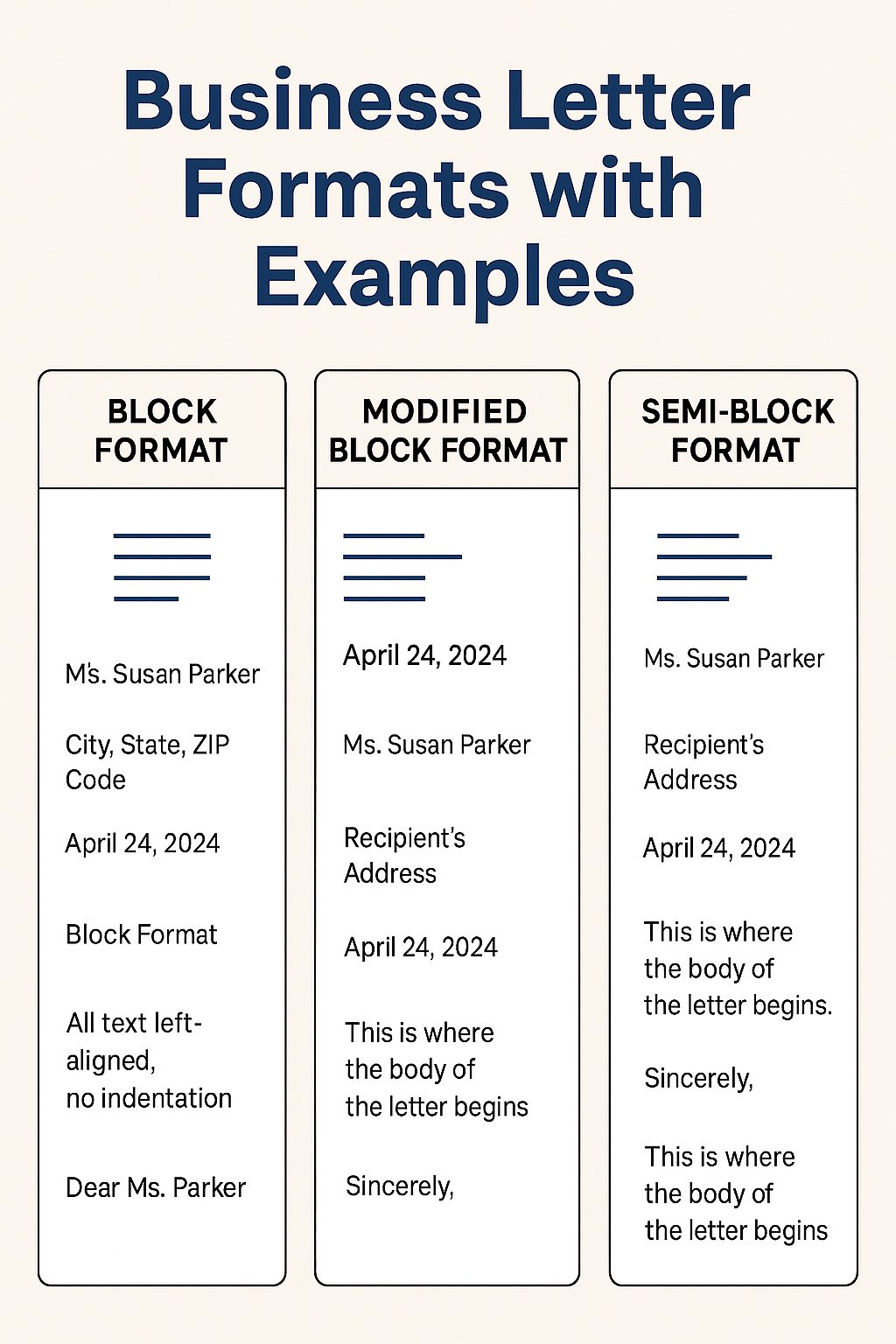
Now let’s take a closer look at each format.
Block Format
The block format is the simplest and the most commonly used style. In this format, everything is aligned to the left margin. The entire letter is single-spaced, and there is a double space between paragraphs.
Advantages of Block Format
- Clean and straightforward layout.
- Easy to create because it requires no special adjustments.
- Accepted in almost every professional context.
When to Use Block Format
Block format is ideal for formal communication, especially in corporate, legal, and government settings. If you are unsure which format to use, block format is the safest choice.
Sample Structure of a Block Letter
[Your Address]
[City, State, ZIP Code]
[Date]

[Recipient’s Name]
[Title]
[Company Name]
[Address]

Dear Mr. Johnson,

This is where the body of the letter begins. In block format, every line starts from the left margin. There are no indentations. Each paragraph is separated by a blank line for clarity.

The closing and signature also start from the left side.

Sincerely,
[Your Name]
[Your Title]
Notice how neat and uniform it looks. That simplicity is the biggest strength of block format.
Modified Block Format
The modified block format is almost identical to the block format, but with one key difference: the date, closing, and signature are aligned to the right side of the page instead of the left. Everything else remains the same.
Advantages of Modified Block Format
- Looks formal but adds a touch of style.
- Creates a balanced layout that some find more attractive than the strict block style.
- Good option when you want a letter that feels professional but less rigid.
When to Use Modified Block Format
This format works well for business correspondence where a slightly personal yet still formal touch is appreciated. It is popular among small businesses and organizations that want a professional look without appearing too mechanical.
Sample Structure of a Modified Block Letter
[Your Address]
[City, State, ZIP Code]

                                                  [Date]

[Recipient’s Name]
[Title]
[Company Name]
[Address]

Dear Ms. Brown,

This is an example of the modified block style. Notice that the main body text is still aligned left, but the date, closing, and signature move to the right.

This gives the letter a more balanced look.

                                                  Sincerely,
                                                  [Your Name]
                                                  [Your Title]
The shift to the right makes the letter look slightly more elegant compared to the full block style.
Semi-Block Format
The semi-block format, sometimes called the indented style, adds another variation. In this format, the paragraphs in the body are indented, usually by half an inch, while the rest follows the modified block style.
Advantages of Semi-Block Format
- Looks less rigid and more traditional.
- Adds a touch of friendliness while still being formal.
- Many people find it easier to read because indentation separates the paragraphs clearly.
When to Use Semi-Block Format
The semi-block format is suitable for business letters that want to be professional but not overly stiff. It works well for letters of appreciation, recommendations, or invitations.
Sample Structure of a Semi-Block Letter
[Your Address]
[City, State, ZIP Code]

                                                  [Date]

[Recipient’s Name]
[Title]
[Company Name]
[Address]

Dear Mr. Carter,

     This is the semi-block style. Notice that the first line of each paragraph is indented. This style looks more like traditional writing.

     While still professional, it feels less rigid and more approachable.

                                                  Best regards,
                                                  [Your Name]
                                                  [Your Title]
The indentation creates a flow that feels more personal, yet still businesslike.
Side-by-Side Comparison of Formats
To make things easier, here is a quick comparison:
- Block format: All text left-aligned, no indentation. Most common and professional.
- Modified block format: Similar to block, but the date, closing, and signature move to the right. Slightly stylish.
- Semi-block format: Like modified block, but body paragraphs are indented. Traditional and friendly.
If you are ever unsure which one to use, block format is the standard. However, modified and semi-block give you flexibility depending on your purpose and audience.
Common Mistakes in Business Letter Formatting
Even though formats are simple, people often make mistakes. Here are a few pitfalls to avoid:
- Mixing styles, for example, using left-aligned date in a semi-block letter.
- Inconsistent spacing, which makes the letter look messy.
- Overusing decorative fonts or colors. Stick to professional fonts like Times New Roman or Arial.
- Forgetting to align the closing properly in modified and semi-block formats.
Remember, consistency is key. A letter with mixed styles looks careless, and that is the last impression you want to leave.
Practical Tips for Choosing the Right Format
Here are some quick tips to help you select the right format:
- If you are writing to government offices or large corporations, go with block format.
- If you are writing to a smaller business or want a less rigid tone, modified block works well.
- If you want to balance professionalism with friendliness, semi-block is a good choice.
- Always check if your organization has a preferred format. Many companies have internal style guides.
- Use templates if you are unsure. They save time and prevent mistakes.
On the other hand, avoid switching formats randomly. Stick to one style throughout your communication.
Conclusion
Business letters may carry the same parts, but the format changes how they look and feel. The block format is the most widely used and considered the gold standard for professionalism. The modified block format adds a subtle touch of style, while the semi-block format offers a more traditional, slightly warmer feel.
Above all, the best format is the one that suits your audience and purpose. A government office might expect strict block format, while a thank you letter to a client may look more appealing in semi-block.
So, the next time you write a business letter, do not just focus on what you write, pay attention to how it looks. Because in professional communication, presentation speaks as loudly as words.
Frequently asked questions
Which format should I use if my company has no style guide?
Block format is the safest default. It’s the most widely accepted across industries and professional contexts. Unless you have a specific reason to choose modified block or semi-block, block format will always be appropriate and won’t raise questions about your professionalism.
Can I mix formats, like using block body with a right-aligned signature?
No. Each format is a complete system. Mixing elements creates inconsistency and looks unprofessional. Stick to one format throughout the entire letter. If you like the right-aligned signature idea, use modified block format, which includes that feature intentionally.
Does the recipient care which format I use?
Most recipients don’t consciously notice format choice if it looks professional and clean. However, some industries and organizations do have preferences. Legal and government sectors typically expect block format. When in doubt, block format is universally acceptable and won’t hurt your message.
Should I use semi-block for personal business letters like thank-yous?
Semi-block works well for thank-you letters and appreciation notes because it feels warmer while staying professional. However, block format is equally appropriate. Choose semi-block if you want a slightly less formal tone, but don’t feel obligated to use it.
What if I’m writing on company letterhead with a pre-set layout?
Follow your company’s letterhead design. If your letterhead already positions elements, adapt your format to match it. Consistency with company branding takes priority over standard format rules. Ask your manager or check previous company letters for guidance.
1 Comment
You just may not make the two day turn around time
deadline.