


Business communication divides into several distinct categories, each suited to different organizational needs and contexts. Understanding these types helps you select the right approach for your message, audience, and business objective.
What is business communication?
Business communication is the structured exchange of information within and outside organizations to achieve specific objectives. It includes everything from a manager assigning tasks to a team member, to a company announcing quarterly earnings to investors, to colleagues coordinating on a project deadline.
No single communication type works for every situation. The right choice depends on your audience size, message urgency, and whether you need immediate feedback. A crisis announcement requires different channels than a routine policy update.
What most people get wrong: they default to familiar channels rather than matching communication type to context. Sending a 2,000-word email when a five-minute conversation would clarify faster wastes time. Holding an hour-long meeting to share information that could live in a brief written update frustrates busy teams.
Communication based on parties involved: Internal vs. external
Internal communication flows within organizational boundaries. It ensures employees understand goals, coordinate work, and maintain operational efficiency. This includes team meetings, department emails, project management updates, and performance reviews.
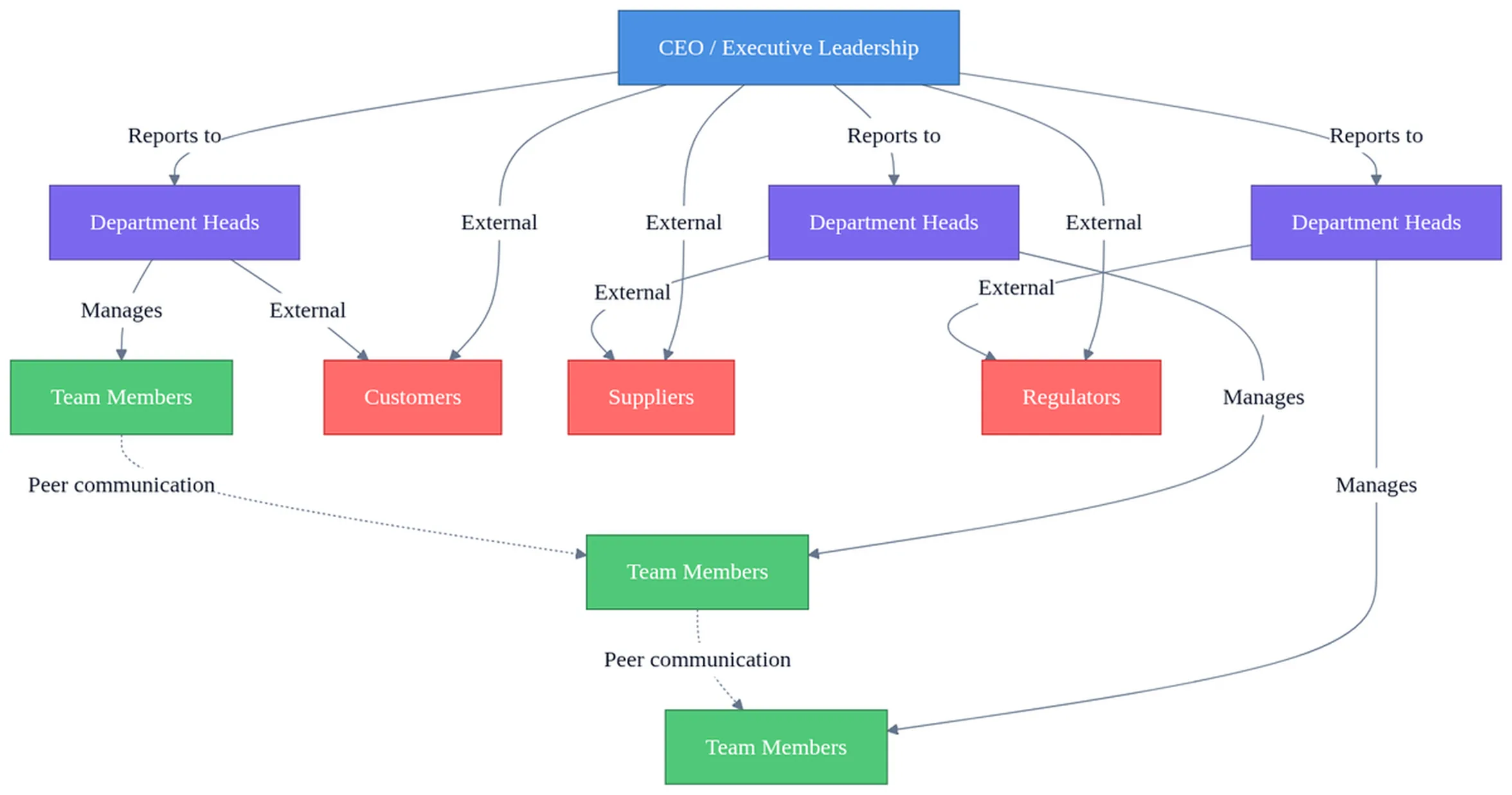
External communication connects your organization with outside stakeholders: customers, suppliers, regulators, investors, media, and local communities. It builds relationships, manages reputation, and facilitates transactions. Examples include marketing campaigns, investor reports, customer service interactions, and regulatory filings.
The key difference: internal communication focuses on coordination within your team. External communication manages stakeholder expectations and protects organizational reputation. A product delay requires internal communication to reallocate resources and external communication to manage customer expectations. The tone, detail level, and approval process differ significantly between the two.
Vertical communication: Downward, upward, and diagonal flows
Vertical communication occurs between organizational levels with different reporting relationships. It moves information up and down the hierarchy, ensuring alignment between strategic decisions and operational execution.
Downward communication flows from management to staff. Executives send organizational goals, policy changes, job assignments, and performance feedback to their teams. A regional director emailing branch managers about new compliance requirements exemplifies downward flow. This type ensures consistency but can feel one-directional if not paired with feedback mechanisms.
Upward communication moves from employees to management. Staff share progress reports, surface operational problems, suggest improvements, and provide market intelligence from customer-facing roles. A sales team reporting that customers repeatedly request a specific feature is upward communication. Organizations that ignore upward channels miss critical ground-level insights, and they pay for it when small problems metastasize into crises that leadership never saw coming.
Diagonal communication crosses both functional and hierarchical boundaries. A marketing coordinator might communicate directly with a senior operations manager to coordinate a product launch, bypassing their respective department heads. This speeds decision-making and reduces bottlenecks, though it can create confusion if overused without clear protocols.
Horizontal communication: Peer-level coordination
Horizontal communication happens among employees at similar organizational levels, often across different departments. A finance analyst and an HR specialist coordinating on budget planning for new hires demonstrates horizontal flow.
This type enables cross-functional problem-solving and reduces silos. When the product development team communicates directly with customer support about reported bugs, they solve problems faster than routing every issue through management layers. Horizontal channels are often more collaborative and less formal than vertical ones, making them ideal for brainstorming and rapid iteration.
Formal vs. informal communication: Structure and spontaneity
Formal communication follows prescribed organizational channels and documentation standards. It includes official emails, scheduled meetings, written reports, policy announcements, and performance reviews. The chain of command governs who communicates what to whom.
Informal communication, often called the grapevine, emerges spontaneously through personal relationships. It includes hallway conversations, lunch discussions, instant messages between colleagues, and after-work social interactions. Informal channels often spread information faster than official ones and carry more credibility with employees who trust peer perspectives over corporate announcements.
Both serve essential organizational needs. Formal communication ensures consistency, creates documentation, and maintains accountability. Informal communication builds trust, spreads tacit knowledge, and surfaces issues employees hesitate to raise through official channels. A small Dhaka-based agency might rely heavily on informal communication due to close-knit teams, while a multinational corporation requires strong formal structures to coordinate thousands of employees across time zones.
Synchronous vs. asynchronous: Timing and feedback
Synchronous communication happens in real time. Participants exchange information simultaneously through face-to-face meetings, phone calls, video conferences, or live chat. This enables immediate clarification, rapid decision-making, and relationship-building through real-time interaction.
Choose synchronous communication for urgent decisions that require immediate input. If your team needs to decide whether to proceed with a contract negotiation before close of business, a quick video call works better than waiting for email responses. Synchronous channels also suit complex topics where misunderstanding carries high costs.
Asynchronous communication introduces time delays between sending and receiving. Email, recorded video messages, project management comments, and shared documents allow recipients to respond when convenient. This format gives people time to craft thoughtful responses and creates automatic documentation.
Choose asynchronous communication for non-urgent updates, when coordinating across time zones, or when you need a permanent record. A project status update sent via email lets team members review details at their own pace and refer back later. Asynchronous channels also respect recipient time.
Employees spend significant time managing communication across multiple channels, which makes thoughtful channel selection important for productivity.
Communication by format: Verbal, written, and non-verbal
Verbal and written communication are the most recognized formats. Verbal communication (spoken words in presentations, meetings, phone calls, and conversations) offers high immediacy and allows tone to convey nuance. A manager delivering difficult feedback verbally can adjust approach based on employee reactions in real time.
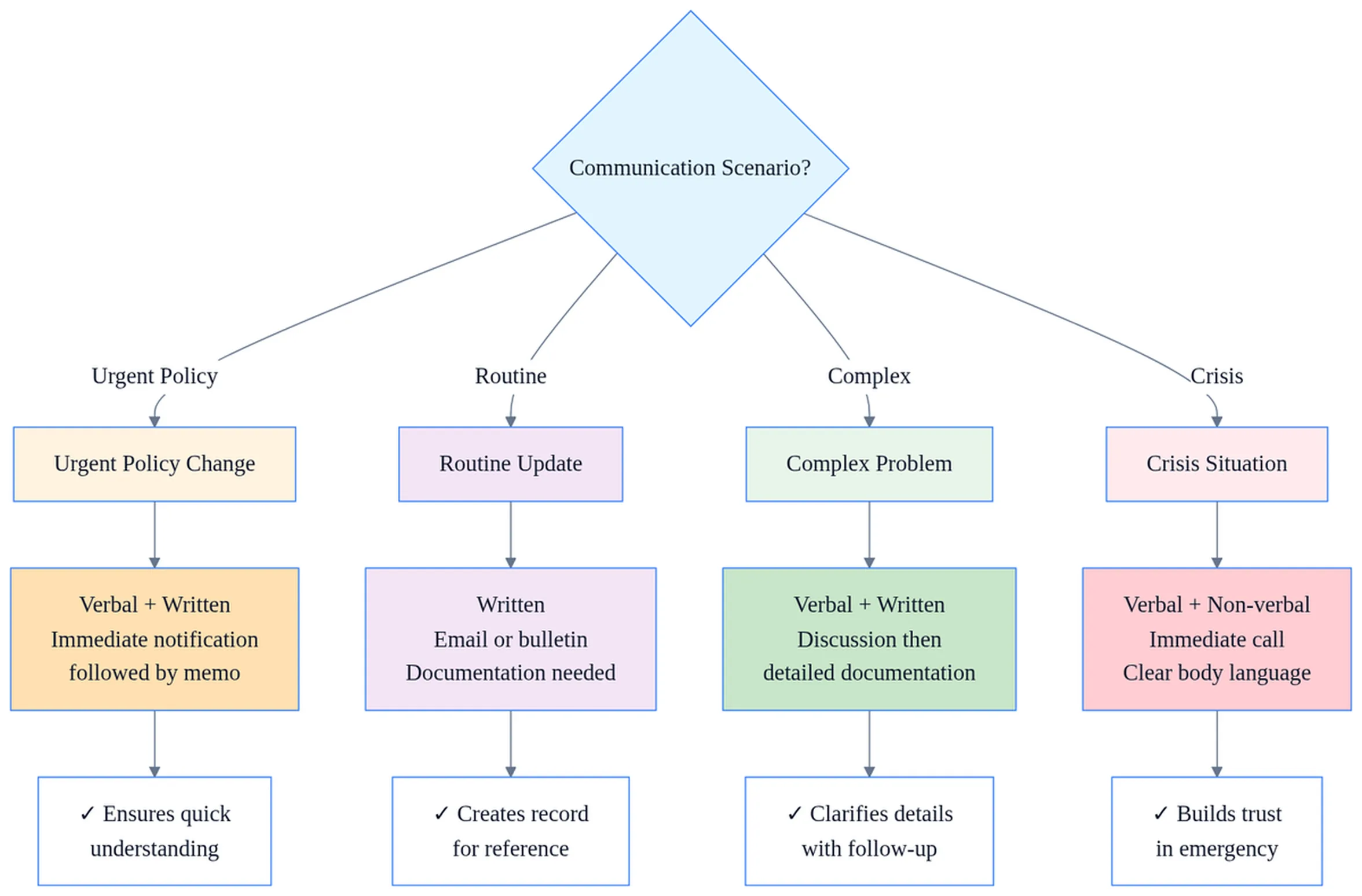
Written communication (emails, reports, memos, proposals, and documentation) creates permanent records and allows careful message crafting. A contract negotiation requires written communication to ensure all parties agree on specific terms. Written formats also scale well: one memo can reach hundreds of employees with identical information.
Non-verbal communication includes body language, facial expressions, tone of voice, posture, and eye contact. These cues often convey more than words themselves. A team member saying “I understand” while avoiding eye contact and crossing arms signals confusion or disagreement despite verbal agreement. In remote and hybrid work contexts, non-verbal communication becomes challenging. Video fatigue partly stems from the cognitive load of interpreting limited non-verbal cues through screens.
Mass communication reaches large, geographically dispersed audiences through channels like company-wide emails, intranet announcements, press releases, and social media. Organizations use mass communication for brand messaging, crisis announcements, and policy changes affecting all stakeholders.
Choosing the right communication type: A decision framework
Effective communicators match type to context using four key factors: audience size, urgency, feedback requirements, and documentation needs.
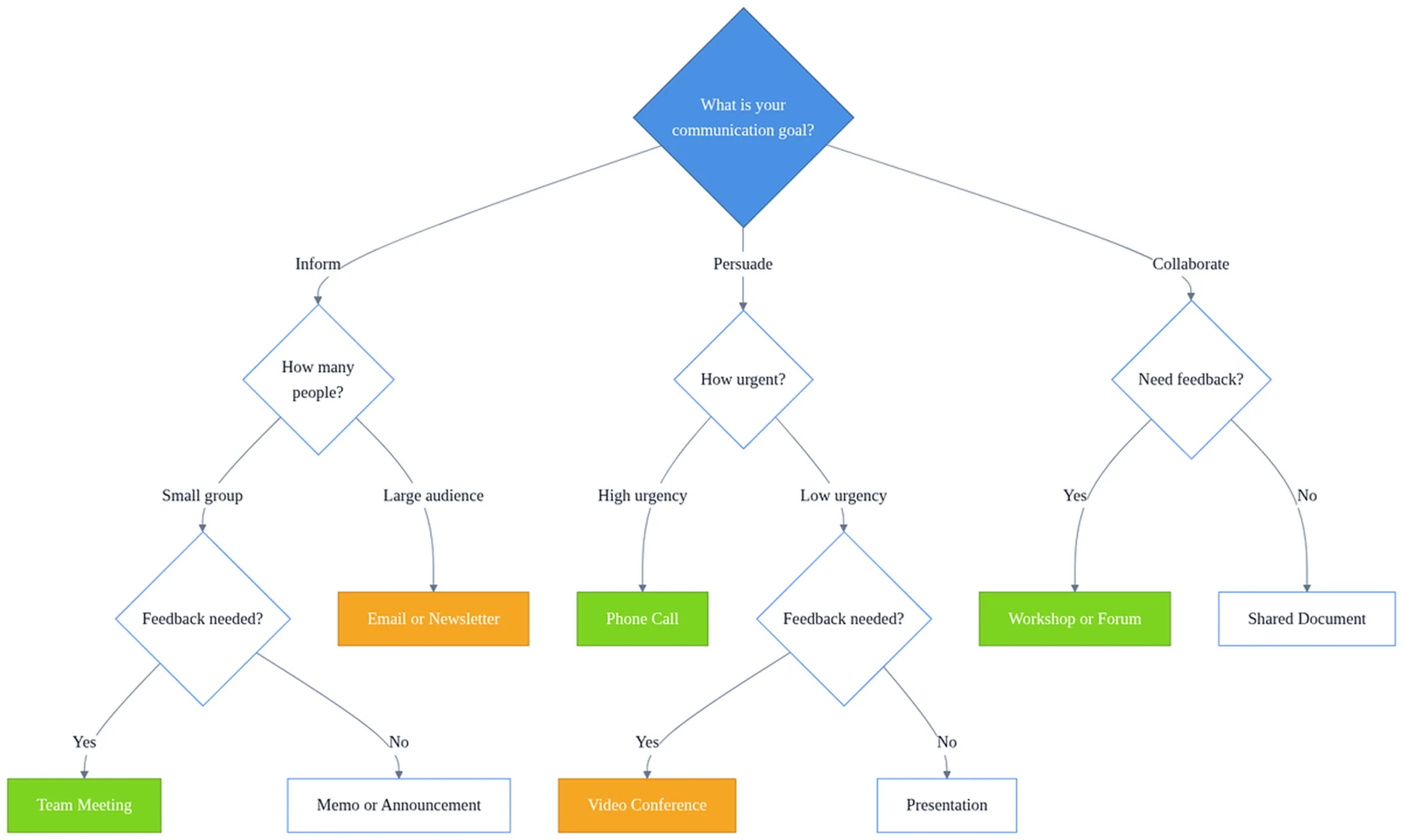
Start with audience size. One-to-one communication suits personal feedback, sensitive topics, or complex negotiations. Small group communication (five to fifteen people) works for collaborative problem-solving. Large audience communication requires formal channels and careful message crafting since you cannot tailor content to individual needs.
Consider urgency. Immediate issues demand synchronous channels. If a server outage affects customer operations, call your technical lead rather than emailing. Routine updates work well asynchronously. Crisis situations often require multi-channel redundancy: a safety incident might warrant an immediate verbal announcement, followed by written documentation, and reinforced through manager conversations.
Evaluate feedback requirements. High-feedback situations (brainstorming sessions, complex problem-solving, or change management) need dialogue-based formats like meetings or workshops. Low-feedback scenarios suit one-way channels like memos or recorded messages.
Assess documentation needs. Regulatory compliance, legal agreements, and policy changes require written formats that create audit trails. Informal relationship-building works well verbally without documentation overhead.
| Scenario | Best Communication Type | Why |
|---|---|---|
| Announcing organizational restructure | Formal written (email/memo) + synchronous town hall + manager follow-ups | Needs documentation, broad reach, and space for questions and emotional processing |
| Quick project status check | Informal synchronous (chat or brief call) | Low stakes, needs immediate answer, no documentation required |
| Contract negotiation | Synchronous discussion + formal written agreement | Complex terms need clarification; final agreement requires documentation |
| Customer complaint | Synchronous (call) + written follow-up (email) | Emotion requires personal touch; resolution needs documentation |
| Routine policy update | Formal written (email) + asynchronous Q&A forum | Non-urgent, needs documentation, allows people to review at own pace |
Here’s how communication types interact in practice. Imagine your company changes its remote work policy. The HR director drafts a formal written memo explaining the new policy (formal, written, downward, asynchronous). She emails it to all employees (internal, mass communication). Department heads hold team meetings to clarify details and answer questions (formal, verbal, downward, synchronous). Employees discuss concerns among themselves during lunch (informal, horizontal, verbal, synchronous). Several staff members submit questions to HR through the employee portal (formal, written, upward, asynchronous). HR compiles common questions into an FAQ document (formal, written, downward, asynchronous).
This layered approach addresses different needs: the memo provides official documentation, meetings enable clarification, informal conversations process emotions, upward channels surface concerns, and the FAQ scales answers efficiently.
Effective remote teams deliberately choose communication channels based on task complexity and relationship needs, rather than defaulting to email for everything.
One practical tip: when in doubt, start with richer communication (synchronous, verbal) for important or complex messages, then follow up with leaner channels (asynchronous, written) for documentation. You can always move from rich to lean, but escalating from email to emergency meeting signals that something went wrong.
The framework works across organizational sizes. A five-person startup might rely heavily on informal verbal communication for speed, while documenting key decisions in writing. A 5,000-employee corporation needs strong formal channels but still benefits from informal networks that surface problems and build trust across silos.
Understanding communication types gives you a vocabulary for diagnosing problems. When a project fails because “communication broke down,” you can identify specifically what failed: Was upward communication blocked? Did informal channels spread misinformation? Did asynchronous communication create delays when synchronous coordination was needed? Precise diagnosis enables targeted solutions rather than generic “we need to communicate better” directives that change nothing.
Frequently asked questions
Should I use synchronous or asynchronous communication for urgent decisions?
Use synchronous (real-time) communication for urgent decisions that require immediate clarification or consensus. Phone calls, video conferences, or in-person meetings let you ask follow-up questions and resolve disagreements on the spot. Reserve asynchronous (email, recorded messages) for decisions that don’t require instant feedback or when participants span multiple time zones and can’t meet simultaneously.
When is diagonal communication appropriate, and when does it create problems?
Diagonal communication works well for time-sensitive coordination across departments, like a marketing coordinator working directly with operations on a product launch. Limit it to specific projects with clear objectives. Overusing diagonal channels without protocols creates confusion about decision authority and can undermine management oversight. Always inform relevant managers when diagonal communication occurs.
How do I know if I should send a formal email or have an informal conversation?
Use formal communication when you need documentation, are setting policy, addressing performance issues, or communicating with external stakeholders. Use informal conversation for quick clarifications, relationship-building, or gathering candid feedback. If the message affects multiple people or has legal/compliance implications, formalize it in writing even if you discussed it informally first.
What happens if I ignore upward communication channels?
Ignoring upward communication causes organizations to miss critical ground-level insights from employees closest to customers and operations. Small problems escalate into crises leadership never saw coming. Employees stop reporting issues, reducing organizational awareness. Create safe upward channels—suggestion systems, skip-level meetings, anonymous surveys—so staff feel heard and problems surface early.
Can informal communication replace formal channels in small teams?
Informal communication alone creates risk even in small teams. Without formal documentation, decisions become unclear, accountability disappears, and new hires lack onboarding clarity. Small teams benefit from informal trust but still need basic formal structures: written decisions, documented policies, and clear role definitions. Blend both to maintain agility without losing institutional memory.
5 Comments
what about intra personal communication?? is it still classification?
what a very rich, up-to-date lecture! l really appreciate it.
Correctly done .This is wonderful
Very interesting
its perfect