


The objectives of business communication are the goals a company tries to reach every time it shares a message. The core goals are to inform, to persuade, to coordinate work, to motivate people and to build goodwill.
Some of these goals face inward, toward employees. Others face outward, toward customers, investors and the public.
Students usually need a clean list for exams. Managers need to know which goal a message serves before they write it. This guide covers both. You will find the ten textbook objectives first, then a closer look at how each one works inside a real organization.
What are the objectives of business communication?
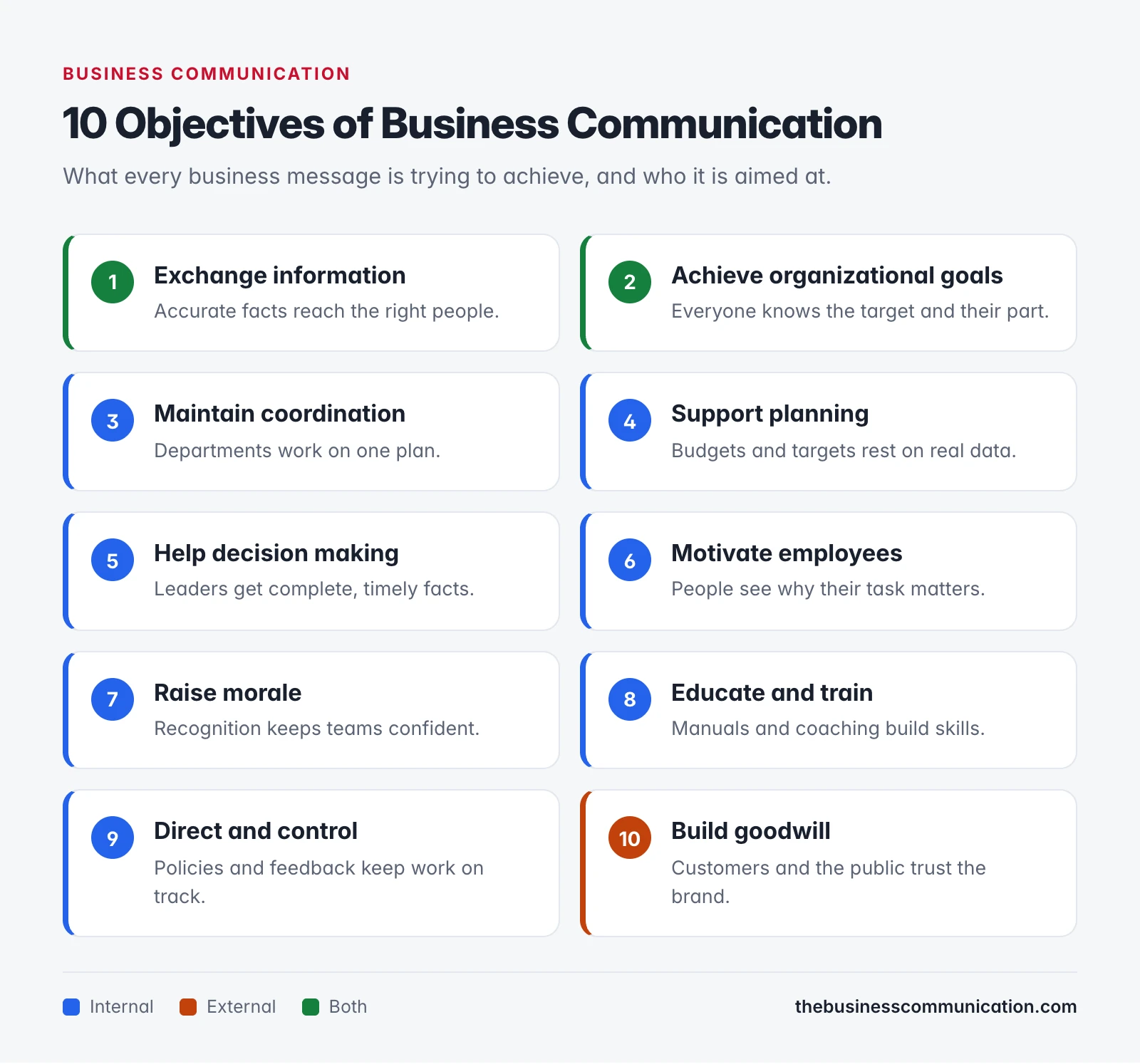
Most BBA and MBA syllabi list ten objectives of business communication. The wording changes a little between textbooks, but the ideas stay the same.
- To exchange information: Facts, instructions and updates must reach the right people without distortion.
- To achieve organizational goals: Every plan depends on people knowing the target and their part in it.
- To maintain coordination: Departments stay in step when they share timelines and decisions.
- To support planning: Managers need accurate data before they set budgets or targets.
- To help decision making: Reports and briefings give leaders the facts they must weigh.
- To motivate employees: People work harder when they understand why their task matters.
- To raise morale: Recognition and honest updates keep a team confident.
- To educate and train: Manuals, workshops and coaching build new skills.
- To direct and control: Orders, policies and feedback keep work on track.
- To build goodwill: Polite, consistent messages earn trust from customers and the public.
Modern writers often group these ten points into four families. The table below shows how that grouping works.
| Category | Objective | What it aims for |
|---|---|---|
| Foundation | Clear information flow | Everyone receives the same accurate message |
| Foundation | Better decisions | Leaders act on complete, timely facts |
| Foundation | Coordination | Teams work on one plan, not several |
| Strategic | Engagement and motivation | Staff care about results, not just tasks |
| Strategic | Change management | People accept new systems with less fear |
| Strategic | Knowledge sharing | Good ideas travel from any level |
| External | Brand reputation | The public hears one consistent voice |
| External | Customer relationships | Buyers return because they feel heard |
| External | Stakeholder trust | Investors and regulators see transparency |
| Modern | Inclusion and digital efficiency | Every voice counts and no channel overloads staff |
What are the three main purposes of business communication?
If you need a shorter answer, most messages serve one of three purposes. They inform, they persuade or they build goodwill. A sales email persuades. A policy memo informs. A thank-you letter builds goodwill.
Many real messages mix all three. A product recall notice informs customers about the risk. It also persuades them to return the item. Handled well, it even protects goodwill.
Internal objectives: keeping the organization in sync
Internal goals keep daily work running. They cover how information moves between managers, staff and departments. When these goals fail, projects slip and people repeat each other’s work.
Clear information flow
The first job of any message is accuracy. Vague instructions create errors, and errors cost time. A clear message names the task, the owner and the deadline.
Information also has to travel in more than one direction. Orders move down, feedback moves up and updates move sideways. Our guide to how messages move up, down and across a company explains each route.
Blocked routes usually trace back to common communication barriers such as jargon or too many layers.
Better decision making
Managers decide with the information they receive. Missing sales data leads to a weak budget. Too much raw data causes a different problem: nobody finds the key number.
Good communication filters and summarizes. A short, well-built report puts the main finding on the first page. Learn more in our guide on writing business reports that support decisions.
Coordination between teams
Say marketing launches a campaign. Sales needs to know the offer before the calls start, and operations needs stock ready for the extra orders. Communication links these steps into one plan.
Remote and hybrid teams feel this most. Without a shared office, a missed update can leave a whole team a week behind.
Engagement and motivation
Engagement is one area where the cost of weak communication is easy to see. Gallup’s 2026 workplace research found that low engagement cost the world economy about $10 trillion in lost productivity, roughly 9% of global GDP.
The same report notes that managers are often the main way employees experience their employer.
That makes the manager’s message central. Explaining the reason behind a task helps. So does a quick note that thanks a team by name. Listening matters as much as speaking, and a working feedback loop shows staff that their input changes something.
Managing change
People resist change they do not understand. Silence makes it worse, because rumors fill the gap. The grapevine often moves faster than any official memo.
Example: imagine a bank moving its branches to new software. A strong plan announces the date early and explains what will change for each role. It also offers training and names a contact for questions. Staff then arrive on launch day prepared instead of anxious.
Knowledge sharing and innovation
Front-line staff often spot problems first. Their ideas only help if a channel exists to share them. Suggestion boxes, team chats and short review meetings all serve this goal.
A junior employee should feel safe proposing a fix to a senior manager. Leaders build that comfort by responding to ideas, even when the answer is no.
External objectives: customers, brand and stakeholders
External goals shape how outsiders see the company. They cover customers, investors, regulators, suppliers and the media. You can read more about this side in our guide to external communication and its goals.
Brand reputation
A brand speaks through every channel at once: press releases, social posts, invoices and support replies. Customers notice when the tone changes from one to the next. A consistent voice builds trust.
Crises put the most pressure on this goal. A quick, honest statement usually limits the damage. Delay and vague wording tend to make the story bigger.
Customer relationships
Communication also shows up in revenue. In the 2024 State of Business Communication report by Grammarly and The Harris Poll, about one in five business leaders said poor communication had cost them business. Among leaders who reported effective communication, 51% cited higher customer satisfaction.
Complaints deserve special care. A customer who complains is giving the company a chance to fix things. A prompt, polite reply that solves the problem often turns that customer into a loyal one.
Stakeholder and investor trust
Investors, lenders and regulators want steady, honest updates. Annual reports, shareholder meetings and timely disclosures all serve this objective. Sharing bad news early, together with a plan, protects that trust far better than silence.
Modern objectives in the digital workplace
Inclusion and psychological safety
Teams today mix cultures, ages and languages. Plain words help everyone follow along. Good meeting habits also matter, such as inviting quieter members to speak and sharing the agenda in advance.
Psychological safety means people can raise a concern without fear of blame. It supports almost every other objective on this list, from feedback to innovation.
Digital efficiency
Knowledge workers now spend about 88% of their workweek communicating, according to the same Grammarly and Harris Poll research. Every worker surveyed reported miscommunication at least once a week. So far, adding channels has not solved the problem of unclear messages.
The modern objective is to use the right channel for each message. An urgent issue suits a call, while a decision belongs in writing so nobody argues about it later. Routine updates can wait for a weekly summary instead of ten separate pings.
How modern goals map to textbook objectives
Exam papers use the classic verbs. Business articles use newer labels. This table connects the two, so you can answer in either style.
| Textbook objective | Modern label | Everyday example |
|---|---|---|
| To inform | Clear information flow | A memo about new office hours |
| To persuade | Customer relationships | A sales proposal to a client |
| To educate | Knowledge sharing | A training session on new software |
| To motivate | Engagement | A manager explaining why a target matters |
| To integrate | Coordination | A joint plan between sales and marketing |
| To order or advise | Direction and control | A policy update with clear steps |
| To relate | Brand and stakeholder trust | A press release or investor letter |
How to write an exam answer on this topic
- Open with a one-line definition of business communication.
- State that the objectives of business communication fall into internal and external goals.
- List the objectives with short headings, as many as the marks require.
- Add one sentence and one example under each heading.
- Close with a line on why clear goals make communication effective, linking to the seven Cs of good communication if time allows.
For a five-mark question, five objectives with brief notes usually work. A ten-mark answer needs more points and a short conclusion.
Frequently asked questions
What are the objectives of business communication?
They are the goals a business pursues through its messages. The main ones are to inform, persuade, coordinate, motivate, educate, direct and build goodwill with employees, customers and other stakeholders.
What are the 10 main objectives of communication?
The usual textbook list covers ten goals: exchanging information, achieving goals, coordination, planning, decision making, motivation, morale, training, direction and control, and goodwill.
What are the three main purposes of business communication?
To inform, to persuade and to build goodwill. Most business messages lean toward one of these, although many serve two or three at once.
What are the 7 business objectives?
This question usually refers to company goals, not communication goals. Common examples include profit, growth, market share, customer satisfaction, productivity, employee development and social responsibility. Communication supports each of them.
What is the difference between objectives and importance of business communication?
Objectives describe what communication tries to achieve. Importance explains why achieving those goals matters to the business. Our article on why business communication matters covers the second topic.
Final thoughts
Every message should serve at least one clear goal. Before you send your next email or memo, ask which objective it supports: to inform, to persuade or to build goodwill. Answering it first usually makes the message shorter.
11 Comments
Nice
It is very helpful for me …
the material is very easy to understanding basic concept of business communication
Thanks soooo much
Best leason
Easy to understand, thanks!!!!
My God bless you ,I like your material
this material is helpful and very easy to understand.
wow
This material is so helpful, thank u so much
Thanks