


Choosing between a business letter and an email is not just about convenience. The format you pick signals how seriously you take the message, affects legal standing, and shapes how your recipient responds. Understanding when each format works best will make you more effective and protect you from common mistakes that damage credibility.
What is a business letter?
A business letter is a formal written document that follows a fixed structure: heading, date, inside address, salutation, body paragraphs, closing, and signature. It is typically printed on company letterhead and delivered by mail or courier. The business letter formats you choose, block, modified block, or semi-block, signal professionalism and attention to detail.
What sets letters apart is their weight. A printed letter on quality paper creates a tangible impression that an email cannot match. Courts accept letters as evidence. HR departments file them in official records. Banks require them for certain transactions. When you need credibility, formality, or a paper trail, a letter delivers all three.
For a deeper look at structure and purpose, see our business letter definition guide.
What is a business email?
A business email is a digital message sent for professional purposes. It includes a clear subject line, polite opening, focused body text, and a closing signature block. Unlike personal emails, business emails follow conventions that protect your reputation and ensure clarity.
Emails dominate daily workplace communication because they are fast, searchable, and accessible from any device. You can attach documents, copy multiple recipients, and get responses within hours instead of days. This speed makes email the default choice for routine updates, meeting coordination, and quick questions.
Quality still matters. A poorly written email, one with typos, vague subject lines, or overly casual language, damages your credibility as much as a sloppy letter would. The email advantages and disadvantages are well documented, but the key takeaway is simple: treat every business email as a reflection of your professionalism.
Key differences: format, formality, and speed
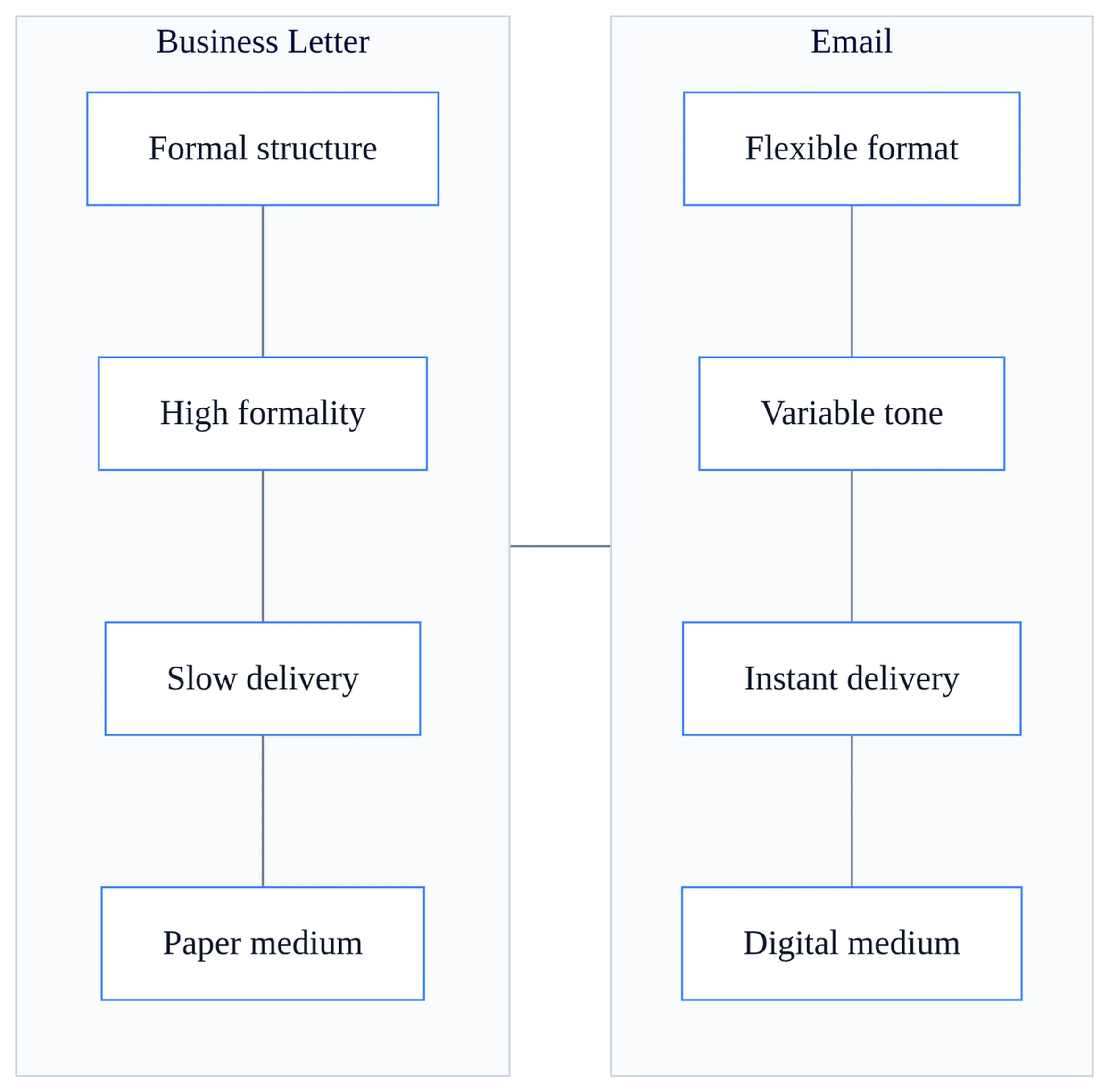
Letters and emails serve different purposes because they differ in structure, tone, and delivery.
| Aspect | Business Letter | Business Email |
|---|---|---|
| Format | Strict alignment (block or modified block); printed on letterhead | Flexible layout; requires subject line and signature block |
| Formality | Highly formal; uses “Sincerely” or “Yours faithfully” | Ranges from formal to semi-formal depending on context |
| Delivery Speed | Days to weeks (printing, mailing, physical handling) | Instant (sent and received within seconds) |
| Medium | Tangible; paper-based; can be signed in ink | Digital; stored on servers; accessed via devices |
| Legal Weight | Strong; often required for contracts and formal disputes | Moderate; can be subpoenaed but less formal than signed letters |
| Impact | Memorable; signals seriousness and respect | Efficient but sometimes forgettable or ignored |
The formality gap is significant. Letters are appropriate for high-stakes communication where you want to convey respect and permanence. Emails work when speed matters more than ceremony. Understanding formal vs informal communication helps you calibrate tone for each format.
When to use a business letter
Business letters are not outdated. They remain the right choice when formality, legal standing, or official record-keeping matter. Use a letter when applying for jobs at traditional organizations. Law firms, financial institutions, government agencies, and academic institutions often expect printed application letters. A well-formatted letter on quality paper signals that you understand professional norms. Use a letter when filing official complaints or adjustment requests. When you need to escalate a problem or create a legal record, a letter shows you are serious. It also provides a physical document that cannot be deleted or lost in an email thread.
Use a letter when drafting contracts or legally binding documents. Signed letters carry more legal weight than emails. Many transactions, real estate deals, employment offers, partnership agreements, require printed letters with original signatures. Use a letter when sending high-impact communications. Recommendation letters, formal thank-you notes, resignation letters, and condolence messages gain gravitas when printed and signed. The extra effort communicates respect. Use a letter when creating an official record. Letters become part of permanent files. HR departments, legal teams, and compliance officers prefer letters for documentation that may be referenced years later.
If you need step-by-step guidance on structure and tone, our guide on how to write a business letter walks through the entire process.
When to use a business email
Email is the workhorse of modern business communication. It handles the majority of daily interactions because it is fast, trackable, and scalable. Use email when you need quick responses. Time-sensitive questions, urgent approvals, and same-day updates require email. Waiting days for a letter to arrive is not practical when decisions must be made quickly. Use email when coordinating routine work. Meeting reminders, status updates, project check-ins, and approval requests are perfect for email. These messages do not require formality, just clarity.
Use email when sharing documents or links. Attachments, cloud storage links, and calendar invites are native to email. Printing and mailing documents is inefficient when you can share them instantly. Use email when communicating across time zones. Distributed teams rely on asynchronous communication. Email lets colleagues in different countries respond when convenient without scheduling calls. Use email when maintaining a searchable record. Email threads create a chronological record of decisions and commitments. You can search your inbox to find exactly what was said and when.
The difference between memo vs email is also worth understanding, especially in organizations that still use internal memos for formal announcements.
Email security, permanence, and emotional intelligence
Here is what most people get wrong about email: it feels temporary but is actually permanent. Every email you send is stored on multiple servers, backed up by IT departments, and can be subpoenaed in legal disputes. Poorly worded emails have been used as evidence in wrongful termination lawsuits, harassment claims, and contract disputes.
Letters, by contrast, are more contained. Once delivered, they exist as a single physical copy unless someone makes duplicates. This makes letters paradoxically more private than emails, which can be forwarded to dozens of people with one click.
The subject line is the most-neglected element of email. A vague subject like “Question” or “Update” gets ignored. A specific subject like “Approval needed: Q3 budget by Friday” tells the recipient exactly what you need and when.
Never write an email when you are angry.
The speed that makes email convenient also makes it dangerous when emotions run high. A letter requires time to print, sign, and mail, which forces you to cool down. Email lets you hit “send” in seconds, and you cannot unsend words that damage relationships or careers. For sensitive topics, bad news, performance feedback, conflict resolution, use a phone call or in-person meeting first, then follow up with a written summary if needed.
Decision framework: letter vs. email vs. phone
Choosing the right format requires more than a binary letter-or-email decision. Sometimes neither is appropriate.
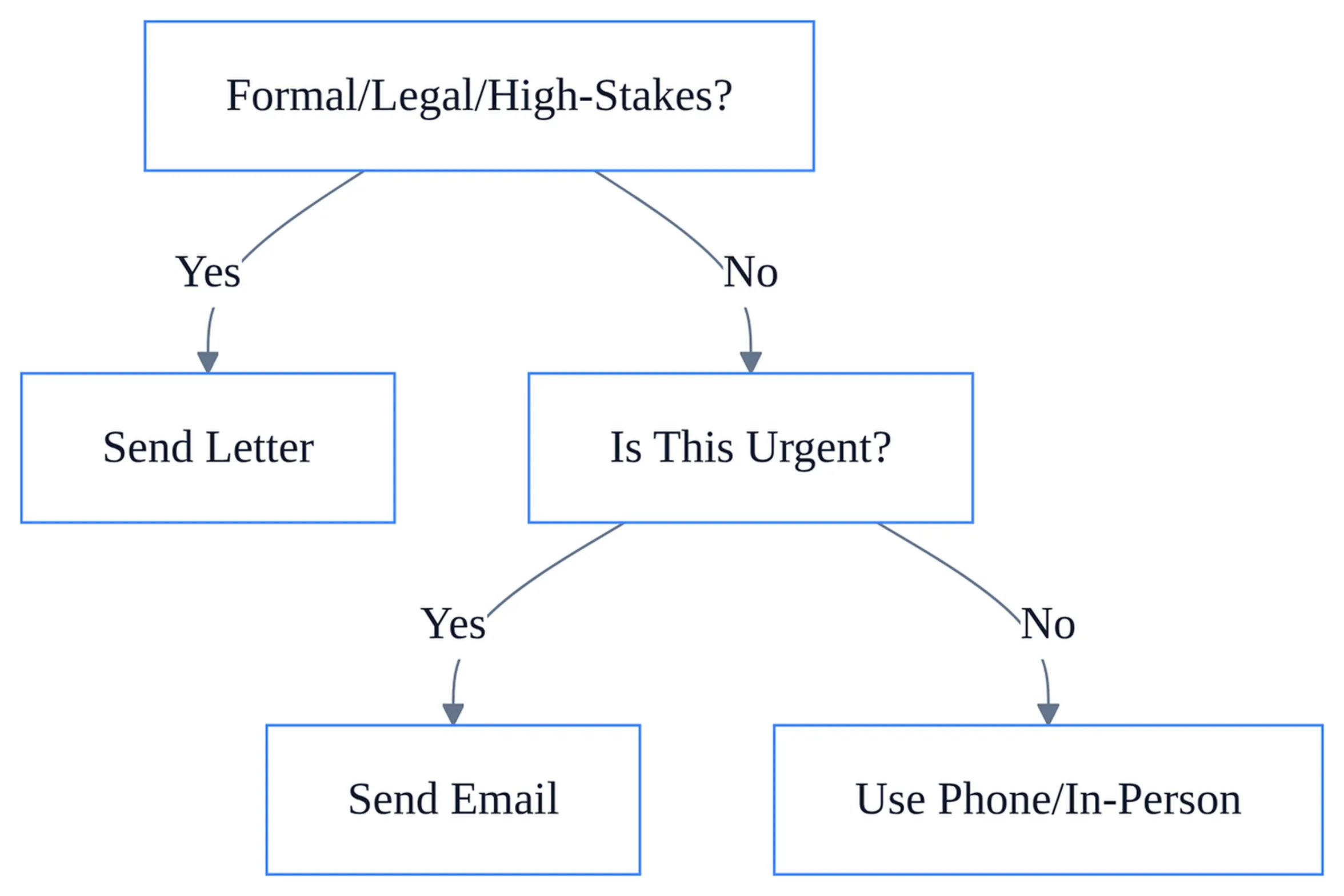
Use a letter when the communication is formal, legal, or high-stakes. You need an official record. The recipient or organization values traditional professionalism. You want to signal respect. Examples: job applications to conservative industries, formal complaints, contracts, resignation letters.
Use email when the communication is routine, time-sensitive, or document-heavy. You need a searchable record. The recipient expects digital communication. Speed matters more than formality. Examples: meeting reminders, status updates, document sharing, quick approvals.
Use phone or in-person when the topic is sensitive, emotionally charged, or requires nuance. You need to build or repair a relationship. Tone and body language matter. Immediate back-and-forth clarification is necessary. Examples: delivering bad news, performance reviews, conflict resolution, salary negotiations, complex problem-solving.
Audience matters. Traditional industries like law, finance, and government lean toward letters for formal communication. Tech startups and creative agencies default to email. Knowing your recipient’s expectations prevents format mismatches that undermine your message.
Urgency also shapes your choice. If you need a response today, email is your only realistic option. If you can wait a week and want maximum impact, a letter may serve you better. The broader context of written communication strengths and weaknesses applies to both formats.
Practical scenarios: making the right choice
Abstract principles only go so far. Here are six real-world scenarios that show how format decisions play out.
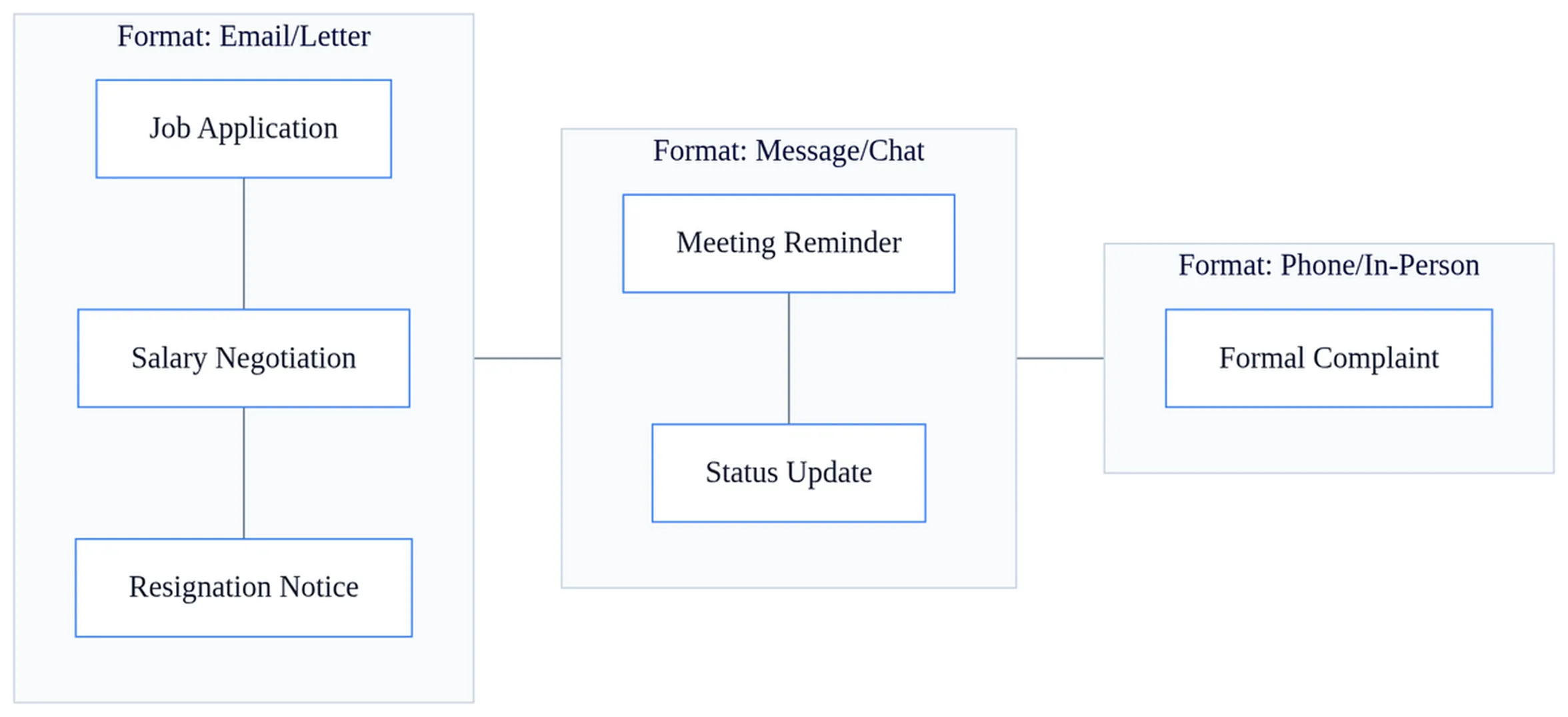
Job application to a law firm or financial institution: Send a printed letter with your resume. These industries value formality and attention to detail. A well-formatted letter on quality paper demonstrates that you understand professional conventions. Follow up with an email if you do not hear back within two weeks. Meeting reminder to a distributed team: Send an email with a calendar link. Your colleagues need quick access to time, location (or video link), and agenda. A letter would arrive too late and cannot include clickable links. Complaint about a service failure: Write a formal letter to the company’s customer service department. A letter creates a legal record, shows you are serious, and often gets escalated faster than email complaints. Keep a copy for your records.
Project status update to your manager: Send an email. Status updates are routine, time-sensitive, and benefit from being searchable. Your manager can refer back to your email when preparing reports or answering questions from senior leadership. Resignation from your current job: Submit a formal letter to your supervisor and HR. Resignation letters become part of your employment file and may be referenced for future background checks. Email a copy as well for speed, but the printed letter is the official document. Salary negotiation or difficult performance feedback: Start with a phone call or in-person meeting. These conversations require emotional intelligence, tone calibration, and real-time adjustment based on the other person’s reactions. After the conversation, send a follow-up email summarizing what was agreed to. This gives you relationship-building and documentation in one sequence.
Consider a small Dhaka-based marketing agency negotiating a contract with a multinational client. The agency might draft the initial proposal as a formal letter to signal professionalism and respect for the client’s corporate culture. Once the relationship is established, routine project updates shift to email for speed. When a problem arises, missed deadlines or scope disagreements, a phone call resolves tension faster than an email exchange that could be misread as accusatory.
The key is matching format to context. A one-size-fits-all approach leaves you either too formal (slowing down routine work) or too casual (undermining serious communication). The best professionals shift fluidly between formats based on what each situation requires. If you are sitting on the fence about which format to use, ask yourself: does this need to be on record in a way that commands respect, or does it need to be handled quickly? That usually points you in the right direction.
Frequently asked questions
Should I follow up a business letter with an email?
Yes, it’s appropriate to send a brief email a few days after mailing a letter to confirm receipt and offer an alternative contact method. Keep the email short and professional. This is especially useful for time-sensitive matters like job applications or formal complaints where you need assurance the recipient got your message.
What if I’m unsure whether the situation calls for a letter or email?
Ask yourself: Does this need legal weight, official record-keeping, or high formality? If yes, use a letter. If the matter is routine, time-sensitive, or requires quick back-and-forth, use email. When in doubt, email first—you can always follow up with a printed letter if the recipient doesn’t respond or if the issue escalates.
Can I print an email and use it as a formal business letter?
No. A printed email lacks the formal structure, letterhead, and handwritten signature that give a business letter its credibility and legal weight. If formality matters, use proper letter format with company letterhead and an original signature. A printed email signals you cut corners.
Why might my complaint letter be ignored if email gets faster responses?
Email is fast but easy to overlook or delete. A printed letter demands attention—it sits on a desk and creates an official record. For serious complaints, a letter shows you’re committed and creates documented evidence. Email works for minor issues; letters work when you need accountability and a paper trail.
Is it acceptable to send a resignation letter by email?
Email is acceptable for resignation if your workplace culture is informal or remote. However, a printed letter followed by email is safer for traditional organizations or if you want to protect yourself legally. The letter creates an official record and shows respect for the formality of the situation.