


A shipment arrives late, the invoice includes charges you never approved, or a product breaks the first time you use it. You need more than frustration, you need a solution. A well-written claim letter documents the problem, presents your evidence, and requests a specific remedy, all while preserving the business relationship.
This guide shows you what a claim letter is, when to write one, how to structure it for fast approval, and which mistakes delay resolution. You’ll see examples for product defects, billing errors, service failures, and warranty disputes, plus a checklist that strengthens every claim you send.
What is a claim letter?
A claim letter is a formal written request for adjustment, compensation, or correction after a problem with a product, service, bill, or contract. You explain what went wrong, attach supporting evidence, and ask the recipient to take a specific action: issue a refund, send a replacement, correct an invoice, or honor a warranty. Unlike a casual complaint, a claim letter aims at a concrete result and creates a documented trail that protects both parties.
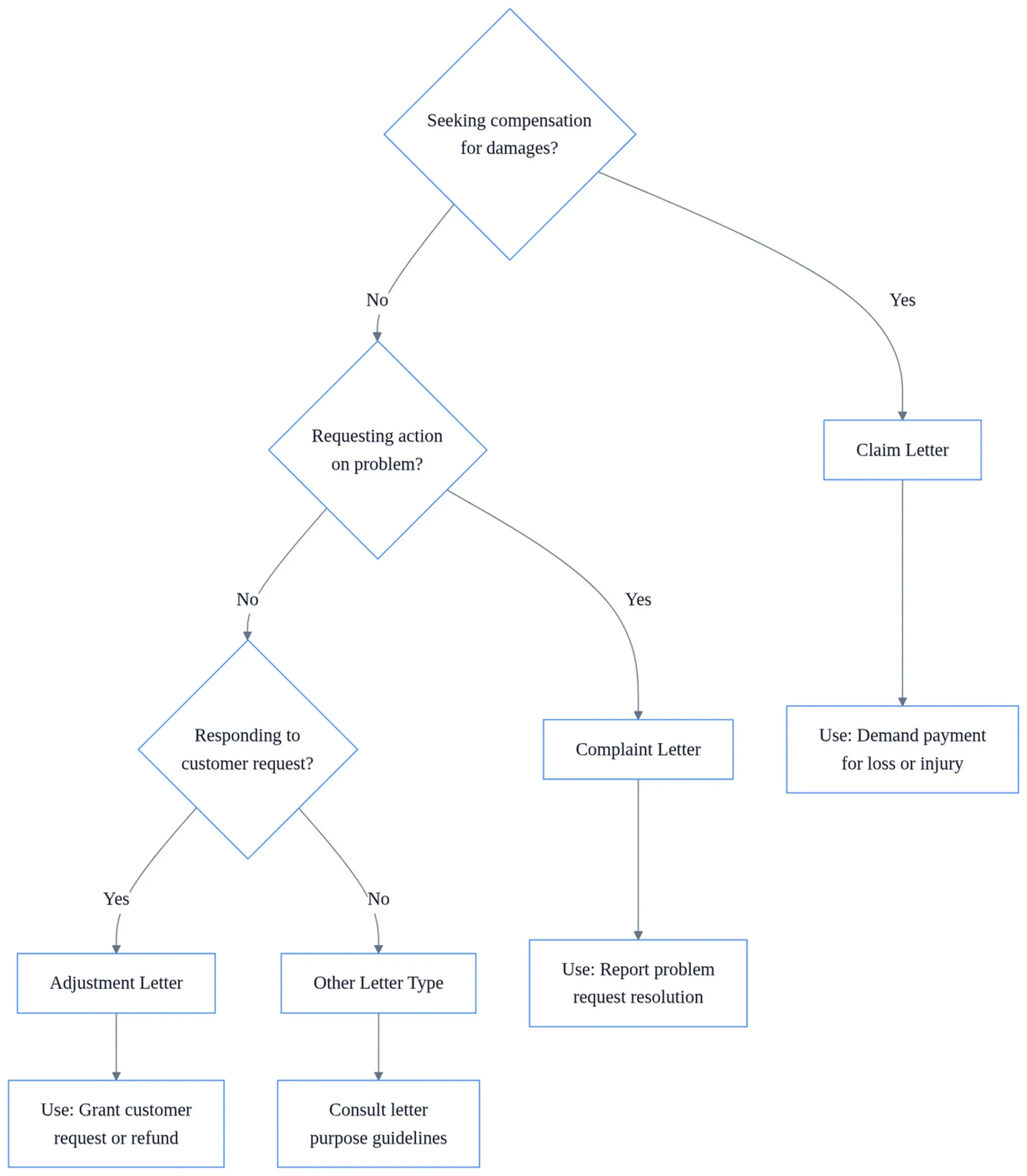
Most businesses expect claim letters and have teams ready to process them. When you follow a clear format and include the right details upfront, you speed up verification and approval. The letter also becomes a record if the matter escalates to legal review, insurance claims, or regulatory complaints. That trail keeps everyone honest and focused on resolution rather than blame.
Keep copies of all correspondence when disputing charges or requesting refunds, especially if the dispute may later need regulatory intervention.
When to write a claim letter
Not every issue needs a letter. A quick phone call often solves minor problems. Write a claim letter when money is at stake, when time has passed without resolution, or when multiple people must coordinate your fix.
Use a letter in these situations: damaged or defective goods where items arrive broken, missing parts, or don’t match the description (photos of the damage and the original order details strengthen your case). Late delivery, lost shipment, or wrong destination where the tracking shows delays or errors despite clear shipping instructions (include tracking numbers and expected delivery dates). Billing errors where double charges, unapproved fees, or incorrect amounts appear on invoices or statements (attach copies of the disputed invoice and your payment records). Poor service where work is incomplete, deadlines are missed, or technicians failed to meet specifications (reference the original contract or service agreement). Warranty claims where repairs or replacements should be covered by the policy (cite the warranty terms and attach proof of purchase).
If you’re unsure whether your situation calls for a formal letter or a more casual approach, review the standard business letter format to understand when structure matters most.
Key characteristics of an effective claim letter
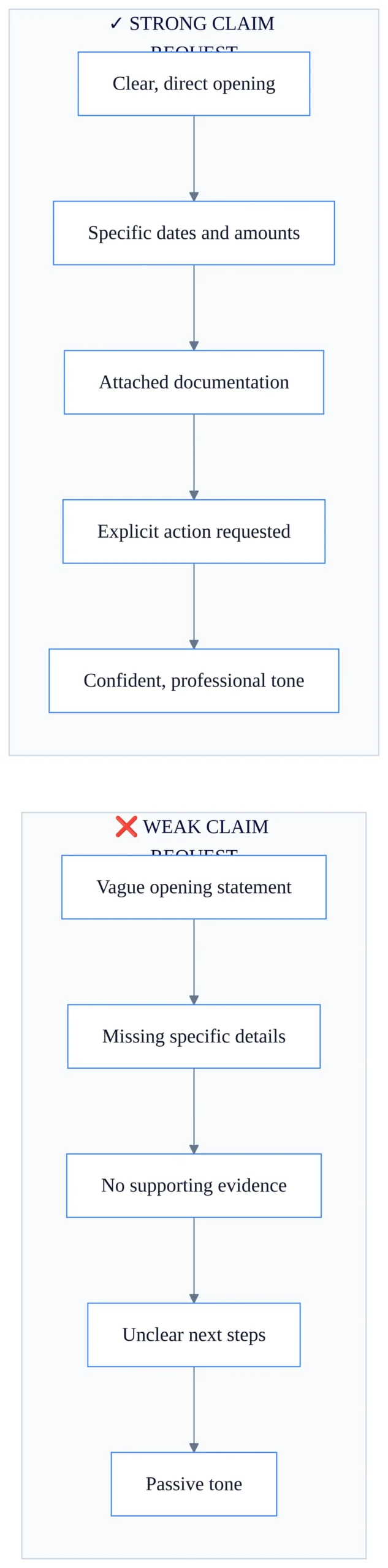
Great claim letters share traits that make them easy to verify and approve. They are brief, factual, and respectful. They include evidence. They ask for a clear action by a specific date.
Write simple sentences. Avoid jargon. Keep one main idea per paragraph. Agents should understand your problem in the first thirty seconds. Name dates, order numbers, invoice numbers, model or serial numbers, and responsible teams. “Order #45821 placed March 3” beats “my recent order.” Attach photos, receipts, tracking pages, screenshots, or test reports. Never send originals, use copies or digital files. Stay courteous but state what you expect and by when. “Please issue a full refund of $450 by April 15” is polite and clear. Show how a quick fix helps both sides and preserves goodwill. Framing the resolution as mutual benefit speeds approval. For deeper techniques, see how you-attitude transforms business correspondence.
One detail most people overlook: the person reading your letter probably wants to help but needs the right information to route your claim correctly. Make their job easy, and you’ll get faster results.
Three more traits separate a good claim letter from a merely correct one:
- A fair and honest claim: Ask only for what is realistic. An inflated or unfair claim makes you look dishonest and can end the business relationship. This is the buyer’s side of the “fair claim, fair adjustment” policy many sellers follow, explained in our adjustment letter guide.
- Confidence in the seller: Write as if you expect the seller to settle the claim fairly. That expectation encourages the reader to give your claim proper consideration.
- No guessing who is at fault: Do not name or blame a particular person for the damage. State the facts impersonally and leave it to the seller to find out who was responsible.
Say this, not that
| Weak wording | Strong wording |
|---|---|
| “You charged me wrongly again!” | “I believe there has been a mistake in the invoice dated May 4.” |
| “Your careless packer broke the units.” | “The units arrived with cracked casings.” |
| “I doubt you will do anything, but I am asking anyway.” | “I am confident you will look into this and settle it fairly.” |
Structure and format of a claim letter
A claim letter follows the same structure as other professional correspondence. If you need a refresher on headers, salutations, and closings, review the parts of a business letter before you start drafting.

Your name, address, phone, and email go at the top. Below that, the date. Below that, the recipient’s name, title, company, and address. This block tells the recipient who you are and where to send the response. Use a formal greeting. “Dear Ms. Patel” or “Dear Customer Service Manager” works. If you don’t have a name, “Dear Sir or Madam” is acceptable, though a name always helps.
Open with a one-sentence statement of the problem. Follow with the facts: dates, order numbers, and what went wrong. Present your evidence in the next paragraph. Close the body with your specific request and a reasonable deadline. Use “Sincerely,” “Regards,” or “Respectfully,” followed by your signature and typed name. If you’re sending a printed letter, leave space for a handwritten signature. List every supporting document at the bottom. “Enclosures: Copy of invoice #7821, photo of damaged item, tracking confirmation.” This list helps the recipient verify that nothing is missing.
Keep the entire letter to one page whenever possible. Two pages maximum. Agents process claims faster when they don’t have to search for the key facts.
Types of claim letters with examples
Claim letters vary by the type of problem you’re addressing. Each type requires slightly different evidence and phrasing. Here are the most common categories with brief examples.
Product claim: A defective item, wrong order, or damaged goods on arrival. Request a replacement or refund. Example: “I ordered a Model X-200 printer (Order #4521, March 10). The printer arrived with a cracked scanner bed. I have attached photos and the original invoice. Please send a replacement or issue a full refund of $340 by March 25.”
Service claim: Incomplete work, missed deadlines, or poor quality. Request rework or a partial refund. Example: “Your team installed new flooring in our office on February 15. Three tiles cracked within one week, and the grout is uneven in two rooms. The contract specified professional-grade installation. Please repair the defects or provide a partial refund of $800 by March 5.”
Billing claim: Double charges, unapproved fees, or incorrect amounts. Request a correction or credit. Example: “My March statement (Account #9921) includes two charges of $125 for the same service on March 3. I authorized only one payment. Please credit my account $125 and send a corrected statement by March 20.”
Warranty claim: Covered repairs or replacements. Cite the policy and request action. Example: “The laptop I purchased on January 10 (Serial #ABC12345) no longer charges. The two-year warranty covers battery and power issues. Please arrange a repair or replacement under the warranty terms by February 28.”
Insurance claim: Payout request for loss or damage. Include the claim number and documentation. Example: “I am filing a claim for water damage to inventory at our warehouse on April 1 (Policy #INS-7821, Claim #45621). I have attached the damage assessment, photos, and inventory list. Please process the claim and issue payment by April 30.”
In finance and insurance contexts, a claim refers to a formal demand for payment or compensation under the terms of a policy or agreement, which mirrors the structure of a claim letter.
Transport claim: Goods lost or damaged in transit. Address the claim to the carrier (the courier, shipping line or transport company) rather than the seller, and attach the delivery note or receipt that records the damage. Example: “Two of the ten cartons delivered under Consignment Note #[number] on [date] were crushed, as noted on the delivery receipt signed by your driver. I have attached the receipt, photos and the invoice for the goods. Please compensate us for the damaged items by [date].”
Complete sample claim letter (defective goods)
The examples above show the key sentence for each type. Here is a full sample letter, laid out in block format, that you can adapt.
[Your Company Name]
[Address]
[Phone] | [Email]
[Date]
[Recipient Name]
Sales Manager
[Supplier Company Name]
[Address]
Subject: Claim for defective air conditioners supplied under Invoice No. 7543
Dear [Recipient Name],
I am writing to inform you that the five air conditioners supplied by your company under Invoice No. 7543, dated [date], were found defective on installation. Two units did not cool at all, and the other three made loud noise during operation.
We request that you replace the defective units or issue a full refund within seven working days of this letter. Copies of the invoice and delivery receipt are enclosed for your reference.
We look forward to your prompt attention to this matter and value our business relationship.
Yours sincerely,
[Signature]
[Your Name]
Purchase Manager
[Your Company Name]
Enclosures: Copy of Invoice No. 7543, copy of delivery receipt
Why this letter works:
- Subject line: names the problem and the invoice number, so the letter reaches the right person.
- First paragraph: states the facts (what, how many, which invoice and what is wrong) without blame.
- Second paragraph: makes a definite request with a deadline and points to the evidence.
- Closing paragraph: ends on goodwill, which makes it easier for the seller to say yes.
- Enclosures line: lists every attachment so nothing goes missing.
To see what the seller’s reply looks like, read our guide to the letter of adjustment.
Common mistakes that delay claim approval
Even a valid claim can stall if you make these common errors. Avoid them, and you’ll cut days or weeks off the resolution timeline.
| Mistake | Why it delays approval | Fix |
|---|---|---|
| Vague requests | “I want a refund” doesn’t specify amount or deadline | “Please issue a full refund of $450 by April 15” |
| Missing details | No order number, date, or model information | Include every identifier in the first paragraph |
| Emotional language | Anger, sarcasm, or threats make agents defensive | Stay professional and focus on facts |
| Weak evidence | No attachments, no photos, no proof of purchase | Attach the most compelling proof first |
| Unclear responsibility | Addressing the wrong department or person | Research the correct contact before sending |
| No deadline | Leaving the request open-ended invites delays | Set a reasonable deadline (7-14 days for simple claims) |
One mistake people rarely discuss: sending the letter to a generic email address instead of a named person. When possible, find the claims manager, customer service director, or warranty coordinator. A named recipient increases accountability and speeds response.
How to strengthen your claim letter
Beyond avoiding mistakes, you can actively strengthen your claim with a few strategic moves. These techniques come from observing which letters get approved fastest.
State the problem in the first sentence, not buried in a paragraph. “I am requesting a refund for Order #4521 due to a defective product” tells the reader everything they need to know immediately. Attach the most compelling proof first. A photo of the broken item, the receipt, and the tracking number should appear before secondary documents like warranty booklets or email threads.
“Four LED panels flicker continuously” beats “the panels don’t work.” Specific descriptions help technicians verify the defect without needing to contact you for clarification. Seven to fourteen days works for simple claims. Thirty days is fair for complex ones that require investigation. Unrealistic deadlines hurt your credibility. “Replacement or refund, whichever is faster” shows flexibility and makes it easier for the recipient to say yes.
One page is ideal. Two pages maximum.
Here’s a contrarian tip: don’t apologize for writing the letter. Phrases like “I’m sorry to bother you” or “I hate to complain” weaken your position. You have a legitimate issue. State it clearly and move to the solution.
Remedies you can request
A definite request names one of these remedies:
- Replacement of the product or service
- A partial or full refund of the purchase price
- Replacement of the whole shipment
- Cancellation of all or part of the order
- Correction of an error in the bill
- A credit note against your next purchase
Claim letter vs complaint letter vs adjustment letter
People often confuse these three types of business correspondence. Each serves a different purpose, and using the right one speeds resolution.
A complaint letter expresses dissatisfaction and describes the issue. It shares feelings and documents the problem but may not request a specific remedy. You might write one to alert a manager to poor service or to create a record of ongoing issues.
A claim letter documents facts, presents evidence, and requests a specific remedy. It aims at resolution: a refund, replacement, correction, or compensation. The tone is professional and solution-focused.
An adjustment letter is the response from the other party. It accepts the claim, rejects it with reasons, or proposes a middle path. Understanding how companies write adjustment letters helps you include the right facts upfront and save rounds of follow-up.
When you know the difference, you can choose the right tool. If you want a concrete outcome, write a claim letter. If you need to document dissatisfaction for the record, a complaint letter may be enough. If you’re responding to someone else’s claim, write an adjustment letter.
Politeness plus firmness works better than anger or threats because it allows the recipient to say yes without losing face. You’re not begging for help; you’re requesting a fair resolution based on the facts. That frame speeds approval and preserves the business relationship for future transactions.
Frequently asked questions
Should I call first or send a claim letter immediately?
Call first for minor issues that a quick conversation can solve. Send a claim letter when money is at stake, the problem persists after contact, or multiple people need to coordinate the fix. A letter creates a documented record that protects you if the issue escalates. If you do call, follow up with a letter to confirm what was discussed and agreed upon.
What if I don’t have the recipient’s name, only the company?
Use a title-based greeting like “Dear Customer Service Manager” or “Dear Claims Department.” A quick phone call or website search often reveals the right person’s name, which speeds processing. If you must use a generic greeting, “Dear Sir or Madam” is acceptable but less effective. Whenever possible, invest the extra minute to find a name.
Can I send a claim letter by email, or must it be printed?
Email is acceptable and often faster. Use a professional subject line like “Claim Request: Order #4521 – Damaged Item.” Keep the same formal structure and attach copies of supporting documents as PDFs. Print and mail only if the recipient specifies it or if the claim involves a legal dispute where a signed original matters.
How long should I wait for a response before following up?
Most businesses respond within 5–10 business days. If you haven’t heard back after two weeks, send a polite follow-up email referencing your original letter and the date you sent it. Include your claim details again in case the first letter was misrouted. Keep follow-ups brief and professional. A short reminder works: “I would like to follow up on my claim letter dated [date] regarding Invoice No. [number]. I would appreciate an update on the matter.”
What if the company denies my claim—can I appeal?
Yes. Send a second letter restating your case with any new evidence you’ve gathered. Reference the denial and explain why you believe it was incorrect. Keep the tone respectful but firm. If the company still refuses, contact your credit card company, file a complaint with the FTC or your state’s consumer protection agency, or consult a lawyer if the amount justifies it.
Should I mention legal action or regulatory complaints in my letter?
No. Threats or mentions of lawsuits can backfire and damage your credibility. State your request clearly and include a reasonable deadline. If the company ignores you, then pursue legal or regulatory options separately. Let your evidence and professionalism speak first.
1 Comment
But keep in mind that whether you have a service or product that’s considered “top of the line,” you will eventually, receive complaints. But think positively because client complaints and claim letters examples can be huge assets for the company.