


A customer complains. Your inbox pings. Your first instinct might be to groan, but here’s the reality: how you respond to that complaint matters more than the complaint itself. A well-written letter of adjustment can turn a frustrated customer into a loyal advocate, protect your reputation, and create a paper trail that prevents disputes from spiraling. This guide will show you exactly what an adjustment letter is, why it’s essential, and how to write one that resolves the issue while preserving goodwill.
What is a Letter of Adjustment?
A letter of adjustment is a formal written reply to a customer complaint. It’s the official response a company sends after receiving a complaint letter about a product defect, service failure, billing error, or any other dissatisfaction. Unlike a quick “Sorry about that!” email, an adjustment letter carries weight. It’s structured, documented, and often becomes part of the company’s permanent records.
The purpose is to acknowledge the customer’s concern, provide a clear solution, and restore their confidence in your business. Think of it as the professional handshake that says, “We heard you, we value you, and here’s exactly what we’re going to do.”
Adjustment letters differ from informal apologies because they follow the standard parts of a business letter, header, salutation, body, and closing, and they commit the company to a specific course of action. They’re not vague. They’re not evasive. They’re accountable.
You may also see it called a claim adjustment letter or a claim settlement letter, because it settles the claim the customer has raised.
Students often mix up the three letters in a complaint exchange. The difference lies in who writes each one and why:
| Letter | Who writes it | Purpose |
|---|---|---|
| Complaint letter | Customer | Expresses dissatisfaction with a product or service. It may not ask for anything specific. |
| Claim letter | Customer | Reports a loss, usually financial, and makes a specific demand such as a refund or replacement, with reasons. |
| Adjustment letter | Seller or service provider | Replies to the complaint or claim by granting it, refusing it, or offering a compromise. |
Why adjustment letters matter in business
Why bother with a formal letter when you could just call the customer? Because written replies create a record, demonstrate seriousness, and often prevent small issues from becoming legal headaches.
Adjustment letters show professionalism. When a customer receives a thoughtful, well-structured reply, they know their concern wasn’t dismissed. Customers who receive prompt, empathetic responses are significantly more likely to remain loyal than those who receive generic replies or silence.
They create documentation. If a dispute escalates, you’ll have proof that you acknowledged the issue and offered a solution. This protects both parties and can prevent misunderstandings down the line.
Adjustment letters build trust. Customers remember how you handled their complaint long after they’ve forgotten the original problem. A respectful, solution-focused reply transforms a negative experience into a demonstration of your company’s integrity.
They reduce conflict. A polite, clear adjustment letter can de-escalate tension before it turns into a social media rant, a chargeback dispute, or even litigation.
Here’s what most businesses miss: complaints are loyalty opportunities.
A customer who complains is still engaged. They’re giving you a chance to fix things. Treat that complaint as a gift, not a nuisance, and you’ll often gain a more loyal customer than you had before the problem occurred.
Key features of an effective adjustment letter
Not all adjustment letters work. Some sound defensive. Others make vague promises that erode trust. Here’s what separates effective replies from damage-control disasters:
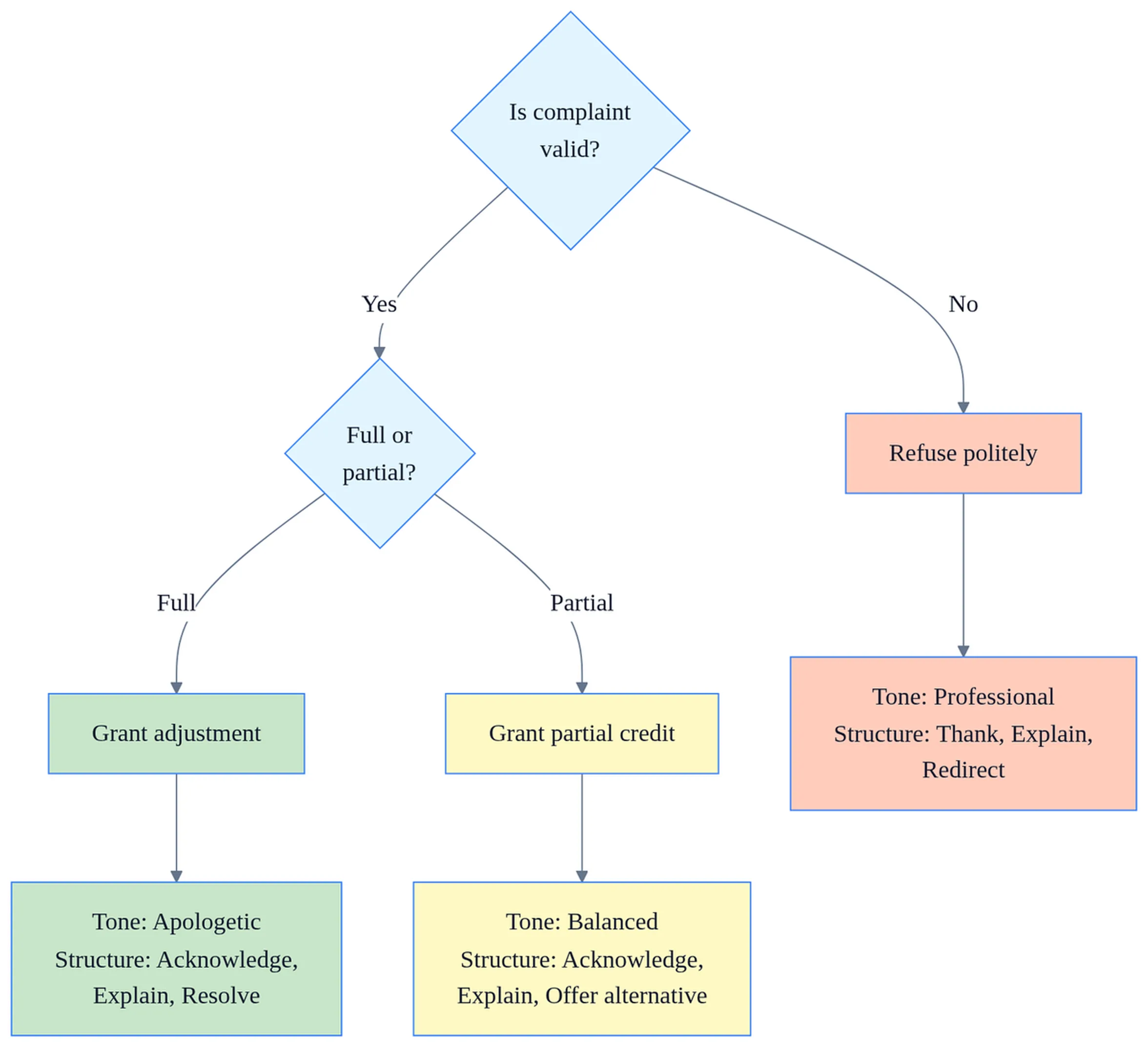
- Respectful, empathetic tone: Even if the complaint feels unfair or exaggerated, your reply must remain courteous. The customer’s perception is their reality.
- Clear acknowledgment: Reference the specific issue. Don’t just say “We’re sorry for the inconvenience.” Say “We understand your frustration with the delayed shipment of your order #4521.”
- Concrete solution with timeline: Avoid “We’ll look into this.” Instead, say “We will issue a full refund to your original payment method within 5 business days.” Specificity builds credibility.
- Assurance of preventive measures: Explain what you’re doing to prevent recurrence. “We’ve updated our inventory system to flag low-stock items before they’re listed as available” is far better than “This won’t happen again.”
- Proper format: Follow the standard business letter format, block, modified block, or semi-block, depending on your company’s style. Structure signals professionalism.
One feature many writers overlook: warmth. Your letter should feel like a handshake on paper, not a legal disclaimer. Balance formality with sincerity, and you’ll strike the right tone.
What should an adjustment letter include? (quick checklist)
For exams and quick revision, the contents of an adjustment letter can be summed up in eight points:
- Acknowledge the claim: Refer to the customer’s letter and thank them for pointing out the problem, for example “Thank you for your letter of [date] about the faulty packet in our last delivery.”
- Express regret: Say sorry sincerely for the inconvenience. If you are clearly at fault, apologise directly, for example “We are sorry that the wrong item reached you.”
- Reply promptly: A late reply only adds to the customer’s anger.
- Grant the request clearly: If you accept the claim, state the refund, replacement or repair at once, within your company’s policy.
- Assure preventive measures: Say what you have changed so the problem does not happen again.
- Offer further cooperation: Close by offering continued service to keep the customer’s goodwill.
- Explain calmly if the claim is unfair: Do not argue. Help the customer see the matter from your side.
- Use courteous, friendly language: Polite wording cools the customer’s anger.
Types of adjustment letters
Adjustment letters aren’t one-size-fits-all. Depending on the situation, you’ll write one of three types. Each requires a slightly different approach, but all demand professionalism and clarity.
Granting the adjustment is the simplest scenario. The customer’s complaint is valid, and you agree to their request, whether that’s a refund, replacement, repair, or formal apology. Your tone here should be apologetic but confident. Example: A customer receives a damaged laptop. You reply with an apology, offer a replacement shipped overnight at no cost, and include a discount code for their next purchase. The key is to act quickly and generously.
Refusing the adjustment is trickier. The customer’s request falls outside your policy, perhaps the warranty expired, the product was misused, or the complaint lacks merit. Your goal is to decline politely without alienating the customer. Example: A customer demands a refund for a phone they dropped in water six months after purchase. You explain that accidental damage isn’t covered under warranty, but you offer a discounted repair service and a link to protective cases. The tone must be firm but respectful, never condescending.
Partially granting the adjustment is the middle ground. You can’t fulfill the full request, but you offer a compromise. Example: A customer complains about a meal at your restaurant. You can’t refund the entire bill because they ate most of the food, but you offer a 50% discount voucher for their next visit and a sincere apology. This approach preserves goodwill while setting reasonable boundaries.
Sending an interim reply comes before any of the three when you don’t yet know who is at fault. It neither grants nor refuses the claim. It confirms receipt, explains that you are investigating, and gives a date by which you will send your decision. Example: “We have received your claim about the damaged carton and have asked our courier for a delivery report. We will write to you with our decision by [date].” Once the facts are clear, follow up with a grant, refusal or partial adjustment.
Some textbooks list six types of adjustment letter. The extra ones, such as a letter apologising for a mistake or a goodwill offer to a dissatisfied customer, are forms of the grant letter rather than separate types.
Adjustment policies: which principle guides your reply?
A company’s claims policy decides which of the letters above you end up sending.
Customer is always right
The company accepts every claim, on the view that customers rarely complain without a genuine reason. Every reply is a grant letter. This wins goodwill, but it can encourage false or exaggerated claims.
Fair claim, fair adjustment
The company checks each claim and grants only those that are genuine. Valid claims get a grant or partial adjustment, and invalid ones get a polite refusal that explains the reason.
Caveat emptor (buyer beware)
The buyer is expected to inspect goods carefully when buying and receiving them. Once sold, goods are not taken back and claims are not entertained. It may save money on individual claims, but it damages goodwill: customers who feel ignored stop ordering and may tell others about the experience.
| Policy | What the company does | Letter you send | Risk |
|---|---|---|---|
| Customer is always right | Accepts all claims | Grant letter | Invites false or exaggerated claims |
| Fair claim, fair adjustment | Checks each claim and accepts only valid ones | Grant, partial adjustment or polite refusal (interim reply while checking) | Takes time to investigate, so replies must still be prompt |
| Caveat emptor | Accepts no claims after sale | Refusal letter | Loses goodwill and repeat business |
How to write an adjustment letter: step-by-step
Writing an effective adjustment letter is easier when you follow a clear process. Here’s the five-step method that works across industries:

| Step | Action | Example Language |
|---|---|---|
| 1. Open with appreciation | Thank the customer for bringing the issue to your attention | “Thank you for contacting us about the issue with your recent order.” |
| 2. Acknowledge the specific issue | Show empathy and reference the exact complaint | “We understand how frustrating it must have been to receive the wrong size after waiting two weeks for delivery.” |
| 3. State the resolution clearly | Explain exactly what you’re doing, with a timeline | “We are shipping the correct size to you today via express delivery, and you should receive it by Friday, March 15.” |
| 4. Explain preventive measures | Describe steps you’re taking to avoid recurrence | “We’ve implemented a double-check system in our warehouse to ensure orders are verified before shipping.” |
| 5. Close with assurance | End on a positive, forward-looking note | “We value your business and are committed to ensuring your next experience with us exceeds your expectations.” |
Notice the specificity. Dates, actions, and systems are named. Vague language like “as soon as possible” or “we’ll try harder” undermines trust. Concrete promises build it.
Tone, language, and diplomacy
Tone is where most adjustment letters succeed or fail. You need to sound professional without being robotic, empathetic without being weak, and firm without being defensive. It’s a balancing act, but a few principles make it easier.
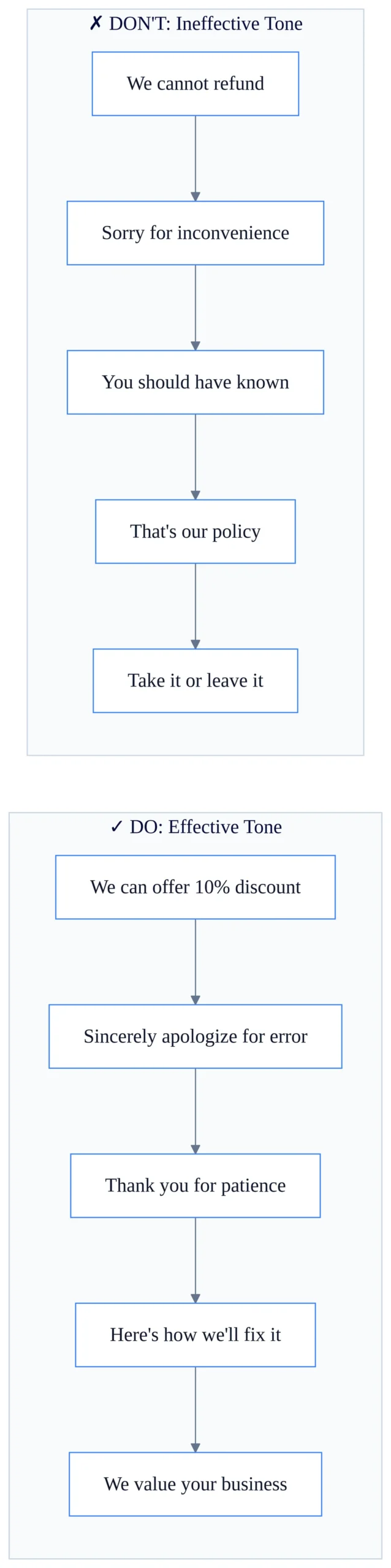
Use positive framing. Instead of “We cannot issue a refund,” say “We can offer a replacement or a store credit.” The first version shuts the door. The second opens alternatives. Positive language reduces customer frustration, even when the answer is no.
Avoid canned phrases. “We apologize for any inconvenience” sounds copy-pasted because it usually is. Instead, write “We’re sorry you had to wait three weeks for a response, that’s not the service we aim to provide.” Specificity signals sincerity.
Never write defensively. Even if the complaint seems unreasonable, resist the urge to argue or explain why the customer is wrong. Your job is to resolve the issue and preserve the relationship, not to win a debate. If you must refuse an adjustment, frame it as policy or limitation, not blame: “Our return policy covers unopened items within 30 days” is better than “You should have read the policy before opening the package.”
Balance formality with warmth. You’re writing a business letter, not a legal brief. A sentence like “We truly appreciate your patience as we worked to resolve this” feels human. “Your patience is appreciated” feels bureaucratic.
Here’s a concrete comparison. Ineffective: “We cannot process your refund request at this time.” Effective: “While we’re unable to offer a refund for opened software, we can provide a full tutorial session with our support team to help you get the most out of the program.”
Response time and urgency
Speed matters. A lot. When a customer complains, every hour you wait is an hour they’re stewing in frustration, telling friends about the problem, or drafting a negative review.
Aim for a same-day response if the complaint arrives during business hours, or a next-business-day reply at the latest. This doesn’t mean you need to resolve the issue immediately, sometimes investigations take time, but you should acknowledge receipt and outline next steps within 24 hours.
Why the urgency? Because speed signals respect. It tells the customer their concern is a priority, not an afterthought. Customers who receive a quicker response tend to remain more loyal than those who wait much longer, even when the final resolution is the same.
When you can’t provide an immediate solution, set clear timeline expectations in your adjustment letter. “We’re investigating the billing discrepancy and will have a resolution for you by end of day Wednesday, March 20” is far better than “We’re looking into it.” Uncertainty breeds anxiety. Clarity builds confidence.
One small contrarian note: don’t sacrifice quality for speed. A rushed, error-filled reply does more harm than a slightly delayed, thoughtful one. But in most cases, you can be both fast and thorough.
Real-world examples by scenario
Theory only goes so far. Here are three concrete examples showing how adjustment letters work in practice, each addressing a different type of response.
Example 1: Granting Full Refund for Defective Product
Dear Ms. Rahman,
Thank you for contacting us about the defective blender you received on March 5. We sincerely apologize that the motor failed after just two uses, that’s not the quality we stand behind.
We are issuing a full refund of Tk 4,500 to your original payment method today, and you should see the credit within 3 to 5 business days. We’ve also arranged for a courier to pick up the defective unit from your address in Dhanmondi at no cost to you. Our team will contact you within 24 hours to schedule a convenient pickup time.
We’ve escalated this issue to our quality assurance team to investigate the manufacturing batch and prevent similar defects. We value your trust in our products and hope you’ll give us another opportunity to serve you in the future.
Sincerely,
Customer Service Team
Example 2: Refusing Refund Due to Warranty Expiration (Tactful Denial)
Dear Mr. Hossain,
Thank you for reaching out about the issue with your laptop’s battery. We understand how frustrating it is when a device doesn’t perform as expected.
After reviewing your purchase records, we found that your laptop was purchased in January 2022, which places it outside our standard one-year warranty period. Unfortunately, we’re unable to offer a free replacement under warranty terms.
However, we’d like to help. We can provide a replacement battery at a 30% discount, bringing the cost to Tk 3,150 instead of Tk 4,500. If you’d prefer, our service center can install it for an additional Tk 500. This offer is valid until March 31, 2024.
We appreciate your understanding and hope this solution works for you. Please let us know how you’d like to proceed.
Best regards,
Support Team
Example 3: Partial Adjustment with Discount Voucher and Apology
Dear Mrs. Chowdhury,
Thank you for sharing your feedback about your recent dining experience at our Gulshan location on March 10. We’re sorry to hear that your main course arrived cold and that our staff took 15 minutes to address the issue.
While we’re unable to refund the full meal cost, we’d like to make this right. We’re sending you a voucher for Tk 2,000 toward your next visit, which covers the cost of your main course and dessert. The voucher is valid for six months and can be used at any of our three Dhaka locations.
We’ve also spoken with our kitchen and service teams to review timing protocols during peak hours. Your feedback helps us improve, and we’re committed to ensuring your next experience meets the standard we’re known for.
We hope to welcome you back soon.
Warm regards,
Restaurant Manager
Exam-style sample: adjustment grant letter for replacement goods
Problem (exam exercise, fictional businesses): Rafee Enterprise, Islamia Market, Nawabpur, Dhaka, a wholesaler of fluorescent markers, has received a claim letter from Nujhat Stationaries, Nilkhet, Dhaka, asking it to replace one packet of markers. Write an adjustment grant letter telling the customer that the new supply will reach them within the next two days.
Rafee Enterprise
Islamia Market, Nawabpur, Dhaka
[Date]
The Proprietor
Nujhat Stationaries
Nilkhet, Dhaka
Subject: Replacement of one packet of fluorescent markers
Dear Sir,
Thank you for your letter of [date] informing us that one packet of fluorescent markers in our last delivery was faulty. We are glad you brought this to our notice.
We are sorry for the trouble this has caused you. We have checked your order and accept your claim in full.
A fresh packet of markers has been set aside for you and will reach your shop within the next two days at no extra cost.
We have asked our packing staff to check every packet before dispatch so that this does not happen again. We value your business and look forward to serving you in future.
Yours faithfully,
[Signature]
[Name]
Sales Manager, Rafee Enterprise
What each part does:
- First paragraph: acknowledges the claim letter and thanks the customer.
- Second paragraph: expresses regret and grants the claim.
- Third paragraph: states the action and time limit the question asks for.
- Fourth paragraph: assures preventive measures and closes on goodwill.
- Layout: full block format, with every part starting at the left margin.
Notice how each example names specific amounts, dates, and actions. There’s no ambiguity about what happens next or when it will happen. That’s the hallmark of effective communication in adjustment letters.
A well-written adjustment letter does more than resolve a complaint. It demonstrates that your business values accountability, respects customers enough to respond thoughtfully, and understands that mistakes are opportunities to prove your character. Whether you’re granting a full refund, offering a compromise, or tactfully declining a request, clarity and empathy will carry you further than any generic apology template ever could.
Frequently asked questions
What if the customer’s complaint seems unfair or exaggerated?
Remain courteous regardless. The customer’s perception is their reality, and a defensive tone will only escalate tension. Acknowledge their concern specifically, explain your position calmly, and offer what you can within policy. A respectful decline with a partial solution often preserves the relationship better than a justified refusal. Set out the facts so the customer can see the matter from your side, rather than telling them they are wrong.
Should I apologize even if the company wasn’t at fault?
Yes, but strategically. Apologize for the customer’s frustration or inconvenience, not necessarily for wrongdoing. Say “We’re sorry you experienced this issue” rather than “We’re sorry we failed.” This shows empathy without admitting liability, which protects you legally while maintaining goodwill.
How quickly should I send an adjustment letter after receiving a complaint?
Within 24–48 hours is ideal. A prompt response signals that you take the complaint seriously and prevents the customer from escalating to social media or chargebacks. If you need time to investigate, send an acknowledgment immediately, then follow up with the full adjustment letter once you have answers.
What should I send if I don’t yet know who is at fault?
Send an interim reply. Thank the customer, confirm that you have received the claim, explain that you are investigating, and give a date for your decision. When the facts are in, send the grant, refusal or partial adjustment letter.
Is email acceptable, or should adjustment letters always be printed and mailed?
Email is acceptable and often preferred for speed. However, use a professional format, include a clear subject line, and maintain the structure of a formal business letter. For high-value disputes or legal sensitivity, follow email with a printed copy. Match the customer’s preferred communication method when possible.
What if I’m offering a partial adjustment but the customer wanted more?
Frame it as a genuine compromise, not a consolation prize. Explain your reasoning clearly, emphasize what you are providing, and show that you’ve considered their position. End by inviting further dialogue if they have concerns. A transparent partial solution often satisfies better than a vague refusal.
Should I include specific preventive measures in every adjustment letter?
Yes, when honest and relevant. Customers want assurance the problem won’t repeat. Avoid generic promises like “This won’t happen again.” Instead, describe concrete steps: “We’ve retrained our shipping team” or “We’ve updated our quality checks.” If no change was needed, a brief explanation suffices.
2 Comments
I’m so glad to have access to such an article. Thank you so much for having jotted down it.
Wow