


Close Menu
The Business CommunicationThe Business Communication
    What's Hot

    Memo vs. Business Letter: Key Differences & When to Use Which

    December 3, 2025

    Mastering Negotiation Skills: The Role of Oral Communication

    December 2, 2025

    Non-Verbal Cues: How Body Language Impacts Oral Communication

    December 2, 2025
    Facebook X (Twitter)
    The Business CommunicationThe Business Communication
    Button
    • Basics
      1. Introduction
      2. Communication Skills
      3. Modern Communication
      4. View All

      Types of Communication | Different Types of Communication

      October 7, 2025

      Qualities of good communication | Requirements of effective communication

      September 26, 2025

      Business Communication Roles: Key Functions And Examples

      September 9, 2025

      What is Communication Process? Steps And Examples Explained

      September 7, 2025

      Meaning Of Cross-Cultural Communication

      October 19, 2025

      8 Ways To Improve Your Listening Skills

      August 11, 2025

      Various Styles Reading or Techniques of Reading

      July 6, 2025

      What Is Communication Style | Classification Of Communication Style

      March 16, 2025

      What Is The Video Conference? Advantages & Disadvantages of Video Conferencing

      April 30, 2025

      Advantages And Disadvantages Of Satellite Television In Business Communication

      November 16, 2024

      What Is Voicemail? Advantages and Disadvantages Of Voicemail

      October 13, 2024

      What Is Communication Satellite?

      August 12, 2024

      Memo vs. Business Letter: Key Differences & When to Use Which

      December 3, 2025

      Mastering Negotiation Skills: The Role of Oral Communication

      December 2, 2025

      Non-Verbal Cues: How Body Language Impacts Oral Communication

      December 2, 2025

      Glossophobia: How to Overcome the Fear of Public Speaking

      December 2, 2025
    • Forms of Communication
      • Oral Communication
      • Non-Verbal Communication
      • Report Writing
    • Written Communication
      1. Letter Writing
      2. Circular Letter
      3. inquiry letter
      4. Ultimatum Letter
      Featured
      Letter Writing

      Memo vs. Business Letter: Key Differences & When to Use Which

      By Masudur RashidDecember 3, 2025
      Recent

      Memo vs. Business Letter: Key Differences & When to Use Which

      December 3, 2025

      Advantages and Disadvantages of Business Letter: A Comprehensive Analysis

      October 20, 2025

      Inquiry Letter for Job Vacancy (Samples & Email Scripts)

      October 19, 2025
    • In Business
      1. Company Meeting
      2. Secretarial Functions
      3. View All

      Virtual Meetings for Companies: Tools, Etiquette & Challenges

      October 19, 2025

      Participants Responsibilities in Meeting

      October 7, 2025

      Meaning of Company Secretary | Appointment of Company Secretary

      May 29, 2025

      What is Annual Business Report – The Business Communication

      January 22, 2025

      What is Secretary? Types of secretary

      January 21, 2025

      What Is Organizational Communication – Types of Organizational Communication

      December 18, 2024

      Functions of a Private Secretary

      April 21, 2024

      Qualifications of a Private Secretary

      October 4, 2023

      Memo vs. Business Letter: Key Differences & When to Use Which

      December 3, 2025

      Mastering Negotiation Skills: The Role of Oral Communication

      December 2, 2025

      Non-Verbal Cues: How Body Language Impacts Oral Communication

      December 2, 2025

      Glossophobia: How to Overcome the Fear of Public Speaking

      December 2, 2025
    • Internal Communication
      1. Downward Communication
      2. Horizontal Communication
      3. Upward Communication
      4. View All

      Essential Elements of Downward Communication: A Complete Guide for Managers

      August 17, 2025

      Key Objectives of Downward Communication in an Organization

      June 26, 2025

      The Effectiveness of Downward Communication: Factors, Barriers, and Measurement

      April 13, 2025

      Advantage And Disadvantages of downward communication

      April 10, 2025

      Upward vs Downward vs Horizontal Communication: Key Differences

      December 19, 2024

      Differences Between Horizontal and Vertical Communication

      September 21, 2024

      What is Horizontal Communication: Definition, Examples & Importance

      March 15, 2024

      Importance of Horizontal Communication (With Real-Life Examples)

      December 28, 2023

      Psychological Safety & Upward Communication: Building Trust at Work

      October 25, 2025

      Common Barriers to Effective Upward Communication and Solutions

      October 15, 2025

      Future of Upward Communication in Remote/Hybrid Workplaces

      May 29, 2025

      Upward vs Downward vs Horizontal Communication: Key Differences

      December 19, 2024

      Memo vs. Business Letter: Key Differences & When to Use Which

      December 3, 2025

      Mastering Negotiation Skills: The Role of Oral Communication

      December 2, 2025

      Non-Verbal Cues: How Body Language Impacts Oral Communication

      December 2, 2025

      Glossophobia: How to Overcome the Fear of Public Speaking

      December 2, 2025
    The Business CommunicationThe Business Communication
    Home » Oral Communication » What is Speech and How to Plan a Speech Step by Step

    What is Speech and How to Plan a Speech Step by Step

    By Masudur RashidNo Comments7 Mins Read Oral Communication
    Facebook Twitter Reddit WhatsApp Telegram Pinterest LinkedIn Email
    Share
    Facebook Twitter Pinterest WhatsApp Email

    Have you ever wondered why some people can stand in front of a crowd and speak confidently, while others struggle to find their words? The secret is not just confidence, it’s planning and understanding the art of speech. In this guide, we will explore what speech is, why it’s so powerful, and how you can plan one that truly connects with your audience.

    Introduction

    Speech is one of the most natural and powerful forms of communication. Whether you’re delivering a motivational talk, explaining a project to your team, or presenting a report in class, a well-structured speech helps you express ideas clearly and influence others.

    Unlike casual conversation, a speech is a structured and purposeful form of oral communication. It has a clear goal — to inform, persuade, motivate, or entertain. Understanding how to craft and plan a speech can make the difference between being heard and being remembered.

    Understanding Speech in Communication

    So, what exactly is a speech?

    A speech is a formal talk delivered to an audience with the purpose of sharing information, ideas, or emotions. It’s not just about words, but about connecting minds. Speech, as a form of oral communication, bridges thoughts between speaker and listener, transforming information into influence.

    Speech is part of a wider communication process that includes verbal, non-verbal, and written forms. You can explore how these work together in your communication strategy by checking out Types of Communication.

    Key Elements of Speech

    Every good speech involves five essential elements:

    1. Speaker – the person delivering the message.
    2. Message – the information, idea, or feeling being expressed.
    3. Audience – the group listening to the speech.
    4. Medium or Channel – how the speech is delivered (in person, online, through video, etc.).
    5. Feedback – reactions from the audience that show understanding and engagement.

    These elements work together to create meaningful interaction. Without them, even the most brilliant ideas can fall flat.
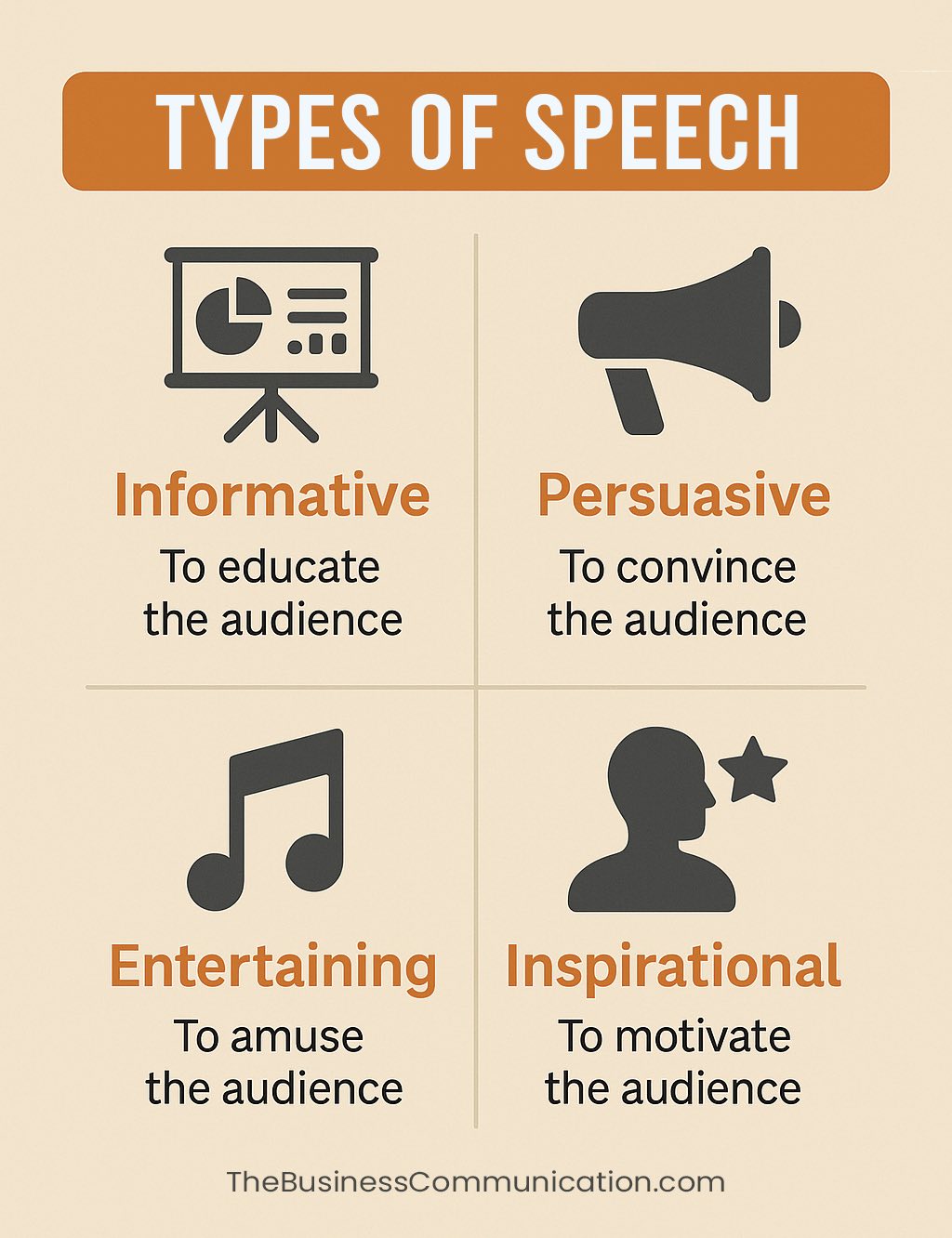
    Types of Speech

    Types of Speech

    Speeches come in many forms, each serving a unique purpose. Let’s look at the major types:

    Informative Speech

    Designed to share knowledge and explain facts. Teachers, trainers, and professionals use this type of speech often. For example, explaining the principles of communication to students falls under this category.

    Persuasive Speech

    Used to influence opinions and motivate action. Think of sales pitches, campaign speeches, or motivational talks.

    Motivational Speech

    Aimed to inspire and encourage. These speeches often include personal stories and emotional appeal.

    Entertaining Speech

    Light-hearted and meant to amuse, such as wedding toasts or award ceremony speeches.

    Special Occasion Speech

    Speeches for ceremonies, farewells, inaugurations, or birthdays. These have emotional and cultural significance.

    Business or Professional Speech

    Used in meetings, conferences, or workplace settings. Learning the ways of oral communication can help you deliver effective business presentations.

    Functions and Importance of Speech

    Why is speech important? Because it shapes perception, builds relationships, and drives action. Here are some key functions:

    1. Influence and Persuasion: Great speeches can change how people think and act.
    2. Leadership Tool: Every successful leader is a powerful speaker.
    3. Relationship Building: Speech strengthens human connections in both personal and professional life.
    4. Education and Awareness: Through speech, knowledge spreads across generations.
    5. Social Harmony: Communication reduces conflict and promotes understanding.

    If you want to understand how speech plays a role in organizations, explore The Nature of Communication for deeper insights.

    Barriers to Effective Speech

    Even the best speakers face challenges. Here are some common barriers:

    • Physical Barriers: Noisy surroundings or poor sound systems.
    • Linguistic Barriers: Using jargon or complex words that confuse the audience.
    • Psychological Barriers: Fear, nervousness, or lack of confidence.
    • Cultural Barriers: Misunderstanding due to cultural differences.
    • Poor Organization: Disorganized ideas can make a speech unclear.

    You can overcome many of these by studying Causes of Failure of Oral Communication and applying those lessons.

    How to Plan a Speech (Step-by-Step Guide)

    Planning is the secret ingredient of every successful speech. Follow these simple steps:

    Step 1: Know Your Purpose and Audience

    Ask yourself, “Why am I speaking, and who am I speaking to?” Your audience determines your tone, language, and examples.

    Step 2: Select the Right Topic

    Pick a topic that matches your purpose and resonates with your audience. It could be informative, persuasive, or inspirational.

    Step 3: Research and Gather Information

    Support your ideas with facts, statistics, stories, and examples. This makes your speech credible and engaging.

    Step 4: Organize Your Structure

    Divide your speech into three clear parts:

    • Introduction – Grab attention with a story, quote, or question.
    • Body – Present your main points logically.
    • Conclusion – Summarize and end with a memorable message.

    Step 5: Write and Refine

    Don’t write for yourself, write for your listener. Keep sentences short and conversational. Avoid jargon.

    Step 6: Add Visual or Audio Aids

    Slides, charts, or videos can make your speech more engaging. To learn more, see Forms of Visual Communication.

    Step 7: Practice and Perfect

    Rehearse several times. Time your delivery. Record yourself and analyze your voice, tone, and expression.

    If you’d like detailed tips, your post on Preparing an Effective Speech expands beautifully on this process.

    Structure of a Well-Planned Speech

    A clear structure keeps your audience engaged. Here’s a simple model:

    • Opening: Use humor, a story, or a surprising fact.
    • Body: Present 3 to 5 main points, each supported by examples.
    • Conclusion: Reinforce the core idea and give a call to action.

    Remember, a good beginning attracts attention, but a strong ending creates impact.

    Qualities of an Effective Speech

    What makes a speech memorable?
    Here are some essential qualities:

    1. Clarity: Use simple language and short sentences.
    2. Organization: Follow a logical flow.
    3. Confidence: Maintain eye contact and steady tone.
    4. Relevance: Tailor your message to your audience’s interest.
    5. Engagement: Encourage interaction or reflection.
    6. Non-Verbal Support: Facial expressions, gestures, and pauses help a lot.

    You can read more about the importance of body language in your post on Non-Verbal Communication.

    Role of Technology in Modern Speech Delivery

    The digital era has transformed speech delivery. Today, speeches can reach millions through live streams and video platforms. Visual aids, presentation slides, and interactive polls can make your delivery more dynamic.

    Understanding Digital Media in Mass Communication can help you adapt your speech for modern audiences.

    Practical Examples of Speeches

    Let’s look at a few real-world cases:

    • Informative Speech: A teacher explaining report writing techniques.
    • Persuasive Speech: A manager motivating the team to embrace new technology.
    • Motivational Speech: A leader encouraging students to pursue lifelong learning.

    You can also connect your speech to writing tasks by reviewing What is Report?, which links oral delivery to written communication skills.

    Final Tips for Effective Speech Planning

    Here are some practical takeaways before you step onto the stage:

    • Practice daily, even in front of a mirror.
    • Ask for feedback from a friend or mentor.
    • Adapt your speech to audience reactions.
    • Stay authentic and use your natural voice.
    • Keep it short and meaningful.
    • Smile — your audience will feel your confidence.

    Remember, even famous speakers like Martin Luther King Jr. and Steve Jobs practiced their speeches for hours before delivering them.

    Conclusion

    Speech is more than words; it’s the art of connection. Whether you speak to inform, persuade, or entertain, planning your speech helps you deliver your message effectively. The key lies in preparation, structure, and genuine communication.

    If you master the planning process, you’ll not only speak confidently but also leave a lasting impression on your audience. So, start planning your next speech today and make your voice count.

    Share. Facebook Twitter Pinterest LinkedIn WhatsApp Reddit Email
    Previous ArticleFormal vs. Informal Communication: Key Differences And When to Use Each
    Next Article What is Secretary? Types of secretary
    Masudur Rashid
    • Facebook
    • X (Twitter)
    • Instagram
    • LinkedIn

    👋 Hi, I am Masudur Rashid. I studied Management (Honors and Masters) but my real passion has always been Business Communication. Through this blog, I share simple tips, lessons, and resources to help students and professionals communicate with confidence.

    Related Posts

    Oral Communication 09 Mins Read

    Mastering Negotiation Skills: The Role of Oral Communication

    Oral Communication 09 Mins Read
    Oral Communication 09 Mins Read

    Non-Verbal Cues: How Body Language Impacts Oral Communication

    Oral Communication 09 Mins Read
    Oral Communication 08 Mins Read

    Glossophobia: How to Overcome the Fear of Public Speaking

    Oral Communication 08 Mins Read
    Oral Communication 09 Mins Read

    The Power of Active Listening in Oral Communication: Skills & Techniques

    Oral Communication 09 Mins Read
    Add A Comment
    Leave A Reply Cancel Reply

    This site uses Akismet to reduce spam. Learn how your comment data is processed.

    Subscribe to Updates

    Get the latest business communication news from TBC.

    By signing up, you agree to the our terms and our Privacy Policy agreement.

    Check your inbox or spam folder to confirm your subscription.

    Top Picks

    Types of Communication | Different Types of Communication

    Here you will get about kinds or classification or Types of communication. There are several…

    Qualities of good communication | Requirements of effective communication

    Whenever the sender and also recipient understand the meaning connected with communication virtually just as,…

    Business Communication Roles: Key Functions And Examples

    In every workplace, communication is the glue that holds everything together. It connects teams, builds…

    What is Communication Process? Steps And Examples Explained

    Have you ever played the “telephone game” as a child? Someone whispers a message, and…

    Welcome to TheBusinessCommunication.com, your guide to clear and effective business communication. Here you will find simple lessons on report writing, letters, meetings, oral and written communication, and modern tools like email or virtual meetings. Our mission is to make learning communication easy, practical, and fun, so you can apply it in your studies, career, and everyday life.
    We're social. Connect with us:

    Facebook X (Twitter) YouTube LinkedIn RSS
    Top Insights

    Memo vs. Business Letter: Key Differences & When to Use Which

    Mastering Negotiation Skills: The Role of Oral Communication

    Non-Verbal Cues: How Body Language Impacts Oral Communication

    Subscribe to Updates

    Get the latest business communication news from TBC.

    By signing up, you agree to the our terms and our Privacy Policy agreement.

    Check your inbox or spam folder to confirm your subscription.

    Copyright © 2025 TheBusinessCommunication. All Rights Reserved.
    • Home
    • About Us
    • Contact US
    • Our Authors
    • Privacy Policy
    • Terms and Conditions

    Type above and press Enter to search. Press Esc to cancel.