


Vertical communication is the exchange of information between different levels of an organization’s hierarchy. It flows up and down the chain of command, connecting executives, managers, supervisors, and frontline employees. Understanding how vertical communication works, and when it breaks down, helps you build more transparent workplaces.
What is vertical communication?
Vertical communication refers to information moving between organizational hierarchy levels. When your manager sends you a project directive, that’s vertical communication flowing downward. When you submit a progress report to your supervisor, that’s vertical communication flowing upward.
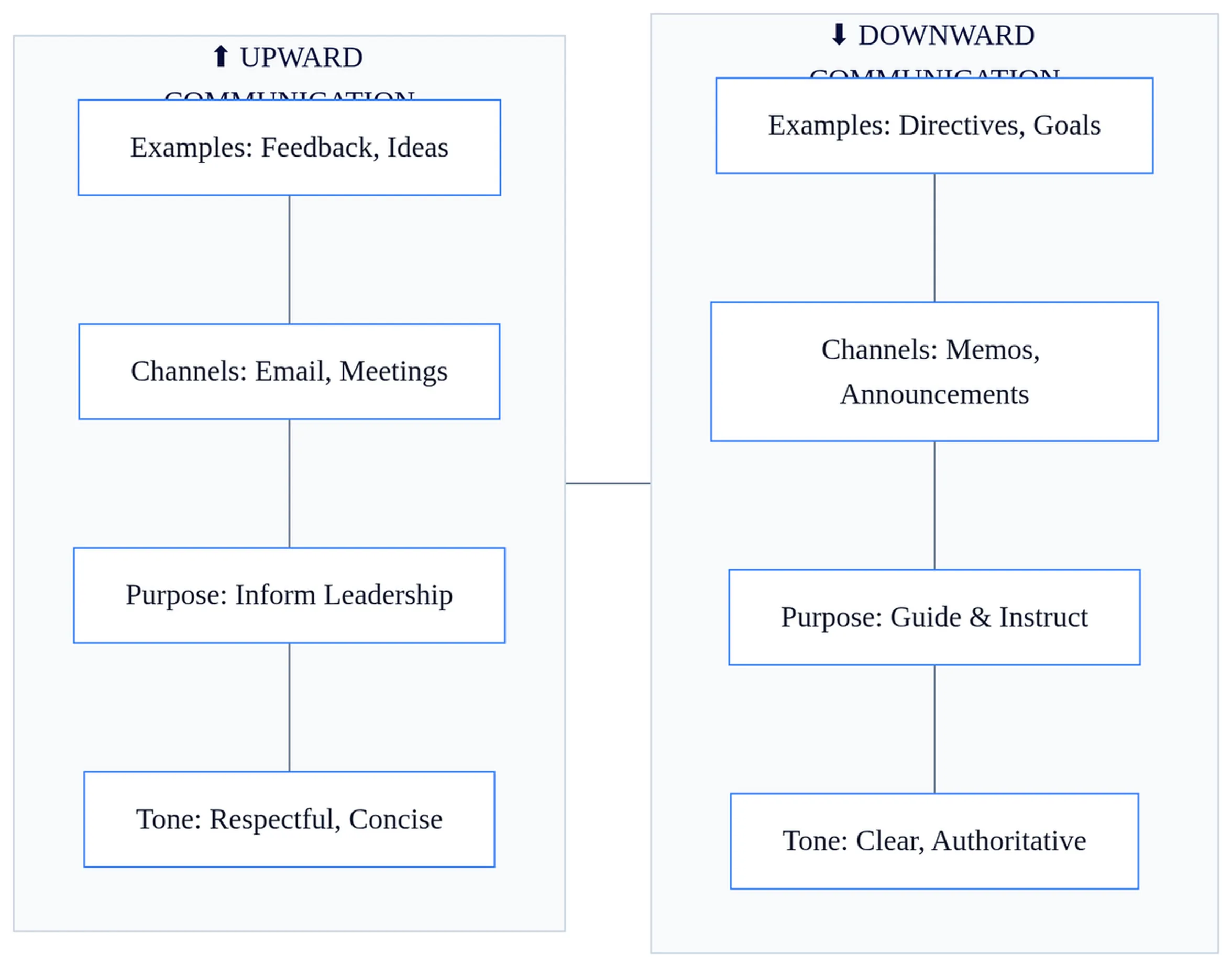
This communication pattern follows the chain of command. A production worker reports to a shift supervisor, who reports to a plant manager, who reports to a regional director. Information travels through these defined levels rather than skipping steps or moving sideways between peers.
Vertical communication is distinct from horizontal communication, where information flows between colleagues at the same organizational level. Both patterns exist simultaneously in healthy organizations. Vertical flows maintain authority structures and strategic alignment. Horizontal flows enable coordination between departments and teams.
The effectiveness of vertical communication depends heavily on your organization’s structure. A traditional manufacturing company with eight management layers will rely on vertical channels far more than a 30-person startup where the CEO sits in an open office next to junior developers.
Upward vs. downward communication
Vertical communication splits into two distinct directions.
Upward communication carries information from employees to management. This includes performance reports, feedback on policies, suggestions for improvement, and alerts about problems. When a customer service representative tells their team lead that clients are confused by the new return policy, that’s upward communication in action. When employees complete engagement surveys or raise concerns through an anonymous hotline, they’re using upward channels.
Upward communication gives leadership visibility into ground-level realities. Without it, executives make decisions based on incomplete or outdated information. A regional manager who never hears from store employees might implement inventory policies that sound efficient on paper but create chaos in practice.
Downward communication flows from leadership to staff. It delivers strategic direction, policy updates, performance expectations, and operational instructions. When your CEO announces a merger via company-wide email, when your manager assigns quarterly goals in a team meeting, or when HR distributes an updated employee handbook, you’re experiencing downward communication.
Downward communication ensures everyone understands their role and how their work contributes to organizational goals. The challenge is keeping downward messages clear and actionable rather than vague or overwhelming.
Both directions are necessary. Organizations that excel at downward communication but ignore upward flows become echo chambers where leadership loses touch with reality. Organizations that encourage upward feedback but provide weak downward direction leave employees confused about priorities.
Formal and informal vertical communication
Vertical communication happens through both official channels and unofficial conversations. The distinction between formal vs. informal communication matters because each serves different purposes.
Formal vertical communication follows documented, official paths. Think quarterly business reviews, written performance evaluations, policy memos, structured one-on-one meetings, and email chains with multiple management levels copied. Formal channels create accountability, provide documentation for compliance or legal purposes, and ensure information reaches everyone who needs it.
A manufacturing plant uses formal vertical communication when the safety officer submits an incident report to the plant manager, who then forwards it to corporate risk management. The paper trail matters if regulators investigate or if the company needs to demonstrate compliance.
Informal vertical communication happens through quick conversations, text messages, hallway chats, and phone calls. When you run into your director in the parking lot and mention that the new software is causing delays, that’s informal upward communication. When your manager stops by your desk to give you a heads-up about an upcoming client visit, that’s informal downward communication.
Informal channels are faster. They build relationships and trust. They allow you to test ideas before formalizing them. A junior analyst might informally float a process improvement suggestion to their manager before investing time in a formal proposal. If the manager’s reaction is lukewarm, the analyst saves effort. If the manager is enthusiastic, the analyst knows to develop the idea further.
Both formal and informal vertical communication coexist in functional organizations. The key is knowing when each is appropriate. Use formal channels for policy changes, performance documentation, compliance matters, and decisions affecting multiple people. Use informal channels for quick updates, relationship-building, urgent issues, and preliminary discussions.
How organizational structure shapes vertical communication
Your organization’s structure determines how much you rely on vertical communication and how well it works.
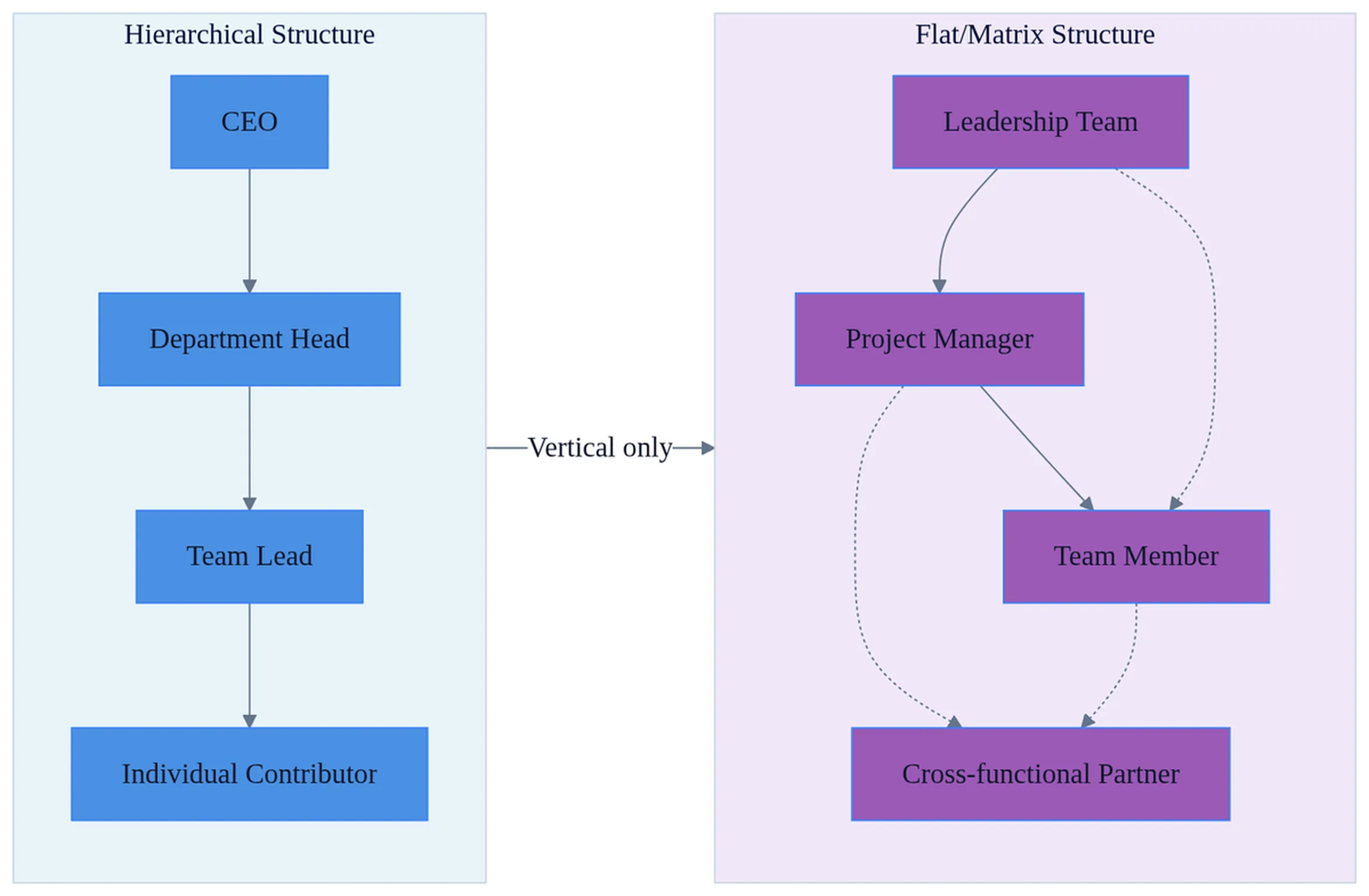
Traditional hierarchical organizations have clear authority levels and reporting relationships. A bank with branch tellers reporting to branch managers, who report to regional directors, who report to a chief operating officer, relies heavily on vertical communication. Information flows up and down through defined channels. This structure works well when consistency, compliance, and clear accountability matter more than speed.
The downside is that vertical communication in tall hierarchies can be slow and distorted. A message passing through five management layers often arrives garbled. Details get lost. Urgency fades. By the time frontline feedback reaches senior leadership, it may be too diluted to inform decisions.
Flat organizations minimize management layers. A software company with only three levels (engineers, team leads, and a CTO) can move information vertically much faster. Fewer layers mean less distortion and quicker response times. However, flat structures require managers to have wider spans of control, which can create bottlenecks if one manager oversees 30 people.
Matrix organizations blend vertical reporting with project-based structures. An engineer might report vertically to an engineering manager for performance reviews and career development, while also reporting to a project manager for daily work assignments. Matrix structures require clear communication about who has authority over what, or employees receive conflicting directives.
Startup and tech cultures often minimize vertical barriers deliberately. They encourage employees to communicate directly with senior leadership, skip levels when necessary, and challenge decisions regardless of hierarchy. This openness accelerates feedback loops but can undermine middle management authority if not handled carefully.
Understanding your organization’s structure helps you navigate vertical communication more effectively. In a hierarchical company, respect the chain of command unless there’s an urgent reason to escalate. In a flat organization, expect more direct access to senior leaders but also more competition for their attention.
Psychological safety and trust in vertical communication
Vertical communication only works if employees feel safe using it.
Consider two customer service teams. In the first, agents who report customer complaints to their supervisor are thanked and their feedback is used to improve processes. In the second, agents who raise issues are told to stop being negative and focus on sales. Which team will give management accurate information about customer satisfaction? The first team has psychological safety. The second doesn’t.
Without psychological safety, employees withhold bad news, hide mistakes, and avoid suggesting improvements that might imply criticism of current practices. Leadership operates in an information vacuum, unaware of problems until they become crises. Research from Harvard Business Review shows that teams with high psychological safety are more innovative and make better decisions because they surface problems early.
Building psychological safety requires consistent management behavior. When employees raise concerns, managers need to respond constructively even if the feedback is uncomfortable. Thank the employee for speaking up. Investigate the issue. Follow up on what you learned. If you punish the messenger, even once, you teach everyone else to stay silent.
Some organizations create formal mechanisms to encourage upward communication while protecting psychological safety. Anonymous employee surveys, third-party hotlines for reporting ethics concerns, skip-level meetings where employees talk directly to senior leaders without their immediate manager present, and suggestion programs with rewards for ideas all help.
A Dhaka-based garment manufacturer implemented monthly skip-level meetings where production workers could speak directly with the factory general manager without supervisors in the room. Within three months, the GM learned about equipment maintenance delays that supervisors had been hiding. Fixing the maintenance backlog reduced downtime by 18 percent. The information was always available, it just needed a safe channel to surface.
Trust works both ways. Employees need to trust that management will listen and act on upward communication. Management needs to trust that employees are raising issues in good faith rather than complaining or undermining authority. Building this mutual trust takes time and consistency.
Key benefits of vertical communication
When vertical communication works well, it delivers several organizational benefits that justify the effort required to maintain it.
Coordination across levels. Vertical communication aligns departments and teams toward shared goals. When corporate strategy flows downward and operational realities flow upward, everyone works from the same playbook. A retail chain uses vertical communication to ensure all stores implement the same promotional campaign while also gathering feedback on which promotions drive sales.
Informed decision-making. Leaders make better decisions when they have ground-level insights. Before changing a commission structure, a sales director who solicits upward feedback from the sales team learns which aspects of the current system work and which create perverse incentives. The resulting policy is more effective because it’s informed by real experience.
Clear accountability. Vertical communication establishes who is responsible for what. When your manager assigns you a project with specific deliverables and deadlines, both of you know what success looks like. When you report progress upward, your manager can identify problems early and provide support. Accountability breaks down when communication is vague or absent.
Operational efficiency. Structured information flow reduces confusion and duplication of effort. When instructions come through clear vertical channels, employees don’t waste time wondering what to prioritize or whom to ask for guidance. When status updates flow upward on a predictable schedule, managers don’t interrupt work with constant check-ins.
Employee engagement. Workers feel valued when their feedback is solicited and acted upon. An IT department that implements a help desk analyst’s suggestion for improving the ticketing system sends a message that employee input matters. Engagement increases when people see their upward communication making a difference.
These benefits explain why vertical communication remains central to organizational communication even as companies experiment with flatter structures and more horizontal collaboration.
Common barriers and how to fix them
Vertical communication often fails not because the concept is flawed but because specific barriers block the flow of information. Recognizing these obstacles helps you fix them.
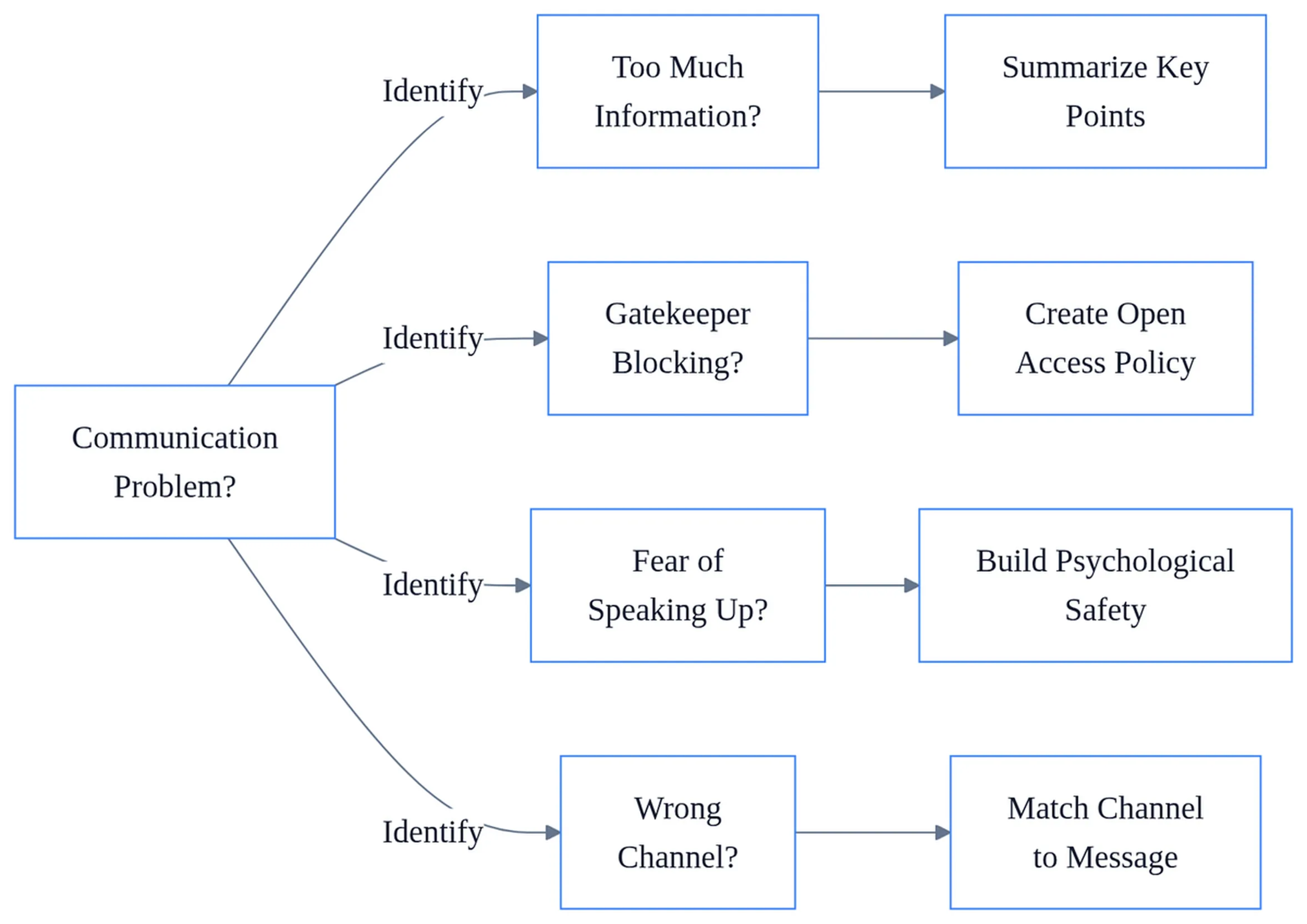
| Barrier | How it manifests | Solution |
|---|---|---|
| Information overload | Too many emails, reports, and memos create noise; critical messages get buried | Prioritize ruthlessly. Use subject line flags for urgent items. Consolidate updates into weekly digests rather than sending 20 separate emails |
| Gatekeeping | Middle managers filter or block upward communication to protect their reputation or avoid conflict | Establish skip-level meetings and anonymous feedback channels. Make it clear that managers are evaluated on how well they surface problems, not on pretending problems don’t exist |
| Fear of reprisal | Employees withhold bad news or honest feedback because they’ve seen colleagues punished for speaking up | Build psychological safety through consistent, constructive responses to upward communication. Reward people who raise difficult issues early |
| Channel mismatch | Using the wrong medium for the message, a 3,000-word email to announce an urgent policy change, or a formal memo for quick feedback | Match channel to purpose. Use face-to-face or video for complex or sensitive topics. Use email for documentation. Use chat for quick coordination |
| Lack of follow-through | Employees submit suggestions or reports that disappear into a void with no response or action | Acknowledge receipt of upward communication within 48 hours. Even if you can’t act immediately, explain what will happen next and when |
Most people assume vertical communication fails because of individual incompetence (a manager who doesn’t listen, an employee who writes unclear reports). The reality is that structural and cultural factors create most barriers. A manager who seems unresponsive might be drowning in information overload. An employee who withholds feedback might have seen a colleague fired for raising a similar concern last year. If you’re trying to diagnose why vertical communication isn’t working in your organization, look at the system before you blame individuals.
Fixing vertical communication requires addressing these systemic issues. For a comprehensive analysis of communication obstacles and solutions, see the guide to communication barriers.
One often-overlooked barrier is inconsistent expectations. If employees don’t know what information to send upward, when to send it, or in what format, they either over-communicate (creating overload) or under-communicate (leaving managers uninformed). Clear guidelines help. A project manager might tell their team: “Send me a brief status update every Friday by 3 PM covering what you completed, what’s in progress, and any blockers. Three bullet points maximum unless there’s a crisis.”
Vertical communication in practice: real examples
Seeing vertical communication in action makes the concept concrete.
CEO announces merger via company-wide email. This is downward communication at the highest level. The CEO needs to control the message, ensure everyone hears the news simultaneously, and provide a written record. The email likely includes strategic rationale, timeline, and what employees should expect next. Follow-up town halls and department meetings cascade the message down through additional vertical layers.
Employee submits monthly performance report to supervisor. A standard upward communication ritual. The report documents what the employee accomplished, where they’re struggling, and what support they need. The supervisor uses these reports to assess performance, identify training needs, and compile their own upward report to the department head. The information flows up the hierarchy in increasingly aggregated form.
Manager gives team directives in weekly staff meeting. Downward communication in a group setting. The manager translates strategic priorities into specific tasks, assigns responsibilities, and sets deadlines. This meeting also creates space for upward communication when team members ask questions or raise concerns about the directives.
Worker raises safety concern to supervisor; supervisor escalates to safety officer. This shows upward communication working as designed. The frontline worker notices a frayed electrical cord. They tell their supervisor, who lacks authority to fix it but escalates to the safety officer, who can authorize repairs. The information traveled upward through appropriate channels until it reached someone with decision-making authority.
HR sends policy update memo to all department heads. Downward communication with an expectation that department heads will cascade the information further down. HR can’t communicate directly with every employee, so they rely on managers to pass the message down through their teams. This multi-step downward flow is efficient but risks distortion if managers don’t communicate the policy clearly.
A small Dhaka-based digital marketing agency provides another example. The agency has 18 employees and two management layers: the founder-CEO and three team leads for creative, client services, and operations. When the CEO wants to shift the agency’s positioning toward fintech clients, they first discuss the strategy with the three team leads (downward communication). The team leads then share concerns from their teams (creative worries they lack fintech portfolio samples, client services notes that current clients might feel neglected, operations flags the need for new project management tools). This is upward communication. The CEO adjusts the strategy based on this feedback, then the team leads communicate the revised plan to their teams (downward communication again). This back-and-forth vertical flow produces a better strategy than top-down decree alone.
According to research from the Society for Human Resource Management, organizations with strong vertical communication see higher employee engagement scores and lower turnover. The correlation exists because effective vertical flows signal that leadership values employee input and that employees understand organizational direction.
When you design vertical communication systems, remember that structure matters more than individual effort. A talented manager can’t overcome a system that punishes upward communication or buries people in information overload. Build channels, norms, and incentives that make vertical communication easy and safe, and information will flow naturally.
Frequently asked questions
Should I skip my direct manager and go straight to their boss?
Generally, no. Bypassing your manager undermines the chain of command and damages trust. Go directly to leadership only if your manager is the problem (misconduct, conflict of interest) or if your organization explicitly allows it. Otherwise, discuss concerns with your manager first. If they don’t respond appropriately, then escalate.
What if my manager gives me conflicting instructions from what leadership announced?
Ask your manager for clarification in private. They may have context you lack, or they may be interpreting the announcement differently. If the conflict persists, document both messages and ask your manager to confirm which takes priority. Avoid publicly contradicting either source.
Is informal communication enough, or do I need to formalize everything in writing?
Use informal for quick updates and relationship-building, but formalize decisions that affect performance, compliance, or multiple people. If something might be questioned later—a deadline change, a policy exception, a safety issue—put it in writing. Informal alone leaves no accountability trail.
How do I give upward feedback without seeming like I’m complaining?
Frame feedback as information your manager needs to lead effectively. Use specific examples: instead of “the new process is broken,” say “three clients this week mentioned the new process added two days to their turnaround.” Offer solutions when possible. Ask for a private conversation rather than raising it in group settings.
What if my organization has too many management layers and communication gets stuck?
Vertical communication slows in deep hierarchies because messages pass through many levels. Push for skip-level meetings, open office hours with senior leaders, or anonymous feedback channels. Document where communication breaks down and propose streamlining to your manager or HR.
33 Comments
very helpful …thank youuu
Wow! I’m highly enlightened.
Originally posted on an earlier version of this article.
Good explanation
Wow what a great source, l was greatly assisted thanks a lot😊
This information is very good for both the students and teacher, but it could have been better you include the author’s name and year of publication.
Originally posted on an earlier version of this article.
Thanks
i love the way you answer my question vertical communication
Originally posted on an earlier version of this article.
Yes I agree also information is good it needs names of authors for referencing.
Originally posted on an earlier version of this article.
Author name is: Masud & Bappi
Originally posted on an earlier version of this article.
Can you post the surname as well? Would really like to use this as a reference.
Thanks!
Originally posted on an earlier version of this article.
good ..
so educative
Understandable
Well done!!!
Thank you 💕
wow, i like this
Originally posted on an earlier version of this article.
Your page will be useful to the students as well as their teachers, so thank you for this recordable contribution.
Originally posted on an earlier version of this article.
Please write full information of scholars, anyway the information about the vertical comm is good. Thank you
Originally posted on an earlier version of this article.
It is well understood
simple language,understandable.thanks
Thanks alot it’s well understandable
Powerful.. I like that
Originally posted on an earlier version of this article.
great work
Originally posted on an earlier version of this article.
Well done
very good
nice explanation of vertical communication, thank you
Ooooh thanks alot
thank u so much for the information. may u plz help me with guidelines on how the following question can be tackled.
with special reference to an organisation of ur choice, xplain how the following channels of communiction can be utilised:
a. vertical comm downwards
b. ” ” upwards
c. horizontal comm
d. diagonal comm
Originally posted on an earlier version of this article.
have enjoy the way the idea beings shared. thanks a lot and bring more
Originally posted on an earlier version of this article.
It’s good information thanks
Originally posted on an earlier version of this article.
hi ,i think it was a pretty understandable article
great job
Great insights on vertical communication! I appreciate how you highlighted both the advantages and disadvantages. It’s crucial for organizations to find the right balance to ensure effective information flow. This post has given me a lot to think about in terms of improving communication within my team. Thank you!
Satisfied thanks
You have pasted good piece of information but due to literature work and referencing, it would be good if you add the names of those who posted the piece and the year.
Thank you.
Originally posted on an earlier version of this article.
Very interesting. Can you please define a communication line in a company for a new employee? How would a new employee find his communication lines?
Originally posted on an earlier version of this article.