


Have you ever wondered why interviews make so many people nervous? Whether you are a student, a job seeker, or even a manager, the word “interview” probably brings a mix of excitement and anxiety. But in reality, an interview is nothing mysterious. It’s simply one of the most effective ways of communication we use in our personal, academic, and professional lives.
Let’s explore what an interview actually is, why it’s so important, and what types you should know about.
Introduction
An interview is not just about asking questions and giving answers. It’s a structured conversation where both sides try to learn something from each other. The interviewer aims to gather information, and the interviewee hopes to create a positive impression.
In the professional world, interviews play a major role in helping employers find the right talent and individuals discover the right opportunities. They also appear in journalism, education, and research, showing how versatile this communication tool is.
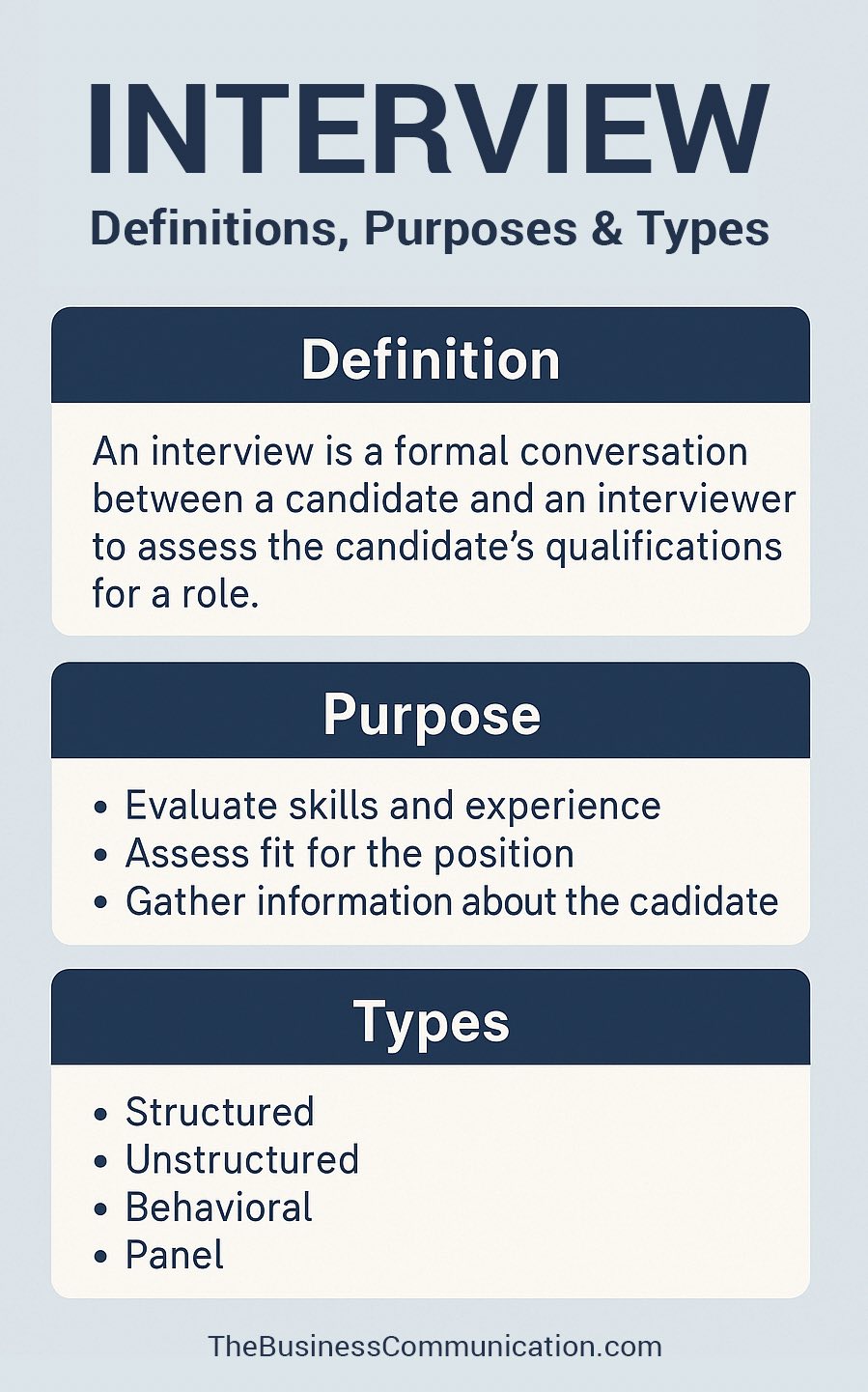
To understand how interviews fit into broader communication, it helps to know the basics of the communication process. (see What is Communication? Functions of Communication on your site).
What is an Interview? (Definition)
An interview is a planned conversation with a purpose. It happens between two or more people where one party seeks information, and the other provides it. The term “interview” comes from Latin roots meaning “to see each other”, highlighting that this process is based on interaction and understanding.
In simpler terms, it’s a formal meeting that allows people to share ideas and make judgments. For example, in a job interview, both the candidate and the employer assess each other’s compatibility. Similarly, in academic or research settings, interviews help exchange knowledge and opinions.
An interview always has three main elements:
- The interviewer who asks questions,
- The interviewee who responds, and
- A goal that both sides want to achieve.
Unlike casual conversation, interviews are structured and goal-oriented, which makes them a key part of professional communication.
Purpose and Objectives of an Interview
Every interview has a reason behind it. The purpose might differ from one type to another, but the ultimate goal is always to communicate effectively and gather meaningful information. Let’s break this down:
- Information Gathering:
Journalists, researchers, and managers use interviews to collect facts directly from people. - Evaluation:
Employers use interviews to assess a candidate’s knowledge, attitude, and behavior. - Decision-Making:
Interviews help managers and organizations make better, more informed choices. - Relationship Building:
A good interview builds trust between individuals and institutions. - Problem-Solving:
Sometimes interviews are conducted to identify issues in performance or behavior and find solutions.
In short, interviews connect communication with purpose. They are less about interrogation and more about understanding.
Characteristics of a Good Interview
What makes an interview effective? Let’s look at a few essential characteristics:
- Two-way Communication:
Both sides share ideas and respond actively. - Clear Purpose:
The goal of the interview is defined from the start. - Objectivity:
The interviewer remains fair and unbiased. - Preparation:
Both interviewer and interviewee do their homework beforehand. - Listening Skill:
Active listening is key to meaningful responses. - Respectful Tone:
Professionalism builds comfort and trust.
A well-conducted interview creates understanding rather than pressure. You’ll find similar ideas discussed in articles about qualities of good communication, which connect directly to this concept.
Functions of Interview in Business Communication
Interviews serve many functions in business and organizational settings. They go far beyond hiring new employees. Some of the most important functions include:
- Recruitment and Selection:
This is the most common purpose. Employers use interviews to identify the best candidates. (see related article on What is Job Interview? Employment Interview). - Performance Appraisal:
Supervisors conduct interviews to evaluate employee progress and set goals. - Exit Interview:
When an employee leaves a company, interviews help HR understand their experience and identify areas for improvement. - Feedback and Counseling:
Interviews help managers support and motivate employees.
Through these functions, interviews become a bridge between management and staff, ensuring open communication and trust.
Types of Interviews
Now that you know the purpose and function, let’s explore how interviews differ based on structure, purpose, and setting.
1. Based on Purpose
- Employment Interview: Used to assess job candidates.
- Academic Interview: Conducted for admissions or research.
- Research Interview: Collects data or opinions for studies.
- Counseling Interview: Helps solve personal or professional issues.
- Exit Interview: Understands employee experiences before leaving.
Each of these serves a distinct goal but follows the same communication principles.
2. Based on Structure
- Structured Interview:
Follows a fixed set of questions for all candidates. - Unstructured Interview:
More open and flexible conversation. - Semi-Structured Interview:
A balanced mix of both, allowing guided yet free-flowing discussion.
The choice depends on what kind of information the interviewer seeks. For example, structured interviews are ideal when fairness is a priority, while unstructured ones suit research settings better.
You can explore more examples in your article on Types of Interviews which expands on these categories in detail.
3. Based on Mode
- Face-to-Face Interview:
Traditional and personal, ideal for deeper understanding. - Telephonic Interview:
Useful for quick screening. - Video Interview:
Increasingly popular in remote work environments.
If you’re curious about modern communication tools, your article on What is Video Conference perfectly complements this section.
4. Based on Participants
- One-to-One Interview:
One interviewer and one interviewee. - Panel Interview:
Several interviewers meet one candidate. - Group Interview:
Multiple candidates assessed together.
Each format has unique benefits and challenges depending on the setting.
The Interview Process
Every interview follows a process, whether formal or informal. Let’s go through the main stages briefly.
- Preparation:
Both sides prepare questions, answers, and background research. - Opening:
A short introduction helps create a comfortable atmosphere. - Questioning:
The interviewer asks relevant questions while listening carefully. - Evaluation:
Observations and notes are recorded for later assessment. - Closing:
The discussion ends with thanks and sometimes feedback.
Experts agree that success depends on how well these steps are handled. (You can check Conditions of the Success of an Interview for more insights.)
Importance of Interview in Communication
Why are interviews so important in communication? Here are some solid reasons:
- They make information exchange more interactive.
- They promote understanding and clarity.
- They allow feedback, something missing in written forms of communication.
- They help in decision-making and relationship building.
Interviews are a classic example of two-way communication, where both parties listen, respond, and adjust. This balance makes them vital in business and education alike.
Advantages and Disadvantages of Interviews
Like all communication tools, interviews have both strengths and weaknesses.
Advantages
- Personal and direct interaction.
- Chance to observe attitude and behavior.
- Immediate clarification possible.
- Builds rapport and trust.
A detailed discussion can be found in Advantages of Interview on your site.
Disadvantages
- Can be time-consuming.
- Interviewer bias may influence judgment.
- Nervousness can affect answers.
- Hard to compare multiple candidates fairly.
Still, interviews remain one of the best ways to understand human behavior and make decisions based on real communication.
Tips for a Successful Interview
Whether you’re the interviewer or the interviewee, these simple tips can make a big difference:
- Prepare well in advance.
- Be confident but humble.
- Listen carefully before responding.
- Dress appropriately and maintain eye contact.
- Keep your answers short and clear.
- Be honest — honesty builds trust faster than perfection.
If you want to learn how body language affects conversations, you might like your article on Types of Nonverbal Communication.
Conclusion
So, what is an interview after all? It’s a purposeful conversation where people meet, talk, and make important decisions together. It’s where communication turns into understanding and opportunities.
Whether you’re attending your first interview or preparing to take one, remember this: interviews are not exams, they are conversations with a goal. Stay calm, be yourself, and focus on clear, honest communication.
And if you’d like to learn how to improve your confidence before an interview, your article on Guidelines for Facing Employment Interview is a great next read.
Frequently asked questions
Should I prepare answers for a structured or unstructured interview differently?
Yes. For structured interviews, prepare concise answers to likely standard questions since all candidates face the same ones. For unstructured interviews, prepare key talking points and examples instead of scripted answers, since the conversation will flow more naturally. Semi-structured interviews need both: solid examples plus flexibility to follow the interviewer’s lead.
What if I freeze or give a bad answer early in the interview?
Stay calm and move forward. One weak answer rarely determines the outcome if the rest of your interview is strong. If you stumble, take a breath, acknowledge it briefly if needed, and refocus on the next question. Interviewers expect some nervousness and judge you on overall performance, not perfection.
Is it acceptable to ask the interviewer questions, or should I only answer?
Asking questions is encouraged and shows genuine interest. Good interviews are two-way conversations. Ask about the role, team, or company culture. Avoid questions about salary or benefits in early rounds. Prepare 2-3 thoughtful questions that demonstrate you’ve researched the organization.
How do I know if an interview went well or poorly?
Good signs include the interviewer asking follow-up questions, maintaining eye contact, and extending the conversation beyond scheduled time. Poor signs include brief responses, checking the clock, or wrapping up early. However, don’t over-analyze. Thank them, follow up professionally, and wait for their decision.
Can I request a different interview format if the scheduled one doesn’t suit me?
You can politely ask, but expect limited flexibility, especially in formal hiring. If you struggle with phone interviews, explain briefly and ask if video is possible. For most professional settings, adapt to their format rather than request changes. Focus on performing well within their chosen structure.
24 Comments
really nice blog, and when I read this blog I can feel what you mean in it,thanks for this blog
thanks
Thankyou for such a detailed description .
This is a relevant skill to be acquired as people are now struggling with interview presentation
These are very useful for us when we are attending interview
The explanation for interviewer and interviewee is given wrong. Kindly rectify
Thanks
This information was excellent.
Its easy to understand
These are very user friendly datas
Just a single word mistake. Very first interviewer should be changed to interviwee. Thanks…
I’ve a problem about “interviewer” and “interviewee”. Thank you!
thanks for your helps
This has really helped me to acquire the best knolege about the meaning of the word interview.
Thank you very much.
the information given about the various types of interviews is relevant to what l responded yesterweek during my interviewing session. Keep up and l wound like to join you after my second degree,will you accept my request, please?
Although I appreciate aspects of the traditional definition of an interview, it is “old thinking.” Today, the new thinking on this topic reveals a definition that is far more profound. It provides the evidence one needs to become definitive and liberated in their preparation.
Good pack of information, just re correct your single mistake of writing interviewer
instead of interviewee!
Nice answer
The inception of the explaination of interviewer and interviewee is wrong, thank you
Thanks u very much for ur explanation,becouse it will help so many students to be so understood the definition of”interview”in a simple language.Even me im included.thank u
These is very useful for us because somebody has don’t know type of interview and her or his impression are focus bad impression on that situation. Thank u..
Yes very impressive,,,, those points helpful every person who is take interview and give interview.
Yes its true, the explanation for interviewer and interviewee is
given wrong. Thanks much
I say lots of thanks for your help me raise my Literature level,, am an upcoming star 🌟 of English..
a rectify to my comment: for helping me raise my Literature level.