


Internal communication determines whether your team operates as a coordinated unit or a collection of isolated silos. This guide explains the core methods organizations use to share information internally, how to match the right channel to your message type, and when to use synchronous versus asynchronous approaches based on real workplace needs.
What are internal communication methods?
Internal communication methods are the channels and approaches an organization uses to exchange information among employees, departments, and leadership levels. Unlike external communication, which targets customers, investors, or the public, internal methods focus exclusively on keeping your workforce informed, aligned, and engaged.
Choosing the right method matters more than most managers realize. A policy change buried in a 2,000-word email gets ignored. An urgent budget cut announced via notice board arrives too late. The same message delivered through the wrong channel wastes time, breeds confusion, and erodes trust.
Effective internal communication requires matching your method to three variables: the direction of information flow, the urgency and complexity of your message, and whether you need immediate feedback or simply need to document a decision.
The 3D framework: downward, upward, and lateral communication
Most organizations rely on three directional flows of information. Understanding these helps you select methods that work with, not against, your organizational structure.
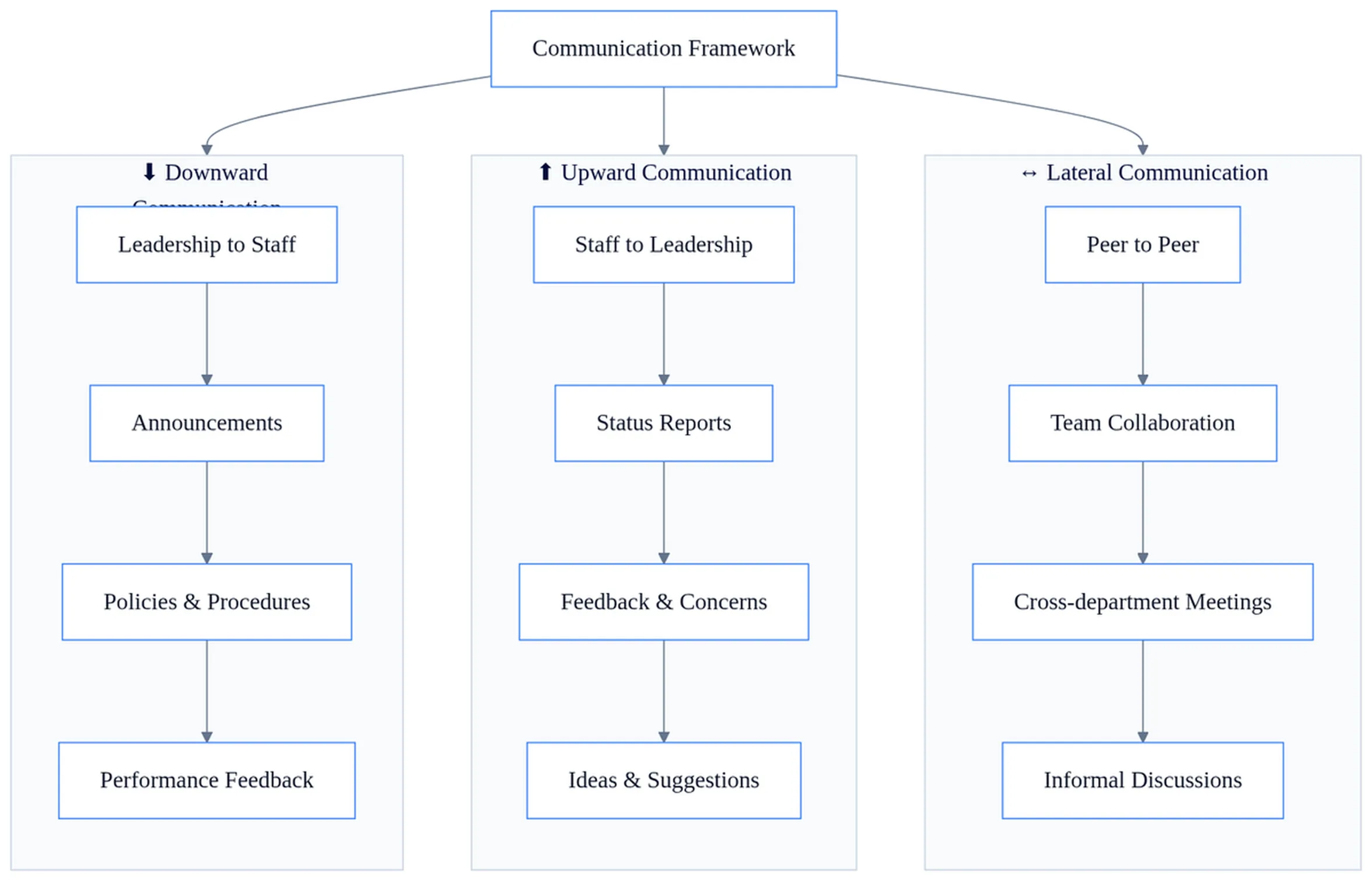
Downward communication moves from leadership to staff. It carries policies, strategic goals, performance expectations, and operational instructions. When a CEO announces a new initiative or a manager assigns tasks, that’s downward flow. The primary risk here is one-way broadcasting that leaves employees feeling talked at rather than included.
Upward communication travels from employees to management. This includes feedback on policies, progress reports, concerns about workflow obstacles, and suggestions for improvement. Many organizations struggle with upward flow because employees fear retaliation or believe their input won’t matter. Without strong upward channels, leadership operates blind to ground-level reality.
Horizontal communication happens peer-to-peer and across departments at similar organizational levels. Marketing coordinates with sales, one engineer troubleshoots with another, regional managers share best practices. This lateral flow enables collaboration and prevents departments from working at cross-purposes.
All three directions need dedicated methods. An organization that only invests in downward channels (memos, announcements, policy documents) will suffocate upward feedback and lateral coordination.
Synchronous methods: real-time communication
Synchronous methods require participants to be present at the same time. They excel when you need immediate feedback, must navigate complex topics, or want to build relationships through dialogue.
Face-to-face meetings remain the gold standard for high-stakes conversations. When you’re delivering performance feedback, negotiating budget priorities, or resolving interpersonal conflict, in-person discussion lets you read body language, adjust your message in real time, and build trust through presence. A 15-minute face-to-face conversation often resolves what would take 20 back-and-forth emails.
Telephone calls and video conferencing adapt synchronous communication for remote teams. Video calls work well for team check-ins, client discussions, and situations where seeing facial expressions adds clarity. Phone calls suit quick clarifications and urgent decisions when video feels too formal. The trade-off: both require scheduling coordination across time zones and offer no automatic documentation.
Interviews provide structured one-on-one dialogue for hiring, performance reviews, exit conversations, and employee development discussions.
Use synchronous methods when the message is time-sensitive, emotionally charged, or requires collaborative problem-solving.
Asynchronous methods: recorded and documented communication
Asynchronous methods let recipients consume information on their own schedule. They create permanent records, scale to large audiences, and work across time zones without coordination overhead.
Business memos and email communication handle most day-to-day organizational messaging. Memos suit formal policy announcements, procedural changes, and messages requiring management signatures. Emails work for project updates, meeting recaps, and information that needs quick distribution. Both create searchable records for future reference.
Business reports and bulletins deliver comprehensive information for decision-making. A quarterly financial report, market analysis, or project post-mortem gives readers time to digest complex data before meetings. Bulletins (shorter, more frequent updates) keep teams informed about ongoing initiatives without requiring real-time attention.
Notice boards and posters provide visible announcements in physical workspaces. A manufacturing floor notice board displaying safety protocols or a break room poster announcing benefits enrollment deadlines reaches employees who don’t sit at computers all day. Digital notice boards on company intranets serve the same purpose for remote teams.
Employee handbooks and manuals function as reference documents for policies, procedures, and behavioral expectations. New hires consult handbooks to understand dress codes, time-off policies, and workplace conduct standards. Operations manuals document processes so teams maintain consistency even as personnel change.
Choose asynchronous methods when information is non-urgent, needs wide distribution, requires documentation for compliance, or when recipients need time to review before responding. They fail when urgency demands immediate action or when the topic requires back-and-forth dialogue to reach understanding.
Feedback and two-way communication methods
One-way broadcasting keeps employees informed. Two-way methods engage them as active participants in organizational dialogue.
Surveys and questionnaires gather structured employee input on specific topics. An annual engagement survey measures workplace satisfaction. A post-training questionnaire assesses learning effectiveness. A pulse survey after a major policy change gauges employee sentiment. The key advantage: anonymity encourages honest feedback that face-to-face conversations might suppress.
Suggestion and complaint boxes (physical or digital) provide anonymous channels for ongoing feedback. A software development team might use a digital suggestion box for feature ideas. A retail chain might place physical boxes in break rooms for frontline staff to report customer service issues. These work best when leadership visibly acts on submissions, demonstrating that input matters.
Town halls and open forums create large-group dialogue between leadership and staff. A quarterly town hall lets the CEO share strategic updates and answer questions in real time. Department-level forums give teams space to discuss challenges and propose solutions collectively.
Organizations with effective two-way communication channels tend to see higher employee engagement and retention. The investment in feedback infrastructure pays dividends in workforce stability.
Two-way methods take more time and coordination than one-way broadcasts. Use them when employee buy-in matters, when you need ground-level insights to inform decisions, or when building trust requires demonstrating that leadership actually listens.
Choosing the right method: a decision framework
Most communication failures stem from method mismatch.
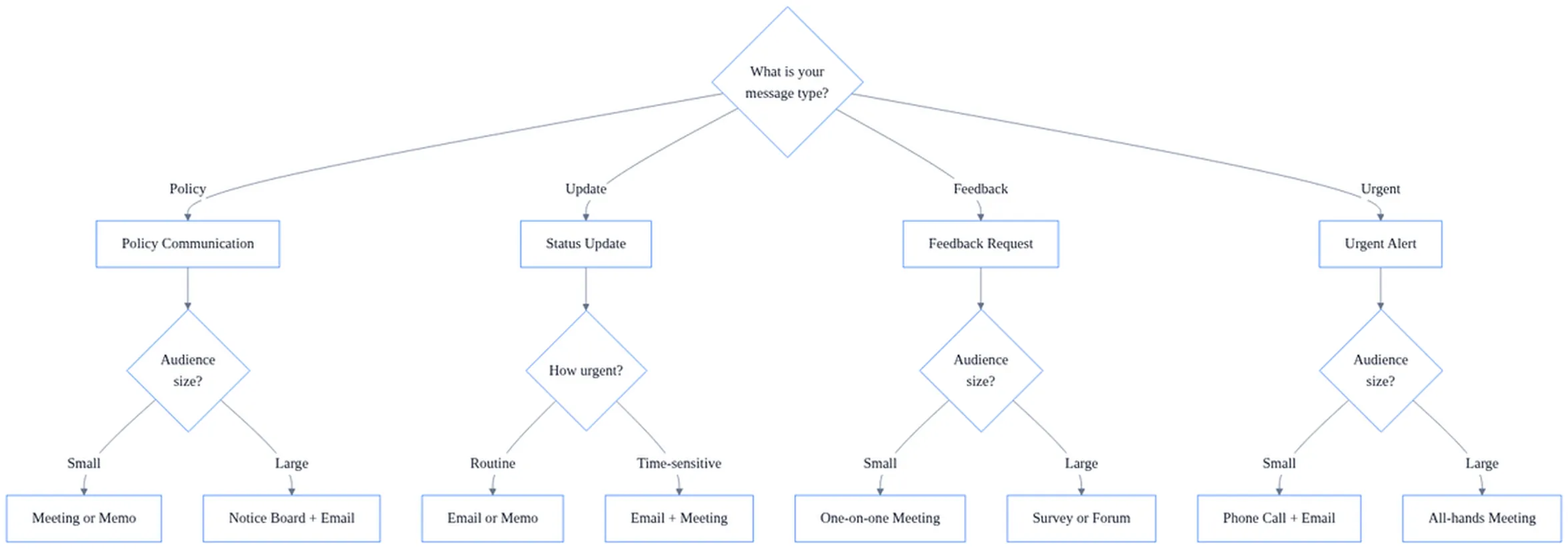
| Message Type | Best Method | Why It Works |
|---|---|---|
| Policy change requiring acknowledgment | Memo + email with signature requirement | Creates documentation trail for compliance |
| Urgent operational issue | Phone call or video meeting | Enables immediate response and clarification |
| Weekly project status | Email or bulletin | Asynchronous consumption, searchable history |
| Gathering employee feedback | Survey or suggestion box | Anonymous input encourages honesty |
| Strategic vision announcement | Town hall + follow-up memo | Real-time Q&A plus documented reference |
| Safety protocol update | Notice board + team meeting | Visual reminder plus verbal reinforcement |
Audience size shapes method selection. One-to-one conversations work for performance coaching. Small group meetings suit team coordination. Organization-wide emails or notice boards reach everyone simultaneously. Trying to conduct a one-on-one conversation with 200 people wastes time; broadcasting personal feedback to the whole company destroys trust.
Urgency dictates synchronous versus asynchronous choice. A server outage affecting customer operations demands immediate phone calls or emergency meetings. A benefits enrollment reminder can go out via email two weeks in advance. Treating every message as urgent trains employees to ignore your communications.
Documentation needs determine formality. If you might need to reference the communication in an audit, performance review, or legal proceeding, use written methods like memos, emails, or reports. If the message is routine and ephemeral, a quick conversation suffices.
Remote versus in-office context requires adaptation. A notice board works in a physical office; remote teams need intranet announcements or Slack channels. In-person town halls become virtual all-hands meetings. The underlying principle (matching method to message) remains constant even as the specific tools change.
Integrating methods for maximum effectiveness
Single-channel communication fails for important messages. Multi-channel reinforcement increases both reach and retention.
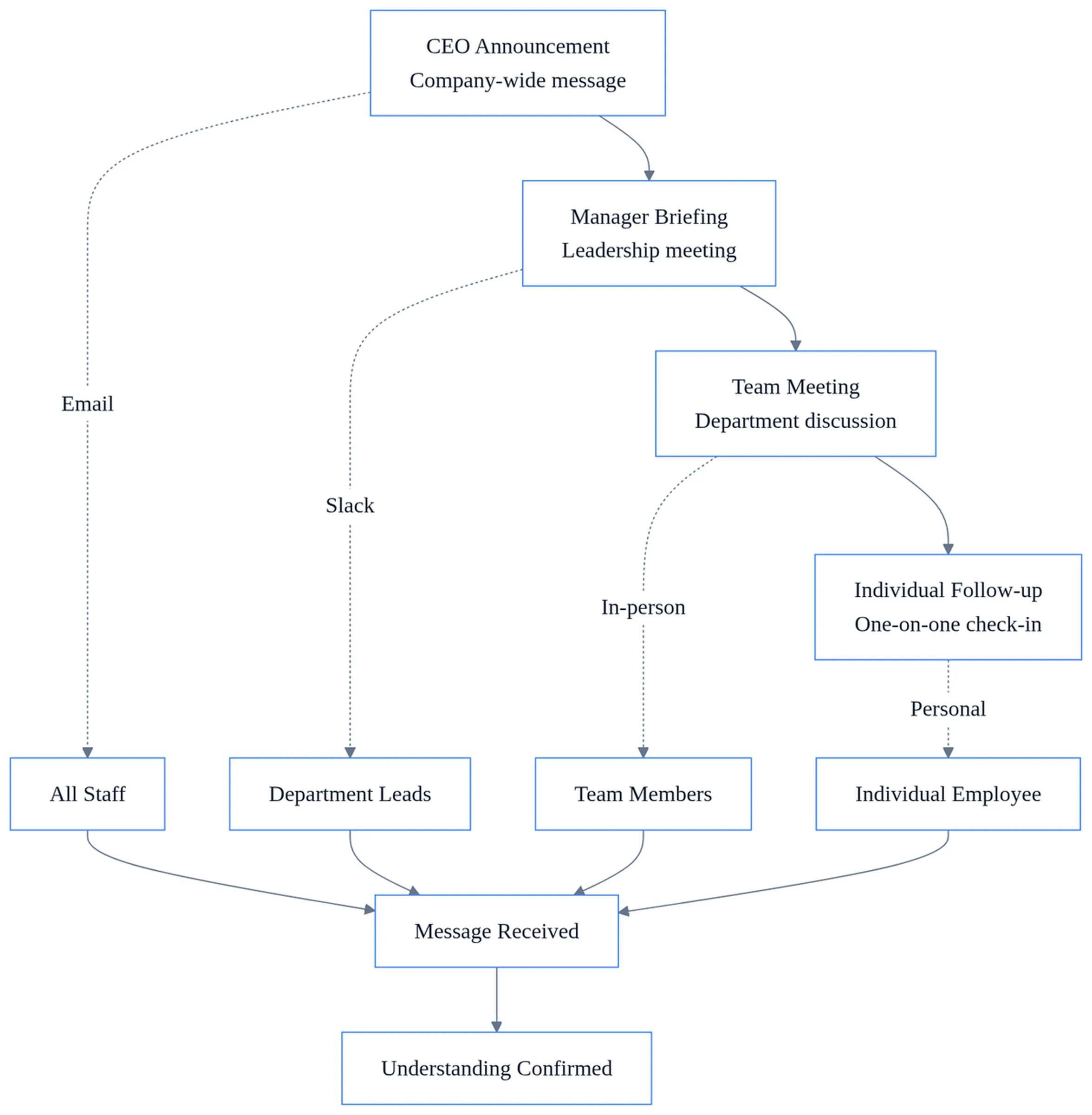
Consider how a mid-sized logistics company in Dhaka rolled out a new safety protocol. The operations director sent an initial email announcement. Supervisors discussed the changes in team meetings. Printed posters went up in the warehouse. The employee handbook received an updated section. A follow-up survey measured understanding two weeks later. This cascading, multi-method approach ensured the message reached drivers who rarely check email, warehouse staff who work rotating shifts, and office employees who needed documentation for compliance records.
Cascading communication moves messages through organizational levels systematically. Leadership crafts the core message. Managers receive briefings with talking points and Q&A preparation. Managers then discuss with their teams, adapting the message to department-specific contexts. Individual employees receive written documentation for reference. This cascade prevents the “telephone game” distortion that happens when messages jump too many levels without structure.
Avoid channel overload. An organization that sends 40 emails daily, posts 15 intranet updates, and schedules three meetings per week trains employees to tune out. Match method frequency to message importance. Reserve urgent synchronous methods for genuinely urgent topics. Batch routine updates into weekly digests rather than constant interruptions.
Measuring effectiveness closes the loop. Track email open rates to gauge attention. Monitor survey response rates to assess engagement. Ask managers whether their teams understood recent announcements. Organizations that measure communication effectiveness can adjust their methods based on data rather than assumptions.
Common pitfalls and how to avoid them
Most organizations make predictable mistakes that undermine their internal communication efforts.
Using only one-way methods creates disengagement. If every communication flows downward (memos, announcements, directives) without channels for response, employees disengage. They comply with minimum requirements but withhold discretionary effort, innovative ideas, and early warnings about problems. Build upward and lateral channels with the same investment you put into downward broadcasting.
Mismatching method to message wastes everyone’s time. Sending a formal 1,500-word memo about a minor schedule change irritates busy employees. Announcing layoffs via email without face-to-face follow-up destroys morale. A crisis requiring immediate action doesn’t belong on a notice board that employees check weekly.
Ignoring informal communication leaves gaps that the grapevine fills with speculation and rumor. When formal channels stay silent during uncertainty (pending merger, leadership transition, restructuring), employees create their own narratives. These unofficial stories spread faster and feel more credible than belated official announcements. Address uncertainty proactively through formal channels before informal networks fill the void with misinformation.
Neglecting remote workers happens when organizations design communication methods around in-office defaults. Notice boards, hallway conversations, and spontaneous desk visits exclude distributed team members. A hybrid team needs parallel methods: virtual town halls alongside in-person ones, digital notice boards mirroring physical ones, and scheduled video calls replacing impromptu office discussions.
What most people get wrong: they treat internal communication as an HR function rather than an operational necessity. Communication methods aren’t bureaucratic overhead. They’re the infrastructure that enables coordination, builds trust, and prevents costly misalignment. A project team that wastes three weeks building the wrong feature because requirements weren’t clearly communicated loses more money than a year’s worth of properly structured internal communication would cost.
Practical takeaway
Start by auditing your current methods against the 3D framework. Map which channels support downward, upward, and lateral flows. Identify gaps (most organizations over-invest in downward broadcasting and under-invest in upward feedback). Then match your three most important recurring messages to appropriate methods using the decision framework above. A well-chosen method delivers your message clearly the first time, eliminating the clarification overhead that consumes hours each week.
Frequently asked questions
Should I announce urgent news via email or call a team meeting?
Use synchronous methods (meetings or calls) for time-sensitive, emotionally charged, or complex messages. Email works only if the news allows a few hours for processing. For layoffs, budget cuts, or strategy pivots, real-time dialogue lets you address concerns immediately and read the room. Email alone risks confusion and erodes trust when stakes are high.
What if my team is spread across multiple time zones?
Prioritize asynchronous methods: email, memos, bulletins, and recorded updates. When synchronous meetings are necessary, rotate meeting times fairly or record sessions for those who can’t attend live. Video calls work better than phone for distributed teams since facial expressions add clarity across distance. Document decisions in writing afterward so no one relies on memory.
How do I encourage upward communication if employees fear speaking up?
Create multiple channels so employees choose what feels safe: anonymous feedback forms, one-on-one check-ins, suggestion boxes, or skip-level meetings with senior leaders. Model receptiveness by acting on feedback visibly and explaining why you rejected ideas. Upward flow dies without psychological safety—leaders must prove input won’t trigger retaliation or dismissal.
Is a notice board still effective if most staff work remotely?
Physical notice boards fail for remote teams. Switch to digital alternatives: company intranet announcements, Slack channels, or email bulletins. Digital boards let you track who saw the message and reach people regardless of location. Reserve physical boards only for on-site employees or hybrid teams who visit offices regularly.
Why does my complaint or suggestion email get ignored by leadership?
Upward communication often gets lost in leadership inboxes or dismissed as noise. Strengthen your message by: using a clear subject line, keeping it brief, proposing a solution not just a problem, and sending it to the right decision-maker. If email fails, request a brief conversation. Written feedback alone rarely drives action without follow-up dialogue.