


Have you ever noticed how a small team at school, in the office, or even among friends can come together and make great things happen? That is exactly what small group communication is all about. It happens when a few people interact, share ideas, solve problems, and make decisions together. It is one of the most common and effective forms of communication in daily life, whether in classrooms, meetings, or virtual discussions.
Let’s explore what small group communication means, its features, types, and why it matters in our personal and professional world.
Definition of Small Group Communication
Small group communication refers to the exchange of information, ideas, and feelings among three to fifteen people who share a common goal. These individuals interact regularly, influence each other, and work together to achieve specific objectives.
Unlike mass communication, where one message reaches thousands, small group communication focuses on direct, personal interaction. It sits between interpersonal communication and organizational communication, making it both intimate and purposeful.
In simple words, it is the art of talking, listening, and understanding each other in a small team setting.
Key Features of Small Group Communication
Let’s look at some features that make small group communication unique and effective:
1. Limited Number of Participants
Usually, small groups consist of three to fifteen members. Fewer people mean everyone gets a chance to speak and contribute. Imagine trying to have a deep discussion with fifty people — sounds chaotic, right?
2. Common Goal
Every small group has a purpose. It might be completing a project, preparing a presentation, or solving a community issue. A shared goal keeps the conversation focused.
3. Face-to-Face or Virtual Interaction
Modern communication tools allow teams to connect through video calls, chat apps, or collaborative platforms. Still, the essence remains the same — active participation and two-way communication.
4. Interdependence
Members rely on each other to achieve success. Each person’s contribution affects the overall outcome.
5. Group Norms and Roles
Groups develop their own rules and assign roles such as leader, note-taker, or motivator. These norms ensure order and cooperation.
If you are curious about how these roles shape communication, you can check out organizational communication where role distribution and feedback are key components.
Types of Small Groups
Small groups can take different forms depending on their purpose and setting. Let’s explore the major types:
1. Task-Oriented Groups
These groups focus on achieving a specific goal or completing a task. Examples include committees, project teams, or problem-solving groups.
2. Relationship-Oriented Groups
Such groups aim to build personal bonds and emotional support. A family discussion or a peer-support club falls into this category.
3. Learning or Study Groups
Students often form these groups to discuss lessons, share notes, and prepare for exams.
4. Problem-Solving Groups
These groups exist to identify problems and suggest solutions. For example, a marketing team analyzing customer feedback to improve products.
To learn more, you can read Types of Small Group which explains each category in depth.
Functions and Purposes of Small Group Communication
Small group communication serves several important functions in both professional and personal life.
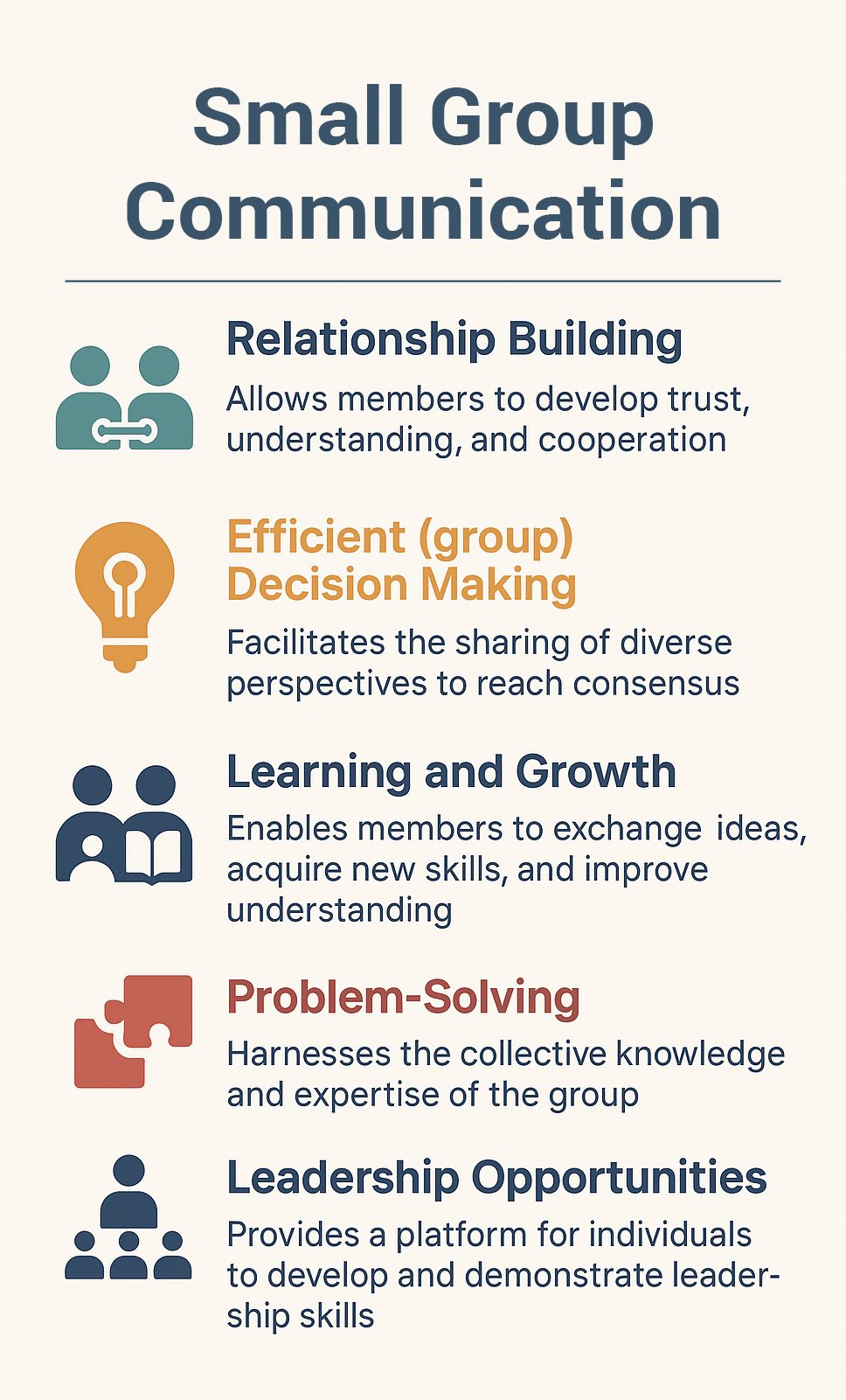
- Decision Making: Teams brainstorm, discuss, and finalize decisions that affect everyone involved.
- Problem Solving: Working together helps identify better solutions.
- Information Sharing: Members exchange knowledge and insights.
- Relationship Building: Communication strengthens trust and cooperation.
- Leadership Development: It helps individuals learn teamwork and leadership skills.
Interestingly, many companies use small group meetings to improve upward communication between employees and management.
Stages of Small Group Development
Every group goes through a few stages before becoming effective. Bruce Tuckman’s model identifies five stages:
1. Forming
At this stage, members get to know each other and set initial goals. People are often polite and cautious.
2. Storming
Disagreements may arise as people express different opinions. This is normal and even healthy, as it leads to better understanding.
3. Norming
The group starts to establish rules, trust, and a clear direction. Everyone learns their role.
4. Performing
This is when real teamwork happens. Members collaborate effectively to achieve their shared goal.
5. Adjourning
After completing the task, the group disbands or moves on to new challenges.
If you want to manage meetings effectively during these stages, check out Effective Project Meeting for practical strategies.
Roles of Members in a Small Group
Not everyone plays the same part in a team. Let’s see who does what:
- Task Roles: People who take initiative, give information, and evaluate ideas.
- Social Roles: Members who encourage others, manage conflicts, and maintain harmony.
- Individual Roles: Sometimes people may act for personal interest, which can disturb the group. These behaviors must be managed tactfully.
A balanced group ensures each member’s strengths are used wisely, a concept also emphasized in Role of Communication in Management.
Characteristics of Effective Small Group Communication
What separates a good group from a great one? These features make a big difference:
- Open and honest dialogue.
- Active listening by all members.
- Equal participation.
- Constructive feedback.
- A shared sense of responsibility.
The 7 Cs of Communication — clarity, conciseness, concreteness, correctness, completeness, consideration, and courtesy — are also essential for small group success.
Barriers in Small Group Communication
Even the best teams face obstacles. Common barriers include:
- Groupthink: When everyone agrees too quickly, avoiding conflict.
- Dominance Issues: One person controls the discussion.
- Lack of Participation: Some members stay silent.
- Cultural Misunderstandings: Different backgrounds can lead to confusion.
You can overcome these by reading Overcome the Communication Barriers in Business which gives simple, effective solutions.
Techniques for Improving Small Group Communication
Here are some proven techniques that can make your group more productive and engaging:
- Set Clear Objectives: Define what success looks like.
- Encourage Diversity: Different perspectives lead to better ideas.
- Use Digital Tools Wisely: Apps like Zoom or Google Meet can boost collaboration.
- Practice Active Listening: Make sure everyone feels heard.
- Review Regularly: Reflect on progress and make improvements.
A quick tip: Humor and encouragement go a long way. A group that laughs together often works better together.
Examples of Small Group Communication
Let’s make it practical with some examples you can relate to:
- Classroom Study Groups: Students discuss lessons and prepare for exams together.
- Workplace Teams: Employees meet weekly to plan and execute projects.
- Community Committees: Members plan local events or charity drives.
- Virtual Teams: Remote workers collaborate using digital platforms.
Each of these examples shows how communication helps build teamwork and achieve success.
Small Group Communication in the Workplace
In modern organizations, small group communication is vital for smooth operation. Whether it is brainstorming sessions, training workshops, or quick daily stand-ups, small groups ensure that ideas flow freely across all levels.
It also encourages internal communication and helps managers identify problems early. Teams that communicate well often enjoy higher productivity, stronger morale, and better decision-making.
Advantages and Disadvantages of Small Group Communication
Let’s weigh the pros and cons.
Advantages
- Encourages creative ideas.
- Builds relationships and teamwork.
- Improves problem-solving.
- Distributes workload.
- Promotes leadership and confidence.
Disadvantages
- May lead to conflicts or dominance by a few.
- Time-consuming decisions.
- Sometimes difficult to reach agreement.
Despite these drawbacks, the benefits far outweigh the negatives. Groups that learn to communicate effectively can achieve remarkable success.
Difference Between Small Group and Large Group Communication
| Criteria | Small Group Communication | Large Group Communication |
|---|---|---|
| Number of Members | 3–15 people | 50 or more |
| Interaction | Direct and personal | Limited and formal |
| Feedback | Immediate | Delayed |
| Decision-Making | Collaborative | Often top-down |
| Examples | Team meetings, study groups | Conferences, lectures |
Small groups offer more intimacy and cooperation, while large groups focus on information delivery. Both have their place, but for teamwork and productivity, small groups usually win.
Conclusion
Small group communication is at the heart of teamwork, learning, and leadership. It teaches us how to listen, share, and respect different opinions. Whether you are a student preparing for a group project or a manager leading a team, mastering small group communication will help you achieve your goals faster and more efficiently.
Remember, great communication is not just about talking, it is about connecting. So next time you join a small team discussion, listen actively, share honestly, and make every word count.
2 Comments
I have learnt alot about small groups communication trough this page. I really appreciate that. All what my precious lecturer Mrs Ngubane FROM Mangosuthu UNIVERSITY OF TECHNOLOGY has taught me is found on this page its like she’s the one who uploaded this data
I learned about the different roles and functions in small group communication. Having good communication skills is required to work well in groups, and there are many ways to develop them. I also picked up that you have to have an open mind to what everyone is thinking even when you don’t agree. Being able to pick up the skills such as control and responsibility is key to group communication as well.