


Organizational communication is the structured exchange of information, ideas, and directives within and beyond the boundaries of an organization. Whether you manage a small team or study business systems, understanding how communication flows through formal channels, informal networks, and across hierarchy levels will help you diagnose bottlenecks and improve execution. This guide explains the core types, directional flows, and strategic importance of organizational communication.
What is organizational communication?
Organizational communication encompasses all information exchange that takes place to achieve organizational goals. It includes messages between employees and managers, announcements from leadership, feedback loops from frontline workers, and interactions with customers, suppliers, and regulators. Unlike casual conversation, organizational communication is purposeful and shaped by hierarchy, roles, and formal structures.
This type of communication applies across every kind of organization: businesses, hospitals, government agencies, military units, universities, and nonprofits. Each organization has specific goals and stakeholders. Meeting those goals depends on whether the right information reaches the right people at the right time.
According to Goldhaber, “organizational communication is defined as the flow of messages within a network of interdependent relationships.” William Scott defined it as “a process which involves the transmission and accurate replication of ideas ensured by feedback for the purpose of eliciting actions which will accomplish organizational goals.”
The key distinction: organizational communication is system-level. It’s not just about whether one person understood another. It’s about whether information flows support coordination, decision-making, and strategic execution across the entire organization.
Formal vs. informal organizational communication
Organizations rely on two parallel communication systems. Formal channels follow official pathways: emails documenting decisions, policy memos, scheduled meetings, performance reviews, and reports. These channels are documented, governed by protocols, and designed for accountability. When a manager sends a written directive or HR publishes a new policy, that’s formal communication.
Informal communication operates outside official channels. It includes hallway conversations, lunch-table discussions, instant messages between colleagues, and the grapevine that spreads news faster than any memo. Informal channels are spontaneous, relationship-based, and undocumented.
Most people assume informal communication is a distraction or a source of rumors. That’s a mistake. Effective organizations treat informal channels as early warning systems. When employees stop sharing concerns informally, it often signals eroding trust or disengagement. When the grapevine buzzes with speculation, it tells leaders they’ve left an information vacuum that people are filling themselves.
The best communication strategies balance both systems. Use formal channels for policies, compliance, and anything requiring a record. Use informal channels to build culture, gauge morale, and gather unfiltered feedback. A manager who only communicates through formal memos will miss half of what’s happening on their team. For a full breakdown of what formal channels do well and where they fall short, see advantages and disadvantages of formal communication.
Directional flows of organizational communication
Communication in organizations moves in four primary directions, each serving distinct purposes.
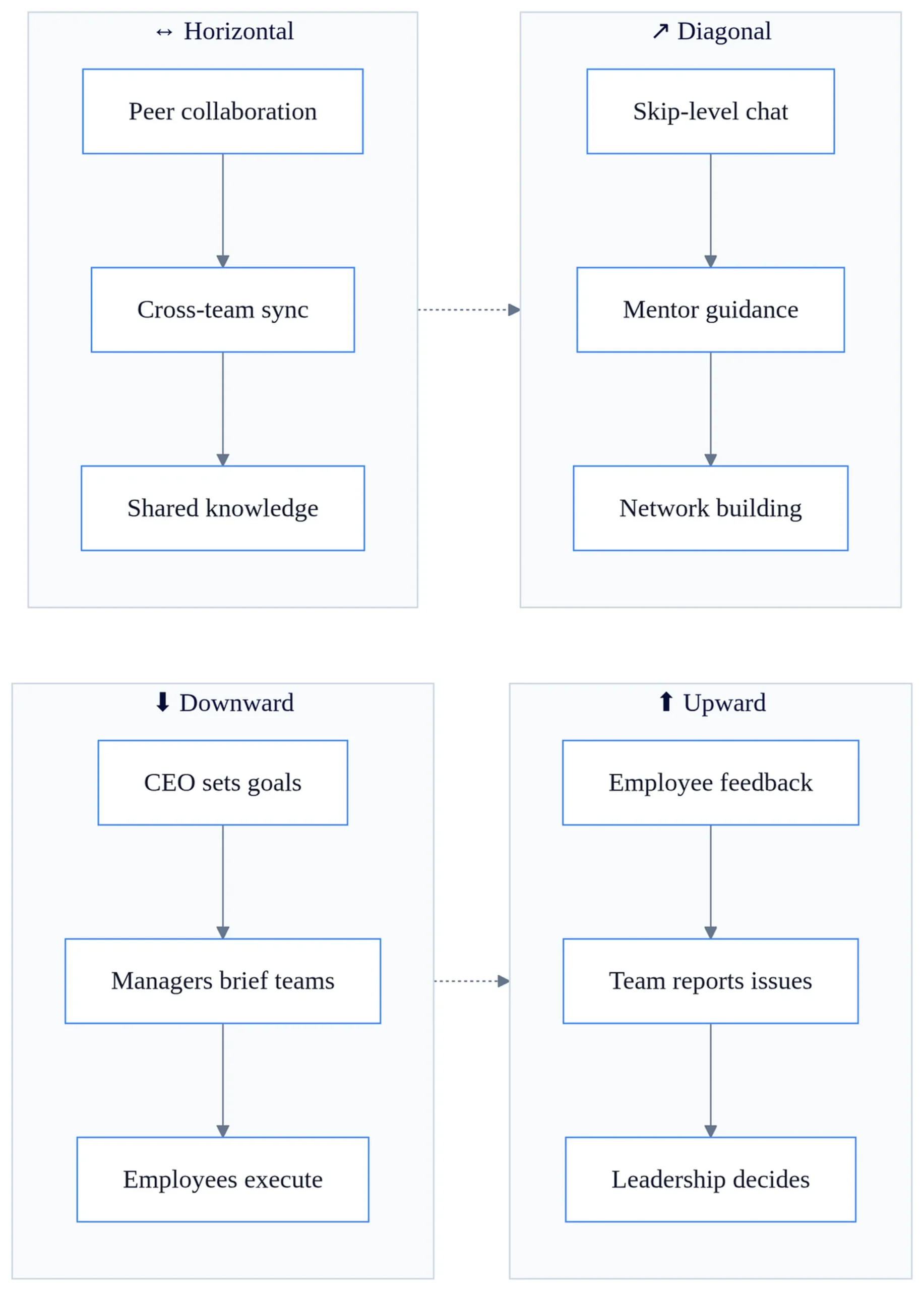
Downward communication flows from leadership to employees. It includes instructions, strategic announcements, policy updates, and performance feedback. A CEO’s quarterly town hall, a department head’s project brief, or a supervisor’s task assignment all represent downward communication. This flow clarifies expectations and aligns teams with organizational priorities. For a deeper look at objectives, advantages, and how to prevent message distortion, see our guide on how top-down organizational messaging works.
Upward communication moves from employees to leadership. It carries feedback, concerns, ideas, performance data, and frontline intelligence. When a sales rep reports customer complaints or a team member suggests a process improvement, that’s upward communication. This flow only works when employees trust that speaking up won’t backfire. Without psychological safety, upward channels shut down, and leaders operate blind.
Horizontal communication occurs between peers at the same organizational level. Marketing coordinates with sales, one project manager consults another, or two engineers collaborate on a technical problem. This lateral flow enables coordination without bottlenecking at the top.
Diagonal communication cuts across both hierarchy and departmental lines. A junior analyst might consult a senior manager in another division, or a product designer might reach out directly to a customer service lead. Diagonal communication has become increasingly important in flat, matrix, or agile organizations where rigid hierarchies slow decision-making. It enables quick problem-solving but requires clear norms so it doesn’t undermine authority structures.
For a deeper look at how information moves up and down organizational hierarchies, see our guide to vertical communication.
Internal organizational communication
Internal communication connects everyone inside the organization: employees, managers, executives, board members, and union representatives. It coordinates daily operations, reinforces organizational values, clarifies authority structures, and ensures everyone understands their role in achieving shared goals.
The channels vary. Face-to-face conversations and meetings allow real-time dialogue and relationship-building. Telephone calls enable quick clarifications. Written formats (orders, instructions, reports, memos, emails) create records and ensure consistency. Many organizations now provide intranets, collaboration platforms, and internal social networks for electronic communication that combines speed with documentation.
Internal communication shapes culture as much as it transmits information.
A team that holds regular stand-ups develops different norms than one that relies solely on email. An organization that publishes transparent performance metrics builds a different culture than one that hoards data at the top.
External organizational communication
External communication connects the organization with outside stakeholders: customers, suppliers, government agencies, regulatory bodies, investors, the local community, and the general public. It builds reputation, manages customer relationships, ensures regulatory compliance, and engages the broader ecosystem.

The channels differ from internal ones. Press releases announce major developments. Marketing materials communicate value propositions. Social media enables two-way engagement with customers. Customer service handles inquiries and complaints. Vendor communications coordinate supply chains. Investor relations reports maintain shareholder confidence.
External communication carries higher stakes because mistakes become public. A poorly worded press release can tank stock prices. An insensitive social media post can trigger boycotts. Conversely, transparent, consistent external communication builds trust and loyalty that competitors can’t easily replicate.
For more on how organizations manage their outward-facing communication, see our article on external communication.
What is the difference between internal and external communication?
Internal communication is the exchange of information among people inside the organization, such as employees, managers and board members. External communication is the exchange of information between the organization and outsiders, such as customers, suppliers, investors, regulators and the public. Internal messages coordinate work; external messages build relationships and reputation.
| Basis | Internal communication | External communication |
|---|---|---|
| Meaning | Information shared within the organization | Information shared between the organization and outside parties |
| Participants | Employees, managers, executives, board members, union representatives | Customers, suppliers, investors, government agencies, media, the public |
| Purpose | Coordinate work, give instructions, collect feedback, build culture | Sell, inform, comply with regulations, protect reputation |
| Formality | Both formal and informal (including the grapevine) | Mostly formal, because it represents the organization |
| Frequency | Continuous, throughout the working day | Less frequent and usually planned |
| Channels | Meetings, memos, reports, internal email, intranet, collaboration tools | Letters, press releases, websites, social media, advertising, customer service |
| Confidentiality | Can include sensitive plans and data meant only for staff | Written on the assumption that anyone may read it |
| Examples | A policy memo, a team stand-up, a performance review | A sales letter, a product announcement, an annual report to shareholders |
How internal communication shapes external image
The two are not separate. Employees who understand the organization’s plans explain them accurately to customers and suppliers, while confused employees pass their confusion on. Internal messages can also leak, so anything written for staff should be something the organization would be comfortable seeing in public. When what staff hear inside matches what customers hear outside, the organization’s external message is easier to believe.
For communication within one person and between two people, see intrapersonal and interpersonal communication.
Why organizational communication matters
Communication isn’t just a support function. It’s the mechanism that turns strategy into execution. When communication breaks down, even brilliant strategies stall.
Strategy execution depends on it. A strategic plan sitting in a slide deck accomplishes nothing. Execution happens when every team understands the plan, knows their role, and can coordinate with others. Clear communication translates abstract goals into concrete actions.
Employee engagement rises or falls with communication quality. Employees who understand organizational goals, receive regular feedback, and feel heard are more productive and less likely to leave. Organizations with strong communication practices report higher employee satisfaction and retention rates.
Decision-making improves when information flows freely. Leaders who receive unfiltered upward communication make better decisions than those who only hear sanitized reports. Teams that share knowledge horizontally solve problems faster than siloed departments.
Customer relationships strengthen through transparent communication. Customers reward organizations that communicate clearly about products, respond quickly to concerns, and admit mistakes when they happen. Amazon’s automated feedback loops, for instance, turn customer communication into a competitive advantage.
The costs of poor communication are measurable. Communication failures can cost organizations significant amounts each year in lost productivity, errors, and turnover.
Common barriers to organizational communication
Even well-intentioned communication systems hit obstacles. Recognizing these barriers is the first step toward removing them.
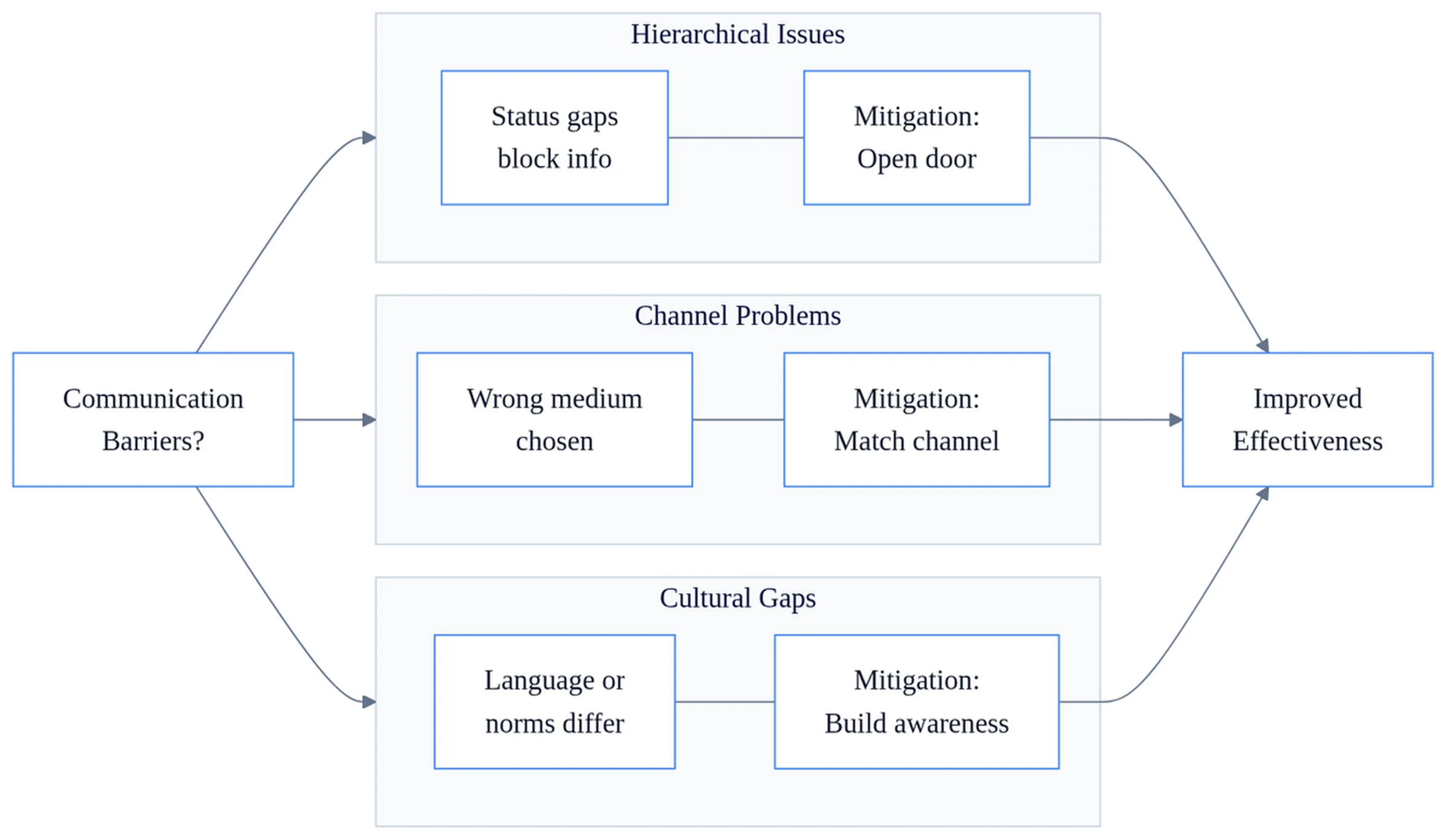
Hierarchical barriers emerge when power distance discourages honest upward communication. Employees who fear retaliation or dismissal won’t share bad news, dissenting opinions, or improvement ideas. Trust erosion blocks the feedback loops leaders need to make informed decisions. A manager who shoots the messenger once will never hear the truth again.
Channel barriers arise from information overload, unclear messaging, or inconsistent use of formal versus informal channels. When employees receive 200 emails daily, critical messages drown in noise. When leadership communicates major changes through a single all-hands email, people miss details or misinterpret intent.
Cultural and language barriers complicate communication in diverse or global organizations. Jargon excludes those outside a function. Generational differences shape communication preferences (some employees prefer face-to-face meetings, others want asynchronous Slack threads). Cross-cultural teams navigate different norms around directness, formality, and hierarchy.
For a comprehensive look at these obstacles and strategies to overcome them, read our guide to barriers to effective communication.
Building effective organizational communication
Improving organizational communication requires both infrastructure and culture. Here’s a practical framework:
| Strategy | What it looks like | Why it works |
|---|---|---|
| Establish clear objectives | Link every communication initiative to a business goal (e.g., “reduce project delays by 20% through daily stand-ups”) | Prevents communication for communication’s sake; ensures accountability |
| Use multiple channels strategically | Formal channels for policy/compliance; informal for culture-building and quick problem-solving | Matches channel to message type; reduces overload and confusion |
| Foster psychological safety | Leaders model active listening, admit mistakes, and reward constructive dissent | Opens upward communication channels; surfaces problems early |
| Monitor the grapevine | Treat informal channels as early warning systems; address rumors with transparent formal communication | Catches engagement issues before they escalate; fills information vacuums proactively |
| Invest in both tools and skills | Deploy collaboration platforms and train teams on listening, feedback, and cross-cultural communication | Technology alone doesn’t fix communication; people need skills to use it effectively |
Leadership plays an outsized role. When executives communicate transparently, ask questions instead of issuing edicts, and respond to upward feedback, those behaviors cascade through the organization. When they hoard information or punish bearers of bad news, that behavior cascades too. Communication culture is set at the top.
Don’t neglect diagonal communication in modern organizational structures. Flat hierarchies and matrix teams require people to reach across traditional boundaries. Set clear norms: when should someone consult a peer in another department versus escalating to a manager? When is it appropriate to skip levels? Without guidelines, diagonal communication can feel like chaos or insubordination.
Treat communication as an ongoing practice, not a project. The organizations that communicate best didn’t implement a perfect system overnight. They built feedback loops, experimented with channels, and continuously refined their approach based on what actually worked for their people and their goals. If you’re sitting on the fence about investing in communication infrastructure, the answer is usually yes, but only if you’re willing to model the behaviors yourself and give the system time to take root.
Frequently asked questions
Should I use formal or informal channels to address a workplace concern?
Start informally if the issue is minor or relationship-based—a quick conversation often resolves misunderstandings faster. Use formal channels (email, documented meeting) if the concern involves policy, performance, or requires a record for accountability. If informal attempts fail, escalate to formal. The key: informal builds trust; formal creates protection.
What happens when upward communication shuts down in an organization?
Leaders lose visibility into problems until they become crises. Employees stop reporting customer complaints, safety issues, or process failures. Morale erodes because people feel unheard. This typically signals low psychological safety—employees fear speaking up will backfire. Recovery requires leaders to actively invite feedback and respond without defensiveness.
Is diagonal communication appropriate in a traditional hierarchical organization?
Use it carefully. Diagonal communication speeds problem-solving but can undermine chain-of-command if overused. Best practice: consult diagonally for information or advice, but loop in your direct manager before making decisions. In flat or matrix organizations, diagonal communication is expected and necessary. Clarify norms with your leadership.
How do I know if my organization’s informal grapevine is healthy or toxic?
Healthy grapevine: spreads accurate information, builds relationships, surfaces concerns early. Toxic grapevine: spreads rumors, creates anxiety, fills information vacuums left by poor formal communication. If speculation runs wild, it signals leaders haven’t communicated clearly. Address the root cause by improving formal channels, not by trying to kill the grapevine.
Why should I pay attention to informal communication if formal channels exist?
Informal channels reveal what people actually think and feel, not just what they say in meetings. They’re early warning systems for morale problems, disengagement, or trust erosion. Ignoring them means you miss half the picture. Effective managers monitor both systems to diagnose bottlenecks and improve execution.
Is email internal or external communication?
It can be either. An email between colleagues is internal communication, and an email to a customer or supplier is external. What decides it is who receives the message, not the channel.
Is public relations internal or external communication?
Public relations is mainly external communication, because it manages the organization’s relationship with the media, the community and the public. Many organizations also brief employees before a public announcement so that internal and external messages match.
18 Comments
Thank for the explanation, may you please assist me now with the role of communication withing the organisation.
Thank you
Really good perspectives, the way the tables are done to show the difference between the types of communication is very helpful especially to students who are learning this for the first time.
Learn much information from here thanks to give it to us to inform us
It is very helpful for every one.I hope you try to more better. Thanks
Thanks 4 ur contribution.
I get alot of information.
The most readerble write up easy to understand
Excuse me but you need to correct the following: “At last, we can conclude that organizational communication is the exchange of formation with the internal and external stakeholders of an organization.” it should read the exchange of information and not formation.
send me all your publications on communication and organizational communication?
Wow I.M Really Appreciate With Dis Detail Xplanation About Ognisational Communication.
Thank U Very Much, Also I.M Wishing U All D Best.
wooooow nice one
Wow, I’m Really Appreciate this wonderful explanation of organizational communication. Thanks 🙂
Prominent exaplanation thanx
well presented. crisp and nice. thanks
Thanks very much for the explanation. It will be better if you use CRM software for organizational communication.
I really appreciate it
This a good explanation of the concept
Excellent post. I used to be checking constantly this blog and I am inspired!
Very useful information specifically the closing part 🙂 I deal
with such info a lot. I was looking for this particular information for a long time.
Thank you and good luck.
Good presentation
Very nice explanation and the words are very understandable